Prices
for prescription drugs in America average almost three times as much as in other
major nations around the world. Even more, the companies that set those prices
are doing everything they can to make sure they stay in the stratosphere:
they’ve filed suit to overturn an
upcoming reform, having Medicare negotiate the prices of some of the costliest
and most commonly used drugs.
The
makers don’t think they need to explain themselves, either. If they hadn’t been
threatened with subpoenas, their CEOs would never have showed up to waffle
their way through a Senate hearing on drug pricing earlier this year.
Lastly,
the companies argue that critics of high prices should instead be praising the
industry for all the research it carries out to make the drugs available in the
first place—failing to mention, of course, the critical role that
government funding regularly plays in the development of new drugs.
A
big contributor to insane drug prices is the billions spent on those
incessant drug commercials. Hour after hour, eyes glazing over, TV watchers are
bombarded with happy-time ads for Rinvoq, Skyrizi, Dupixent, Sanofi, Jardiance,
on and on and then some.
Thank
heaven for mute buttons; more to the point, thank heaven that the Biden
Administration is leading the way to somewhat less insanity.
Since last September, a joint legislative study commission has been trying to answer that question and find solutions to ensure Rhode Island’s official state shell doesn’t completely disappear from Narragansett Bay.
At its peak in 1959, nearly 5 million pounds of quahogs were harvested from Rhode Island waters, according to a March 2024 report by the Rhode Island Department of Environmental Management (DEM). Over the past three years, that number was less than 500,000 pounds.
“The findings and recommendations that are going to come from this commission are going to steer us on that path where we are going to replenish that bay,” Co-Chair Rep. Joe Solomon, a Warwick Democrat, said during the commission’s meeting Tuesday.
But department officials and the Rhode Island Shellfisherman’s Association are at odds over recommendations to achieve a final long-term solution to bring back the population of the iconic hard-shelled clam.
Shellfishermen want the state to permit additional nitrogen discharges from wastewater treatment facilities during the winter. Jim Boyd, one of four shellfishermen who serve on the commission, said doing so would help fertilize more phytoplankton that feed quahogs.
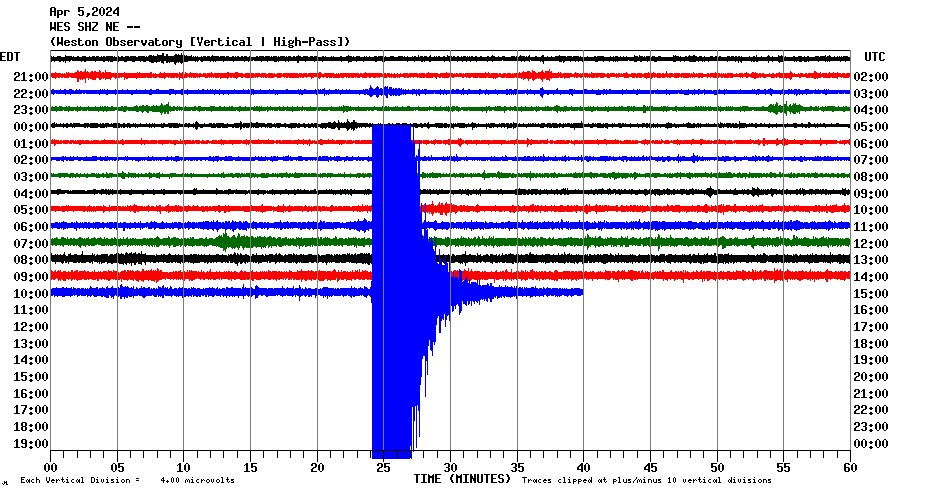
At 10:23 AM this morning, there was a 4.7 to 5.4 on the Richter scale earthquake in New Jersey. I could feel it here in Charlestown as a shaking and swaying motion - very noticeable - that lasted for a few seconds.
The quake was centered in a northern New Jersey suburb of New York City. As you can see from the map above, reports of shaking came in from quite a distance.
We should see official reports of the exact magnitude of the quake in the next day or so as the data gets collated. I have not seen any news about damage. I wouldn't be surprised if there was damage close to the epicenter.
A proposal to overhaul the state’s troubled coastal regulatory agency is making a comeback at the Rhode Island State House, this time with the endorsement of the state’s top lawyer.
The legislation introduced by Sen. Victoria Gu, a Westerly and Charlestown Democrat, is nearly identical to the proposal unveiled last year to abolish the politically appointed arm of the Rhode Island Coastal Resources Management Council. The legislation instead reshapes the agency as an administrative department similar to the Rhode Island Department of Environmental Resources.
But unlike last year, where the bill stalled in committee, the 2024 version is sponsored by the Rhode Island Office of the Attorney General.
“If protecting our coastal resources is a priority, Rhode Island deserves a dedicated agency with resources and expertise to handle these permitting and enforcement issues,” Attorney General Peter Neronha said in a statement on Wednesday.
Two other members of his team spoke in favor of the bill during a hearing before the Senate Committee on Environment and Agriculture at the State House Wednesday.
The attorney general’s support is not surprising considering his office’s role in a high-profile dispute over the proposed expansion of Champlin’s Marina on Block Island.
The CRMC’s alleged “backroom deal” with the marina owners in 2020 is one of several contested decisions spurring calls to reform the agency. Neronha’s office filed a motion in 2021 in the legal challenge before the Rhode Island Supreme Court in 2021, urging the court to reject the CRMC’s decision because it violated the public review process. The court ultimately sided with Neronha, rejecting the agreement in its 2022 decision.
“This is not specific to the people on the council, it’s more about the structure of how the council is made up,” said Sarah Rice, assistant attorney general and deputy chief of the office’s civil division. “We need the entity charged with these really weighty responsibilities to be transparent, to have clear responsibilities and to be empowered to make decisions based on their expertise.”
Since the rise of Jacksonian democracy and the expansion of the vote to all white men in the late 1820s, however, the support of rural white people has been vital to the governing power of almost every major party coalition. Which is why my co-author Paul Waldman and I describe rural white people as America’s “essential minority” in our book “White Rural Rage: The Threat to American Democracy.”
As a political scientist, I’ve written or co-written five books addressing issues of racial politics at some level of government or part of the country. My latest, “White Rural Rage,” seeks to understand the complex intersections of race, place and opinion and the implications they hold for our political system.
The unfortunate fact is that polls suggest many rural white people’s commitment to the American political system is eroding. Even when they are not members of militant organizations, rural white people, as a group, now pose four interconnected threats to the fate of the United States’ pluralist, constitutional democracy.
Although these do not apply to all rural white people, nor exclusively to them in general, when compared with other Americans, rural white people:
Express the most racist, least inclusive, most xenophobic, most anti-LGBTQ+ and most anti-immigrant sentiments.
Subscribe at the highest rates to conspiracy theories about QAnon, the 2020 presidential election, Barack Obama’s citizenship and COVID-19 vaccines.
Support a variety of antidemocratic and unconstitutional positions and exhibit strong attachments to white nationalist and white Christian nationalist movements inimical to secular, constitutional governance.
Are most likely to justify, if not call for, force or violence as acceptable alternatives to deliberative, peaceful democracy.
The Rhode Island Department of
Environmental Management (DEM) is reminding Rhode Islanders to remain vigilant
for invasive species as their lifecycles progress and they emerge during the
spring.
First detected in Pennsylvania in 2014, the SLF has established populations in
14 states, including Rhode Island. SLFs are commonly attracted to the
invasive Tree of Heaven (Ailanthus
altissima) but also threaten many fruit crops such as
apples, apricots, cherries, grapes, hops, nectarines, peaches, and plums as
well as native maple, oak, pine, poplar, sycamore, walnut, and willow trees.
Rhode Island is at high risk of this invasive pest that can cause significant
damage to agricultural crops and trees and affects the quality of life and
enjoyment of the outdoors.
When Karla Adkins looked in the rearview mirror of her car one morning nearly 10 years ago, she noticed the whites of her eyes had turned yellow.
She was 36 at the time and working as a physician liaison for a hospital system on the South Carolina coast, where she helped build relationships among doctors. Privately, she had struggled with heavy drinking since her early 20s, long believing that alcohol helped calm her anxieties.
She understood that the yellowing of her eyes was evidence of jaundice. Even so, the prospect of being diagnosed with alcohol-related liver disease wasn’t her first concern.
“Honestly, the No. 1 fear for me was someone telling me I could never drink again,” said Adkins, who lives in Pawleys Island, a coastal town about 30 miles south of Myrtle Beach.
But the drinking had caught up with her: Within 48 hours of that moment in front of the rearview mirror, she was hospitalized, facing liver failure. “It was super fast,” Adkins said.
Historically, alcohol use disorder has disproportionately affected men. But recent data from the Centers for Disease Control and Prevention on deaths from excessive drinking shows that rates among women are climbing faster than they are among men.
The Biden administration considers this trend alarming, with one new estimate predicting women will account for close to half of alcohol-associated liver disease costs in the U.S. by 2040, a $66 billion total price tag.
It’s a high-priority topic for the Department of Health and Human Services and the Department of Agriculture, which together will release updated national dietary guidelines next year.
But with marketing for alcoholic beverages increasingly geared toward women, and social drinking already a huge part of American culture, change isn’t something everyone may be ready to raise a glass to.
As the Moon casts its shadow across the Earth during the upcoming solar eclipse, cameras of all kinds will turn skyward. While professional photographers with specialized equipment will aim to capture the perfect shot, others will reach for their smartphones to immortalize this moment.
While smartphone cameras can’t take a great picture of a solar eclipse itself, you can still create a memorable record of the moment with your smartphone.
Your smartphone camera has capabilities that lots of specialized equipment can’t match. It’s lightweight, has built-in orientation detection and can shoot well in darkness and light. Plus, thanks to its computational photography features, it focuses the image for you and provides image stabilization.
Be careful: Photographing the eclipse with a smartphone might damage the camera’s sensor and your eyes. If you want to look at the Sun or take a photo, wear eclipse glasses and get a lens filter.
EDITOR'S NOTE: It all depends on the weather. There isn't really any best place for viewing. Northern RI will get a slightly longer duration than Charlestown but only by less than 2%, hardly worth the drive. Staff at the state's two observatories - Frosty Drew and Ladd at Brown University are expected to be travelling to observation points within the track of the total eclipse which passes to our west. - Will Collette
Lots of questions for Rhode Island Republicans to answer
By Will Collette
If you were wondering whether Rhode Island’s Republican Party had
succumbed to Trumpmentia like the GOP nationwide, RI's April 2 Presidential Preference Primary provided an answer.
While, as expected, Trump (and Joe Biden) easily won, although both saw around 20% of primary voters vote for someone
else or selected “uncommitted”, the more interesting
results were seen in the vote count for individual delegates.
All of Rhode Island’s Republican delegates are pledged to vote for
Donald Trump. Delegates pledged to other candidates, such as Nikki Haley, lost.
That included prolific Westerly Sun letter-to-the-editor writer Scott Bill
Hirst of Hopkinton who only received 751 votes out of 12,905 GOP votes cast.
The three slots for Congressional District 2 Republican delegates were
filled by three peculiar choices. In order, the three elected were:
#1: Lacey McGreevey with 3,781. McGreevy
was an unsuccessful Tea Party candidate for state Representative for South
Kingstown in 2014 losing to present incumbent Kathy Fogarty (D).
#2: Justin Price with 3,749. Price
was a Tea Party state representative from Richmond, first elected in 2014, the
same year McGreevey lost. Price achieved national notoriety as an
insurrectionist, MAGA devotee and far right crank. Incumbent Megan Cotter (D) ousted Price from office in 2022.
#3: Sean Todd with 3,326. Todd is
a former East Greenwich town council member who first drew statewide attention
for an incredibly sexist comment in 2017 that
led to protests, calls for his resignation and ultimately his ouster from office in 2018.
All three are Trump delegates.
In Charlestown, 153 Republicans voted, giving Trump 86.9% which is
higher than Trump’s margin statewide. 98 of them also picked Price over McGreevey.
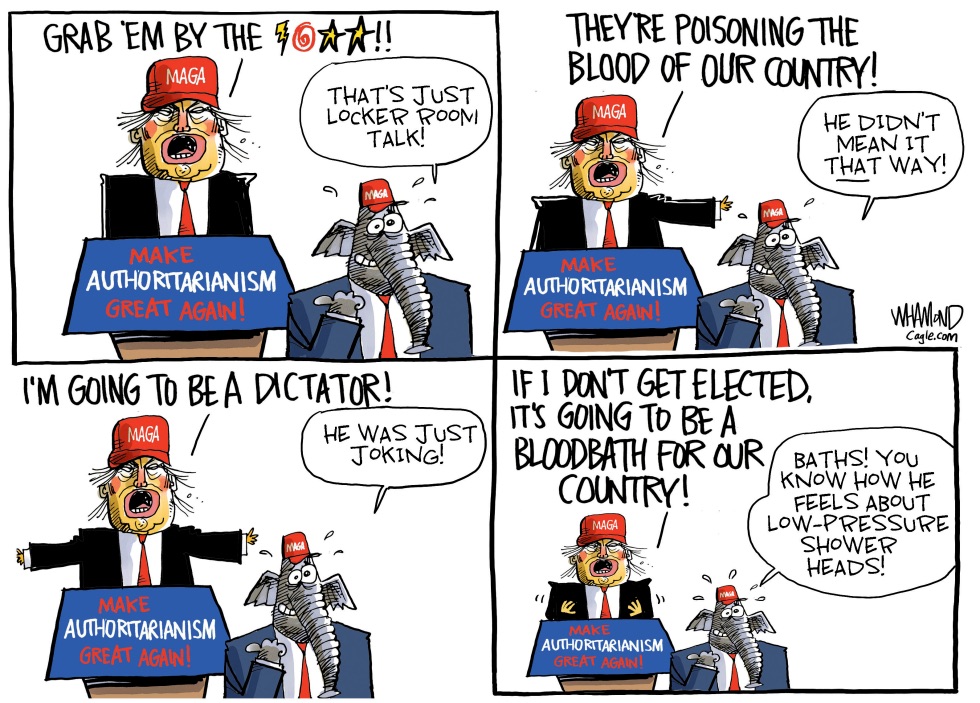
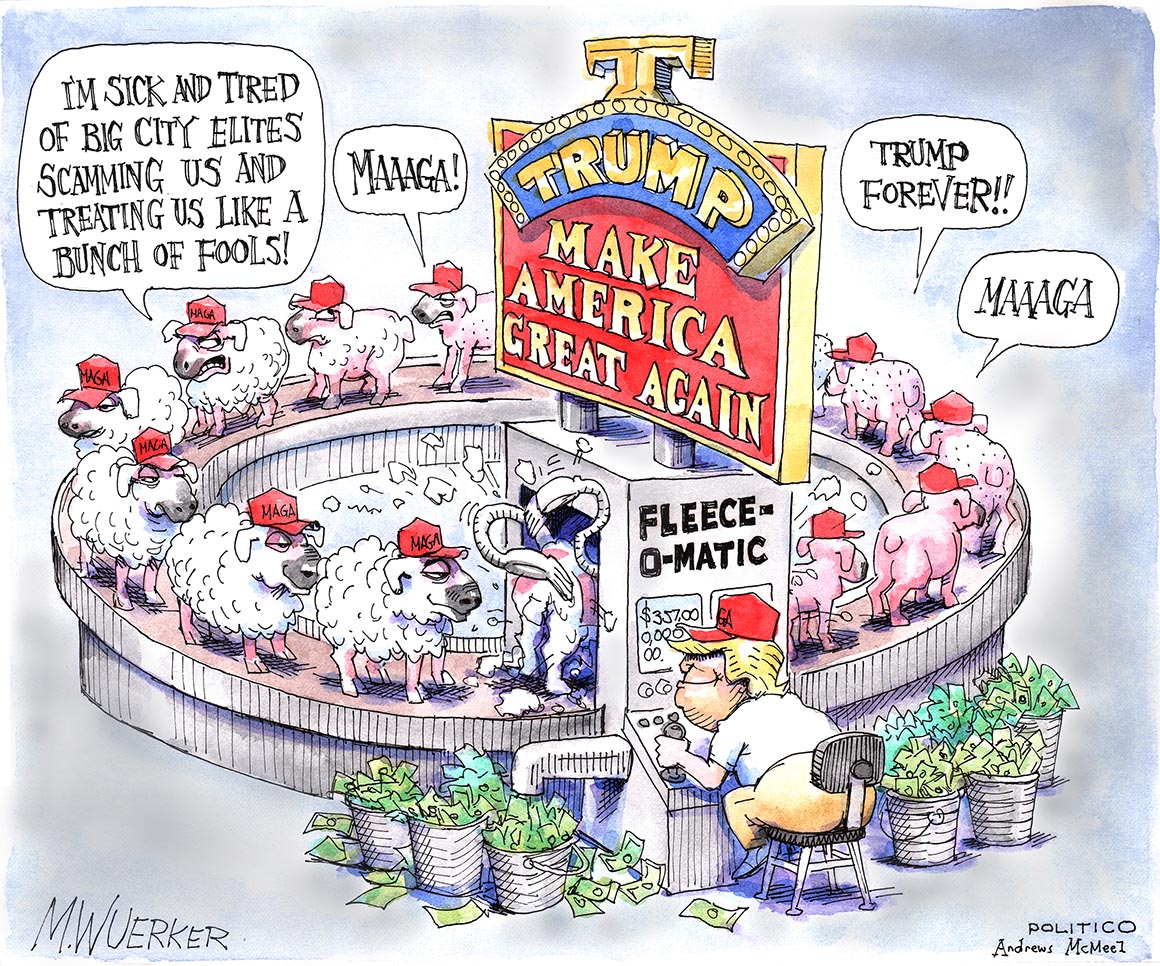
These vote totals now justify challenging every Rhode Island
candidate running as a Republican whether they support Donald Trump’s MAGA
agenda: his national ban on abortion and
punishment for any woman who gets one;
his racism; his pro-Nazi, pro-Putin authoritarianism; his calls for violence and death for his opponents; His corruption and lies;
And this is hardly an all-inclusive list.
If you are an “R” where do you stand on these issues?
Let’s take a closer look at the two top GOP vote-getters, Lacey McGreevey
and Justin Price.
You may not remember McGreevey since she was only a blip on the
political scene with her 2014 state rep bid. But I remember her well. Here’s
how I wrote about her in 2014:
Kathy
Fogarty will now go on to battle Lacey McGreevy (R) in the November 4 general
election. I swear I am not making this up, and working hard to not make this
sound sexist, but when McGreevy announced her candidacy, she gave her frequent
efforts as a beauty pageant contestant as her main qualification. Sarah Palin also included this
in her resume, but she also had Mayor of Wasilla and a view of Russia from her
window to complete her qualifications.
From McGreevey's campaign website
Here’s how she describes
herself in her campaign bio: “Lacey McGreevy attended
South Kingstown high school then went on to Southern New Hampshire University
with a double major of marketing and fashion merchandising. She currently works
as a trade show consultant and helps to keep women safe with princess pepper spray.” [emphasis added and I am NOT
making this up.]
Kathy Fogarty went on to win the Representative District 35 seat by
thumping McGreevey by 16 points.
Here she is with The Donald. Where is Trump's left hand?
McGreevey pretty much fell off the political map after that, perhaps too busy home schooling her kid. She was an early Trumpnik, even posting a link to Amazon and a $20 Trump pool float ring. On her Facebook page, she has only increased her love for Trump and posted photos of her and Trump. In one of them, you’re left guessing where Trump’s left hand is.
So, do you think Lacey is going to try running for local office
again? What exactly does she stand for other than Trump-love and Trump tchotchke?
Finally,
let’s look at Justin Price and how renewed RI GOP support for him raises
questions about where they stand, not to mention whether they plan to back him if he tries a General Assembly comeback.
Price was a part of what I called “The Revenge of the Swamp Yankees.” In 2014, three of the best members of the General Assembly – Donna Walsh, Cathy Cool
Rumsey and Larry Valencia – were beaten by three right-wing nuts: Blake “Flip”
Filippi, Elaine Morgan and Justin Price.
All three were hard-right, but Price was really out there. In his
four terms as state Representative, Price accomplished nothing other than garnering state and national exposure for his positions not only on guns and taxes, but -
believe it or not - “chemtrails,” an obscure right-wing
conspiracy theory that contrails from high-flying jets are actually spewing
mind-altering chemicals on an unsuspecting public.
If there was even a germ of truth to this, I guess Price must have been an early victim.
His great legislative achievement was winning passage of a bill to create a “geo-engineering” study commission" to study chemtrails and other far right boogeymen. The commission never met and of course issued no findings.
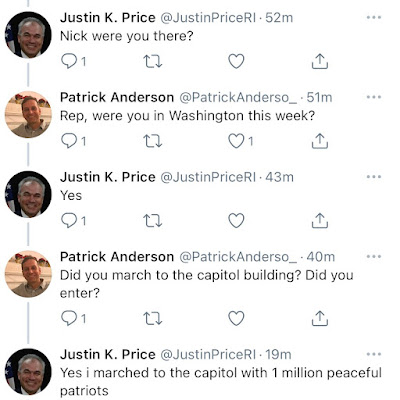
Price managed to top that by being one of several serving state legislators to participate in the January 6 insurrection to overthrow the 2000 election.
He responded to calls for his resignation by claiming that (a) he
didn’t actually enter the Capitol building though he has never said how deep
into the fray he went and (b) that he saw Antifa actually lead the attack.
Both claims are bullshit and here’s why.
I worked on Capitol Hill for 10 years out of an office in the
United Methodist Building just across the street from the Capitol. I know the
area well and how the Capitol Police set up security cordons. For major events,
police “do-not-cross” lines are set well away from the building.
It is virtually impossible for Price to have not breeched those
lines and certainly must have done so if we are to believe his claim that
“Antifa did it.”
As for the briefly popular Antifa conspiracy claim, we now know beyond a doubt that the insurrection was planned by Trump supporters as well as
right-wing militias and white supremacists including the Oath Keepers and Proud
Boys.
The Antifa theory never made sense since there is no reason the
Left would storm the Capitol to overturn Joe Biden’s rightful election victory.
But Price also needs to account for his conduct and subsequent statements. His Antifa claim
is either a lie or an admission that he breeched his own sworn oaths.
As a member of the Marine Corps and as a member of the General
Assembly, Price sworn oaths to uphold the Constitution and to protect the
country from “all enemies, foreign and domestic.”
If he
truly believed he saw Antifa (or for that matter anyone), attacking police and
the Capitol Building, why did he rise to defend against these enemies of the
nation? It was his sworn duty, and he admits he did nothing. So is he a liar or
a coward?
Can Rhode Island Republicans explain why this ignorant man is going
to represent them at their national convention? Oh, oh, oh…wait, I forgot. Donald
Trump. Never mind.






.webp)