Menu Bar

Home           Calendar           Topics          Just Charlestown          About Us

Sunday, June 9, 2024

Tracking the unprecedented impact of humans on the climate

Yeah, we did it

Prof Piers Forster, professor of climate physics at the University of Leeds and founding director of the Priestley Centre for Climate Futures and Dr Debbie Rosen, research and innovation development manager at the Priestley Centre.


Our new scientific assessment of how humans are affecting the climate is nothing short of alarming, yet it does contain some encouraging news.

The second “Indicators of Global Climate Change” report, published in Earth System Science Data, provides an annual update on a set of metrics originally assessed by the Intergovernmental Panel on Climate Change (IPCC).

With the latest IPCC assessment report on climate science completed in 2021 and the next one not expected until at least 2027, there is a substantial gap to fill. 

This is crucial at a time when human activity is changing the climate system at a rate and scale not experienced since records began. 

For 2023, which smashed the record for the warmest year, our best estimate of the warming caused by human activity is 1.31C above pre-industrial levels. 

This is the first year where this estimate has reached the 1.3C threshold. Our report also shows that human-caused warming has been increasing at a rate of 0.26C per decade.

This high rate of warming is caused by a combination of greenhouse gas emissions being close to an all-time high and a reduction in the cooling impacts of aerosols as society tackles deadly air pollution. 

Yet, there is some positive news: greenhouse gas emissions have not yet risen beyond pre-pandemic levels and there is evidence that the rate of increase in CO2 emissions over the past decade has slowed compared to the 2000s.

URI study to examine ethical considerations of using generative AI in communications work

Robot readings

Dawn Bergantino 

If you’ve heard the term deepfake, you may have some notion of how artificial intelligence can be used in communications. 

Earlier this year, a robocall purportedly of President Joe Biden discouraging voters from participating in the New Hampshire state primary prompted swift investigation by election officials as well as action by the Federal Communications Commission. More recently, TikTok announced its intention to label AI-generated content as the technology becomes more universal.

But how are professional communicators and public relations firms utilizing generative AI? And what are the ethical considerations for doing so? That’s what a new study from researchers at the University of Rhode Island, along with industry partner and independent public relations agency MikeWorldWide, aims to discover. 

The study, made possible through a $10,000 grant from The Arthur W. Page Center for Integrity in Public Communication at Penn State, will explore the drivers and barriers to the adoption of AI technology as well as perceptions of its ethical use.

Women’s unique immune systems and cells make them more susceptible to Alzheimer’s and auto-immune diseases than men.

Sexism, pollution and Alzheimer’s

Mel (Mary Ellen) Harte BY EHN 

Women are two to four times more likely to develop any of 100-plus chronic auto-immune diseases than men.

This could include Alzheimer's disease, which some researchers are starting to link to the immune system, the sixth leading medical cause of U.S. deaths. Women comprise two-thirds of diagnosed Alzheimer’s patients and often develop worse symptoms of memory failures and lower brain metabolism, than men. Why are they so susceptible?

While women’s unique biology plays a role, growing research also suggests chronic stress — often stemming from sexism — as well as tiny particles of environmental pollution may play a role in this disparity.

As we untangle the causes of Alzheimer’s and auto-immune diseases, we need to eliminate gender bias in health care, sexism, and the insidious contamination that may be driving disease in women.

Saturday, June 8, 2024

Safe gun storage, police reform bills pass and go to McKee for signature

Modest but meaningful wins

By Christopher Shea, Rhode Island Current

The Rhode Island General Assembly took historic steps Thursday to pass contested reforms on disciplining police officers accused of misconduct and safe storage of firearms.

The updates to the Law Enforcement Officers Bill of Rights (LEOBOR) and safe gun storage now head to Gov. Dan McKee’s desk.

McKee has already signaled his support on social media for the safe storage bill and spokesperson Olivia DaRocha said Friday afternoon the governor does intend to sign LEOBOR reform into law.

“We will update you when we finalize a date with the sponsors,” DaRocha said.

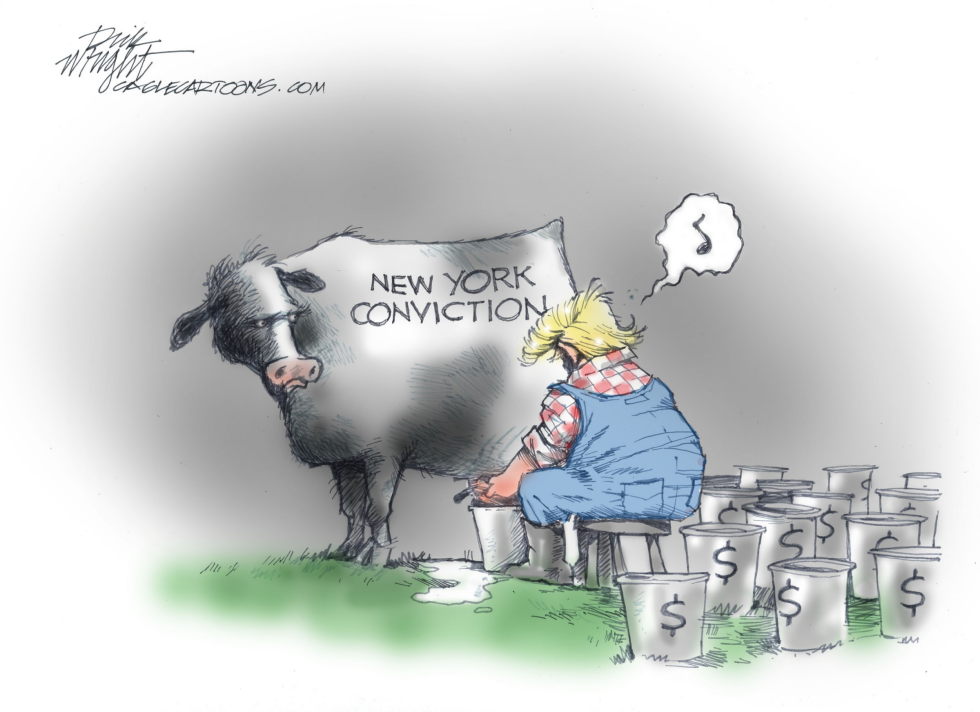
MAGA forever

Trump commits new crime

House approves Fogarty bill to criminalize false reports of shootings and other dangerous events

“Swatting” penalties strengthened

The House of Representatives passed legislation introduced by Rep. Kathleen A. Fogarty (D-Dist. 35, South Kingstown) that would expand the crime of false reporting to include shootings or other dangerous events.

The bill (2024-H 7972) would amend an existing law that criminalizes false bomb threats that cause terror, anxiety, unrest or fear, prompting an evacuation or lockdown of a location or other law enforcement response.

“These false reports not only waste resources by mobilizing law enforcement unnecessarily, but they can be extremely dangerous,” said Representative Fogarty. “They can create risky situations at schools and other public places and tie up first responders who may be needed at legitimate emergencies.”

The phenomenon commonly known as “swatting” occurs when a false report of an ongoing emergency or threat of violence is made to law enforcement with the intention of prompting the mobilization of significant law enforcement resources. These calls are becoming more and more prevalent around the country.

Eleventh hour bottle bill reignites debate between environmental, business groups

Last minute bills often fail

By Nancy Lavin, Rhode Island Current

Disagreement over a state bottle recycling program is as pervasive as the piles of recyclable bottles and cans littering Rhode Island streets, beaches and waterways.

So it’s no surprise that controversy again clouded the bottle bill conversation Wednesday night. 

Hours of debate unfolded in an airless second-floor State House hearing room as a parade of proponents and critics sat elbow to elbow, waiting to make their case to the House Committee on Environment and Natural Resources. 

Their arguments, punctuated by the staccato of a cell phone alarm signaling the end of each two-minute speaking window, sounded nearly identical to years past. Environmental advocates backed the deposit-refund program as a means to reduce litter and incentivize recycling, while retail store owners and business groups railed against what they perceived as an unwelcome financial and administrative burden.

Yet the latest version of bottle bill legislation, introduced May 24 by Rep. Carol McEntee, a South Kingstown Democrat, is markedly different from prior iterations, leaving many of the most controversial components up to state regulators and beverage producers to decide.

“Blue-lining” joins the list of climate change problems

Insurers are pulling out of areas prone to climate risk

By Jessica Garcia 

In an era of climate disasters, Americans in vulnerable regions will need to rely more than ever on their home insurance. But as floods, wildfires, and severe storms become more common, a troubling practice known as “bluelining” threatens to leave many communities unable to afford insurance — or obtain it at any price.

Bluelining is an insidious practice with similarities to redlining — the notorious government-sanctioned practice of financial institutions denying mortgages and credit to Black and brown communities, which were often marked by red lines on map.

These days, financial institutions are now drawing “blue lines” around many of these same communities, restricting services like insurance based on environmental risks. Even worse, many of those same institutions are bankrolling those risks by funding and insuring the fossil fuel industry.

Originally, bluelining referred to blue-water flood risks, but it now includes other climate-related disasters like wildfires, hurricanes, and severe thunderstorms, all of which are driving private-sector decisions. (Severe thunderstorms, in fact, were responsible for about 61 percent of insured natural catastrophe losses in 2023.)

Friday, June 7, 2024

A century ago, anti-immigrant backlash almost closed America’s doors

Many of us wouldn't be here if the US embraced anti-immigrant bigotry

Matthew Smith, Miami University

Immigrant children at Ellis Island in New York, 1908.
 National Archives/Wikimedia Commons
One hundred years ago, the U.S. Congress enacted the most notorious immigration legislation in American history. Signed by President Calvin Coolidge, the Immigration Act of 1924 dramatically reduced immigration from eastern and southern Europe and practically barred it from Asia.

How the law did this, however, was somewhat subtle: a quota. 

Lawmakers calculated how many immigrants from each European country were residing in the United States in 1890 and then took 2% of that number. 

Only that many newcomers could be admitted from any particular country each year. Before the end of the 19th century, the number of immigrants from outside western and northern Europe was still relatively small – meaning their 2% quotas would be minuscule.

In short, the Immigration Act was unabashedly racist, seeking to roll back the demographic tide. One of its sponsors, U.S. Rep. Albert Johnson, warned the House Committee on Immigration that “a stream of alien blood” was poisoning the nation.

Torn between “the American dream” and fears of an ungovernable “melting pot,” Americans have always viewed immigrants ambivalently. In 1924, as is true today, many citizens thought in terms of “good” immigration versus “bad” immigration. In their minds, 1890 marked a dividing line between the two.

Looking back as a historian of immigration and religion, I’m struck by three changes in U.S. views of immigration over the course of the 19th century.

Perfect speaker

Jeff Stahler

Spin a conspiracy around this, why doncha?


Assembly approves bill to educate buyers of shoreline property of the public’s right to access the shoreline

Victoria Gu bill goes to the Governor 

Photo by Will Collette
The General Assembly has approved legislation from Sen. Victoria Gu and Rep. Terri Cortvriend to improve disclosure of shoreline access rights and related conditions during the sale of oceanfront property.

The legislation (2024-S 2185A, 2024-H 7376A) now heads to the governor’s desk for his signature.

“This legislation builds on the historic shoreline access law that we passed last year,” said Senator Gu (D-Dist. 38, Westerly, Charlestown, South Kingstown). “A lot of people in Rhode Island are now aware of the new law but a lot of people coming in from other states to buy property aren’t necessarily aware of it. This is an important consumer protection and education measure to ensure that people buying ocean front real estate understand the public’s right to access the shoreline.”

Mediterranean Diet Tied to 23% Lower Risk of Death in Landmark 25-Year Study

Approaches scientific consensus

By BRIGHAM AND WOMEN'S HOSPITAL 

Researchers at Brigham and Women’s Hospital have explored and evaluated the potential underlying mechanisms that could account for the 23 percent decrease in all-cause mortality risk among American women following the Mediterranean diet.

The health benefits of the Mediterranean diet have been reported in multiple studies, but there is limited long-term data on its effects on U.S. women and little understanding of why the diet may reduce the risk of death.

In a new study that followed more than 25,000 initially healthy U.S. women for up to 25 years, researchers from Brigham and Women’s Hospital, a founding member of the Mass General Brigham healthcare system, found that participants who had greater Mediterranean diet intake had up to 23% lower risk of all-cause mortality, with benefits for both cancer mortality and cardiovascular mortality.

The researchers found evidence of biological changes that may help explain why: they detected changes in biomarkers of metabolism, inflammation, insulin resistance, and more. Results are published in JAMA.

Multiple Trump Witnesses Have Received Significant Financial Benefits From His Businesses, Campaign

Witness tampering or just Trump biz as usual?

By Robert Faturechi, Justin Elliott and Alex Mierjeski for ProPublica

Nine witnesses in the criminal cases against former President Donald Trump have received significant financial benefits, including large raises from his campaign, severance packages, new jobs, and a grant of shares and cash from Trump’s media company.

The benefits have flowed from Trump’s businesses and campaign committees, according to a ProPublica analysis of public disclosures, court records and securities filings. 

One campaign aide had his average monthly pay double, from $26,000 to $53,500. Another employee got a $2 million severance package barring him from voluntarily cooperating with law enforcement. And one of the campaign’s top officials had her daughter hired onto the campaign staff, where she is now the fourth-highest-paid employee.

These pay increases and other benefits often came at delicate moments in the legal proceedings against Trump. One aide who was given a plum position on the board of Trump’s social media company, for example, got the seat after he was subpoenaed but before he testified.

Significant changes to a staffer’s work situation, such as bonuses, pay raises, firings or promotions, can be evidence of a crime if they come outside the normal course of business. To prove witness tampering, prosecutors would need to show that perks or punishments were intended to influence testimony.

White-collar defense lawyers say the situation Trump finds himself in — in the dual role of defendant and boss of many of the people who are the primary witnesses to his alleged crimes — is not uncommon. 

Their standard advice is not to provide any unusual benefits or penalties to such employees. Ideally, decisions about employees slated to give evidence should be made by an independent body such as a board, not the boss who is under investigation.

Even if the perks were not intended to influence witnesses, they could prove troublesome for Trump in any future trials. Prosecutors could point to the benefits to undermine the credibility of those aides on the witness stand.

“It feels very shady, especially as you detect a pattern. … I would worry about it having a corrupt influence,” Barbara McQuade, a former U.S. attorney for the Eastern District of Michigan, said after hearing from ProPublica about benefits provided to potential Trump witnesses.