Friday, April 24, 2020
VIDEO: John Oliver on COVID-19 bullshit
To watch this video on YouTube: https://www.youtube.com/watch?v=dRFbwjwQ4VE



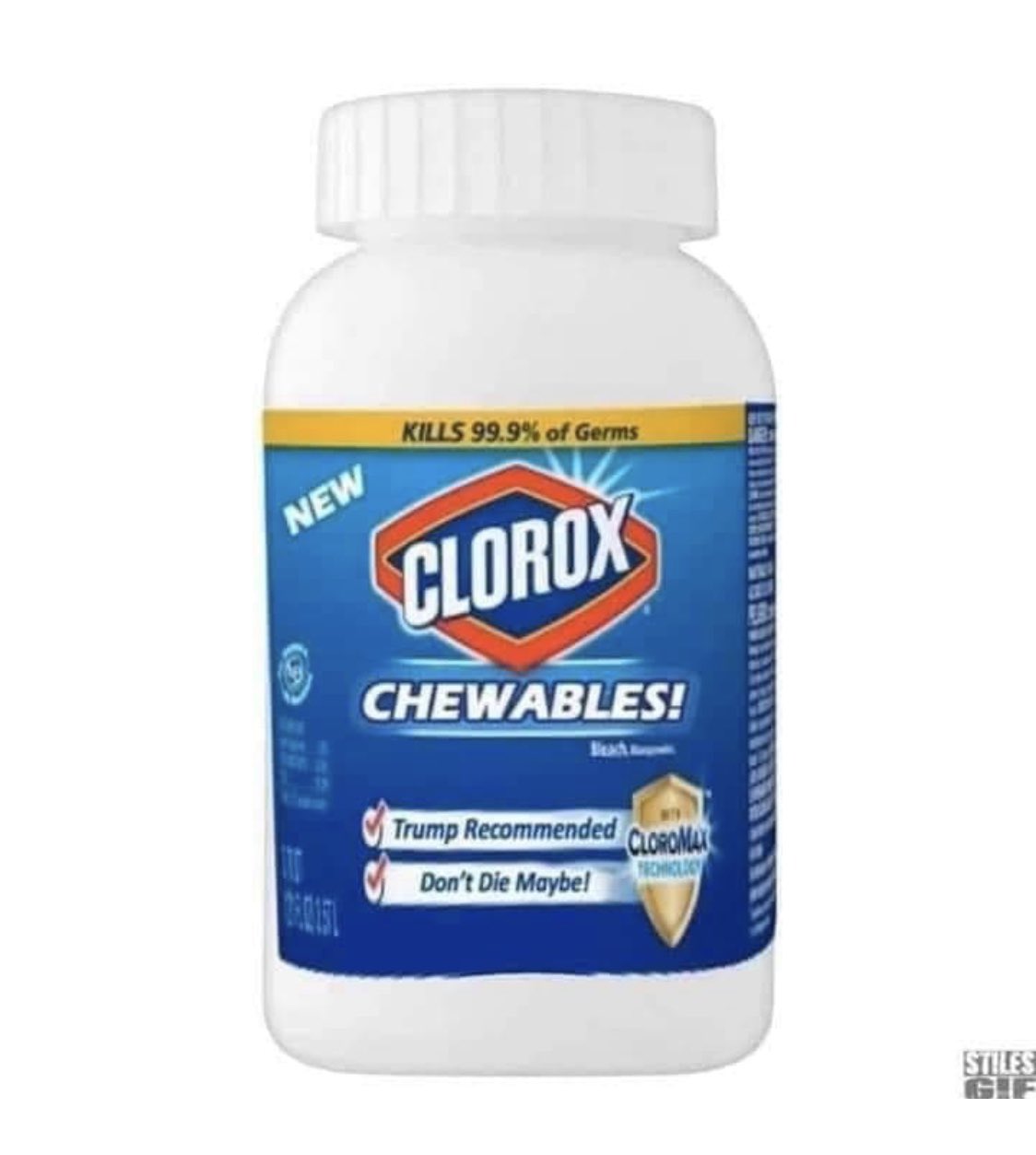
DON’T drink bleach or Lysol. Don’t inject it either
'People Will Die' If They Listen to Trump and drink his disinfectant Kool-Aid
 The hashtag #DontDrinkBleach trended on Twitter
Friday in reaction to comments by President Donald Trump Thursday evening
endorsing the idea that Americans could somehow imbibe or be injected with
disinfectants to eradicate the coronavirus.
The hashtag #DontDrinkBleach trended on Twitter
Friday in reaction to comments by President Donald Trump Thursday evening
endorsing the idea that Americans could somehow imbibe or be injected with
disinfectants to eradicate the coronavirus.
"It
is April 24, 2020 and #DontDrinkBleach is trending on Twitter," tweeted poet Remi Kanazi. "The
world has not ended, but may soon."
The
president's comments came during a press conference on the White House's
handling of the pandemic, which has, as of press time, killed over 50,000
Americans.
"I
see the disinfectant, where it knocks it out in a minute—one minute—and is
there a way we can do something like that by injection inside, or almost a
cleaning?" Trump asked Department of Homeland Security
scientist William Bryan during the briefing. "Because you see it gets
in the lungs and it does a tremendous number on the lungs, so it would be
interesting to check that"
 As Common
Dreams reported, the Trump's remarks led
scientists and other officials to insist the public not listen to the country's
highest elected official.
As Common
Dreams reported, the Trump's remarks led
scientists and other officials to insist the public not listen to the country's
highest elected official.
"My
concern is that people will die" if they listen to the president, said New York-Presbyterian/Columbia
University Medical Center director of global health in emergency
medicine Craig Spencer.
Politicians
and commentators on Twitter seized on the #DontDrinkBleach hashtag as a way to
both mock the president and to urge Americans not to take Trump's advice.
"Anyone
who does this will not die from #COVID19 because they will have already
poisoned themselves to death," tweeted Rep. Frederica Wilson
(D-Fla.). "Do NOT try this! #DontDrinkBleach."
TV tips in the Year of the Plague
TV news and
entertainment in a pandemic
Brown University
 As COVID-19 continues to spread,
housebound Americans are glued to their screens more than ever before.
As COVID-19 continues to spread,
housebound Americans are glued to their screens more than ever before. According to the latest Nielsen ratings, consumption of local television news has increased steadily in nearly every metropolitan area, as has streaming on platforms such as Netflix, Hulu and Amazon Prime.
Taking in a steady stream of TV is
nothing new for Lynne Joyrich, a professor of modern culture and media at Brown
University. For Joyrich, watching is research as much as it is recreation.
She teaches courses in film and
television studies at Brown, edits the media studies journal Camera Obscura,
and regularly contributes scholarly observations on
the influences of TV on our culture, politics and perceptions. But these days,
even Joyrich is hopping between ever more news channels and joining an
increasing number of viewing parties for thought-provoking series such as
“Pose.”
As the virus continued to escalate
across the U.S., Joyrich shared her thoughts on how TV news is influencing
public behavior during the pandemic — and how Americans are using television as
both a source of information and as a respite from bad news.
Hannity viewers more likely to die
Misinformation
During a Pandemic
Leonardo Bursztyn, Aakaash
Rao, Christopher Roth, David Yanagizawa-Drott
BECKER FRIEDMAN INSTITUTE for
Economics, University of Chicago
 We study the effects of news coverage of the novel
coronavirus by the two most widely-viewed cable news shows in the United States
– Hannity and Tucker Carlson Tonight, both on Fox
News – on viewers’ behavior and downstream health outcomes.
We study the effects of news coverage of the novel
coronavirus by the two most widely-viewed cable news shows in the United States
– Hannity and Tucker Carlson Tonight, both on Fox
News – on viewers’ behavior and downstream health outcomes.
Carlson warned viewers about the threat posed by the
coronavirus from early February, while Hannity originally dismissed the risks
associated with the virus before gradually adjusting his position starting late
February.
We first validate these differences in content with
independent coding of show transcripts. In line with the differences in
content, we present novel survey evidence that Hannity’s viewers changed
behavior in response to the virus later than other Fox News viewers, while
Carlson’s viewers changed behavior earlier.
We then turn to the effects on the pandemic itself,
examining health outcomes across counties.
First, we document that greater viewership of Hannity relative
to Tucker Carlson Tonight is strongly associated with a
greater number of COVID-19 cases and deaths in the early stages of the
pandemic.
Thursday, April 23, 2020
Short Takes #11 on Rhode Island’s struggle with the pandemic
One last place
ranking that is good news
By Will Collette
 We’re
used to seeing Rhode Island ranked at or near the bottom for so many economic
metrics so this one comes as a shock. According
to WalletHub, the folks who spend all their time measuring the differences
between states, Rhode Island was LAST PLACE for the number of new unemployment
claims filed.
We’re
used to seeing Rhode Island ranked at or near the bottom for so many economic
metrics so this one comes as a shock. According
to WalletHub, the folks who spend all their time measuring the differences
between states, Rhode Island was LAST PLACE for the number of new unemployment
claims filed.
We’re
used to seeing Rhode Island ranked at or near the bottom for so many economic
metrics so this one comes as a shock. According
to WalletHub, the folks who spend all their time measuring the differences
between states, Rhode Island was LAST PLACE for the number of new unemployment
claims filed.
My
joy in that finding is tempered by the huge number of RI workers who have
already signed up for unemployment comp, temporary disability or pandemic
relief for the self-employed and gig workers.
Still, this is one last place finish to savor.
Still, this is one last place finish to savor.
WalletHub
also ranks Rhode Island as one of the worst places (ranked #45) in the
country to work from home. That’s bad but it figures, given our workforce is
concentrated in construction, services and health care.
Another
unpleasant statistic is that Rhode Island is one of only four states that WILL
NOT be able to use a new, FDA-approved in-home test for coronavirus,
The other states are New York, New Jersey and Maryland. The test manufacturer
LabCorp says this is due to “Certain
state laws and regulations prohibit individuals from initiating their own lab
tests.”
Speaking of
numbers
Dan
McGowan leads the Boston Globe’s expanded coverage of Rhode Island and does a
daily e-mail bulletin called Rhode
Map. In his Thursday post, he gave a context for understanding how serious
a threat to life we face. He reports that on an average day under average
conditions, 27 Rhode Islanders die for all causes.
So,
as Dan put it, the dozen or so COVID-19 deaths the Governor announces daily are
pretty significant compared to our normal daily death rate.
URI drive-thru
test site closed
Well,
depending on how you look at it, this is either good news or bad news. The
highly publicized URI
drive-through COVID-19 test site closed due to lack of demand. South County’s
confirmed cases have been a lot lower than the rest of the state, but – talk about
chicken or the egg – that could be due to less testing.
Anyway,
Wood River Health Services opened a new COVID-19 test site in Hope Valley on April 16 (CLICK
HERE for more information).
Another
South County hot spot
In
my last Short
Takes, I reported on the uptick in coronavirus cases at Electric Boat. In
another manufacturing plant in the Quonset Business Park, around 100 workers
have tested positive. A whistleblower reported that his son-in-law, an employee
of Taylor
Farms New England, a food processor, not only tested positive but infected
his whole family.
The
plant is owned by Stop & Shop’s parent company, Ahold Delhaize, a giant food conglomerate based in the
Netherlands.
The
whistleblower said workers stood side-by-side on the assembly line with only
inches between them and had no personal protective equipment.
According
to WPRI, the company issued this, ahem, denial:
In a statement, Taylor Farms said the company first implemented new protocols to deal with COVID-19 on March 15, including extended paid sick days, employee outreach, “working in smaller groups, social separation and personal and job site sanitation.” Addition sanitation personnel were also hired “to continuously clean common areas in all our plants,” the company said.
Temperature checks and mandatory facemasks began on March 24, according to the company.
“In our Rhode Island operation, we have several employees who have tested positive for COVID-19 and those individuals are currently in self quarantine or under medical care,” Taylor Farms said. “All employees who recently came in contact with those individuals have been asked to contact their company funded healthcare providers and are home on paid sick leave.”
“We continue to monitor the situation carefully,” the statement added.
Right.
Raimondo calls
for geezer restrictions
As
a card-carrying geezer, age 70, I take Gov. Raimondo’s recent words personally:
"I want some of the people in that older age group to come to terms now that your re-entry is going to be a bit slower, different and designed to keep you healthy… I don't know precisely what the age restrictions are going to be in different age brackets …. I just want everyone to be thinking upon these lines and be prepared for a week from now when we start to get into more details [and] you've had time to think about it."
Those of us aged 60 and
up will
be required to stay home more often and longer than their younger counterparts,
according to the Narragansett
Patch.
Sure,
the realities of COVID-19 are that older persons, especially those underlying
health issues, are especially vulnerable. Residents of nursing homes, the VA
home and group homes constitute the bulk of Rhode Island’s fatalities. But
folks in care are hardly likely to go out to mass gatherings.
Except
maybe for Donald Trump rallies, a lot of ambulatory geezers aren’t big fans of large
crowds. I, for one, am willing to pledge that I will not attend a Donald Trump
rally for the greater good as well as my own sanity.
CDC self-check
on-line
The
Centers for Disease Control have a new user-friendly
tool to help you figure out if any symptoms you are showing warrant medical
attention. This is NOT the Google/Microsoft on-line tool Donald Trump bragged
about some weeks ago or that Jared Kushner was supposed to create.
This
new online symptom self-check tool is actually
real and seems to work.

VIDEO: no bailout for irresponsible corporations
To watch this video on YouTube: https://www.youtube.com/watch?v=auAM3tjTP5s&feature=emb_title
What do ventilators do?
Ventilators aren’t going to cure COVID-19 but they DO save many lives
By Caroline Chen for ProPublica
From the first days of the coronavirus outbreak in the United States, hospitals and elected officials began scrambling to amass ventilators.
By Caroline Chen for ProPublica
 |
| Wikipedia |
So long as we had enough of the devices, the idea went, people’s lives would be saved. “It’s all about the ventilators,” Gov. Andrew Cuomo of New York said in a March 18 press briefing, adding that the state could need 37,000 ventilators at the peak of the outbreak, compared with an existing capacity of 3,000.
Yet as the death toll has continued to rise in New York, where I live, it’s become increasingly clear that these devices often cannot stop someone with the virus from dying, once the disease takes a fatal turn. “The longer you’re on a ventilator, the less likely you will come off the ventilator,” Cuomo acknowledged last week.
Few people infected with the coronavirus will need a ventilator. For those who do, ventilators can certainly be life-saving. Patients have successfully come off ventilators, and outcomes would be even worse if hospitals didn’t have the devices at all. But they are not going to be a cure.
The conversations I’ve had over the past two weeks with front-line doctors, nurses and researchers about treating critically ill patients reminded me that this virus is called the novel coronavirus for a reason — humanity has only gotten to know it for a handful of months, and it’s naive to think that we’d already know how to best treat the disease.
Ventilators are just part of the picture, and doctors are continuing to learn as they go how to best use the devices, and when to use them, along with other medications and therapies.
Yet as the death toll has continued to rise in New York, where I live, it’s become increasingly clear that these devices often cannot stop someone with the virus from dying, once the disease takes a fatal turn. “The longer you’re on a ventilator, the less likely you will come off the ventilator,” Cuomo acknowledged last week.
Few people infected with the coronavirus will need a ventilator. For those who do, ventilators can certainly be life-saving. Patients have successfully come off ventilators, and outcomes would be even worse if hospitals didn’t have the devices at all. But they are not going to be a cure.
The conversations I’ve had over the past two weeks with front-line doctors, nurses and researchers about treating critically ill patients reminded me that this virus is called the novel coronavirus for a reason — humanity has only gotten to know it for a handful of months, and it’s naive to think that we’d already know how to best treat the disease.
Ventilators are just part of the picture, and doctors are continuing to learn as they go how to best use the devices, and when to use them, along with other medications and therapies.
Simply breathing can spread coronavirus
Indoor
precautions essential to stem airborne COVID-19
Queensland University of Technology
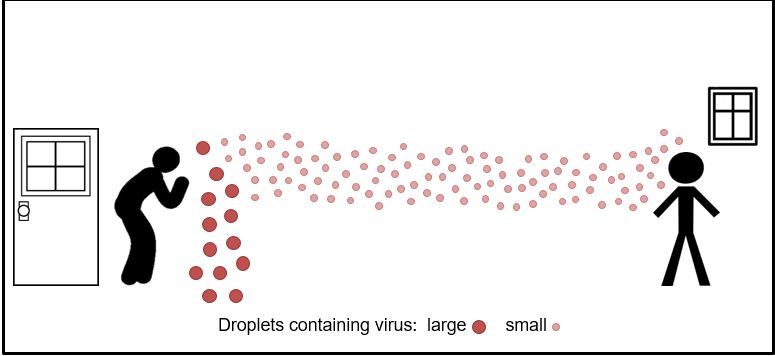 |
| Airborne transmission of COVID-19 must be taken into account. Likely COVID-19 spread to cruise ship passengers through ventilation system even when passengers confined to their cabins. Viable airborne viruses can travel beyond 1.5m on airflow when exhaled by an infected person. Virus air transmission research must begin now not retrospectively |
World-leading air quality and health
expert QUT Professor Lidia Morawska and Professor Junji Cao from Chinese
Academy of Sciences in an article in Environment International published this
week called on health bodies to initiate research into the airborne
transmission of COVID-19 as it is happening.
“National health bodies responsible
for controlling the pandemic are hampered by not acknowledging the research
evidence of airborne transmission of viable virus droplets, that was conducted
after the SARS 2003 outbreak,” Professor Morawska said.
“Now is the ideal time to conduct
research into how viruses can travel on the airflow, because there are many
similarities between the coronavirus that caused SARS and the COVID-19
coronavirus and therefore it is highly likely that COVID-19 spreads by air.
“Analysis of the initial pattern of
COVID-19 spread in China reveals multiple cases of non-contact transmission,
especially in areas outside Wuhan.
“On numerous cruise ships where
thousands of people onboard were infected, many of the infections occurred
after passengers had to isolate in their cabins even though hand hygiene was
implemented.
“Therefore, the ventilation system
could have spread the airborne virus between the cabins.
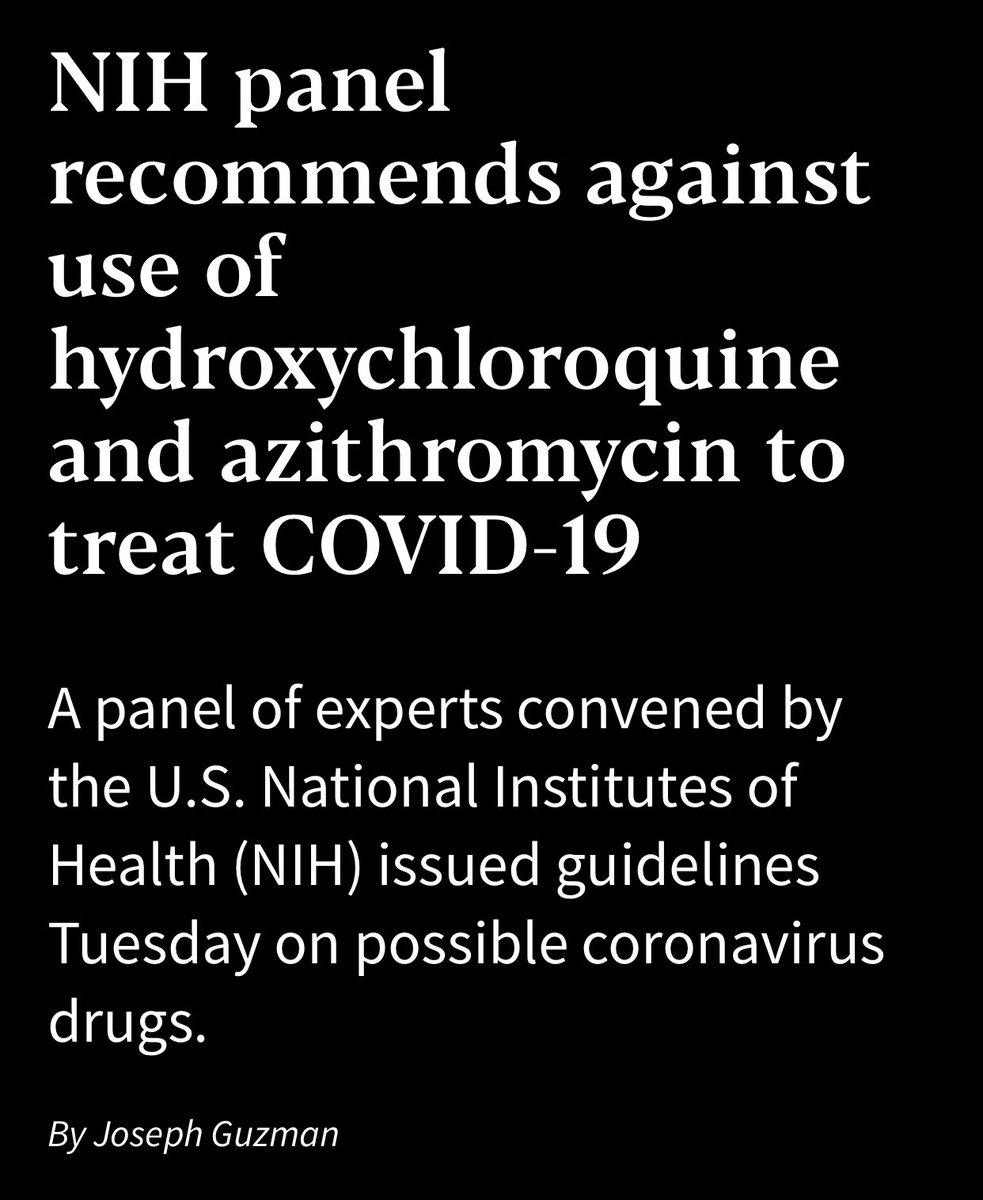
Studies are showing hydroxychloroquine can make COVID-10 patients sicker...or dead
Mark Sumner,
Daily Kos Staff
 Donald
Trump began pressing the case for hydroxychloroquine during his very
first appearance at what’s since become the daily campaign rally replacement.
Donald
Trump began pressing the case for hydroxychloroquine during his very
first appearance at what’s since become the daily campaign rally replacement.
Since then, Trump has declared that he had a “hunch” about the effectiveness of
the treatment over and over. And over.
Meanwhile, he’s been quick to shove
actual experts, like Dr. Anthony Fauci, director of the National Institute
of Allergy and Infectious Diseases, away from the microphone to keep them
from responding to questions about the anti-malaria medication.
Fox News
has backed up Trump’s claims by repeatedly trumpeting the supposed benefits
of hydroxychloroquine—a drug in which Trump has a personal financial interest.
In addition to
his shilling for profit during multiple hours networks are inexplicably
allotting him on a daily basis, Trump has frequently tweeted praise for
the drug, calling it “one of the biggest game changers in the history of
medicine.”
On
Tuesday, a study in The New England Journal of Medicine showed
that COVID-19 patients given Trump’s wonder drug were actually more likely to die than patients given
standard care.
Even so, Fox and other dead-enders continued to claim
that those researchers simply weren’t doing it right.
Wednesday, April 22, 2020
MUSIC VIDEO: adult version of "Earth" for Earth Day
To watch this surprisingly entertaining video on YouTube: https://www.youtube.com/watch?v=pvuN_WvF1to&feature=emb_title

VIDEO: Donald Trump was always a jerk
To watch this video on YouTube: https://www.youtube.com/watch?v=YwqklRh2irA&t=2s.
He still uses that same dance move. Maybe he should reprise this performance at his daily briefing on COVID-19.
Subscribe to:
Posts (Atom)