Scientists Just Confirmed What’s Driving Sea Level Rise And It’s Alarming
By Institute of Atmospheric Physics, Chinese Academy of Sciences
Sea level rise is one of the most visible consequences of
human-driven climate change. As the planet warms, oceans absorb heat and
expand, while melting glaciers and giant ice sheets add increasing amounts of
water to the seas. Scientists say the process is persistent, difficult to
reverse, and likely to continue for centuries.
A new international study has now provided the clearest
explanation yet for what has been driving global sea level rise over the past
60 years. The research also resolves a long-standing discrepancy that had left
scientists unable to fully account for all observed ocean rise.
Sea Level Rise Is Accelerating Worldwide
The study, published in Science Advances and
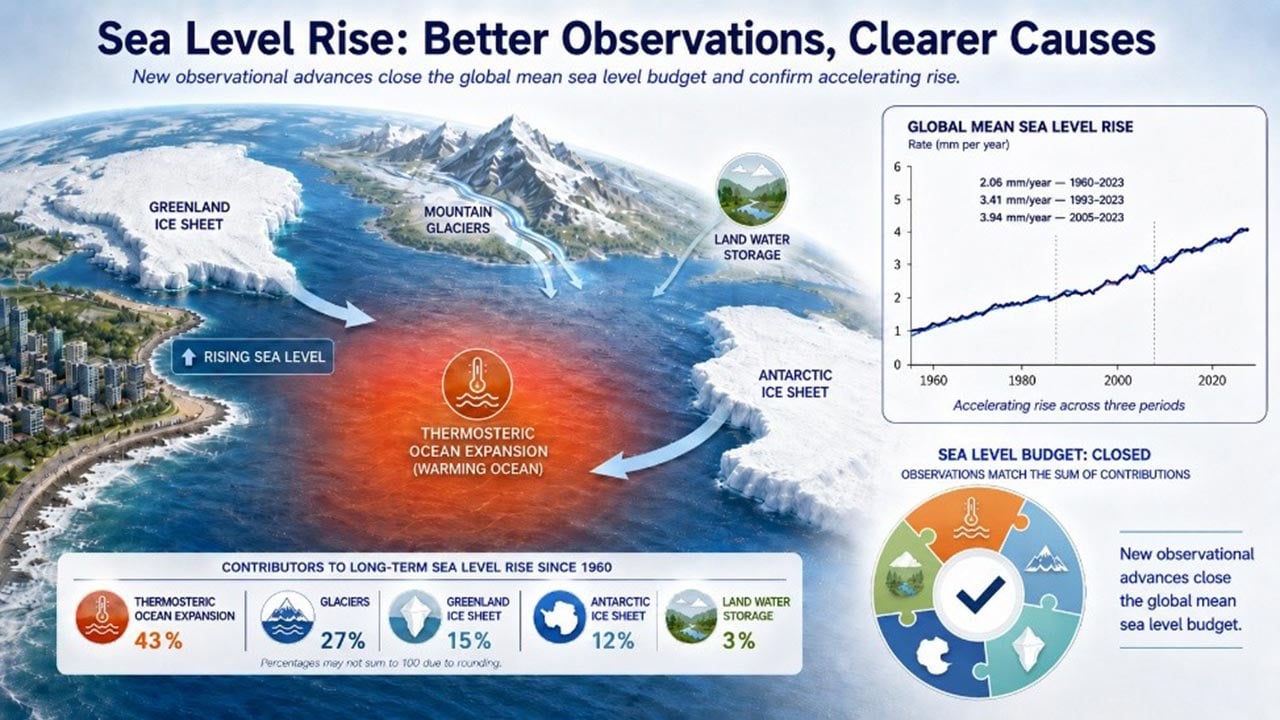
led by researchers in China, found that global sea levels have risen by an
average of 2.06 millimeters per year since 1960. More concerning, the pace has
accelerated sharply in recent decades, climbing to 3.94 millimeters per year
between 2005 and 2023.
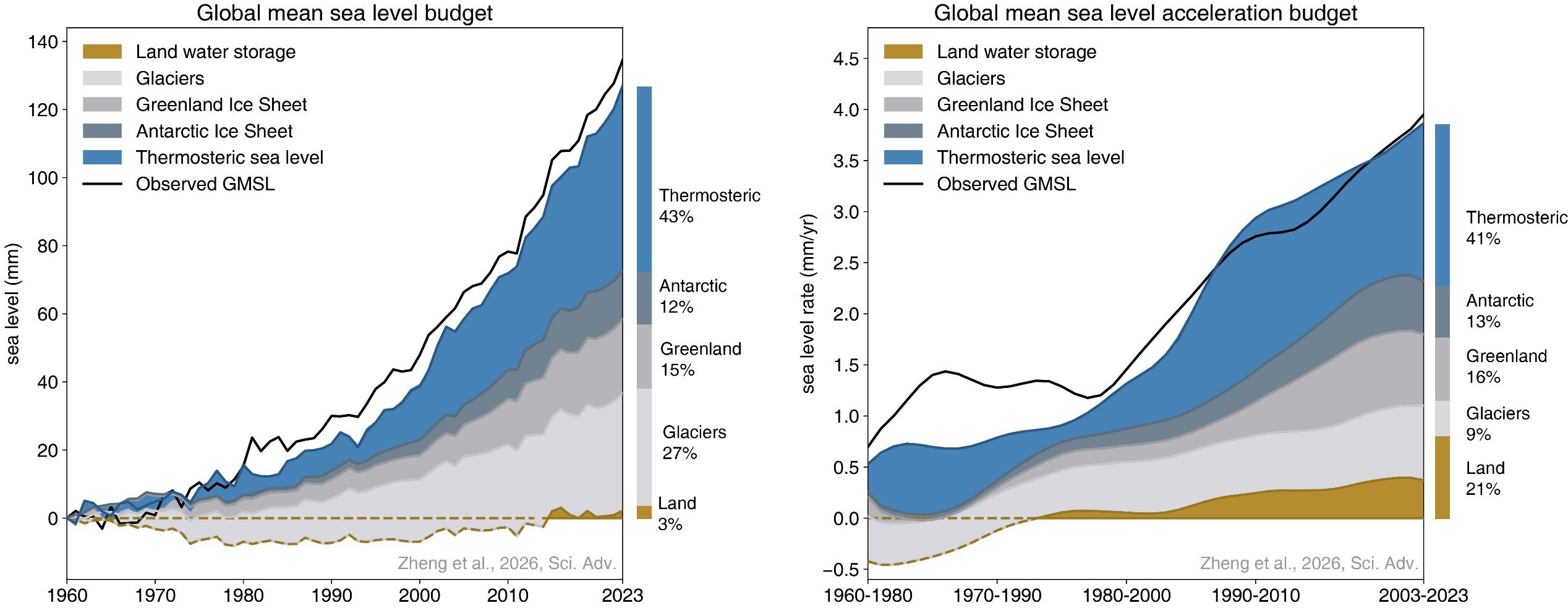
Researchers determined that ocean warming is the single largest contributor, responsible for 43% of total sea level rise since 1960. When seawater heats up, it expands and occupies more space, causing ocean levels to increase even without adding extra water.
Melting ice is also playing a major role. Mountain glaciers
account for 27% of the rise, while the Greenland Ice Sheet contributes 15% and
the Antarctic Ice Sheet contributes 12%. Changes in land water storage make up
the remaining 3%.
The scientists found that different factors have become more
important over time. Earlier in the record, ocean warming and changes in land
water storage were dominant influences. Since the 1990s, however, accelerating
ice loss from glaciers and the Greenland and Antarctic ice sheets has become a
much larger driver of rising seas.
Researchers warn that these trends are expected to continue
in the decades ahead.
Scientists Resolve Sea Level Measurement Gap
For years, climate scientists struggled with a puzzling
mismatch between measured sea level rise and estimates based on known causes
such as warming oceans and melting ice.
The new study says that gap has finally been closed.
“For years, there has been a frustrating gap between how
much the oceans were observed to be rising and how much we could explain from
the individual causes. This work shows that, with better instruments,
processes, and smarter analysis, this knowledge gap can be closed. We can
explain sea level rise with greater confidence,” said Prof. John Abraham,
School of Engineering, University of St. Thomas; co-author.
The international team included researchers from the
Institute of Atmospheric Physics at the Chinese Academy of Sciences, Tulane
University, the NSF National Center for Atmospheric Research, the University of
St. Thomas, and scientific collaborators in France.
According to the researchers, several advances helped solve
the problem. Scientists improved corrections to satellite observations that had
slowly drifted after 2015, developed better ways to measure land movement near
coastal tide gauges, and refined estimates of ice loss from Greenland and
Antarctica.
Rising Oceans Expected To Continue for Centuries
The findings also highlight the long-lasting nature of
climate-driven sea level rise. Scientists say that even if greenhouse gas
emissions eventually stabilize, oceans will likely continue rising for many
generations.
That is because oceans warm slowly and store enormous
amounts of heat deep below the surface. Massive glaciers and ice sheets also
respond gradually to rising temperatures and continue melting long after
warming begins. Because of this long-term inertia in Earth’s climate system,
researchers expect sea level rise to continue for centuries.
Reference: “Improved closure of the global mean sea level
budget from observational advances since 1960” by Huayi Zheng, Lijing Cheng,
Sönke Dangendorf, Benoit Meyssignac, Anne Barnoud, Kevin E. Trenberth, John T.
Fasullo and John Abraham, 20 May 2026, Science Advances.
DOI: 10.1126/sciadv.aea0652

