What she did and didn't do - are the attacks fair?
By Philip Eil, Rhode Island Current
.jpeg)
Aside from a few high-profile moments — a jab in a debate by candidate Luis Daniel Munoz, a controversial TV ad where the McKee campaign claimed Foulkes had made money “pumping opioids into our homes” — you could have easily missed discussion of the issue. McKee ultimately won that primary over Foulkes by three percentage points.
This time has been different.
On the day the former CVS executive announced her run again for governor last fall, McKee debuted a website and attack ads tying her to the opioid crisis. And he hasn’t let up, continuing to link her to the crisis via campaign statements, interviews, TV ads, and social media posts. His ongoing criticism of CVS recently prompted a rebuke from some state business leaders.
Foulkes — who polls show leading McKee by a significant margin — defended her opioids record in her first TV ad of the campaign. To date, CVS — the Woonsocket-based juggernaut with a market capitalization exceeding $125 billion — has been sued by thousands of cities, counties, states, and tribal governments for its role in the crisis. In 2022, the company paid $5 billion to settle those lawsuits, though it stated that the deal was “not an admission of any liability or wrongdoing.”
CVS has also paid more than $70 million in fines after Department of Justice (DOJ) investigations into opioid-related conduct — involving improper dispensing, filling prescriptions for unauthorized prescribers, record-keeping violations, and more — across 11 states, including Rhode Island and its neighbors, Connecticut and Massachusetts.
Foulkes was president of CVS’s Pharmacy division from January 2014 to February 2018. During that time she was, as a company-produced bio noted, responsible for all aspects of the company’s retail business, including pharmacy operations.
In her answers to reporters’ questions and in stump speeches, Foulkes has returned to a few points: the company’s record of cutting off pill mill doctors, its role in passing legislation that lowered the number of pills allowed in initial opioid prescriptions, the sweeping drug-takeback initiatives on her watch, and a steep overall drop in opioids dispensed during her tenure.
Here’s a closer look at her claims:
CLAIM 1: During her tenure as CVS pharmacy president, CVS took an aggressive approach to identifying and cutting off “pill mill” doctors.
Foulkes has consistently said the number of reckless prescribers CVS cut off during her tenure is “over 600 pill mill docs.” She has added that CVS brought a list of these doctors to the Drug Enforcement Administration, but the agency did not act on it.
CVS has not released the names of or dates when it cut off doctors. However, in 2024, in response to a Department of Justice lawsuit about improper opioid dispensing, the company stated, “12 years ago CVS Pharmacy pioneered a first-of-its-kind program to block controlled-substance prescriptions written by doctors of potential concern. To date, we have blocked more than 1,250 practitioners, including nearly 600 prescribers who the government continues to license.”
The Foulkes campaign confirmed for Rhode Island Current that “roughly 600” of those cutoffs occurred during her tenure as head of the pharmacy divisions.
“The pressure this generated ran hard in the other direction: blocked prescribers have repeatedly sued CVS — in one 2021 case winning a preliminary injunction that the doctor’s attorney called ‘the first time a federal court has overturned a pharmacy’s decision’ to block a prescriber — and pain patients brought a class action over CVS’s restrictions,” her campaign noted in a written statement.
Both cases cited by the campaign as blowback to the policy were filed years after Foulkes left CVS.
The campaign also shared a transcript from an opioid-focused civil trial in Ohio in 2021 where a CVS vice president testified, under oath, that CVS had offered to share a list of suspended doctors with the Drug Enforcement Administration, but the agency “refused to take it.”
The DEA declined to comment on Foulkes’ claims about the agency’s inaction and referred to the 2024 DOJ lawsuit against CVS alleging the company knowingly filled illegitimate prescriptions for opioids and other controlled substances. That lawsuit covers a timespan that includes all of Foulkes’ tenure as president.
In the complaint filed in U.S. District Court in Providence, the DOJ alleges the opposite of what Foulkes has claimed: that CVS, in fact, continued to fill prescriptions for problem prescribers despite warnings. At the time the lawsuit was filed, then-U.S. Attorney for the District of Rhode Island Zachary Cunha claimed, “CVS failed to exercise its critical role as gatekeeper of dangerous prescription opioids and, instead, facilitated the illegal distribution of these highly addictive drugs, including by pill mill prescribers.”
No CVS executives are named in the lawsuit. However, the complaint names seven pill-mill style doctors and, for six of them, the bulk of the alleged misconduct occurred during Foulkes’ tenure. The alleged conduct of a seventh physician overlapped for more than two years with Foulkes’ tenure. The alleged overprescribing by two of them took place entirely during Foulkes’ tenure.
The complaint states that CVS continued to permit pharmacists to continue filling prescriptions by one of the doctors despite repeated escalations flagging inappropriate prescribing practices, only stopping weeks after a federal grand jury indicted him for violating the Controlled Substances Act and other federal crimes.
The complaint claims CVS was alerted to another doctor’s inappropriate prescribing as early as 2014 but continued to fill his prescriptions until finally blocking him in 2017, a year after DEA agents raided his office in March 2016. The DOJ complaint states that CVS filled prescriptions for two patients who later died during Foulkes’ tenure.
“Due to…corporate-driven conditions, CVS’s pharmacists regularly filled prescriptions they knew had unresolved red flags and should not be filled,” the complaint reads. “CVS’s actions contributed to the opioid crisis, a national public health emergency with devastating effects in the United States.”
The Foulkes campaign did not respond to a request for comment on the red flags mentioned in the lawsuit.
As for CVS, Amy Thibault, a spokesperson for CVS Health, sent Rhode Island Current the following statement via email in response to a request for comment on the 2024 DOJ lawsuit: “Our focus, and the focus of our 7,000 employees who live and work in the state, remains on improving the health our friends [sic], families, and neighbors in Rhode Island and across the country.”
Thibault shared a link to the “Our Response to Opioid Litigation” page published by CVS when the 2024 lawsuit was filed. That page reads, in part, “When it comes to filling opioid prescriptions, pharmacists are held to vague, undefined, and ever-changing standards of practice…Whichever decision they make, community pharmacists know they can—and will—be second-guessed later. Too often, we have seen government agencies and trial lawyers question the good-faith decisions made by pharmacists while a patient waits at the pharmacy counter, often in pain.”
The lawsuit is ongoing. U.S. District Judge Melissa R. DuBose is presiding over the case.
CLAIM 2: During Foulkes’ tenure at the head of CVS Pharmacy, opioids dispensed dropped by 40%.
In interviews, Foulkes has repeatedly touted a 40% reduction in opioids dispensed by CVS during her tenure as pharmacy president. That number also appears in a May 2026 TV advertisement, in which she claims to have overseen “an almost 40 percent reduction in opioid prescriptions.”
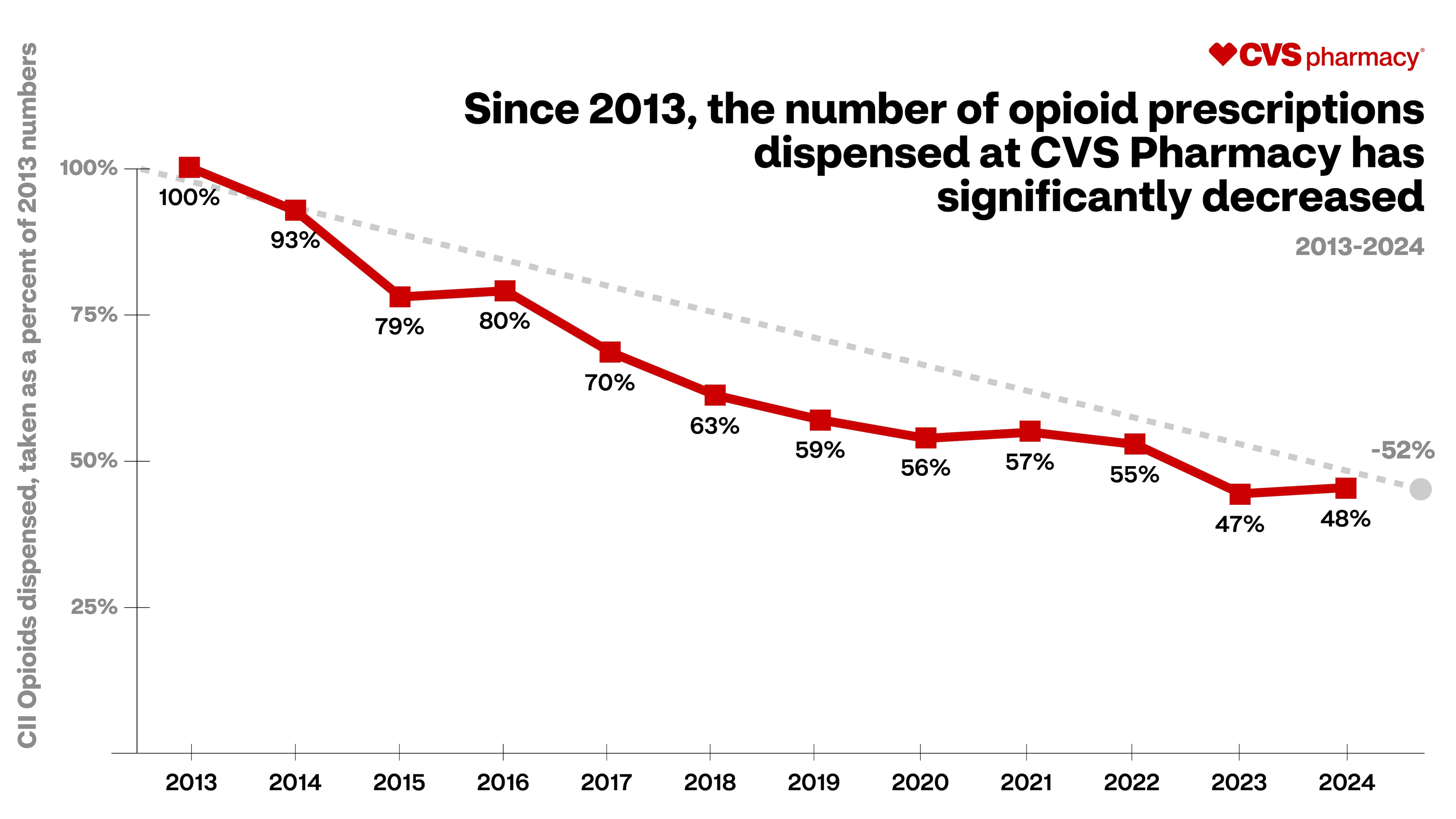
CVS does not regularly share detailed info about the individual medications, or classes of medications, it dispenses. So this claim is difficult to independently check. But among the materials released by CVS in response to the DOJ’s 2024 lawsuit was a graph that backs up Foulkes’ general assertion. The graph indicates that, between 2013 and 2024, opioid prescriptions dispensed at CVS fell by 52%.
When assessing this claim, though, it’s important to not just consider if the drop occurred, but the reasons for it. Foulkes has repeatedly claimed that the drop was because of actions the company took on her watch. In a February 2026 interview with WJAR, for example, she cited cutting off pill-mill doctors and drug-takeback initiatives as two reasons for the drop. This framing leaves out significant industry-wide trends.
National opioid prescriptions were falling by the time Foulkes was hired as CVS pharmacy president and continued to drop during her tenure. A 2017 U.S. Centers for Disease Control and Prevention report showed that the amount of opioids prescribed in the U.S. decreased after peaking in 2010. A 2019 state-specific summary of opioid trends in Rhode Island from the National Institute on Drug Abuse shows a local drop in opioid prescriptions during the years Foulkes was at the helm of CVS Pharmacy. Foulkes has cited the 40% drop in a campaign ad, campaign appearances, and interviews without mentioning these broader trends.
“That’s where the trends were,” Dr. Andrew Kolodny, the Brandeis-based medical director for the Opioid Policy Research Collaborative and president of Physicians for Responsible Opioid Prescribing, told Rhode Island Current.
The Foulkes campaign responded: “No question the decline was industry-wide — but CVS helped drive the industry, then outperformed it.”
To support the claim that CVS outperformed the industry in restricting the flow of opioids, the Foulkes campaign shared a September 2017 NBC article describing CVS as “the first national retail chain to restrict how many pain pills doctors can give patients.” The policy took effect in February 2018, the month Foulkes left the company.
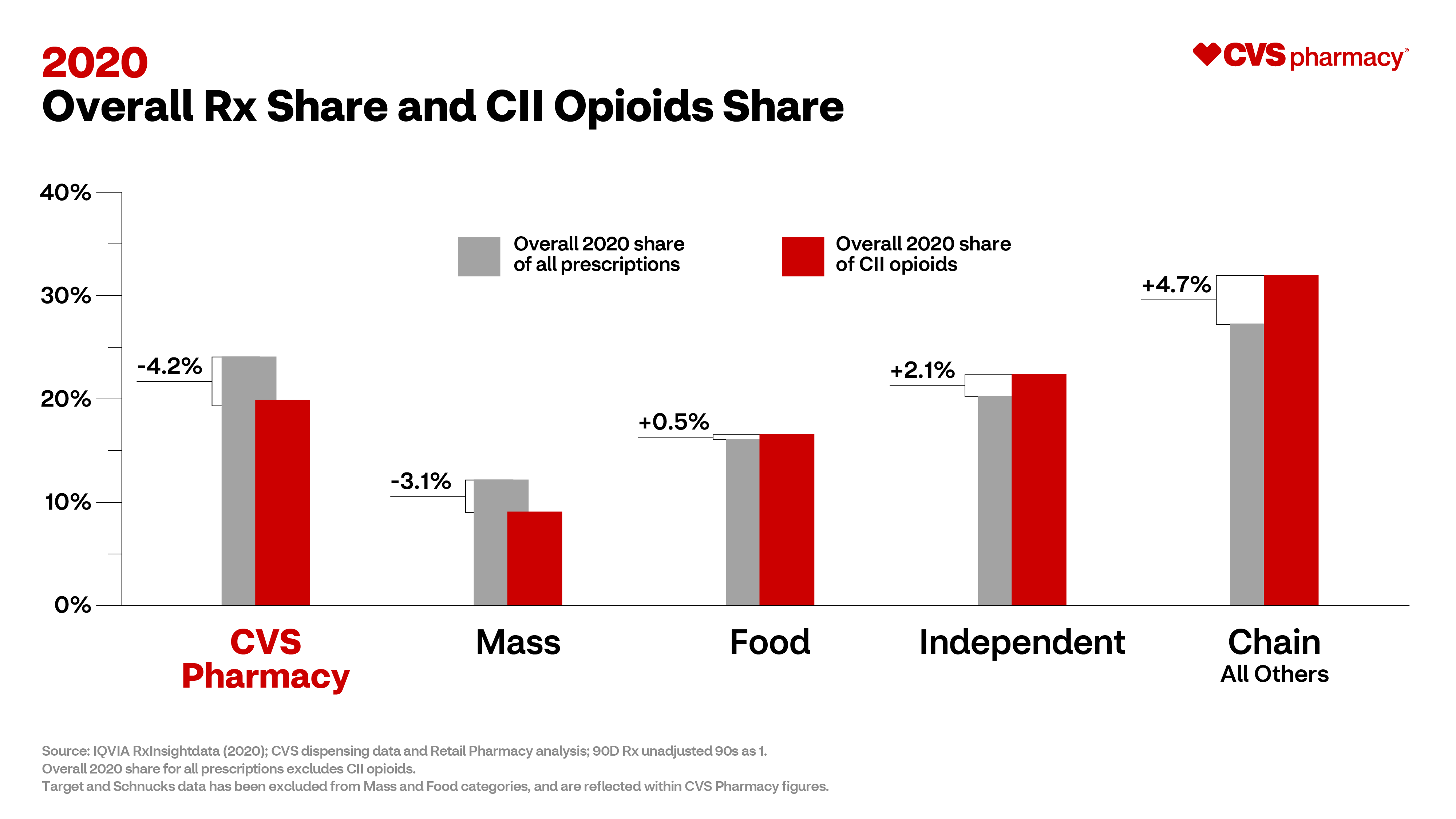
The campaign also pointed to a graph shared by CVS in 2024 showing the company’s nearly one-fourth industry-wide share of all prescriptions filled, alongside its share of prescriptions filled for Category II opioids (such as oxycodone, hydrocodone, and codeine) dispensed. The graph shows that by 2020, CVS’ industry-wide share of Class II opioids dispensed was 4.2% lower than its overall share of prescriptions filled, while the Class II opioid shares for independent pharmacies, other chains, and grocery-store based pharmacies were higher than those respective sectors’ share of overall prescriptions filled.
“If the decline were purely environmental, every pharmacy’s opioid share would track its overall share,” the campaign said. “Only CVS’s runs meaningfully below.”
CLAIM 3: On Foulkes’ watch, CVS performed massive drug takeback programs, which represented a significant measure to address the opioid epidemic.
In September 2025, during an appearance on WPRI’s “Newsmakers,” Foulkes said CVS “did the biggest drug takeback this country has ever seen. We had 4,000 of our stores. Because we knew the first way people get addicted is in their own family’s medicine cabinet.”
She mentioned the participation of 4,000 stores at least two other times: at an event with Rhode Island Attorney General Peter Neronha, and in a Rhode Island Report podcast interview with the Boston Globe.
“Drug takebacks” can refer to two different things: a single event where unused or expired medications are collected, or an ongoing effort to collect medications via specially-designed receptacles. Foulkes does not usually specify which she is referring to in interviews. CVS has a documented history of both practices.
Foulkes’ statements raise questions about timing. The 4,000 number matches a number describing in-store kiosks from a 2025 CVS press release about its drug-takeback efforts.
But the numbers from her time at the company were much lower. A CVS press release from 2017 reports a drug-takeback program expanded to “750…disposal units in CVS Pharmacy across the country.” An April 2018 CNBC report states, “CVS Health is in the process of installing 750 kiosks to its stores.”
The campaign acknowledged that Foulkes has been citing CVS’s more recent numbers.
“The 4,000 figure describes where the program CVS built ultimately arrived,” the campaign said. The campaign noted that, throughout Foulkes’ tenure, customers at any CVS store could buy envelopes to mail off unused medications, including opioids, for proper disposal.
Two other points about drug takebacks bear mentioning.
In the field of public health, drug takebacks — however laudable — are not viewed as a serious intervention on the availability of opioids. A 2016 article in The American Journal of Drug and Alcohol Abuse called the impact of drug takebacks on the public supply of controlled substances minimal. “Controlled medications collected by take-back events and permanent drug donation boxes constituted a miniscule proportion of the numbers dispensed,” the authors wrote.
Dr. Josiah Rich, a Brown professor of medicine and addiction expert who has long served on Rhode Island’s overdose task force, doesn’t view drug takebacks as an effective measure for tackling the number of opioids in circulation.
“They’re kind of a feel-good thing, but don’t really address the root cause of this problem,” Rich told Rhode Island Current.
Separate from the effectiveness of drug takebacks, reporting from Foulkes’ tenure indicates that the company was slow to act after the DEA began allowing drugstores to take back and destroy controlled substances in 2014. In 2015, The New York Times reported that chain-pharmacy participation in drug takebacks was virtually non-existent: “Only about 1 percent of American pharmacies have set up disposal programs, with none of those belonging to the two largest chains, CVS and Walgreens, which have balked at the cost and security risks, according to government and industry data.”
A CVS spokesperson told The Times that the company did not allow any of its 7,800 pharmacy locations to accept controlled medications like opioids, with the exception of one store where a pilot program was underway.
Asked about the delay in setting up in-store kiosks for opioids and other controlled substances, the Foulkes campaign said it took time to address logistical and security concerns: “Placing open receptacles for controlled substances inside nearly 10,000 retail stores raises real security and diversion problems, and the company built the camera coverage, procedures, and safeguards to run it safely at scale before launching 750 in-store units in 2017. It’s not cheap.”
The campaign reiterated that CVS’s drug-disposal-via-mailed-envelopes program was available at this time.
CLAIM 4: Foulkes and CVS were instrumental in passing opioid-limiting legislation in Rhode Island and elsewhere.
During Foulkes’ tenure at CVS, many states enacted laws to lower or limit the amounts of opioids prescribed to acute-pain patients. In 2017 alone, 17 states adopted such laws. Rhode Island’s pill-capping bill was signed into law in 2016, along with a group of other opioid-focused bills. It took effect upon passage.
Foulkes has maintained that CVS played a role in the success of the legislation. “We were able to change the legislation,” she told The Public’s Radio in 2021. “So across the country, Rhode Island in particular in 2016, we reduced the number of pills people could get after surgery.”
In a February 2026 WJAR interview, she said, “We changed legislation in this state and across the country so now it’s only 10 pills.” At an event in March, she clarified, “Obviously, the legislature did that work.”
In response to questions about her specific role in getting the pill-capping legislation passed in Rhode Island, the Foulkes campaign said, “Helena helped push a state-by-state advocacy for prescribing-limit legislation.” The campaign also pointed to Foulkes’ public support of then-Gov. Gina Raimondo’s 2016 plan to combat overdoses, which included a call to limit initial opioid prescriptions.
Former Sen. Josh Miller, a Cranston Democrat, was the chair of the Senate Health and Human Services Committee at the time the bill passed. And he told Rhode Island Current CVS was part of a larger working group that included manufacturers and distributors, the Rhode Island Medical Society and the Department of Health. Given the pressures of the opioid epidemic and the wave of similar bills being passed in other states, the legislation had an air of inevitability, Miller said.
“It was trending,” he said. “It was legislation everybody understood had to be done.”
When discussing legislation, Foulkes has described how she “got together with other chain drugstore leaders to make sure we advocated for legislation to reduce the number of pills you could get when you left minor surgery.”
Until 2022, CVS was a member of the National Association of Chain Drug Stores (NACDS) and Foulkes served on the trade organization’s board of directors, which she joined in 2015. In 2017, the association expressed support for legislation that would limit a supply for initial acute-pain opioid prescriptions to seven days.
But the association also backed the “Ensuring Patient Access and Effective Drug Enforcement Act,” signed into law by then-President Barack Obama in April 2016. Among other effects, the law limited the DEA’s power to intervene when it believed drug distributors or pharmacies were filling suspicious orders.
That law — nicknamed the “Marino Bill,” for one of its lead sponsors, former Pennsylvania Republican U.S. Rep. Tom Marino, who later withdrew as a nominee for federal drug czar due to scrutiny over the bill — is notorious among anti-overdose advocates who have called for it to be repealed. A DEA administrative law judge co-wrote a headline-making law review article which stated, in part, “If it had been the intent of Congress to completely eliminate the DEA’s ability to ever impose an immediate suspension on distributors or manufacturers, it would be difficult to conceive of a more effective vehicle for achieving that goal.”
NACDS publicly supported the Marino Bill and praised its passage. There is no public indication that Foulkes broke with the association in its support of the legislation.
Indeed, according to a 2017 Washington Post story about corporate influence on the DEA, CVS Health spent $32.5 million on lobbying efforts related to the Marino Bill and other legislation between 2014 and 2016. That number dwarfed lobbying sums from chain-store competitors like Rite Aid and Walgreens, and was second only to the group Pharmaceutical Research and Manufacturers of America, which spent $40.8 million on lobbying for those bills during the period, the Post reported.
In response to questions about the Marino Bill, the Foulkes campaign said: “Helena had no involvement with the Ensuring Patient Access and Effective Drug Enforcement Act, did not work on federal legislation, and knowing what everyone knows now, believes the law was a serious mistake.”
The campaign added: “If President Obama who signed it, the Justice Department that cleared it, and Congress did not see the bill as a problem in real time, Helena cannot be expected to have been the person to catch the bill or its problems.”
YOU MAKE OUR WORK POSSIBLE.
Rhode Island Current is part of States Newsroom, a nonprofit news network supported by grants and a coalition of donors as a 501c(3) public charity. Rhode Island Current maintains editorial independence. Contact Editor Janine L. Weisman for questions: info@rhodeislandcurrent.com.