And that's if you can find it
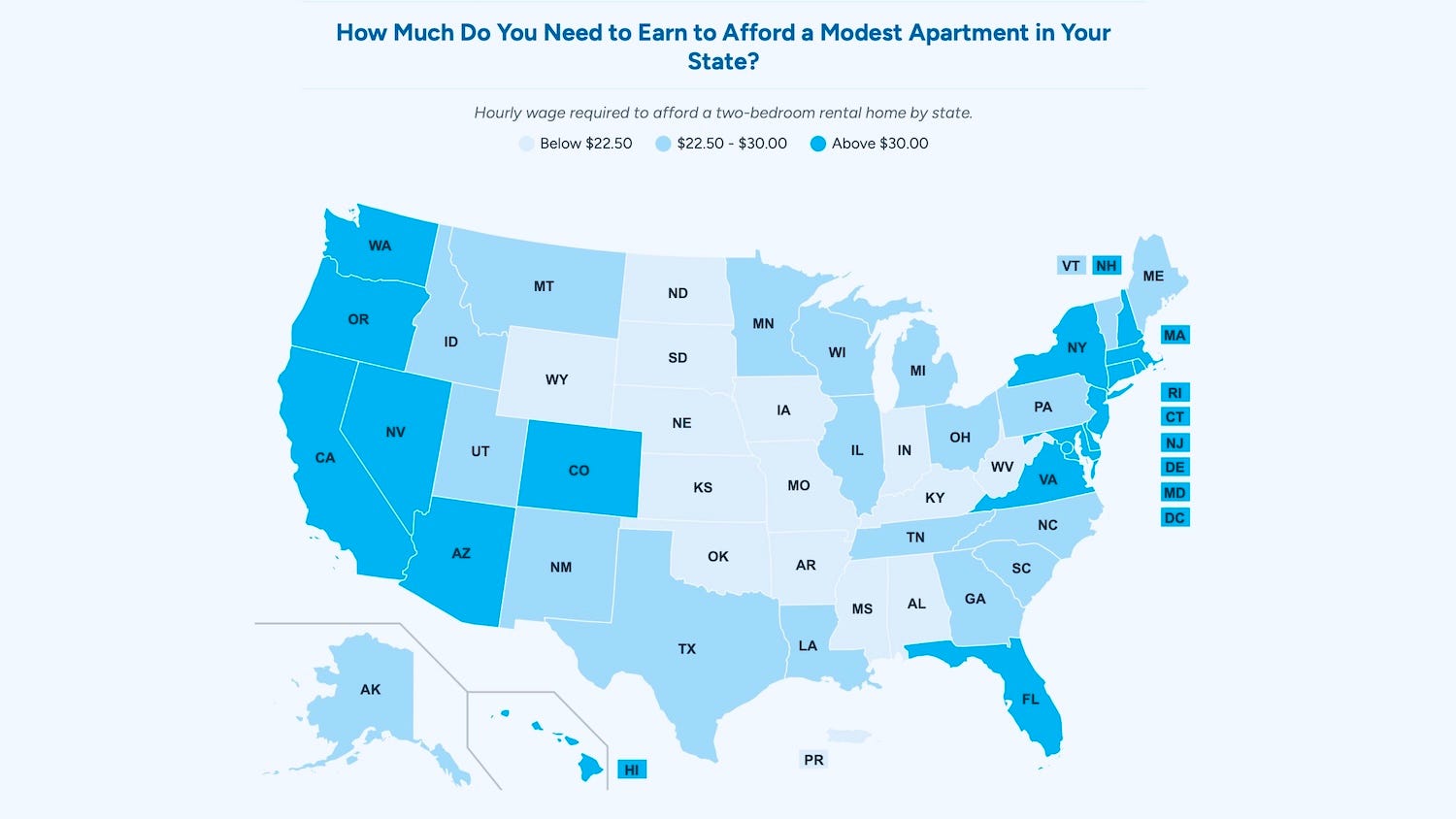
A full-time worker in Rhode Island must earn $33.95 per hour — or $70,617 annually — to afford a modest two-bedroom apartment at today’s Fair Market Rent (FMR), up from $31.71 per hour in 2025. This is Rhode Island’s “2026 Housing Wage” according to Out of Reach, a report published jointly by the National Low Income Housing Coalition (NLIHC) and the Housing Network of Rhode Island.
From a press release
Released annually, Out of Reach underscores
the significant disparity that exists between actual wages and the wages people
need to earn to afford their rents nationwide, reflecting the broader trend of
rising income inequality across the U.S. The report’s “Housing Wage” is an estimate
of the hourly wage full-time workers must earn to afford a rental home at FMR
without spending more than 30% of their incomes.
In Rhode Island, the FMR for a two-bedroom apartment is
$1,765. To afford this level of rent and utilities without paying more than 30%
of income on housing, a household must earn $5,885 monthly or $70,617 annually.
This level of income translates into an hourly Housing Wage
of $33.95. The average Rhode Island renter earns only $19.24 per hour. Minimum
wage is just $16 an hour.
Out of Reach 2026 underscores the significant need for subsidies to assist the lowest-income renters. Despite this need, federal resources for affordable housing remain insufficient. Currently, only one in four eligible households receives federal housing assistance due to chronic underfunding, largely because housing assistance programs compete for limited discretionary federal funding.
“With housing costs so much higher than what many people can
afford, an increasing number of renters are forced to spend more of their
incomes and make difficult tradeoffs to keep a roof over their heads,”
said Melina Lodge, executive director of the Housing Network of
Rhode Island. “As federal resources still fall short, we will continue to
advocate for resources including a state-funded rental subsidy to provide
project-based rental assistance aligned to tenants’ income, helping reduce
reliance on emergency shelters, improving housing stability, and complementing
existing federal homeless assistance resources. Sustained, long-term
investments in affordable housing programs, both locally and federally, are
essential to ensure that the lowest-income renters can access and maintain safe,
stable homes.”
“The 2025 Housing Fact Book states that of the more than
32,000 lowest-income renter households in Rhode Island, 54 percent of them are
severely cost burdened, meaning they are spending more than half of their
income on housing,” said Brenda Clement, Executive Director of
HousingWorks RI. “With the gap between wages and the cost of housing continuing
to widen, the number of Rhode Islanders struggling to afford a safe place to
call home will only increase. We must do more to bridge this gap and ensure
safe, affordable, and secure housing doesn’t remain out of reach for Ocean
State residents.”
Rhode Island is the 13th most expensive state in the
country, based on its two-bedroom housing wage, behind Massachusetts (3rd), New
Hampshire (8th), and Connecticut (9th), but ahead of Vermont (18th) and Maine
(19th). While Rhode Island may not be the most unaffordable in the region,
Rhode Island’s comparatively lower housing costs could attract higher-wage
earners from other states, driving up demand and contributing to rising housing
costs.
According to the report, Rhode Islanders would have to work
85 hours a week at minimum wage to afford a two-bedroom apartment at FMR (which
would require 2.1 full-time jobs); or 68 hours per week for a one-bedroom
(requiring 1.7 full-time jobs).
“To meaningfully address the affordable housing crisis, the
federal government must adequately fund housing programs in a way that would
expand rental assistance and both preserve and increase the supply of deeply
affordable homes for those with the lowest incomes,” said NLIHC President and
CEO Renee M. Willis. “Out of Reach 2026 shows why
millions of low-income renters are struggling to afford their homes. The
president’s recent FY27 budget request would drastically underfund HUD
programs, worsening the affordable housing crisis and threatening the housing
stability of families struggling to keep roofs over their heads. We have the
resources to invest in expanding housing solutions that provide stable homes
for the lowest-income people in our country. We need the political will to do
so.”
For additional information
and to download the report, click here.
SteveAhlquist.news is a reader-supported publication. To
receive new posts and support my work, consider becoming a free or paid
subscriber.

