Menu Bar

Home           Calendar           Topics          Just Charlestown          About Us
Showing posts with label Nancy Pelosi. Show all posts

Wednesday, July 2, 2025

Why does MAGA spread hate and violence?

The MAGA mind virus

Stephen Robinson

The disastrous choice American voters made in last year’s presidential election was put on grim display earlier this month in response to the politically motivated shooting of Minnesota state lawmakers and their spouses by a right-wing extremist named Vance Boelter.

Minnesota Gov. Tim Walz responded to the violence like a decent human being and condemned the shooting as an attack on all Americans and our very civic order.

“We are not a country that settles our differences at gunpoint,” a somber Walz said during a press conference. “We have demonstrated again and again in our state that it is possible to peacefully disagree, that our state is strengthened by civil public debate. We must stand united against all forms of violence — and I call on everyone to join me in that commitment.”

The president, meanwhile, responded to the shootings like — well, like a maniac.

Trump rejected Walz’s call for unity and as always refused to even pretend he’s supposed to be the president of the entire United States.

“I think the governor of Minnesota is so whacked out. I’m not calling him. Why would I call him?” Trump told reporters on Air Force One. “The guy doesn’t have a clue. He’s a mess. So I could be nice and call him, but why waste time?”

Trump’s predecessors responded more humanely to gun violence. After the Virginia Tech shooting in 2007, Republican president George W. Bush immediately reached out to Democratic Gov. Tim Kaine and offered his support and sympathy. 

Four years later, when 19 people, including Rep. Gabby Giffords, were shot in Tucson, Arizona, President Barack Obama offered Republican Gov. Jan Brewer — a vocal political opponent — the full resources of the federal government.

Unfortunately, 77 million Americans surrendered these moments of shared humanity when they put Trump back in the White House. The tragedies that once united us now only result in more division. And no one, including his supporters, should have expected anything else.

Saturday, November 11, 2023

Why are US politicians so old?

And why do they want to stay in office?

Mary Kate CaryUniversity of Virginia

When former President Bill Clinton showed up at the White House in early 2023, he was there to join President Joe Biden to celebrate the 30th anniversary of the Family and Medical Leave Act. It was hard to avoid the fact that it had been three decades since Clinton was in office – yet at 77, he’s somehow three years younger than Biden.

Biden, now 80 years old, is the first octogenarian to occupy the Oval Office – and his main rival, former President Donald Trump, is 77. A Monmouth University poll taken in October 2023 showed that roughly three-quarters of voters think Biden is too old for office, and nearly half of voters think Trump is too old to serve.

My former boss, President George H.W. Bush, happily chose not to challenge Clinton again in the 1996 election. If he had run and won, he would have been 72 at the 1997 inauguration. Instead, he enjoyed a great second act filled with humanitarian causes, skydiving and grandchildren. 

Bush’s post-presidential life, and American ideals of retirement in general, raise the question of why these two men, Biden and Trump – who are more than a decade and a half beyond the average American retirement age – are stepping forward again for one of the hardest jobs in the world.

Friday, May 12, 2023

Shame on CNN!

Trump Uses CNN Town Hall To Insult a Woman He Assaulted

By 

Thursday, February 2, 2023

Is the United States on the Verge of Civil War II?

We’re definitely on the brink of—or in the middle of—something.

ROBERT C. KOEHLER for Common Dreams

January 6: Close call, wake-up call or both? Kent Nishimura/Los Angeles Times via Getty Images

“Folks keep talking about another civil war. One side has about 8 trillion bullets, while the other side doesn’t know which bathroom to use.”

The words — actually a 2019 Facebook post — are those of then-Iowa Republican congressman Steve King, loosing a puerile smirk as he stirred the pot of violence on the American political right. The politics of stupid has intensified since then, as white supremacy and fear of the Great Replacement Theory take over the GOP.

Are we truly on the brink of a civil war? What, indeed, is a civil war? When does violence move from being random and individual — psychological — to strategic and political, which is to say, militarized? Can this happen without a quasi-governmental entity emerging, officially declaring “war” on the political establishment whose decisions it hates? Or is having 8 trillion bullets enough?

Resorting to violence — indeed, celebrating and honoring its use for just and moral purposes — requires a surrender to the temptation of force. No matter how disempowered you are, intellectually and spiritually, force is always available as a means of making your presence felt, if not actually getting your way. Force is a lost soul’s last resort. It often turns into the first resort.

Say you’re a Republican and you lose an election. What a nuisance! Consider the troubles faced by MAGA-T-shirt-wearing, would-be state rep Solomon Peña, who ran for a New Mexico House seat in November, Yeah, he lost, garnering only 26 percent of the vote, but refused to concede and challenged the legitimacy of the election. 

That accomplished nothing, so . . . what choice did he have? He allegedly hired some guys who drove past at least four houses of local politicians — two state legislators and two county commissioners — and fired bullets into walls and doors. He was arrested a few days ago and charged in the shootings.

There was a time when this would have been seen, in most respectable circles, as insanity. Now I fear it’s just one more example of Republican fun and games, as the party members come to grips with their (is it possible?) permanent minority status. Voter suppression is no longer adequate to ensure victories. Donald Trump has given losing GOP candidates their mantra du jour: The election was rigged.

And thus, as Stephen Marche wrote recently in The Guardian: “The United States is a textbook example of a country headed towards civil war. The trends increasingly point one way, and while nobody knows the future, little — if anything — is being done, by anyone, to try to prevent the collapse of the republic. Belief in democracy is ebbing. 

Wednesday, November 23, 2022

GOP won't dump Trumpism anytime soon

Trump-backed Republicans lost some big races this year, but the leopard won’t change its spots.

By Mitchell Zimmerman 

By Michael deAdder
In the face of midterm election results that confounded predictions and crushed Republican hopes for a landslide victory, some in the media are suggesting that the party may finally turn away from Trump.

Trump-backed Republicans did indeed blow some critical races. But this hope suggests there are reasonable Republican office-holders out there who are now ready to liberate themselves from Trump’s orbit and re-make the GOP as a normal, democracy-respecting party.

The suggestion that there was an “extremist” fever that has run its course is false.

The reality: MAGA Republicans are the Republican Party. Few Republican politicians who resisted Trumpism remain in office, while Republican office-holders who supported Trump’s efforts to overthrow American democracy remain the mainstay of the party.

Recall that in 2020, even in the immediate aftermath of an insurrection that threatened the murder of Vice President Pence and House Speaker Pelosi, a large majority of Republican representatives voted to reject the results of a free and fair election.

These democracy-defying Republicans remain the core of the party. A solid majority of the Republican representatives who will assemble in Washington in January are the very same people who voted to reject the 2020 election result. There is no reason to imagine they will be more respectful of democracy in the future.

The Republican Party long ago abandoned behaving like a normal party — one which prizes democracy, accepts the verdict of the voters when it loses, and learns from defeats.

Friday, November 4, 2022

Political violence in America isn’t going away anytime soon

Especially right-wing violence fed by Republican misinformation

Richard FornoUniversity of Maryland, Baltimore County 

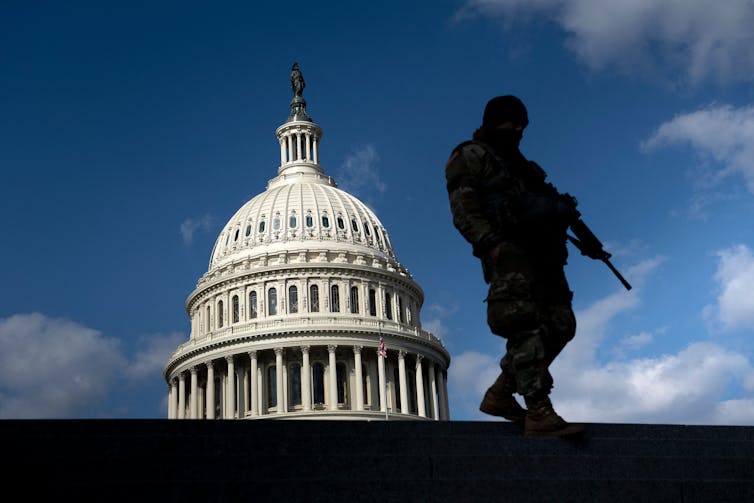
A member of the National Guard patrols the U.S.
Capitol on March 4, 2021. 
Brendan Smialowski/AFP via Getty Images
A warning about the threat of political violence heading into the 2022 midterm elections was issued to state and local law enforcement officials by the U.S. Department of Homeland Security on Oct. 28, 2022.

The bulletin was released the same day that Speaker of the House of Representatives Nancy Pelosi’s husband was hospitalized after a home invasion by a lone right-wing extremist seeking to harm her.

This incident is the latest in an increasing stream of extremist confrontations taking place across the United States in recent years. These incidents have primarily targeted Democrats, including a plot to kidnap Michigan Gov. Gretchen Whitmer in 2020. But threats from both sides of the political spectrum are up significantly.

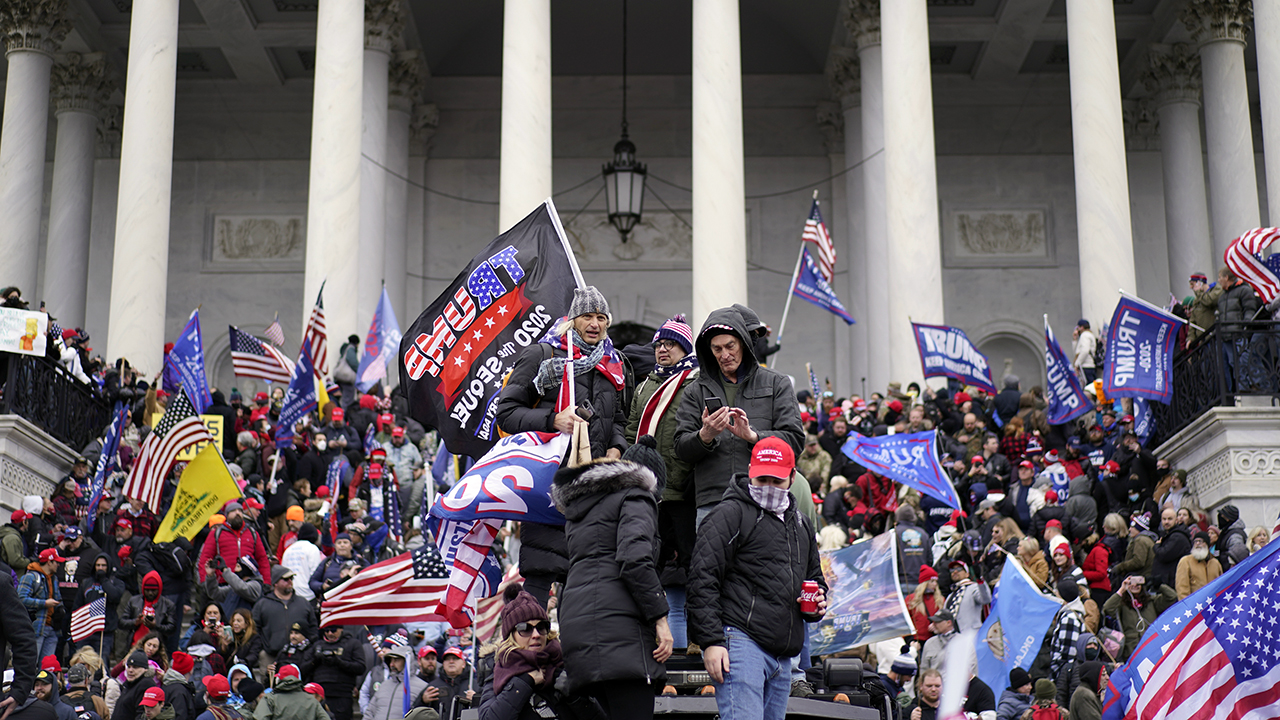
And, of course, there was the Jan. 6, 2021, insurrection at the U.S. Capitol, where supporters of a defeated Republican president, acting on a widespread lie he perpetuated, violently attempted to prevent the certification of electoral votes. According to well-documented public evidence, some rioters planned to find and execute both Speaker Pelosi and Vice President Mike Pence.

Such incidents reflect a disturbing trend that targets the very fabric, foundation and future of U.S. democracy. But what led to this point?

As a researcher taking a critical and apolitical eye toward security issues, I believe the rise in contemporary right-wing political extremism – and violence – began with an outdated focus in national communications policy.

Tuesday, July 19, 2022

Guns and racism

Militant white identity politics on full display in GOP political ads featuring high-powered weapons

Ryan Neville-ShepardUniversity of Arkansas and Casey Ryan KellyUniversity of Nebraska-Lincoln

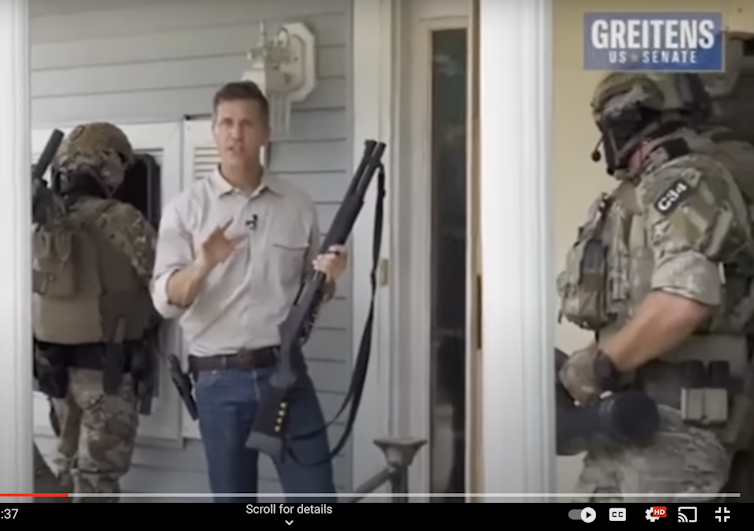
Eric Greitens poses with a high-powered rifle and commandos in a political ad. Eric Greitens

Republican Eric Greitens, a candidate for Missouri’s open U.S. Senate seat, shocked viewers with a new online political ad in June 2022 that encouraged his supporters to go “RINO hunting.”

Appearing with a shotgun and a smirk, Greitens leads the hunt for RINOs, shorthand for the derisive “Republicans In Name Only.” Along with armed soldiers, Greitens is storming a house under the cover of a smoke grenade.

“Join the MAGA crew,” Greitens says in the video. “Get a RINO hunting permit. There’s no bagging limit, no tagging limit and it doesn’t expire until we save our country.”

The ad comes from from a candidate who has repeatedly found himself in controversy, having resigned as Missouri’s governor amid accusations of sexual assault and allegations of improper campaign financing that sparked an 18-month investigation that eventually cleared him of any legal wrongdoing.

The political ad was also launched – and quickly removed – from Facebook and flagged by Twitter at a time when the nation is still coming to terms with the insurrection at the U.S. Capitol and reeling from mass shootings in Tulsa, Oklahoma, Uvalde, Texas, Buffalo, New York and Highland Park, Illinois.

The ad continues to circulate on YouTube via various news sources.

Greitens’s call to political arms is hardly new.

In his 2016 gubernatorial ads, Greitens appeared firing a Gatling-style machine gun into the air and using an M4 rifle to create an explosion in a field to demonstrate his resistance to the Obama administration.

What Greitens’ ad represents, in our view, is the evolution of the use of guns in political ads as a coded appeal for white voters.

While they might have been a bit more ambiguous in the past, candidates are increasingly making these appeals appear more militant in their culture war against ideas and politicians they oppose.

Thursday, August 12, 2021

Trump’s Shadow Cabinet is Part of His Ongoing Attempted Coup

Trump is determined to become America's first dictator

By Thom Hartmann, Independent Media Institute

By Bill Bramhall
Even though the number of dying Trump followers increases daily, his coup rolls on. 

Now, in the Trump shadow-universe he’s created a shadow-government for his shadow-fans. It’s not as wacky an idea as it seems and suggests Trump’s solidifying his control over the GOP going toward 2022 and 2024.

Last November, on election day, I suggested on my radio program that if the Biden ticket were to lose (something we did not expect, but after 2016 who knows what can happen) they should set up a “shadow government” to be a visible and ongoing opposition and alternative to Trump’s second term. 

Apparently, somebody on Team Trump was listening.  Or they copped the idea from the same place I did — the UK, Canada and Australia, all countries where the party out of power assembles a “shadow government” with a “shadow cabinet” that regularly informs voters of how and why they’d run the government differently were they in power. 

Trump’s last Chief of Staff, former Tea Party Congressman Mark Meadows, appeared on a fringe rightwing TV internet show and repeatedly referred to Trump’s “Cabinet.” 

“We met with several of our Cabinet members tonight,” Meadows said. “We actually had a follow-up ... meeting with some of our Cabinet members.” 

Referring to Trump as “the president,” just as Trump does himself in the daily fundraising emails I receive from him, Meadows added, Trump is “a president who is fully engaged, highly focused and remaining on task.”

In other words, the coup rolls on.

Voltaire’s old quote, that “Those who can make you believe absurdities can make you commit atrocities,” is playing out right in front of our eyes.  

Monday, May 3, 2021

The one line that drove Trumplicans to explode

Right-wingers are convulsing over one line in Biden's speech

Mark Sumner, Daily Kos Staff


In his speech to a joint session of Congress earlier this week, President Joe Biden called for a series of programs to rescue the economy, rebuild the nation’s infrastructure, and help workers and families reach new levels of success. But a large number of pundits apparently heard none of that, because they were so enraged by one of Biden’s opening lines, they could make it no further.

"As I stand here tonight—just one day shy of the 100th day of my administration, 100 days since I took the oath of office, lifted my hand off our family Bible, and inherited a nation in crisis.

The worst pandemic in a century.

The worst economic crisis since the Great Depression.

The worst attack on our democracy since the Civil War."

Some Republicans have determinedly nitpicked the seriousness of the pandemic’s threat to the economy, but it’s really that last line that popped a lot of pressure valves. 

Because accepting the idea that we’ve just been through the “worst attack on our democracy since the Civil War” means accepting that the assault on the Capitol was not a “peaceful protest,” that it was not “patriots knocking on the Capitol,” and not just a visit from people who “cared more” about the election. 

It was an attempted coup—an effort to overthrow a democratic election that featured would-be-assassins out to capture and kill high officials, including Mike Pence and Nancy Pelosi. 

Thursday, March 18, 2021

Key issues unresolved about January 6 right-wing attack on the Capitol

Six Questions Officials Still Haven’t Answered After Weeks of Hearings on the Capitol Attack

By Joaquin Sapien and Joshua Kaplan for ProPublica

Saul Loeb/AFP via Getty Images
Series:
The Insurrection

The Effort to Overturn the Election

After two weeks of congressional hearings, it remains unclear how a rampaging mob of rioters managed to breach one of the most sacred bastions of American democracy on Jan. 6.

During more than 15 hours of testimony, lawmakers listened to a cacophony of competing explanations as officials stumbled over themselves to explain how America’s national security, defense, intelligence and law enforcement agencies allowed a homegrown enemy to put an entire branch of government in danger during the attack on the U.S. Capitol.

The continuing questions surrounding the attack have prompted calls for a more sustained inquiry than has so far taken place. House Democrats have setting up an outside commission to investigate, similar to what followed the 2001 attack on the World Trade Center, but so far Republicans have the proposal. Among the key questions yet to be answered:

1. Why did national security officials respond differently to Black Lives Matter protesters than to Trump supporters?

Last week, deputy assistant defense secretary Robert G. Salesses was sent to explain to Congress the Defense Department’s decision-making on Jan. 6.

Salesses said the National Guard had been criticized for being too aggressive during the Black Lives Matter protests last year, and that played into the more restrained response to the insurrection.

But his personal involvement in the insurrection response was limited. Much to the frustration of the senators questioning him, he wasn’t able to provide details on why the guard took so long to arrive on Capitol grounds that day. This leaves some of the most alarming blunders of the day unexplained.

Last June in Washington, demonstrations calling for police reform following the death of George Floyd became a priority for top Defense Department officials. District of Columbia National Guard commander Maj. Gen. William Walker told Congress on March 3 that the head of the Army, Ryan McCarthy, spent almost a week by his side at the D.C. Armory to facilitate the guard’s response to those protests.

Nothing similar happened for the planned protests on Jan. 6.

Capitol Police Chief Steven Sund had to plead for guard support during a series of phone calls during the insurrection. Walker said McCarthy was “not available” for one crucial conference call at about 2:30 p.m. 

Rioters were minutes from the House chamber at that point, but the defense officials on the call were still skeptical. Walker said they were worried about how it might look to send troops to the Capitol and whether it might further “inflame” the crowd.

“I was frustrated,” Walker said. “I was just as stunned as everybody else on the call.”

It took more than three hours for the Pentagon to approve the request. During the Black Lives Matter protests, Walker said such approval was given immediately.

Salesses told Congress that McCarthy wanted to know more about how exactly the guard would be used at the Capitol.

An Army spokesperson did not answer specific questions about McCarthy’s decision-making during the Black Lives Matter protests or on Jan. 6, but said the guard’s posture on Jan. 6 was based on a request from the mayor of Washington.

“The Department of Defense Inspector General is now reviewing the details of the preparation for and response to the Jan. 6 protest and attack on the U.S. Capitol,” she said. “We intend to allow that process to proceed independently.”

2. Did lawmakers, particularly House Speaker Nancy Pelosi and then-Senate Majority Leader Mitch McConnell, play a role in security decisions?

Both the House and the Senate have a position known as a sergeant-at-arms, an official responsible for protecting the lawmakers. These officials oversee the Capitol Police chief, and while staff in lawmakers’ offices frequently maintain contact with the sergeants-at-arms about security plans and briefings, there are still questions about the details of consultations held before or during the Jan. 6 attack. Paul Irving, the House sergeant-at-arms, and Michael Stenger, his equivalent in the Senate, resigned along with Sund following the riot.

The pair reported to House Speaker Nancy Pelosi and Senate Majority Leader Mitch McConnell, respectively. Pelosi’s deputy chief of staff, Drew Hammill, told ProPublica that prior to Jan. 6, the speaker’s staff asked Irving questions about security and were assured on Jan. 5 that the Capitol complex had “comprehensive security and there was no intelligence that groups would become violent.” McConnell’s spokesperson did not immediately respond to questions about whether the senator was involved in any security preparations before Jan. 6. Staffers for both lawmakers told ProPublica they did not learn of the request for the guard until the day of the attack.

Sund has said that he began asking his superiors for guard assistance on Jan. 4.

Irving and Stenger dispute that. In their congressional testimony, they said Sund merely relayed an offer from the National Guard to dispatch a unit of unarmed troops to help with traffic control. They said the three of them together decided against it.

Irving and Stenger also said they did not discuss the guard with Pelosi or McConnell’s staff until Jan. 6, when the riot was well underway. But the details of those conversations remain vague.

Sund said he called Irving and Stenger to ask them to declare an emergency and call in the guard at 1:09 p.m. that day. In his written testimony, he said that Irving told him he would need to “run it up the chain of command” first.

Irving disputed that too. He said he granted the request as soon as Sund made it and Irving simply told congressional “leadership” they “might” be calling in the guard.

Sund also said in his written testimony that as they were waiting for the guard, Stenger offered to ask McConnell to “call the Secretary of the Army to expedite the request.”

Asked about his conversations with Congress, Stenger said only that he “mentioned it to Leader McConnell’s staff” on Jan. 6. No one asked him to elaborate.

In an emailed response to questions, Hammill said that at approximately 1:40 p.m. on Jan. 6, Irving approached Pelosi’s staff near the House chamber, asking for permission to call in the guard. Pelosi approved the request and was told they needed McConnell’s approval, too. Pelosi’s chief of staff then went to Stenger’s office, where McConnell’s staff was already meeting with the sergeants-at-arms.

Hammill said there was shared frustration at the meeting. “It was made clear to make the request immediately,” he said. “Security professionals are expected to make security decisions.”

A spokesman for McConnell did not answer questions about whether he was in fact asked to call the Army secretary, as Sund’s written testimony suggested. He referred ProPublica to an in The New York Times. The story describes McConnell’s staff learning of the guard request for the first time at the meeting with Stenger and staffers being confused and frustrated that it was not made sooner.

3. Was law enforcement unprepared for the attack because of an intelligence failure?

FBI leaders told Congress that the bureau provided intelligence on the threat to both the Capitol Police and local D.C. police. They also referenced more general warnings they’ve issued for years about the rise of right-wing extremism.

Jill Sanborn, assistant director of the bureau’s counterterrorism division, told Congress that leading up to the riot, the FBI had made Jan. 6 a priority for all 56 of its field offices.

But acting Capitol Police Chief Yogananda Pittman told Congress on Feb. 25 that the agency had received no actionable intelligence.

“No credible threat indicated that tens of thousands would attack the U.S. Capitol,” Pittman said, echoing a common position among law enforcement on the lack of persuasive intelligence going into Jan. 6. As a result, she said, her department was ready for isolated violence, not a coordinated attack.

A Jan. 5 intelligence bulletin from an FBI field office in Norfolk, Virginia, has generated significant attention. by The Washington Post, it described individuals sharing a map of tunnels beneath the Capitol complex and locations of potential rally points, and quoted an online thread calling for war: “Congress needs to hear glass breaking, doors being kicked in .... Get violent.” But the FBI itself has emphasized that the intelligence had not been fully vetted.

Pittman, who helped oversee the Capitol Police intelligence division at the time but was not yet the acting chief, also downplayed the memo. She said that while her department received the bulletin the evening before the riot, it never reached anyone in leadership. 

Reviewing the document later, though, she said the information was consistent with what the department already knew and that the memo specifically requested that agencies receiving it not "take action” based on its contents. “We do not believe that based on the information in that document, we would have changed our posture,” Pittman said.

4. Or was it a security failure?

Congress has not focused as much on the culpability of Capitol Police leadership.

Last month, ProPublica published an drawing on interviews with 19 current and former members of the Capitol Police. 

The officers described how internal failures put hundreds of Capitol cops at risk and allowed rioters to get dangerously close to members of Congress.

“We went to work like it was a normal fucking day,” said one officer. Another said his main instruction was to be on the lookout for counterprotesters.

On Feb. 25, Pittman acknowledged that the department’s communication system became overwhelmed during the riot. But fending off a mob of thousands would have required “physical infrastructure or a regiment of soldiers,” she said, and no law enforcement agency could have handled the crowd on its own.

She said that on Jan. 6, the department had roughly 1,200 officers on duty out of a total of over 1,800. On a normal Wednesday, she said, there are more than 1,000 officers on duty.

5. Was the National Guard ready?

Walker, the National Guard commander, offered startling testimony on what he called “unusual” restrictions limiting what he could do on Jan. 6.

He said that on Jan. 4 and 5, he was told he would need approval from top defense officials to issue body armor to his troops, use a “quick reaction force” of 40 guardsmen, or move troops stationed at traffic posts around the city.

In his testimony, Walker said he had never experienced anything like it in his nearly four decades in the guard.

At one point, the Metropolitan Police, D.C.’s police force, asked Walker to move three unarmed guardsmen one block to help with traffic control. To do it, he had to get permission from McCarthy, the man running the entire U.S. Army.

More frustrating, Walker said, was that he could have sent roughly 150 National Guard members to the Capitol within 20 minutes if he had received immediate approval. That “could have made a difference,” he said. “Seconds mattered. Minutes mattered.”

So far, the only Pentagon official who has testified publicly is Salesses, who had little direct involvement in the Jan. 6 response.

“I was not on the calls, any of the calls,” Salesses said.

Instead, Salesses stated that acting Secretary of Defense Christopher Miller was at the top of the chain of command and “wanted to make the decisions.”

“Clearly he wanted to,” Sen. Rob Portman said. “The question is why.”

6. How did officer Brian Sicknick die?

Capitol Police officer Brian Sicknick died the day after the insurrection. That evening, the Capitol Police released a saying he had died from injuries sustained in the riot. 

Law enforcement officials said Sicknick had been hit in the head with a fire extinguisher. Several Capitol Police officers told ProPublica the same. ProPublica also with members of Sicknick’s family shortly after he died. 

They said Sicknick texted them after fending off the mob to tell them he had been hit with pepper spray. The family told ProPublica that Sicknick later suffered a blood clot and a stroke. “This political climate got my brother killed,” his eldest brother said.

But the exact cause of Sicknick’s death remains unclear. On Feb. 2, CNN published a citing an anonymous law enforcement official who told the news outlet that medical examiners did not find signs of blunt force trauma, reportedly leading investigators to believe he was not fatally struck by a fire extinguisher. 

On Feb. 26, The New York Times reported that the FBI has “” and has identified a suspected assailant who attacked several officers, including Sicknick, with bear spray. The D.C. medical examiner has yet to conclude its investigation into the exact cause of Sicknick’s death.

On March 2, Sen. Chuck Grassley, R-Iowa, asked FBI Director Christopher Wray if a cause of death had been determined and if there was a homicide investigation.

Wray said there is an active investigation into Sicknick’s death, but the bureau was “not at a point where we can disclose or confirm the cause of death.” He did not specify whether it was a homicide investigation.

Pittman was also questioned about Sicknick.

“I just want to be absolutely clear for the record,” said Rep. Jennifer Wexton, a Virginia Democrat. “Do you acknowledge that the death of officer Brian Sicknick was a line-of-duty death?”

“Yes ma’am, I do,” Pittman responded.

ProPublica is a Pulitzer Prize-winning investigative newsroom. Sign up for The Big Story newsletter to receive stories like this one in your inbox.

Thursday, January 14, 2021

Trump Should Be Hospitalized

 Mental Health Experts Say It’s Time for an ‘Involuntary Psychiatric Hold’

By Drs. Bandy X. Lee and Madeline Taylor


Before the nation could recover from Donald Trump’s violent insurrection at the Capitol, a QAnon propaganda video calling for a “great reawakening” in the U.S. ahead of the coming Jan. 20 inauguration was posted—seemingly inciting more violence before it was taken down.  A string of social media platforms have banned Donald Trump and his hateful followers.

But will this be sufficient to stop him from being a danger?

No. The assault on an entire branch of government, both physically and metaphorically, now no longer allows us to dismiss Trump’s pathology as mere idiosyncrasies, just “Trump being Trump,” or his being little more than a “jerk”

He is exhibiting serious symptoms that pose a profound danger to society. Seeing him as “merely” a brutish and bad politician may seem to work for a while, but does not explain the intense emotional responses Donald Trump arouses from his followers.

The assault on an entire branch of government now no longer allows us to dismiss Trump’s pathology as mere idiosyncrasies.

By what mechanism do they abandon all reason in such strong attachment to him, that they would unquestioningly adopt his false beliefscommit crimes, physically attack police officers, threaten the lives of members of Congress, and ransack the People’s House in response to him?  

That for a man who, after telling his followers, “I’ll be there with you,” got into a bullet-proof limousine and returned to the White House, where he held a watch party of the violent insurrection on television.

Mental pathology defies the imagination and does not make rational sense to most persons who are untrained in it and do not deal with it on a daily basis.  When people wonder how Donald Trump controls the emotions of his followers, “unconscious” mechanisms are dominant.  

What is not commonly known is that, according to brain scientists, over 95% of mental activity is unconscious.  When the conscious, highest-functioning part of the mind is impaired, “the primitive brain” takes over greater control, operating on a relentless, often violent, survival mode.