By Kate Brannen
This article comes from Just Security which is based at the Center for Human Rights and Global Justice at New York University School of Law. A warning to those with short attention spans – this is a long article, far exceeding 140 characters. However, the writing style is lively and readable. The information contained herein is vital for the challenges Americans now face.
Remember that giant pile of manila folders?
They were stacked high at Donald Trump’s press conference on
Jan. 11. While no one was allowed to take a closer look at them, the unlabeled
folders were said to contain the documents that Trump had signed in order to
hand over control of his business to his two sons, Don Jr. and Eric.
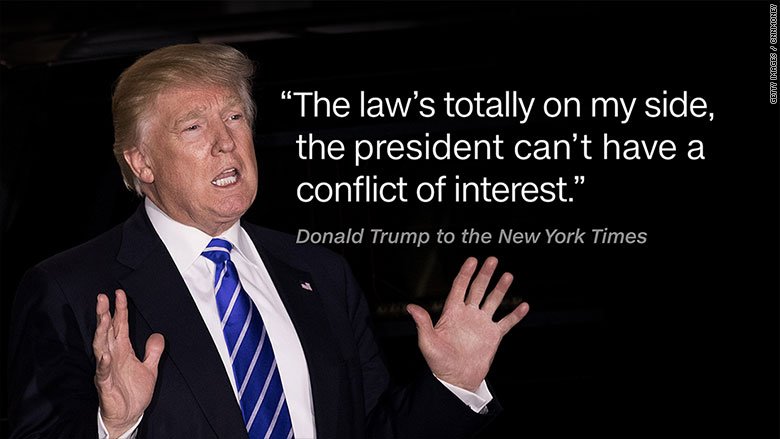
The move was supposed to free Trump of any conflicts of of interest
as he became president, or at least give the appearance that he’d done that.
Sheri Dillon, of the law firm Morgan Lewis, said at
the January press conference that Trump had asked her firm to design a
structure that would “completely isolate him from the management of the
company.”
As part of this arrangement no new foreign deals would be made while
Trump was president. New domestic deals would be allowed but would undergo
vigorous vetting, according to Dillon. Trump would limit how much information
about the business could be shared with him. And the Trump Organization,
through its social media and marketing materials, would not refer to Trump as
president.
Dillon also addressed the Emoluments Clause in the Constitution,
which is meant at a minimum to protect the American public from a foreign
government being able to bribe the president. Dillon argued that it could not
be construed to cover fair value goods or services, for example, paying one’s
bill at a Trump hotel. (Trump is now facing three Emoluments lawsuits that argue
these kinds of payments represent exactly the kind of foreign payments that the
Constitution sought to prohibit.)
Despite asserting that foreign governments’
spending money at Trump properties could not be considered an emolument, Dillon
said Trump would voluntarily donate all profits made from foreign government payments
to his hotels to the U.S. Treasury.
This was the ethics plan that Trump laid out for himself and his
family. It was meant to assure the public that Trump’s private business
interests would never overlap or influence his duties as president. His daughter,
Ivanka, and her husband, Jared Kushner, made somewhat similar arrangements for
themselves and their companies as they got ready to work in the White House.
While all three distanced themselves to some degree from the companies and
brands that carry their names, their financial stakes in the Trump and Kushner
business empires remain the same. As for Trump’s sons, they frequently attend
White House events and remain very much a part of the political scene
surrounding their father.
It has become difficult to track these conflicts of interest
stories as they often get drowned out by competing headlines. To help keep up,
below is an attempt at a master list. It’s not comprehensive, but it starts to
paint a picture of the vast number of issues that require oversight and
scrutiny during this presidency.




 That’s
what
That’s
what 
 The Trump administration is taking steps towards eliminating the White House Council on Women and Girls, according to a