Menu Bar

Home           Calendar           Topics          Just Charlestown          About Us

Friday, March 6, 2020

A simple way to keep workers – and the economy – from getting sick

Provide unemployment benefits to all workers affected by pandemics
Jay L. Zagorsky, Boston University
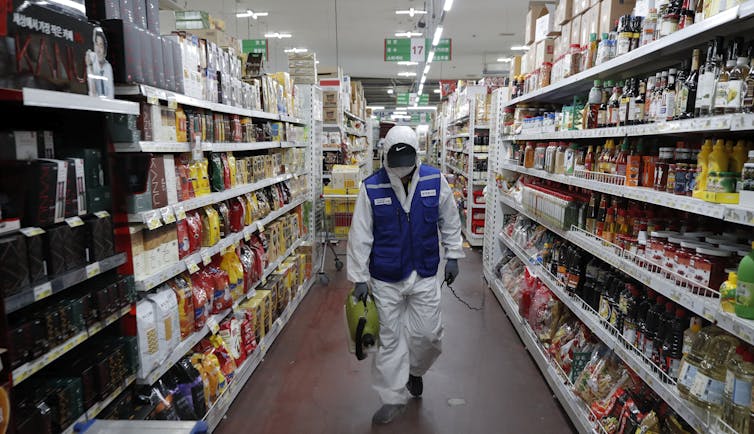

Wearing a mask may not be enough. AP Photo/Lee Jin-man 
The COVID-19 outbreak appears headed for the U.S., and the Centers for Disease Control and Prevention are urging Americans to prepare now, such as by stocking up on food and prescription drugs.

But since the U.S. economy and its workforce are also at risk of getting sick – a concern you can see in the recent stock market rout – it’s important to make preparations to ensure they stay healthy too.

While the Federal Reserve says it is carefully watching COVID-19’s “evolving” impact and will cut interest rates if necessary, this would primarily help banks and businesses. 

It would do relatively little to aid workers who might be temporarily without an income, which would hurt not only their families but the economy as well.

Fortunately, there’s a remedy: unemployment insurance – a topic I’ve written about in the past. Currently it’s not designed to help in a pandemic. 

But with a few easy changes, it could make a big difference, not only in softening the blow for workers and the economy but also in preventing the spread of COVID-19.

Workers are vulnerable

More than three-quarters of U.S. workers live paycheck to paycheck, while a significant share of American households would struggle with an unexpected US$400 expense.

If you are living this way, you have a strong incentive to go to work even when sick, which makes it easier for a disease like coronavirus to spread and increases the odds of an outbreak.

In addition, during a pandemic, health officials put large numbers of people in quarantines in hopes of preventing the virus’ spread. This temporarily shuts down businesses and puts hourly workers out of a job until it reopens.


Thursday, March 5, 2020

The only choice the insurance/medical industry gives you is “Take it or leave it”

The Big Lie about “health care choice”
Image result for nobody loves their health insuranceLyndon Johnson had a saying about special interests trying to get his support to pass some blatantly self-serving legislation: “They can’t make chicken salad out of chicken (bleep)!”

Yet chicken (bleep) is all that the corporate health complex has to work with as it frantically tries to defend its current system of mass malpractice. 

After all, as most Americans have learned the hard way, profiteering insurance giants, Big Pharma, and hospital chains grossly overcharge us while constantly trying to shortchange — or outright deny — care to millions of our families.

So, unable to win public support on their own merit, the corporatists and their hired political hacks are going all out to continue their gouging and keep control of America’s dysfunctional system.

They’re now running a multimillion-dollar PR and lobbying campaign of lies to trash and kill all reforms that would deliver quality, comprehensive care to everyone, at far less cost than they can deliver.

Masquerading as a “Partnership for America’s Health Care Future,” the profiteers warn ominously that such reforms as Medicare for All or a public option for health insurance would take away people’s “choice” and our “control” over health care.

Hello: we presently have no choice or control.


Hail to the Chief

Good thing somebody has one

A plan to save Earth's oceans
University of Queensland

ocean waves GIFAt least 26 per cent of our oceans need urgent conservation attention to preserve Earth's marine biodiversity, a University of Queensland-led international study has found.

Dr Kendall Jones said the international community needed to rapidly increase marine conservation efforts to maintain the health of the world's oceans.

"Preserving a portion of habitat for all marine species would require 8.5 million square kilometres of new conservation areas," Dr Jones said.

"Currently one-third of all marine species have less than 10 per cent of their range covered by protected areas.

"Conserving the areas we've identified in our study would give all marine species a reasonable amount of space to live free from human impacts like fishing, commercial shipping or pesticide runoff."

The authors mapped more than 22,000 marine species habitats and applied a mathematical approach to identify the minimum area required to capture a portion of each species range.

They also included areas of international importance for biodiversity (known as Key Biodiversity Areas), and areas where human impacts on the ocean are extremely low (known as marine wildernesses).

They found that the total ocean area required for conservation varied from 26-41 per cent, depending on the proportion of each species range conserved.

Key regions for conservation included the Northern Pacific Ocean near China and Japan, and the Atlantic between West Africa and the Americas.


Different strokes for different folks

Study of 418,000 Europeans finds different foods linked to different types of stroke
European Society of Cardiology

Image result for stroke
Mayo Clinic
Different types of food are linked to risks of different types of stroke, according to the largest study to investigate this, published in the European Heart Journal.

Until now, most studies have looked at the association between food and total stroke (all types of stroke combined), or focused on ischaemic stroke only. 

However, the current study of more than 418,000 people in nine European countries investigated ischaemic stroke and haemorrhagic stroke separately.

The study found that while higher intakes of fruit, vegetables, fibre, milk, cheese or yoghurt were each linked to a lower risk of ischaemic stroke, there was no significant association with a lower risk of haemorrhagic stroke. 

However, greater consumption of eggs was associated with a higher risk of haemorrhagic stroke, but not with ischaemic stroke.

Ischaemic stroke occurs when a blood clot blocks an artery supplying blood to the brain or forms somewhere else in the body and travels to the brain where it blocks blood flow. 

Haemorrhagic stroke occurs when there is bleeding in the brain that damages nearby cells. About 85% of strokes are ischaemic and 15% are haemorrhagic. Stroke is the second leading cause of deaths worldwide.


Trump Endorsed a Risky Antidepressant for Veterans.

Lawmakers Want to Know if His Mar-a-Lago Pals Had a Stake in the Drugmaker.
By Isaac Arnsdorf for ProPublica


Image result for Spravato and ketamineHouse Democrats are expanding their investigation of outside influence at the U.S. Department of Veterans Affairs, examining whether a push to use a new antidepressant from Johnson & Johnson was advanced by a group of unofficial advisers who convened at Mar-a-Lago, President Donald Trump’s private club.


The chairmen of the House veterans affairs and oversight committees sent letters last week asking for emails and financial records from the three advisers, Marvel Entertainment chairman Ike Perlmutter, physician Bruce Moskowitz and lawyer Marc Sherman. The Democrats are seeking, among other documents, any communications the men had with Johnson & Johnson and financial records showing whether they had any stake in the company.

As revealed by ProPublica in 2018, Trump gave the three men sweeping influence over the VA despite their lack of any relevant experience, such as having served in the U.S. military or government. VA officials called the trio the “Mar-a-Lago Crowd” because they met at the president’s getaway in Palm Beach, Florida.

Trump has enthusiastically endorsed a drug called Spravato, made by Johnson & Johnson, as a treatment to help prevent veterans from committing suicide. The federal government has faced criticism for not doing enough to curb suicides by veterans, which the VA says occur at a rate of 20 a day. 

While the problem has persisted for years, it gained more attention after a series of deaths in VA parking lots.

Through a spokesman representing all three men, Perlmutter, Moskowitz and Sherman said they had no role in the VA’s consideration of the Johnson & Johnson drug. They said they’re reviewing the committees’ request for documents. (The congressional committees have the power to issue subpoenas but usually start by asking for voluntary cooperation.)


Wednesday, March 4, 2020

Is Trump too insane to manage the coronavirus outbreak?

We’re Now In The Middle Of The Worst-Case Scenario
By Bandy X. Lee 

The moment we feared has come: in a real emergency, the president’s inability to stay with reality and to resist the need to conform the world to what is in his head will now result in a tangible loss of lives.  

People are asking: Is the president capable of functioning in a crisis?  

Why is the messaging more important than the actual job of protecting the country and responding to a health crisis?  

Why does he care more about looking or acting like a president than actually performing the job of president?  

In all these questions, there is an implicit assumption of mental capacity.

Almost three years ago, my colleagues and I embarked on publicly warning against the dangers of the president’s mental impairments because of our concerns for public health.  

As mental health experts, we found it important to inform that, when a president is mentally incapacitated, it becomes a matter of public health, with potential life-and-death consequences for whole populations.

Priorities, etc., etc.

Today's progressive comic.

Here's what quid pro quo looks like

Image may contain: 3 people, people standing, possible text that says 'September 19, 2019: Nancy Pelosi announces the Lower Drug Costs Now Act, a bill that aims follow through on one of Trump's unkept campaign promises: Medicare drug price negotiation. Later that day... McConnell declares the bill will have ZERO chance of passage in the GOP controlled Senate. Mitch McConnell, OCT- DEC 2019: Rakes in more than $50,000 in contributions from PACS and individuals tied to Big Pharma.'

They are not expendable

Threatened birds and mammals have irreplaceable roles in the natural world
University of Southampton

red panda lol GIF by LeVar Burton Kids
A species doesn't have to be cute to be important
A new study led from the University of Southampton has shown that threatened birds and mammals are often ecologically distinct and irreplaceable in their environment.

Mammals such as the Asian elephant and the Sumatran rhinoceros, and birds such as the great Indian bustard, Amsterdam albatross and the Somali ostrich are both highly threatened and ecologically distinct. 

The extinction of these species could therefore lead to the loss of unique ecological roles. The findings also highlight that the most distinct species are often charismatic, such as emperor penguins, wolves, sea-eagles and leopards.


Mix it up to stay sane

Variety and consistency are essential to keep the mind healthy
University of South Florida (USF Innovation)

donald trump GIF by Our Cartoon PresidentFor many adults, the mid-30's is a busy time. There's often career advancement, the start of a new family and associated responsibilities. 

It's also a critical time for how we diversify our days in order to stay up to speed. 

A new study from the University of South Florida (USF) finds a key piece to maintaining cognitive function throughout adulthood is to engage in diverse activities regularly.

Researchers focused on seven common daily activities: paid work, time with children, chores, leisure, physical activity, volunteering, and giving informal help. They reviewed two sets of data from 732 people ranging between the ages of 34 and 84 that was collected by the National Survey of Daily Experiences. 

Every day for eight consecutive days, each participant was asked if they partook in those activities and scored on an activity diversity score that captures both the breadth (variety) and evenness (consistency) of activity participation. 


Hospitals need to improve their infectious disease controls

U.S. Hospitals Say They’re Ready for Coronavirus. Their Infection Control Violations Say Otherwise.
By Marshall Allen, Caroline Chen, J. David McSwane and Lexi Churchill for ProPublica


 In early February, Royal Caribbean’s Anthem of the Seas docked in Bayonne, New Jersey, in need of a hospital. 

The cruise ship was carrying patients who had traveled from China, where an outbreak of COVID-19 had taken root. Four passengers needed to go somewhere for further medical observation.

The obvious next step was University Hospital in Newark, a major academic medical center equipped with isolation rooms. 

“The hospital is following proper infection control protocols while evaluating these individuals,” Gov. Phil Murphy said in a statement. The patients tested negative, but the governor was clear. The state’s first coronavirus cases would go to University.

That’s a hospital that has struggled in recent years with a critical skill essential to battling COVID-19: controlling the spread of infection.

Less than two years ago, a deadly bacteria made its way through the facility. Three babies in the neonatal intensive care unit got infected and died. 

Government inspectors cited the hospital for being short of staff; failing to maintain a sanitary environment, including improper hand hygiene and sterilization; and inadequately isolating patients with respiratory conditions. They determined the hospital had put patients in “immediate jeopardy.”


Tuesday, March 3, 2020

Paid sick leave would help Rhode Island stem the spread of infectious disease

Staying home when sick isn't an option for many low-wage workers
By Aaron Regunberg

Image result for stay home when you are sickThis weekend, the Governor announced there have been two positive cases of coronavirus detected here in Rhode Island. 

While the general risk for Rhode Islanders remains low (see RI Department of Health guidance here), we should take this public health threat seriously.

The good news? There is a very simple step our state could take to help contain the spread of COVID-19 -- by strengthening our paid sick days law to ensure that every single Rhode Islander is covered.

Helping to win paid sick days here in Rhode Island -- alongside Senator Maryellen Goodwin and hundreds of workers, business owners, and community members across our state -- was one of my proudest accomplishments in the General Assembly. 


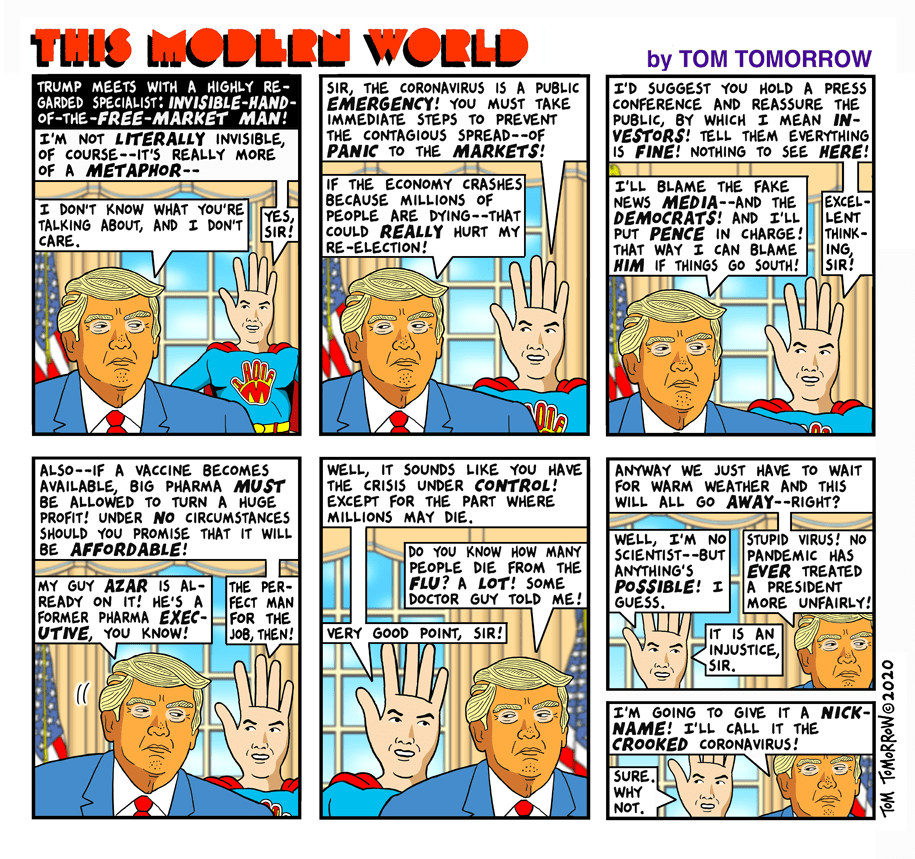
Trump consults an expert


For more cartoons from Tom Tomorrow, CLICK HERE. 

Unite, don't fight

Image may contain: stripes, possible text that says 'UNITE DON'T FIGHT VOTE BLUE NO MATTER WHO'