Menu Bar

Home           Calendar           Topics          Just Charlestown          About Us

Tuesday, October 6, 2020

Drowning

Our plastic planet

Peter Dykstra for Environmental Health News

It's always a challenge to find good news on the climate and environment beat. And we all desperately need a little more of the upbeat stuff right now.

So I apologize in advance for the following.

It's hard to ignore the looming mountain of plastics problems. Plastic pollution has been hiding in plain sight as the next eco-calamity for decades. With climate change teed up as the major global environmental challenge, let's take stock of another modern crisis.

Nurdle alert! 

My first encounter with nurdles was on what should have been a pristine Costa Rican beach in 1986. The lentil-sized, grayish pellets spread the sands for miles, along with a stunning number of shoes. I never figured out the source of the shoe spill, but nurdles eventually became a headline-maker in the oceans world.

Nurdles are the feedstock for much of the world's production of plastics products. If plastic things were pancakes, nurdles would be the batter. They're spilled from trucks, boxcars, and in the case of the Costa Rican beach, apparently a container ship. There are no firm statistics on how many spills there have been, or how many hundred of billions of virtually indestructible nurdles litter our beaches and seafloors.

One example: in 2017, 600 volunteers scoured 279 U.K. beaches, reporting that two-thirds of them were "littered" with nurdles.

We do know that nurdle pollution is the tip of the plastic pollution sh*tberg.

Stop talking!

 Conversation quickly spreads droplets inside buildings

 By John Sullivan This article is part of an ongoing series on COVID-19 Research and Service.

To study the flow of exhaled material, researchers filmed the movement of a mist of tiny droplets illuminated by a laser sheet in front of a person speaking several different phrases adjacent to the sheet. Photo composition by Princeton University.

With implications for the transmission of diseases like COVID-19, researchers have found that ordinary conversation creates a conical ‘jet-like’ airflow that quickly carries a spray of tiny droplets from a speaker’s mouth across meters of an interior space.

“People should recognize that they have an effect around them,” said Howard Stone, the Donald R. Dixon '69 and Elizabeth W. Dixon Professor of Mechanical and Aerospace Engineering at Princeton University. “It’s not just around your head, it is at the scale of meters.”

Although scientists have not yet fully identified the transmission mechanisms of COVID-19, current research indicates that people without symptoms could infect others through tiny droplets created when they speak, sing or laugh. Stone and co-lead researcher Manouk Abkarian, of the University of Montpellier in France, wanted to learn how widely and quickly exhaled material from an average speaker could spread in an interior space.

Housing prices decline within mile of solar energy arrays

‘We need to be smarter in siting solar installations’

Todd McLeish


A study of the impact of utility scale solar power installations on nearby housing prices by University of Rhode Island economists found that house prices within a mile of a Rhode Island or Massachusetts solar array declined by an average of 1.7%. Homes within a tenth of a mile of the installations declined by 7%.

Those are among the findings of a report issued today by Corey Lang, URI associate professor of natural resource economics, and doctoral student Vasundhara Gaur. They discussed their study last night as part of a virtual lecture series sponsored by the URI Cooperative Extension.

“Utility-scale solar energy has been growing in southern New England over the past several years, and while it’s a really good thing to transition away from fossil fuels, it also comes with a new set of challenges,” said Lang. “It has become a contentious land-use issue because solar arrays take up quite a bit of land per unit of energy produced.”

The biggest issue of contention between residents and solar developers is siting, according to Lang. The easiest and cheapest locations for installing solar arrays are on farmland and forested properties, and yet those are areas particularly prized by residents, who would prefer that the installations take place on previously developed properties.

Monday, October 5, 2020

Self-inflicted

We Shouldn’t Be Surprised That Trump Is Infected

By Terry H. Schwadron, DCReport Opinion Editor

That Donald and Melania Trump should test positive for what was described as relatively mild COVID-19 seems both sad and avoidable, the inevitable and ironic result of snubbing mask-wearing and physical distancing.

It is what it is, after all.

That the White House and the Trump campaign were not forthright about learning that close adviser Hope Hicks had been found infected and went ahead with fund-raisers and lots of contacts without taking precautions is reprehensible.

Amid calls for recovery were notes of open disbelief over whether the news as announced was true, questions about the First Couple’s medical status and a chaotic race to reach scores of people with whom Trump and Hicks had contact over the previous four days. Worry mounted about exactly how the government is functioning, as a result, to say nothing of the effects on elections.

The White House never acknowledged the Hicks contagion for at least a full day after learning of it. A bevy of others were exposed to the illness. People need to hold someone responsible.

Opponent Joe Biden tested negative after contact with Trump at the Tuesday debate, but three senators, the Trump campaign manager and head of the Republican National Committee, White House staffers and guests and three journalists at White House events are ill.

Through the day, as Trump was moved to Walter Reed Hospital, it sounded as if Trump was sicker than acknowledged. But then again, it was hard to tell: The White House is controlling closely the information.

Life inside a computer simulation

For more cartoons by Tom Tomorrow, CLICK HERE.


Don't care. Don't have to.


VIDEO: Decency

To watch this video on YouTube: https://www.youtube.com/watch?v=LpWKRFRizqg
 

Let's make a deal for $802,000

Green Development Settles with Coventry Over Solar Facility

By TIM FAULKNER/ecoRI News staff

The Coventry Department of Planning & Development issued Mark DePasquale two cease-and-desist orders in June 2019 for commencing the construction of a proposed ground-mounted solar facility in western Coventry without town approval. (Kevin LaRose/YouTube)

The town and a litigious renewable-energy developer have resolved their differences and are moving forward with a disputed ground-mounted solar facility.

The agreement will allow Green Development LLC to build a proposed ground-mounted solar project in western Coventry, and the town will receive $802,000. All claims and lawsuits instigated by either party have been dropped. The agreement also includes a mutual understanding by each party not to sue or participate in future litigation.

“I’m pleased to report we have resolved all ongoing disputes with Green Development without the costly burden of going to court,” Town Council president Kerry McGee is quoted as saying in a press release sent by Green Development. “The settlement is fair for all parties and it allows the town to move forward and secure a new revenue stream along the way.”

The saga of the originally proposed 5.22-megawatt solar array began in late 2016, when the North Kingstown-based developer was cited for destroying wetlands at the proposed project site.

VIDEO: Food Bank presentation on "Food Is Medicine"


Food is Medicine: 
Dietary & Policy Priorities to Leverage the Power of Nutrition Security

 The Rhode Island Community Food Bank recently hosted a virtual presentation by Dr. Dariush Mozaffarian who discussed the impact of nutrition insecurity on poor health in the United States. Dr. Mozaffarian is the Dean of the Friedman School of Nutrition Science & Policy at Tufts University. Click on the image below to watch the recording and learn more about the changes that are needed to facilitate healthy nutrition for all.


"Our Food is Killing too Many of Us" 

 Dr. Mozaffarian and Dan Glickman published an opinion piece in The New York Times highlighting the need to improve nutrition for all Americans. Click here to read their commentary to better understand the crisis and the proposed solutions.


Copyright © 2020 Rhode Island Community Food Bank, All rights reserved.

Our mailing address is:

Rhode Island Community Food Bank

200 Niantic Ave

Providence, RI 02907-3150

You paid more taxes than Donald Trump

 Now we know why Trump wants to hide his tax returns

By Chuck Collins 

My daughter, a librarian in Tucson, paid more taxes in 2017 than Donald Trump. So did my neighbor Rita, a teacher, and her son Tony, who stocks grocery shelves in Leland, Michigan

I also pay more in taxes than the president of the United States. And, probably, so do you.

We now understand why Trump was the first presidential candidate since the 1970s not to divulge his tax returns.

In 2016 and 2017, the billionaire paid just $750 each year in taxes to the U.S. Treasury. In 10 out of 15 years between 2001 and 2017, Trump paid zero taxes.

The average middle class household paid approximately three times as much in federal taxes as Trump did in 2017, an average of $2,200 based on an income of roughly $60,000. Any individual earning over $25,000 most likely paid more than the president.

It’s not that Trump wasn’t paying taxes at all. In 2017, Trump paid $156,824 in taxes in the Philippines and $145,500 in India. He just wasn’t paying them to support veterans, build roads, or protect seniors in this country.

The other secret Trump doesn’t want you to know is that his image as a wealthy successful business mogul is a mirage.

Sunday, October 4, 2020

The war of the Red against the Blue

 The Coming Civil War Over Trump’s Ego

By Robert Reich

Jeff Kowalski/AFP

What is America really fighting over in the upcoming election? No particular issue. Not even Democrats versus Republicans.

The central fight is over Donald J Trump.

Before Trump, most Americans weren’t especially passionate about politics. But Trump’s MO has been to force people to become passionate about him – to take fierce sides for or against. And he considers himself president only of the former – whom he calls “my people.”

Trump came to office with no agenda except to feed his monstrous ego. He has never fueled his base. His base has fueled him. Its adoration sustains him.

So does the antipathy of his detractors. Presidents usually try to appease their critics. Trump has gone out of his way to offend them. “I do bring rage out,” Trump unapologetically told journalist Bob Woodward in 2016.

In this way, he has turned America into a gargantuan projection of his own pathological narcissism.

His entire re-election platform is found in his use of the pronouns “we” and “them.” “We” are people who love him, Trump Nation. “They” hate him.

Priorities again


Trump 200000


“Don’t eyeball me!”

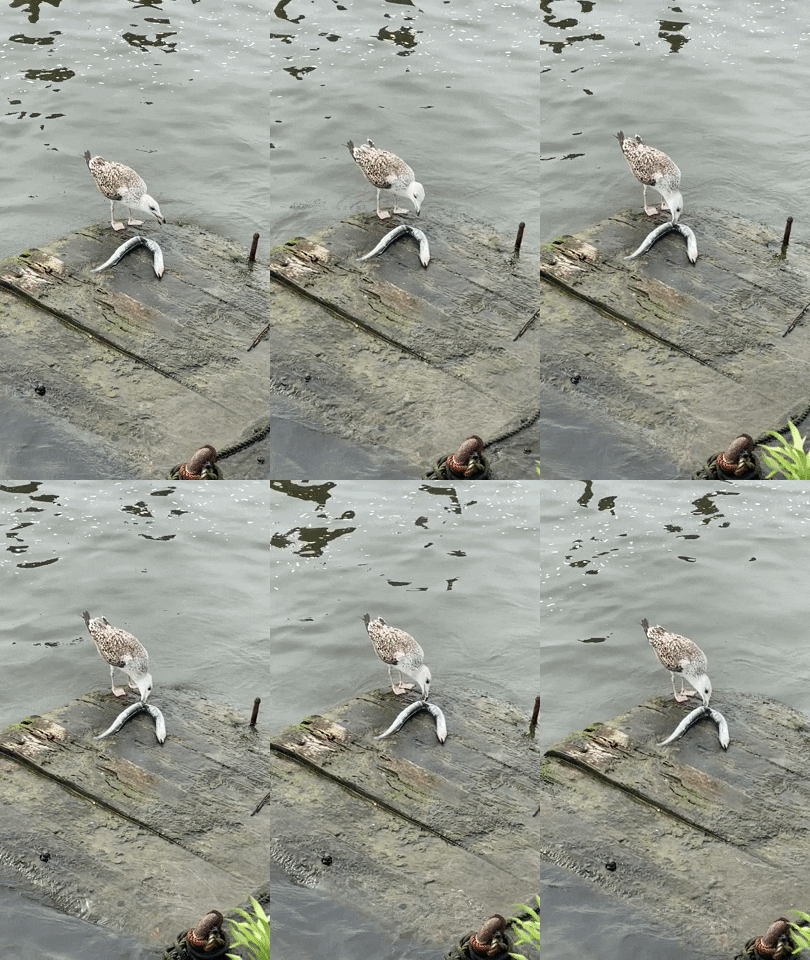
Herring Gulls Pay Attention to Human Gaze, New Study Finds
By Science News Staff / Source

Sea Life Eating GIF by Kimmy RamoneWith an increasing human population and expansion of urban settlements, wild animals are often exposed to humans.

As our species may be a threat, a neutral presence or a source of food, animals will benefit from continuously assessing the potential risk they pose in order to respond appropriately.

European herring gulls are increasingly breeding and foraging in urban areas, and thus have many opportunities to interact with humans.

Madeleine Goumas and her colleagues from the Centre for Ecology and Conservation at the University of Exeter recently found that these birds take longer to approach food when being watched by a human.

However, it is not known whether aversion to human gaze arises from experience with humans, and whether individual differences in responsiveness are a result of differential exposure.

In the new study, the researchers tested whether herring gulls’ responses to human gaze differ according to their age class and urbanization of their habitat.

Trump is being given an assortment of treatments for COVID-19

Here's what doctors know works against the virus 

With 74-year-old Donald Trump and 50-year-old first lady Melania Trump testing positive for the coronavirus, what are the best proven treatments for them and other patients?

We are both physician-scientists at the University of Virginia. We care for COVID-19 patients and conduct research to find better ways to diagnose and treat COVID-19.

Here we are sharing what physicians have learned over the past eight months treating various stages of this disease. 

Early in the year, there were few known treatments for people who showed severe COVID-19 symptoms apart from sustaining them on ventilators. Now, several months later, there are a handful of treatments, including drugs, that give doctors far better tools to heal patients, particularly very ill ones.

Who is at greatest risk for severe COVID-19?

Men are one-and-a-half times more likely to die, and an 80-year-old has a twentyfold greater risk of death than a 50-year-old. 

In addition to age and male gender, obesity; diabetes; recent cancer diagnosis; chronic heart, lung and liver disease; stroke; and dementia all are associated with an increased risk of dying from COVID-19. Based on these criteria, the president falls into a higher-risk category based on male gender and age.