Menu Bar

Home           Calendar           Topics          Just Charlestown          About Us

Sunday, November 28, 2021

Death of 1000 cuts: How Trump’s Appointees Continue to kill the Postal Service

But the Big Postal Unions Won’t Join the Effort to Force Trump hold-outs from Their Posts

By JOE MANISCALCO

The men Donald Trump handpicked to run the U.S. Postal Service into the ground continue to do The Don’s dirty work, intentionally slowing the mail and outsourcing vital services to private delivery companies. But the heads of the nation’s four postal service unions are too spellbound to react.

That’s the view of postal workers across the country who are seeing service standards deteriorate and privatization expanded under the watch of Postmaster General Louis DeJoy and Postal Service Board of Governors Chair Ron A. Bloom. And the postal workers want to give both men the boot. 

Last month, 77 public interest groups comprising the Save The Post Office Coalition signed a letter urging President Joe Biden not to extend Bloom’s term after it expires in December.

Notably absent from the appeal, however, were any of the four postal worker unions — American Postal Workers Union (APWU), National Association of Postal Mail Handlers Union (NPMHU), National Association of Letter Carriers (NALC) or the National Rural Letter Carriers Association (NRLCA). 

In March, 50 House Democrats called on Biden to can the entire board  — including Bloom — but NALC reportedly stepped in to throw cold water on the irate legislators. 

NPMHU spokesperson Katie Maddocks — the union representing more than 50,000 postal employees — concedes that her union’s priority is moving the Postal Reform bill forward and that the NPMHU, at least, wants to make sure that “if Mr. DeJoy is ousted, that won’t mess up our bill.”

Saturday, November 27, 2021

Why are we being screwed by inflation?

Price Gouging

By Phil Mattera for the Dirt Diggers Digest

Many of the increasingly clamorous inflation hawks are convinced that the main culprits behind the recent rise in prices are Congressional Democrats and the Biden Administration.

Other observers point to supply chain problems or escalating wage demands. Yet there has been surprisingly little focus on the parties responsible for actually setting most of the prices: large corporations.

That’s why it was refreshing to see a front-page article in the Wall Street Journal the other day that provided a more honest account of what is happening. Its headline was: “Inflation Helps Boost Profit Margins: Companies Seize Rare Opportunity to Increase Prices and Outrun their Own Rising Costs.”

The second part of that is the most significant: corporations are raising prices not only to cover their rising costs but well beyond. In other words, they are exploiting a crisis situation to fatten their bottom lines. There is a term for this: price gouging.

Companies such as high-end mattress producer Sleep Number and heating/cooling equipment manufacturer Carrier Corp., the Journal noted, have each pushed through three major price increases this year.

Over my dead body


Stop it before it spreads

By Clay Bennett, Chattanooga Times Free Press


Dec. 2: Live theatre at URI

URI Theatre investigates whodunit comedy with ‘Clue: On Stage’

Tony LaRoche


Riley Nedder (Mrs. White), Liam Roberts (Wadsworth), and Sydney Davey (Miss Scarlet), in “Clue: On Stage.” (URI photo by Jesse Dufault)

Was it Miss Scarlet in the conservatory with the rope or Col. Mustard in the billiards room with the candlestick?

Either way, Mr. Boddy probably won’t survive the night as the University of Rhode Island Theatre Department brings the whodunit, “Clue: On Stage,” to the Robert E. Will Theatre starting Thursday, Dec. 2.

“Clue: On Stage” is written by Sandy Rustin, based on the screenplay by Jonathan Lynn for the 1985 Paramount Pictures motion picture, with additional material by Hunter Foster and Eric Price and original music by Michael Holland. The cult classic film was, of course, based on the board game by Hasbro, which is sponsoring URI Theatre’s 2021-2202 season.

If you’ve played the game or seen the film, you know the basics. On a fittingly dark and stormy night, the usual suspects with colorful nicknames – Mrs. Peacock, Mrs. White, Prof. Plum, and Mr. Green, along with Scarlet and Mustard – are mysteriously summoned by Boddy to his mansion.

Don't get ripped off while shopping online

Here are 10 tips for avoiding scams

H. Colleen Sinclair, Mississippi State University

A little digging can help you avoid those too-good-to-be-true
traps when shopping online. martin-dm/E+ via Getty Images
Online shopping is already booming this holiday season. While last year’s big increase in holiday e-commerce due to the COVID-19 pandemic isn’t going to be repeated this time around, November and December online shopping is projected to top US$200 billion for the first time. And as online shopping increases, so do online scams.

Already, multiple companies from outside the U.S. are advertising relatively unchecked on the internet, selling – or even just pretending to sell – all manner of products. 

The items are typically advertised using designs stolen from legitimate businesses and artists, often ripped off from Etsy, especially if those designs have been featured on popular sites like Bored Panda.

When people buy these scam products, what arrives is typically of low quality. That’s if anything ever arrives. Often the company just shutters and renames itself without sending anything. In worst-case scenarios, they also steal customers’ credit card information.

So how to shop smart and spot scams? Here are some clues to watch for.

Women are more competitive when they’re given an option to share winnings

An approach that may help close the gender pay gap

Mary L. Rigdon, University of Arizona

Women may be more team-oriented than men. 
Delmaine Donson/E+ via Getty Images
The big idea

Women are more likely to take risks and engage in competitive activities if they’re allowed to share their potential winnings with peers, according to new research I co-authored. 

Since one explanation of the gender pay gap is that women tend to be less competitive than men in workplace settings, this finding could lead to ways to narrow it.

In a study published on Nov. 1, 2021, in the Proceedings of the National Academy of Sciences, Alessandra Cassar and I report an experiment in which we invited 238 undergraduate students – split almost evenly between men and women – into our labs to solve a simple numbers puzzle. 

We wanted to see how different types of financial incentives prompt men and women to compete differently. We randomly assigned them to groups of four and had them do versions of the puzzle over three rounds.

Researchers have conducted this experiment many times, with the result that women show less interest in competing than men. But we added a twist.

Friday, November 26, 2021

Is Qanon a tragedy, a danger, or a terrorist group?

Or is it all of the above?

By Thom Hartmann for the Independent Media Institute.

A significant number of Qanon followers, according to NBC News reporter Ben Collins, believe the end-point of their religion will be reached when Donald Trump takes back control of America, unleashes police to mass-arrest elected and other high-profile Democrats, and Qanon followers then engage in an orgy of violence and murder against Democratic Party-aligned neighbors, friends and family.  

Already, one believer has murdered two of his children, saying they had “serpent DNA” and had to be killed to save humanity.  There’s evidence that a majority of the people who stormed the US Capitol on January 6th, leading to more than a half-dozen deaths and nearly overthrowing our republic, were solidly within the Qanon cult.

This isn’t quite as weird as it sounds; mass death or even murder of unbelievers, often for political or “End of Days” rationales, is a familiar trope within multiple world religions.

Over the years I’ve spent a lot of time in Israel, which is frequently the target of evangelists trying to convert Jews in anticipation of the End Times. 

Many of these evangelists are quite upfront about their belief that in the end times, in preparation for the return of Jesus, all but 144,000 of the roughly 7 million Jews in Israel must die. 

And those who survive will all be converted to Christianity and “wear the names of the Father and Son on their foreheads throughout eternity.” When that happens, Jesus comes down from the sky.

It’s a belief that millions of Christians — and a solid majority of white Evangelicals — fervently hold, and one of the reasons why there’s so much support for Israel among the Republican white Evangelical movement: that’s where the mass death has to happen to bring back Jesus. 

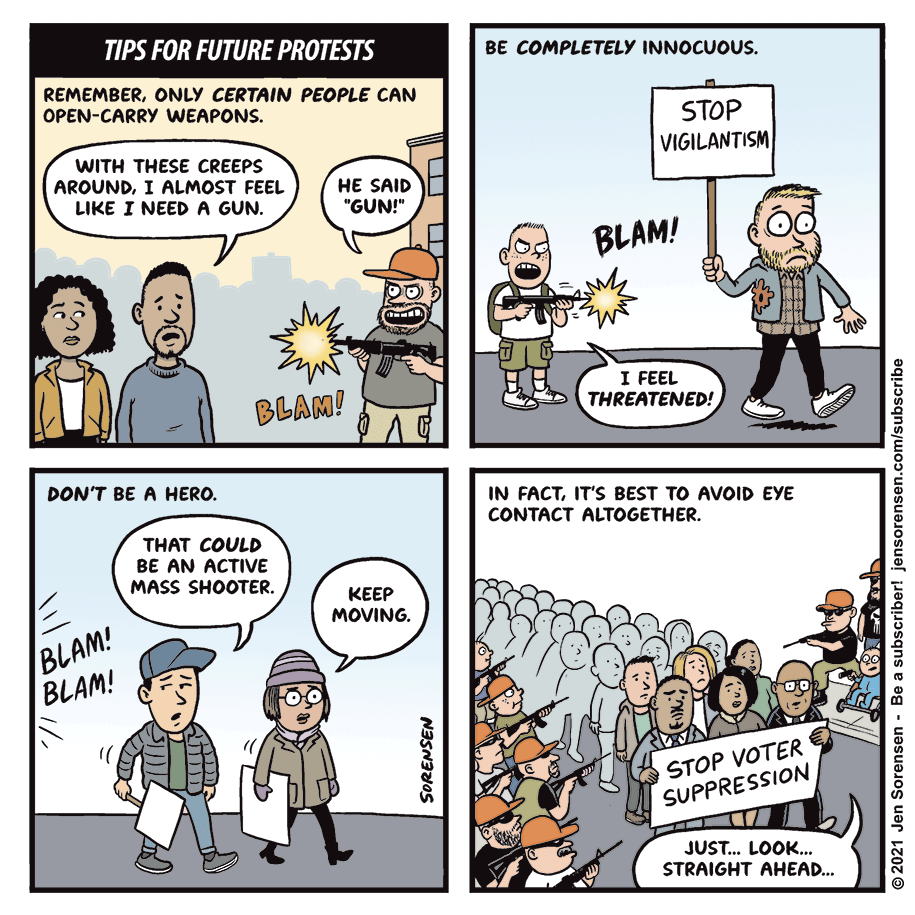
Rittenhouse Rules: tips for future protests

For more cartoons by Jen Sorenson, CLICK HERE.


The threat we face


Scary new COVID variant has researchers worldwide scrambling for answers

The hunt for coronavirus variants: how the new one was found and what we know so far

Prof. Wolfgang Preiser, Stellenbosch University; Cathrine Scheepers, University of the Witwatersrand; Jinal Bhiman, National Institute for Communicable Diseases; Marietjie Venter, University of Pretoria, and Tulio de Oliveira, University of KwaZulu-Natal

Scientists find variants by sequencing samples from people
that have tested positive for the virus. Lightspring/Shutterstock
Since early in the COVID pandemic, the Network for Genomics Surveillance in South Africa has been monitoring changes in SARS-CoV-2. This was a valuable tool to understand better how the virus spread. 

In late 2020, the network detected a new virus lineage, 501Y.V2, which later became known as the beta variant. 

Now a new SARS-CoV-2 variant has been identified, known as B.1.1.529. To help us understand more, The Conversation Africa’s Ozayr Patel asked scientists to share what they know.

What’s the science behind the search?

Hunting for variants requires a concerted effort. South Africa and the UK were the first big countries to implement nationwide genomic surveillance efforts for SARS-CoV-2 as early as April 2020.

Variant hunting, as exciting as that sounds, is performed through whole genome sequencing of samples that have tested positive for the virus. This process involves checking every sequence obtained for differences compared to what we know is circulating in South Africa and the world. 

When we see multiple differences, this immediately raises a red flag and we investigate further to confirm what we’ve noticed.

Fortunately South Africa is well set up for this. This is thanks to a central repository of public sector laboratory results at the National Health Laboratory Service, (NGS-SA), good linkages to private laboratories, the Provincial Health Data Centre of the Western Cape Province, and state-of-the-art modelling expertise.

In addition, South Africa has several laboratories that can grow and study the actual virus and discover how far antibodies, formed in response to vaccination or previous infection, are able to neutralise the new virus. This data will allow us to characterise the new virus.

Viruses on a white background
3d Variants of Covid-19 Virus (Sars-COV-2). Alpha, Beta, Gamma, Delta in white background. Shutterstock

The beta variant spread much more efficiently between people compared to the “wild type” or “ancestral” SARS-CoV-2 and caused South Africa’s second pandemic wave. It was therefore classified as a variant of concern. During 2021, yet another variant of concern called delta spread over much of the world, including South Africa, where it caused a third pandemic wave.

Very recently, routine sequencing by Network for Genomics Surveillance member laboratories detected a new virus lineage, called B.1.1.529, in South Africa. Seventy-seven samples collected in mid-November 2021 in Gauteng province had this virus. It has also been reported in small numbers from neighbouring Botswana and Hong Kong. The Hong Kong case is reportedly a traveller from South Africa.

Whether B.1.1.529 will be classified as a variant of interest or of concern, like beta and delta, has not been decided by the World Health Organization yet. We expect that it will be given a Greek name soon.

Coffee and Tea Linked With Reduced Rates of Stroke and Dementia

 Here’s How Much To Drink

By  

Drinking coffee or tea may be associated with a lower risk of stroke and dementia, according to a study of healthy individuals aged 50-74 published on November 16th, 2021, in the open-access journal PLOS Medicine. Drinking coffee was also associated with a lower risk of post-stroke dementia.

Strokes are life-threatening events that cause 10 percent of deaths globally. Dementia is a general term for symptoms related to decline in brain function and is a global health concern with a high economic and social burden. Post-stroke dementia is a condition where symptoms of dementia occur after a stroke.

Yuan Zhang and colleagues from Tianjin Medical University, Tianjin, China studied 365,682 participants from the UK Biobank, who were recruited between 2006 and 2010 and followed them until 2020. At the outset participants self-reported their coffee and tea intake. Over the study period, 5,079 participants developed dementia, and 10,053 experienced at least one stroke.

Treat retail workers with respect

Grocery workers suffer the mental health effects of customer hostility and lack of safety in their workplace

Brian Mayer, University of Arizona; Melissa A. Barnett, University of Arizona; Mona Arora, University of Arizona, and Sabrina V. Helm, University of Arizona

Many grocery store workers have experienced high rates of
anxiety and depression during the pandemic. 
Ben Hasty/MediaNews Group/Reading Eagle via Getty Images
With the holiday season here, consumers are understandably desperate for a “normal” holiday season. For many, that includes big family dinners and Black Friday shopping sprees.

Retail and service sector workers have been laboring to keep shelves stocked and customers happy from the earliest days of the COVID-19 pandemic. Life on the front lines has been exceptionally stressful for these employees. 

Suddenly, they found themselves identified as “essential workers,” providing critical services while working in close contact with customers and coworkers. But unlike health care workers, grocery store employees had no prior experience or training in combating infectious diseases.

Early in the pandemic, the public celebrated grocery workers. They were hailed as “heroes” who were risking their lives for the benefit of their local communities. Billboards and the nightly news reminded the public to show kindness and compassion to store workers.

Major grocery chains initially offered their employees a “"hero bonus,” but that quickly went away. Many grocery workers soon felt forgotten as businesses and customers adjusted to the new normal.

We are a team of researchers from the University of Arizona with expertise in worker health, retail marketing, human development and public health. We have been following the impacts of the pandemic on grocery workers across the state of Arizona.

Our research and that of others show that rates of mental health distress among grocery workers are very high. In a newly published study, we reported that 20% of employees working in Arizona grocery stores in the summer of 2020 exhibited signs of severe anxiety and depression. And the mental health struggles of these workers do not show much improvement since we began our research in summer 2020.

Thursday, November 25, 2021

How US elections get stolen

Will You Storm the Capitol if the 2024 Election is Stolen?

By Thom Hartmann for the Independent Media Institute

We’re demonizing the wrong people.

This is not a call to “understand” or “have compassion” for Trump voters.  Instead, it’s a call for a wholesale political and social indictment of Trump’s Big Lie, along with every elected Republican politician or media member who knows Trump lost but keeps perpetuating that Lie.

If we fail, history may repeat itself and — this time — the result will be far worse than Bush’s lying us into two wars and privatizing Medicare. 

That, in part, is because numerous Republican-controlled states are passing laws and gaming out scenarios that could enable a repeat of a variation on the election of 1876: if GOP-controlled swing states submit multiple slates of electors denying either candidate 270 uniquely certified Electoral College votes, the election could again get thrown to the House of Representatives (as was the election of 1800, too), where Trump (or another neofascist Republican) would win.

Democrats tend to forget that Donald Trump received about 10 million more votes in 2020 than he did in 2016. It’s why he’s still a potent political force in America and around the world.

Although Biden got around 7 million more votes than Trump and overwhelmingly won the popular (and Electoral College) votes, Trump’s raw-numbers electoral popularity actually went up at the end of the 4 years of his presidency. 

Those Trump voters — from the people who stormed the Capitol on January 6th to the folks who just quietly showed up at the polls and never mentioned anything political to neighbors, friends or relatives — believed he was the best guy for the presidency.

And today, about three-quarters of them (76%) also now believe that his presidency was stolen from him in 2020.  

Consider, for a moment, if the tables were reversed: 

It’s 2024 and President Biden and Donald Trump just faced off in the election. Biden wins the popular vote by over 10 million, but the Electoral College vote is up in the air because of a weird constitutional technicality.

Just like in the election of 1876, several swing states in the midst of political turmoil have submitted dueling slates of electors, one (based on the popular vote) for Biden and another (reflecting the will of the state legislature) for Trump.  And, just like in 1876, when you exclude the “contested states” neither candidate hits the 50%-plus-one electoral votes needed (now 270) to win the White House.

Under the 12th Amendment, as John Eastman pointed out in his 2020 memo to Trump (and echoed by Jenna Ellis and Mark Meadows), that throws the election to the House of Representatives, where each state has one single vote, that vote being decided by each state’s legislature back home.  Thirty states are Republican controlled and submit their 30 votes for Trump, with Biden receiving the remaining 20: the House declares the election goes to Trump.

Democrats immediately sue before the Supreme Court, but — for the second time in history — the Court awards the presidency to the Republican who lost the popular vote amid a contested Electoral College vote.

Trump, say the Republicans in Congress and on the Court, is to be sworn in as president a few weeks after the votes are certified on January 6th, 2024.  

But President Biden calls a press conference to tell the nation that the states that submitted dual ballots were behaving with corrupt intent just to allow this very scenario to play out. 

“Trump and his Republican allies used a technicality in our Constitution and law to claim they won an election they very clearly lost,” Biden says.  “Americans shouldn’t stand for this!”

All across the country, people begin pouring into the streets.  Pitched battles break out between Trump and Biden supporters, as cities are set afire and hundreds die from gunshots.

What do you do?

This would be, after all, the fourth time Republicans have tried to use this same strategy to bring a presidential election around to themselves on their own terms, and the first two out of three times they were successful. 

How Republicans Pulled It Off In 1876

The first was the election of 1876, when the Republican who lost that election (both popular and Electoral College), Rutherford B. Hayes, was nonetheless installed as president by the House of Representatives in March, 1877.

Democrat Samuel Tilden won the popular vote nationwide but, with 184 electoral votes, was one vote short of the then-necessary 185 electoral votes to become president.

Republican Rutherford B. Hayes not only lost the popular vote but had only 163 uncontested electoral votes. (He was sold to voters as an antidote to the Radical Republicans like Thaddeus Stevens who’d worked so hard to bring formerly enslaved people into politics. White supremacists were rising again…in both parties.) 

"All politics is local"

By Marc Murphy, Louisville Courier-Journal