Menu Bar

Home           Calendar           Topics          Just Charlestown          About Us

Thursday, March 3, 2022

Let your grassy lawn go

Transforming Lawn into Meadow Benefits Everyone: ‘Your Garden Comes to Life’

By CYNTHIA DRUMMOND/ecoRI News contributor

Mini meadows that replace lawns benefit pollinators and act as carbon sinks. (American Meadows)

Garden designer Owen Wormser describes lawns as “something of a national obsession.” In his 2020 book, “Lawns into Meadows,” he writes about the proliferation of lawns in America and the resources spent on maintaining them.

“This massive footprint makes lawns the biggest irrigated crop in the continental United States, and it sucks up an outsized amount of fossil fuels, fertilizer, chemicals and water,” he writes.

As an alternative to a monoculture of turf grass, Wormser proposes a meadow, which not only benefits pollinators, but also acts as a carbon sink.

A meadow is “what can happen when you give the earth a chance to heal itself,” he writes. “With every year in the ground, meadow plants support more life and build healthier soil. This makes them quite efficient at parking carbon — just the opposite of a resource-guzzling lawn.”

With Wormser and others, such as entomologist Douglas Tallamy, writing about the connections between home landscapes and surrounding ecosystems and the importance of wildlife and pollinator corridors, more homeowners are converting areas of their lawns to meadows.

Some meadows contain a mix of natives and both annual and perennial cultivars, while others have only native plants.

EDITOR'S NOTE: I let the small sections of lawn go to meadow last year and was surprised at the result. I saw monarchs sipping from wild flowers for the first time in years and lots of bees. It cost nothing, either in cash or sweat, and the rewards were, frankly, surprising.  The bunnies loved it. - Will Collette

Low-meat and meat-free diets associated with lower overall cancer risk

Bad news for weat lovers

BMC (BioMed Central)

Charlestown's state Rep. Flip Filippi loves his cows and wants everyone
to eat them regardless of any health or environmental consequences.
Eating meat five times or less per week is associated with a lower overall cancer risk, according to a study published in the open access journal BMC Medicine.

Cody Watling and colleagues from the University of Oxford, UK investigated the relationship between diet and cancer risk by analysing data collected from 472,377 British adults who were recruited to the UK Biobank between 2006 and 2010. 

Participants, who were aged between 40 and 70 years, reported how frequently they ate meat and fish and the researchers calculated the incidence of new cancers that developed over an average period of 11 years using health records. 

They accounted for diabetes status and sociodemographic, socioeconomic and lifestyle factors in their analyses.

 247,571 (52%) of participants ate meat more than five times per week, 205,382 (44%) of participants ate meat five or less times per week, 10,696 (2%) ate fish but not meat, and 8,685 (2%) were vegetarian or vegan. 54,961 participants (12%) developed cancer during the study period.

The researchers found that the overall cancer risk was 2% lower among those who ate meat five times or less per week, 10% lower among those who ate fish but not meat, and 14% lower among vegetarians and vegans, compared to those who ate meat more than five times per week. 

Why the cost of mitigating climate change can’t be boiled down to one right number

"Known unknowns"

Matthew E. KahnUSC Dornsife College of Letters, Arts and Sciences

Renewable energy prices have fallen faster than predicted. 
ImageBROKER/Lilly
Back in November 2019, before the pandemic began, would you have guessed how important video conferencing like Zoom would be in people’s lives just a few months later?

That’s the kind of challenge economists face when they try to put a single number on the long-term cost of mitigating climate change or the cost of allowing global temperature to keep rising. Human behaviors shift as public policies change and new technology arrives and evolves.

I am a microeconomist who investigates the causes and consequences of climate change. When I think about the climate change challenge in 2040 and beyond, I anticipate many “known unknowns” about our future. Thus, I am amazed to read precise climate cost estimates like those recently published by economic consultants McKinsey & Co.

McKinsey pegs the global cost of transitioning energy and other sectors to net-zero emissions by 2050 at US$9.2 trillion a year. The insurer Swiss Re has estimated that doing nothing will cut global GDP by as much as 14%, or about $23 trillion, by 2050.

Numbers like these are widely used to encourage action by governments, companies and individuals. Economists agree that climate change, left unchecked, will harm economies. But these estimates are produced using formal models that feature many assumptions, any one of which could throw off the accounting in a big way, leaving the estimates either wildly high or low.

While people might think they want “precision,” precise predictions raise the risk of conveying too much certainty in a constantly changing world. Here’s what goes into climate economic models and why certainty isn’t an option for future cost projections.

Wednesday, March 2, 2022

When you run out of COVID things to complain about

There's always something else

By Will Collette

Now that our accidental Gov. Dan McGee has virtually eliminated COVID masking and vaxxing mandates, what's left for right-wing nuts to complain about?

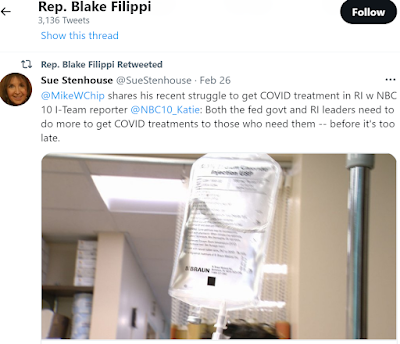
Well, plenty. Our embarrassment of a state representative Blake "Flip" Filippi, re-tweeted a post about the travails of fellow Trumplican Mike Chippendale (R-Coventry, Foster, Gloucester, No School) in getting the COVID treatment of his choice.

Chippendale has flown his wingnut flag high, rejecting masking whether mandated or not as well as being vaccinated. Predictably, he caught a very bad case of COVID in December. 

Chippendale told right-wing Sinclair Broadcasting Channel 10 News: "I had a 104 fever, and my oxygen was in the high 70s, low 80s." Oxygen levels should be in the mid to high 90s. 

Chippendale wanted to be treated with monoclonal antibodies, one of the few not-crazy treatment choices of many anti-vaxxers. But his treatment was delayed because of short supplies of the desired drugs. He was lucky to find a supplier who had some and pulled through.

The maskless guy with the beard who is looking lovingly at Filippi is
Mike Chippendale (Boston Globe)
He nearly died while he was taking up time and medical resources seeking treatment for a disease he could have prevented if he wasn't an idiot. 

If he had gotten the safe, effective and free vaccine, he would probably have been spared this ordeal. But, you know, freedom.

Trumplican Sue Stenhouse, whose tweet Filippi re-tweeted, complained that the federal and state leaders need to get more COVID treatment drugs out there. Well, maybe. 

Yes, I am all in favor of proven COVID treatment for those who are sick through no fault of their own. But anti-vaxxers? They can wait in the back of the line and wash some invermectin down with bleach while they wait.

Not surprisingly, Chippendale had nothing to say to Channel 10 about his choice to refuse to get vaccinated. No remorse, no regrets. He may have gotten the treatment he needed for his COVID before it killed him, but unfortunately, there is no cure for stupid.

Filippi too has taken a hardline against mandates and to railing against the Governor retaining any emergency powers even though we could see another surge once everyone stops masking and many remain unvaccinated. 

Flip has been adamant about refusing to reveal his vaccination status which, to me, is the equivalent of admitting he isn't. 

Even though the mandates are gone, COVID isn't. In many of my COVID stories, I have noted that Rhode Island's COVID transmission rate was down to 14 per 100,000 on the Fourth of July when many of us thought the pandemic was over.

Now, after a huge spike, Rhode Island's are back down and, as of March 2, our transmission rate is 125 per 100,000. That's good news compared to the scale of infection during the Omicron surge (3,000+), but is almost one hundred times higher than it was last Fourth of July.

Personally, I am not changing my anti-COVID routine even though gutless Gov. Dan McGee has once again sounded an "all clear." I plan to continue to mask up and stay away from crowds and venues where COVID is still spreading. 

A little history


Lost in translation


They're such a class act


Singing in the brain

Still no cure for the deadly earworm

Massachusetts Institute of Technology

For the first time, MIT neuroscientists have identified a population of neurons in the human brain that lights up when we hear singing, but not other types of music.

These neurons, found in the auditory cortex, appear to respond to the specific combination of voice and music, but not to either regular speech or instrumental music. Exactly what they are doing is unknown and will require more work to uncover, the researchers say.

"The work provides evidence for relatively fine-grained segregation of function within the auditory cortex, in a way that aligns with an intuitive distinction within music," says Sam Norman-Haignere, a former MIT postdoc who is now an assistant professor of neuroscience at the University of Rochester Medical Center.

The work builds on a 2015 study in which the same research team used functional magnetic resonance imaging (fMRI) to identify a population of neurons in the brain's auditory cortex that responds specifically to music. In the new work, the researchers used recordings of electrical activity taken at the surface of the brain, which gave them much more precise information than fMRI.

In case you're looking for a new pet

Ticks survive for 27 years in entomologist's lab

by Binghamton University

Food is necessary for survival, but an East African species of ticks adapted to survive without feeding for eight years. Not only did they live for a total of 27 years, but they healthily reproduced long after the last male tick died.

Julian Shepherd, associate professor of biological sciences, discovered the longevity and reproduction abilities of the Argas brumpti after running out of a suitable food source for the species

He received the ticks as a gift in 1976 and decided to observe them in his lab in a habitat with stable conditions. Little did he know the original group of ticks would survive until the next century, with offspring alive and reproducing today.

The more commonly known species of ticks have a hard plate in their skin, but Argas brumpti have soft and leathery skins. Besides their shells, the biggest difference between the two are their eating patterns. A. brumpti ticks bloat less, eat faster and eat more frequently. 

When Shepherd no longer had lab rabbits, mice and rats for the ticks to feed on, the A. brumpti's ability to survive with longer breaks in between meals turned out to be more significant than he first realized.

After 45 years of researching the ticks, Shepherd published his findings in the Journal of Medical Entomology. In the paper, "Record Longevity and Reproduction of an African Tick, Argas brumpti," Shepherd observed the record adaptability and survival of the tick.

How much damage could a Russian cyberattack do in the US?

They've hit us before - will they do it again and how bad might it get?

Scott JasperNaval Postgraduate School

Hackers can get eyes inside systems that are supposed to be secure. Yuichiro Chino via Getty Images


U.S. intelligence analysts have determined that Moscow would consider a cyberattack against the U.S. as the Ukraine crisis grows.

As a scholar of Russian cyber operations, I know the Kremlin has the capacity to damage critical U.S. infrastructure systems.

Federal officials have been bracing for this. In January 2022 the U.S. Cybersecurity and Infrastructure Security Agency issued an alert that outlined the Russian cyberattack threat, with technical details of sophisticated Russian-led hacking from recent years. 

That included a complicated digital break-in that targeted the U.S. energy industry and gained access to the control rooms of U.S. electric utilities. According to Homeland Security officials, the hackers “could have thrown switches” and knocked out power to the public – but did not.

In mid-February 2022, federal cybersecurity experts met with executives from big U.S. banks to discuss defenses against Russian hacking attempts.

Tuesday, March 1, 2022

Should they be allowed to drive?

Time to Look under the Hood

By Stephen Hoff, CPA

This article originally appeared as a letter to the Westerly Sun and is re-printed here with the author’s permission.

A little knowledge is a dangerous thing when it is held by a majority of the Charlestown Town Council.  

This was recently demonstrated when they refused to acknowledge that the most recent $3 million “oops” problem actually exposed a serious breach of internal financial controls within the Town’s financial management system. 

The CCA’s Steering Committee doubled down on their lack of knowledge with February 24’s letter to the editor of The Sun titled, “Truth Missing In Charlestown’s Savings Allegations” written by Ruth Platner, also known as “Where have all the cars gone?”  

Their letter also states that Charlestown’s fund balance is essentially the Town’s savings and resembles multiple cars parked in different garages around town. Really?  If that is the CCA’s intellectual response to the $3 million “oops” then Charlestown taxpayers better buckle up our seatbelts while at the same time keeping a firm hand on the cash in our wallets.  As their letter literally states, “$3 million is not missing; it is parked in the garage.”  

Total Fund Balance is “not” simply the Town’s savings as they stated.  Only 53% of it is, the Unassigned Fund Balance portion $5.8 million.  And that $5.8 million can now be spent on emergencies, more long lived capital projects, or transferred to other garages around Town.  

And if you really want to be technical, which they don’t, the Town has additional liabilities previously incurred that have never been funded that would wipe out the full $5.8 million if paid. 

By the numbers

28% ($3 million) of total Fund Balance was spent during the current year and is now gone “oops”.

6% ($0.7 million) of it is for Severance expenses already incurred.   We still owe another 5% that has never been funded.  

Another 6% ($0.7 million) has either been specifically allocated for expenditure or deemed un-spendable by the auditors.  

Only 7% ($0.7 million) is set aside for risks identified in the Government FinanceOfficer’s Association core risk analysis study. 

The CCA letter continues to beat the car analogy into the ground stating that while their car is not still in the driveway but in a garage somewhere, it is still available to drive to work and that it still has the same value.  Absolute poppycock.  

Their car was sold in the current year budget for cash to pay for 2 long lived building projects that would have been bonded if the Town had been able to simply balance its own checkbook which is understandably difficult when you forget how much in Unassigned Funds you really have to spend.  

I am a CPA and you can take my numbers to the bank, but not so much the theoretical $3 million parked in someone else’s garage that supposedly still has value. 

Owning the Libs

For more cartoons by Tom Tomorrow, CLICK HERE.


What did they do?


Bye, Bye ISS?

Russian invasion of Ukraine and resulting US sanctions threaten the future of the International Space Station

Wendy Whitman CobbAir University

The International Space Station is run collectively by the U.S., Russia, the European Space Agency, Japan and Canada. NASA Marshall Spaceflight Center/FlickrCC BY-NC-SA
New U.S. sanctions on Russia will encompass Russia’s space agency, Roscosmos, according to a speech U.S. President Joe Biden gave on Feb. 24, 2022.

In response to these sanctions, the head of Roscosmos on the same day posted a tweet saying, among other things, “If you block cooperation with us, who will save the ISS from an uncontrolled deorbit and fall into the United States or Europe?”

The International Space Station has often stayed above the fray of geopolitics. That position is under threat.

Built and run by the U.S., Russia, Europe, Japan and Canada, the ISS has shown how countries can cooperate on major projects in space. The station has been continuously occupied for over 20 years and has hosted more than 250 people from 19 countries.

As a space policy expert, the ISS represents, to me, a high point of cooperation in space exploration. But for the current crew of two Russians, four Americans and one German, things may be getting worrisome as tensions rise between the U.S. and Russia.

Several agreements and systems are in place to make sure that the space station can function smoothly while being run by five different space agencies. As of Feb. 24, there were no announcements of unusual actions aboard the station despite the ongoing Russian invasion of Ukraine. But the Russian government has brought the ISS into geopolitics before and is doing so again.

Fake viral footage is spreading alongside the real horror in Ukraine.

Here are 5 ways to spot it

T.J. Thomson, Queensland University of Technology; Daniel Angus, Queensland University of Technology, and Paula Dootson, Queensland University of Technology

Screenshot of fake news TikTok video
Old footage, rebadged on TikTok as the latest
 from Ukraine.
 TikTok
Amid the alarming images of Russia’s invasion of Ukraine over the past few days, millions of people have also seen misleading, manipulated or false information about the conflict on social media platforms such as Facebook, Twitter, TikTok and Telegram.

One example is this video of military jets posted to TikTok, which is historical footage but captioned as live video of the situation in Ukraine.

Visuals, because of their persuasive potential and attention-grabbing nature, are an especially potent choice for those seeking to mislead. Where creating, editing or sharing inauthentic visual content isn’t satire or art, it is usually politically or economically motivated.

Disinformation campaigns aim to distract, confuse, manipulate and sow division, discord, and uncertainty in the community. This is a common strategy for highly polarised nations where socioeconomic inequalities, disenfranchisement and propaganda are prevalent.

How is this fake content created and spread, what’s being done to debunk it, and how can you ensure you don’t fall for it yourself?