Menu Bar

Home           Calendar           Topics          Just Charlestown          About Us

Tuesday, September 6, 2022

Trump faces possible obstruction of justice charges for concealing classified government documents

What Trump did and why he might be indicted for it

Clark D. CunninghamGeorgia State University

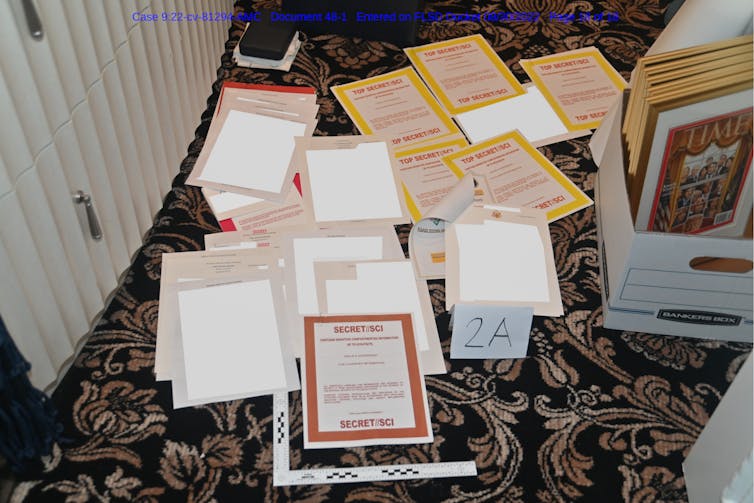
A Department of Justice photo shows of documents seized during its Mar-a-Lago search. Department of Justice via Associated Press

A court filing by the Justice Department just minutes before midnight on Aug. 30, 2022, was a sharply worded attack on FPOTUS Donald Trump’s request for a so-called “special master” – a neutral arbiter – to review the documents the FBI seized at his estate, Mar-a-Lago, earlier in the month.

Bottom line: The Justice Department says the documents don’t belong to Trump and says someone has deliberately concealed documents marked classified from a federal grand jury investigation. The department has not yet publicly stated who they believe is guilty of this crime – whether Trump himself, members of his team, or both.

In the filing, the Justice Department wrote, “The government also developed evidence that government records were likely concealed and removed from the Storage Room and that efforts were likely taken to obstruct the government’s investigation.”

This latest revelation has prompted observers to say that obstruction of justice charges are at stake. But that’s a broad term that covers many wrongful acts. The specific crime at issue here is obstructing a federal investigation.

The Conversation asked Georgia State University legal expert Clark Cunningham, an authority on search warrants, to describe the meaning of obstruction, and why Trump may be charged with this crime.

The crime of obstruction, and a particular version of it

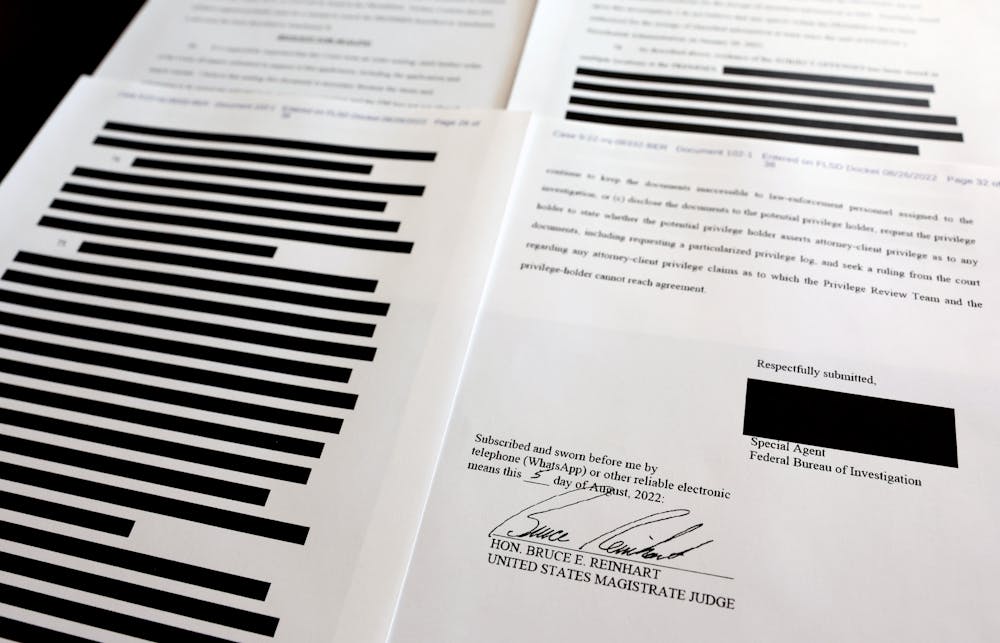
White pages are shown with text, much of it blacked out.
Pages from the FBI’s redacted search warrant affidavit for FPOTUS
Donald Trump’s Mar-a-Lago estate are shown.
 Mario Tama/Getty Images
There are 21 different federal crimes that involve obstruction of justice. One of the obstruction laws, called Section 1519, is violated if someone “knowingly conceals any document with the intent to obstruct” – or block – a federal investigation. That’s obstruction of a federal investigation, and conviction for this crime can result in up to 20 years of prison.
For example, Jesse Benton, who managed Ron Paul’s 2012 presidential campaign, was convicted of violating Section 1519 when he concealed improper campaign payments from the Federal Election Commission. Trump later pardoned Benton in December 2020.

The FBI cites Section 1519 in its Mar-a-Lago search warrant and in the recently unsealed affidavit submitted to a Florida court to obtain the warrant. But until the Department of Justice’s Aug. 30, 2022, midnight court filing, the public did not know what kind of concealment and what kind of obstruction the department was alleging Trump committed.

Monday, September 5, 2022

The case for Diossa

“Economic development” or economic development?

By Tom Sgouros in UpRiseRI

Through years of watching changes in Rhode Island economic development personnel, I’ve noticed that a successful career in the field is not necessarily related to a successful economy. I was reminded of this recently when I heard Stefan Pryor, candidate for General Treasurer, express pride that Rhode Island came back from the COVID slump second-most quickly among all states.

People who follow the local economy recognize that as a statistic that is likely true, but doesn’t mean at all what Pryor wants you to think. It was a weak economy that COVID upended, and if you can’t fall far, you won’t have far to climb back: this is the same reason toddlers don’t bruise while learning to walk. A look at the detailed data bears this out; right after us in that list are Nebraska, South Dakota, and West Virginia, none exactly economic powerhouses. Should we be proud to be a competitor of West Virginia?

This is how you succeed (personally) as an economic development professional: by learning to make a sow’s ear sound like a silk purse. 

In truth, the economic development industrial complex rests on a mirage everyone agrees to see: that lasting prosperity can be created by directly affecting the location and investment decisions of rich people and large corporations. Time and again we see the fleeting nature of these deals, where a corporation extorts a government by moving somewhere or promising to hire people. But when the tax breaks expire, usually the benefit does, too. This kind of “economic development” often seems little more than a game by which rich people and corporations suck money from the public treasury.

As neighbors of Massachusetts, we are accustomed to saying its economic success is due to all those universities and research, but think what that says: patient investment in higher education led to prosperity. Over recent decades, Massachusetts also made similarly long-term investments in elementary and secondary education and public transportation. With patience, they built a middle class proportionally much larger and more prosperous than Rhode Island’s. Boston booms, while Providence… doesn’t. This was not the result of “economic development” but it certainly was economic development.

So sure, you can criticize Stefan Pryor’s multi-state record: as Deputy Mayor of Newark, he oversaw an economic development agency so troubled its auditors recommended it simply stop making loans; as Connecticut Education Commissioner he was so controversial he resigned rather than threaten his governor’s reelection; and as director of CommerceRI, Rebuild RI tax credits were managed so they cannot possibly meet the original goals, according to a study by Pryor’s colleagues at the Department of Revenue. But the real danger here is a fundamental misunderstanding of economic development. Rhode Island doesn’t need more “economic development” that are just bad tax deals, we need fundamental reform of how our government thinks about our economy. We need real investments in education, in public transit, in housing, in making the lives of Rhode Islanders better. And we need the patience to see that work make good.

The job of state Commerce Secretary is mostly about being nice to businesses that want to grow here. But by Stefan Pryor’s telling, he’s in charge of the Rhode Island economy. My advice is if you think that our state’s economy is fine — if you think he built the conditions for long-term growth — vote for him. Otherwise consider James Diossa, who is familiar with struggle and has managed a city with near-zero resources to great effect. Diossa understands that government exists to help people who need help, and to make those long-term investments that will pay off — in a permanent way. That’s why I’ll vote for Diossa.

EDITOR'S NOTE: As on many other things, I agree with Tom in his comparison of James Diossa to Stephan Pryor. I too support Diossa whole-heartedly. He took Central Falls from the deepest hole possible and helped to make it a liveable city again. CF was such a write-off that the state tried to pay Pawtucket to absorb the city - and Pawtucket refused. Diossa involved the community and built a great team to bring the city back from beyond the fringe. And he modestly credits others rather than take the credit he deserves.

Stefan Pryor, on the other hand, takes almost sole credit for everything he even comes near. Sure, he was involved in some high profile efforts, such as the rebuilding of lower Manhattan. But that's not so hard when you are running a project with limitless cash and national priority. Pryor's campaign is now throwing rocks at James for "not being ready" for the job of General Treasurer because he "only" saved Central Falls, while Pryor is clearly an ubermenchen. 

No thanks, Stefan. I'm voting for James.     - Will Collette

Whatever it is, they're against it

For more cartoons by Tom Tomorrow, CLICK HERE.


Your Brain Wakes Up Over 100 Times a Night

This Is a Good Thing

By UNIVERSITY OF COPENHAGEN - THE FACULTY OF HEALTH AND MEDICAL SCIENCES 

You wake up. The alarm clock says 02:56.

“Oh no, it is not time to wake up yet,” you think, fearing that you will need lots of coffee to stay awake the following day.

The majority of individuals feel that a good night’s sleep must be uninterrupted. That is why waking up in the middle of the night when all you want to do is sleep can be incredibly irritating.

According to a new study from the University of Copenhagen, the stress transmitter noradrenaline leads you to wake up often throughout the night. But don’t be concerned. It’s all part of a regular, good night’s sleep, and it may even indicate that you slept well.

Scientists Find New Way To Clear Toxic Waste From Brain

Could aid efforts to find treatments for Alzheimer’s dementia and other diseases.

By WASHINGTON UNIVERSITY SCHOOL OF MEDICINE 

Researchers have found a way to increase the clearance of waste products from the brains of mice by ramping up a genetic quirk known as readthrough.

A new druggable pathway that potentially could be used to help prevent Alzheimer’s dementia has been discovered by researchers at Washington University School of Medicine in St. Louis.

Amyloid beta accumulation in the brain is believed to be the first step in the development of Alzheimer’s dementia. Researchers have poured countless hours and millions of dollars into finding ways to clear amyloid away before cognitive symptoms arise. Unfortunately, the results have been largely disappointing.

Inside the Countrywide Campaign to Unionize Every Starbucks in America

How did this campaign get so big, so fast?

SAURAV SARKAR for The Progressive

The recent wave of Starbucks workers seeking to join a union shares many characteristics of a mass movement. 

With union drives now reaching more than 300 Starbucks stores across the country, organizers are grappling with questions of national structure and tactics. But the organizing push wasn't always envisioned as a countrywide campaign.

"[We weren't] initially looking at Starbucks as a national project but as a geographic upstate New York restaurant [one]," says Richard Bensinger, an organizer with Workers United and senior adviser on the Starbucks Workers United (SBWU) campaign.

To understand how the union shepherded SBWU into being, one needs to go back to Ithaca, New York, in 2017. There, Workers United—an 86,000 member affiliate of the Service Employees International Union—got its start in the coffee industry, organizing a small chain called Gimme! Coffee. 

DISCLOSURE: My last job before retiring in 2009 was as Director for Manufacturing, Distribution & Retail Division for Workers United. - Will Collette

Sunday, September 4, 2022

America is in the middle of a labor mobilization moment

Self-organizers at Starbucks, Amazon, Trader Joe’s and Chipotle show a different way to organize

John LoganSan Francisco State University

A revised movement on the backs of young workers?
 Calla Kessler for The Washington Post via Getty Images
Labor Day 2022 comes smack bang in the middle of what is increasingly looking like a pivotal year in the history of American unions.

The summer has seen a steady stream of workforce mobilizations. Employees at Trader Joe’s locations in Massachusetts and Minneapolis both voted to unionize. Meanwhile, restaurant chain Chipotle saw the first of its stores unionize, following a vote by workers at an outlet in Lansing, Michigan.

It comes on the back of a wave of successful efforts to mobilize at Starbucks and Amazon. The growth of unionized stores at Starbucks in particular has been stunning. Since baristas in Buffalo, New York, became the first at the chain to unionize in December 2021, colleagues at a further 234 outlets have followed suit in recent months.

Likewise, the success of an independent Amazon Labor Unionformed in 2020 by Chris Smalls, an Amazon worker fired for protesting what he saw as inadequate COVID-19 safety precautions – in forming the first plant of the retail giant to have a unionized workforce has inspired others to do likewise.

It comes as polling shows that public support of unions is at its highest since 1965, with the backing of 71% of Americans. Something is definitely happening in the labor movement in 2022.

Yeah, trade secret


VIDEO: The crypto-currency Ponzi is collapsing


Bird behavior influenced by human activity during COVID-19 lockdowns

People's problem turned into bird opportunity

by Will Shenton, UW College of the Environment

For humans, the early days of the COVID-19 pandemic were a stressful time, marked by fear, isolation, canceled plans and uncertainty. But for birds that inhabit developed areas of the Pacific Northwest, the reduction in noise and commotion from pandemic lockdowns may have allowed them to use a wider range of habitats in cities.

A new University of Washington study led by Olivia Sanderfoot reports that many birds were just as likely to be found in highly developed urban areas as they were in less-developed green spaces during the peak of the COVID-19 lockdowns. The paper was published Aug. 11 in the journal Scientific Reports.

“Our findings suggest that some birds may have been able to use more spaces in cities because our human footprint was a little lighter,” said Sanderfoot, who completed the study as a doctoral researcher in the UW School of Environmental and Forest Sciences and is now a postdoctoral scholar in the Department of Ecology and Evolutionary Biology at the University of California, Los Angeles.

“For about half of the species we observed, neither land use nor canopy cover had an effect on their site use. That’s very interesting, because we would expect that whether a habitat was mostly covered in concrete or vegetation would tell you something about what birds would be there,” Sanderfoot said.

Smoking Is Even More Damaging to the Heart Than Thought

New research finds that smokers have weaker hearts than non-smokers

By EUROPEAN SOCIETY OF CARDIOLOGY 

According to a new study presented at the European Society of Cardiology’s ESC Congress 2022, smokers have weaker hearts than non-smokers.[1] The research found that the more people smoked, the worse their heart function became. Fortunately, some function was restored when people kicked the habit.

“It is well known that smoking causes blocked arteries, leading to coronary heart disease and stroke,” said study author Dr. Eva Holt of Herlev and Gentofte Hospital, Copenhagen, Denmark. 

“Our study shows that smoking also leads to thicker, weaker hearts. It means that smokers have a smaller volume of blood in the left heart chamber and less power to pump it out to the rest of the body. The more you smoke, the worse your heart function becomes. The heart can recuperate to some degree with smoking cessation, so it is never too late to quit.”

Tobacco kills more than eight million people each year, according to the World Health Organization (WHO).[2] Cigarette smoking is responsible for 50% of all avoidable deaths in smokers, with half of these due to atherosclerotic cardiovascular diseases such as heart attack and stroke.[3] The detrimental effects of smoking on the arteries and arterial diseases such as heart attack and stroke are well established.[4]

The most cost-effective energy efficiency investments you can make

Joe Biden's new Inflation Reduction Act could help pay for them

Jasmina BurekUMass Lowell

Weatherization and new windows are big money and energy savers. 
Jasmin Merdan via Getty Images
Energy efficiency can save homeowners and renters hundreds of dollars a year, and the new Inflation Reduction Act includes a wealth of home improvement rebates and tax incentives to help Americans secure those saving.

It extends tax credits for installing energy-efficient windows, doors, insulation, water heaters, furnaces, air conditioners or heat pumps, as well as for home energy audits. It also offers rebates for low- and moderate-income households’ efficiency improvements, up to US$14,000 per home.

Together, these incentives aim to cut energy costs for consumers who use them by $500 to $1,000 per year and reduce the nation’s climate-warming greenhouse gas emissions.

With so many options, what are the most cost-effective moves homeowners and renters can make?

My lab at UMass Lowell works on ways to improve sustainability in buildings and homes by finding cost-effective design solutions to decrease their energy demand and carbon footprint. There are two key ways to cut energy use: energy-efficient upgrades and behavior change. Each has clear winners.

Saturday, September 3, 2022

CCA gets much of the power it wanted to block new housing

Final "Conservation Development" Hearing, Wednesday, 8/31/22

By Regina DeAngelo

On Wednesday night (8/31/22), in a final continuation of the public hearing on proposed, controversial amendments to a residential development ordinance, the Charlestown Citizens Alliance (CCA-3) majority of the Town Council voted to approve the ordinance, with new, final amendments. 

Voting along the partisan divide, most of the proposed amendments stood. Two of them were changed as proposed by Council president Deb Carney. 

Among those changed:

- In Section 7D, which covers ownership of open space within a proposed conservation subdivision, the words “is to” were changed to “may be,” allowing owners more authority over how such open space might be owned. 

- In part E of that section, wording was changed from “The Planning Commission may request that specific areas of open space be publicly owned where necessary to contribute to a connecting greenway system or to provide public access to open space […]” to "The Planning Commission may request but not require that specific areas of open space be publicly owned where necessary to contribute to a connecting greenway system or to provide public access to open space […]” 

- In Section D, covering permitted uses for proposed conservation developments, the word “only” was removed from “Only single-family detached homes, agricultural and forest land preserved within open space, open space/recreation areas shall be permitted in a conservation development subdivision.” 

In additional proposed amendments, Council President Carney proposed including a two-option approach that would give property owners the option to choose the existing cluster development or the new conservation development option. The majority CCA Council voted against it. 

In her vote against the final ordinance as amended, Carney said that the town already conserves and protects groundwater and open space in cluster subdivisions, and that the proposed amendments do not address the concerns of property owners who spoke at the public hearings. 

However, she said of the amended conservation development ordinance, “I believe what we have now is better than when we started.” 

Councilors Carney and Klinger voted against the ordinance as amended, and the “CCA-3” Councilors Clarkin, Cooper and Van Slyke voted in favor of it.

That's not fair!


Barbara Ehrenreich Dies at 81

'Honor Her Memory... by Fighting Like Hell'

JULIA CONLEY For Common Dreams

Barbara Ehrenreich, whose books about economic inequality include Nickel and DimedBait and Switch, and Fear of Falling, died on Thursday, September 1 at the age of 81.

Her death was announced on Twitter by her son, Ben Ehrenreich, and daughter, Rosa Brooks.

"She was never much for thoughts and prayers, but you can honor her memory by loving one another, and by fighting like hell," Ben Ehrenreich wrote.

Ehrenreich wrote on her personal website that she went through a "political, as well as a personal, transformation" in 1970 when she gave birth to her first child in a public health clinic in New York where she was "the only white patient at the clinic" and learned how many poor women are treated when seeking healthcare.

"They induced my labor because it was late in the evening and the doctor wanted to go home," she later said. "I was enraged. The experience made me a feminist."

She wrote columns for Ms. and Mother Jones and published several books about the healthcare industry, feminism, and the economy before writing one of her best-known works, Nickel and Dimed, an examination of the working poor in the United States.

Ehrenreich took low-wage jobs at a restaurant, a cleaning service, and Walmart between 1998 and 2000 and experienced firsthand the struggles faced by millions of Americans attempting to afford housing, groceries, and other necessities while earning minimum wage at corporations headed by wealthy executives.

"The 'working poor,' as they are approvingly termed, are in fact the major philanthropists of our society," Ehrenreich wrote in the book.

In a review of the book, The New York Times said Nickel and Dimed helped solidify Ehrenreich as "our premier reporter of the underside of capitalism."

"We have Barbara Ehrenreich to thank for bringing us the news of America's working poor so clearly and directly, and conveying with it a deep moral outrage and a finely textured sense of lives as lived," Dorothy Gallagher wrote for the Times.

In some of her other books Ehrenreich delved into the shrinking of the U.S. middle class, the history of communal celebrations, and Americans' "obsession with wellness" and the prolonging of life.

"We've lost a gifted writer and a relentless fighter for the working class," said progressive organizer Aaron Huertas.

Ehrenreich also established the Economic Hardship Reporting Project, which supports independent journalists editorially and financially.

"I have never seen a conflict between journalism and activism," she wrote at her personal website. "As a journalist, I search for the truth. But as a moral person, I am also obliged to do something about it."