
Friday, March 29, 2024

More exposure to artificial, bright, outdoor night-time light linked to higher stroke risk
Turn off the lights?
American Heart Association

Bright,
outdoor lights are used at night to enhance the visibility of the environment,
improving human safety and comfort. However, the excessive use of artificial
light has resulted in about 80% of the world's population living in
light-polluted environments, according to the study's authors.
While
previous studies have linked increased exposure to bright, artificial light at
night to the development of cardiovascular disease, this is one of the first
studies to explore the relationship between exposure to light pollution at
night and the potential risk to brain health and stroke.


Americans die at higher rates than people in other high-income countries
American exceptionalism. USA! USA!
By UNIVERSITY OF OXFORD
.webp)
Using annual mortality data from the World Health
Organization Mortality Database, the study compared trends in midlife mortality
for adults aged 25-64 years between 1990 and 2019 across 15 major causes of
death in 18 high-income countries, including the US and UK, and seven Central
and Eastern European countries.
Over the past three decades, the study found that most of these countries have experienced significant declines in midlife mortality from all possible causes of death, known as all-cause mortality.
US improvements,
however, were slower and interrupted by recent periods of stalling and
reversals, depending on age and sex. As a result, by 2019, the US saw all-cause
mortality rates that were 2.5 times higher than the average of other
high-income countries studied.
Worsening midlife mortality in the US was driven by several causes of death, including highly preventable ones such as transport accidents, homicide, suicide, and drug overdoses.
For example, drug-related deaths in the US increased up to 10-fold (depending on sex and age group combination) between 2000 and 2019, diverging tremendously from other countries.
Thursday, March 28, 2024
Prevent fires through better RI forest management
Action for Rhode Island’s Forests
By Megan Cotter / State
representative

This includes allocating $16 million
for the Green Bond, with specific allocations of $5 million for farms, $5
million for open space preservation, $3 million for local open space initiatives,
and $3 million for forest management.
By leveraging these resources effectively, we can ensure
the protection of Rhode Island’s natural landscapes, promote sustainable
agriculture, and enhance recreational opportunities for our residents. These
investments are essential for preserving our state’s environmental heritage and
ensuring a vibrant and resilient future for generations to come.
The Forestry and Forest Parity Act (H7618) is already in
place in the majority of states, including most of New England. This
underscores the widespread recognition of the that proper forest management is
critical to responsible conservation.
Forest management involves planning, identifying problems
specific to that forest, and outlining the steps necessary to bring that forest
back to health. Just like in a garden, where you may plant three seeds in a
single hole and later thin seedlings so one healthy plant can thrive, forests
benefit from judicious thinning. A well-maintained forest sequesters more
carbon than one that is 25% dead trees.

Climate change is shifting the zones where plants grow
Here’s what that could mean for your garden
Matt Kasson, West Virginia University
 |
| Climate change complicates plant choices and care. Early flowering and late freezes can kill flowers like these magnolia blossoms. Matt Kasson, CC BY-ND |
But some plants that once thrived in your yard may not flourish there now. To understand why, look to the U.S. Department of Agriculture’s recent update of its plant hardiness zone map, which has long helped gardeners and growers figure out which plants are most likely to thrive in a given location.
Five factors to ensure an infant thrives
For healthier kids
Washington University in St. Louis
.webp)
Start with good nutrition, breast milk if possible. That baby is going to need stimulation, lots of looking, reciprocal interactions, exposure to language and interesting stimuli.
If at all possible, you should
live in a place where you don't have to constantly be looking over your
shoulder in fear while you coo at the baby. Lastly, you must help the baby
learn how to regulate themselves including developing regular circadian rhythms
and sleep.
In short, focus on the "Thrive 5," five conditions to ensure an infant in the first year of life has what they need for healthy development. Those conditions include:
- Environmental stimulation
- Nutrition
- Neighborhood safety
- Positive caregiving
- Regular circadian rhythms and sleep.
New studies suggest millions with mild cognitive impairment go undiagnosed
Often until it’s too late
Soeren Mattke, University of Southern California and Ying Liu, USC Dornsife College of Letters, Arts and Sciences
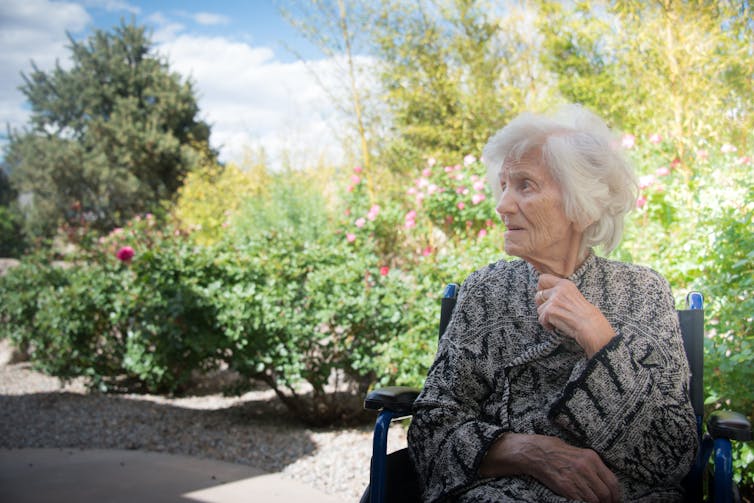 |
| Mild cognitive impairment can be an early sign of Alzheimer’s disease or other dementias. ivanastar/iStock via Getty Images Plus |
In the first study, we used Medicare data for about 40 million beneficiaries age 65 and older from 2015 to 2019 to estimate the prevalence of mild cognitive impairment in that population and to identify what proportion of them had actually been diagnosed.
Our finding was sobering: A mere 8% of the number of cases with mild cognitive impairment that we expected based on a statistical model had actually been diagnosed. Scaled up to the general population 65 and older, this means that approximately 7.4 million cases across the country remain undiagnosed.
In the second study, we analyzed data for 226,756 primary care clinicians and found that over 99% of them underdiagnosed mild cognitive impairment in this population.
Wednesday, March 27, 2024
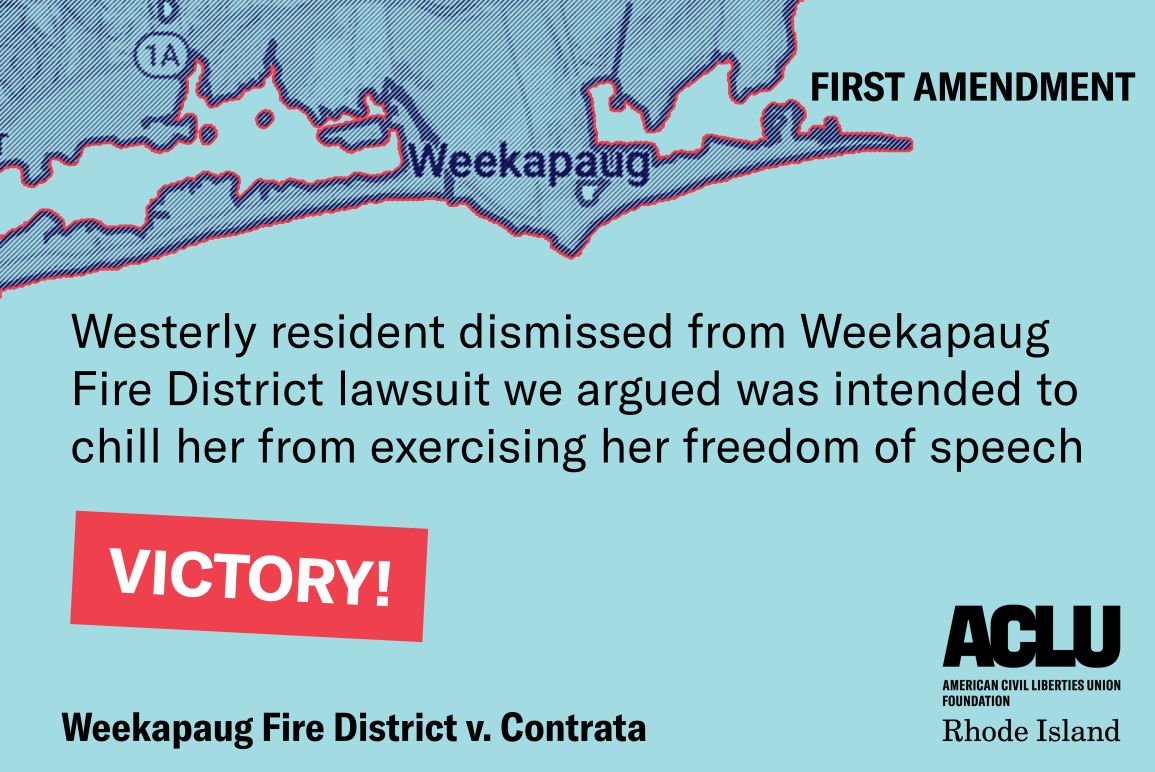
Weekapaug fake fire district drops SLAPP suit against beach access activist
Free speech wins
ACLU of
Rhode Island
The ACLU of
Rhode Island had joined the case to represent Contrata, who was being sued for
monetary damages by the District in what the ACLU argued was a SLAPP
(“Strategic Lawsuits Against Public Participation”) suit intended to chill her
from exercising her freedom of speech about this dispute. The ACLU had sought
her dismissal from the case under the SLAPP statute.
In
December, the Fire District filed this suit in Superior
Court against more than 20 defendants, including the Attorney
General and the Town of Westerly, for seeking a determination from
the Coastal Resources Management Council that a strip of land along the
beach at Weekapaug is not purely private.
Contrata,
who had moved to intervene in the proceedings before the CRMC, was the
only private individual being sued in the case. In defending Contrata, ACLU of
RI cooperating attorney Michael Rubin had argued in a court filing last month
that the only reason she was named in the complaint was because she “had the
temerity to ask the CRMC to designate a tract that is universally
acknowledged as a roadway … as a public right-of-way.”
The
ACLU called the dismissal of Contrata from the suit before it proceeded further
a victory validating her right to petition the government without retaliation.
In
response to the Fire District’s actions, Contrata said today: “With the help
of the ACLU, we achieved success in the court case. Now, I can get back
to the merits of the Spring Avenue right-of-way case that is before the CRMC.”
Attorney
Rubin added: “I am glad that this local governmental district relented in the
case of this brave citizen, Caroline Contrata.”
ACLU
of RI executive director Steven Brown said: “The ACLU is very pleased that the
Fire District reconsidered its decision to sue Ms. Contrata and has dismissed
her from this lawsuit. We commend Ms. Contrata for standing up to the District
to vindicate her rights and the rights of others.”
A
copy of the District’s motion dismissing Contrata from the case, alongside the
ACLU’s memo to dismiss and the Fire District’s initial complaint, can be
found here.


Why We Wait
The Science of Procrastination
By OHIO STATE UNIVERSITY
.webp)
The psychological term to describe this
mental process is called valence weighting bias, which describes people’s
tendency to adapt in new circumstances by drawing more strongly from either
their positive or negative attitudes – or, in the context of approaching an
unpleasant task, whether negative or positive internal “signals” carry the most
weight in guiding the final behavior.
The Battle Between Positivity and Negativity
“And the question is, which wins that battle
– if, indeed, there are elements of both positivity and negativity?” said
Russell Fazio, senior author and professor of psychology at The Ohio State
University.
Is “Food as Medicine” a Game Changer for Diabetes?
So far, not really
By PETER DIZIKES, MASSACHUSETTS
INSTITUTE OF TECHNOLOGY

The study, co-authored by MIT health care economist Joseph Doyle of the MIT
Sloan School of Management, tracks participants in an innovative program that
provides healthy meals in order to address diabetes and food insecurity at the
same time. The experiment focused on Type 2 diabetes, the most common form.
Subscribe to:
Posts (Atom)