Menu Bar

Home           Calendar           Topics          Just Charlestown          About Us

Tuesday, June 11, 2024

School boards, long locally focused and nonpartisan, get dragged into the national political culture wars

South County MAGAs are already disrupting local schools

Kathleen Knight Abowitz, Miami University

Hopkinton MAGA leader Scott Bill Hirst
who convinced Hopkinton voters to kill
Chariho schools' budget
In more than 90% of U.S. public school districts, school board elections are nonpartisan and have been for centuries. But that long tradition may well be changing – and putting at risk the quality of the country’s education system by introducing divisive national political issues into the process by which a local community governs itself.

At present, nine states have passed legislation that enables school board races to be partisan. Four states provide for board elections that have partisan affiliations listed on the ballot; another five states permit districts to choose nonpartisan or partisan races. Bills introduced in six states in 2023 would require or permit school board candidates to declare party affiliations on the ballot.

In 2024, lawmakers in Iowa, New Hampshire and Arizona introduced similar bills. Neither Iowa’s nor New Hampshire’s bill has yet been voted on, and Arizona’s bill was vetoed by the governor. Floridians will decide on partisan school board elections at the ballot box in November 2024.

MAGA leader Clay Johnson of Richmond
was illegitimately appointed to the
Chariho School Committee before being
booted by the state Supreme Court
The sponsor of the 2023 bill in Ohio, which has not yet passed, said partisan elections provide voters with better “information about candidate platforms.”

As a former school board member in Ohio and a scholar of educational leadership, I see this shift having the potential to disrupt the important work of nonpartisan school boards in communities across the nation.

Obviously

By Nick Anderson

Trump's words to his own campaign crowd

Robot-phobia could exacerbate hotel, restaurant labor shortage

“Robot-Phobia?” No kidding

Washington State University

Using more robots to close labor gaps in the hospitality industry may backfire and cause more human workers to quit, according to a Washington State University study.

The study, involving more than 620 lodging and food service employees, found that "robot-phobia" -- specifically the fear that robots and technology will take human jobs -- increased workers' job insecurity and stress, leading to greater intentions to leave their jobs. The impact was more pronounced with employees who had real experience working with robotic technology. It also affected managers in addition to frontline workers. The findings were published in theInternational Journal of Contemporary Hospitality Management.

New Study Links Vegetables To Lower Prostate Cancer Risks

Eat Plants, Beat Cancer

By UNIVERSITY OF CALIFORNIA - SAN FRANCISCO 

According to new research from UC San Francisco, men with prostate cancer may significantly lower the risk of their disease progressing by increasing their intake of fruits, vegetables, nuts, and olive oil.

A study of more than 2,000 men with localized prostate cancer found that eating a primarily plant-based diet was associated with a 47% lower risk that their cancer would progress, compared with those who consumed the most animal products.

This amounted to eating just one or two more servings per day of healthy foods, particularly vegetables, fruits, and whole grains, while eating fewer animal products, like dairy and meat. The study followed the men, whose median age was 65 years old, over time to see how dietary factors affected the progression of their cancer.

Plant-based diets include fruits, vegetables, whole grains, nuts, legumes, vegetable oils, tea and coffee. The researchers measured consumption using a plant-based index and compared the men who scored in the highest 20% to those who scored in the lowest 20%.

COVID-19 Virus Can Lurk in Sperm for 100+ Days After Infection

COVID is the gift that keeps on giving

Will the GOP approve COVID as an alternative form of contraceptive?

By SÃO PAULO RESEARCH FOUNDATION  

A study by the University of São Paulo reveals that COVID-19 can persist in sperm for over three months, potentially reducing semen quality. This research highlights the virus’s significant impact on male fertility and suggests new immune functions for sperm, including pathogen defense.

Researchers from the University of São Paulo have discovered that the COVID-19 virus can linger in the sperm of infected individuals for up to 110 days post-infection, impacting semen quality. This finding underscores the virus’s ability to infiltrate and damage the male reproductive system, suggesting a quarantine period for those planning to conceive post-recovery.

Monday, June 10, 2024

Is Flip going to go clubbing?

With Republicans, cruelty is the point

By Will Collette

Composite by Will Collette.
I wouldn’t be at all surprised if Charlestown’s former state Representative Blake “Flip” Filippi (R) shows up at Blue Shutters Beach for one of the Mystic Aquarium’s frequent releases of rehabilitated seals. 

Except unlike most onlookers, instead of a camera, he'll have a big club to beat the newly healed critters to death before they hit the water.

I’m not joking.

If you follow Flip on Twitter/X, you’ll notice that he’s been campaigning against the growing population of seals in Block Island Sound on the grounds that they will attract great white sharks. 

And before you can say “Jaws,” there goes tourism on Block Island where, not coincidentally, the Filippi family has large business holdings catering to said tourists.

In his own words, here is what Flip has been saying: 

From Flip's Twitter/X feed
Accompanying a photo (👉) of seals gathered on a beach, he wrote: “Lots of Block Island shark bait!”
 

He wrote another post using the same photo and said: “Whoa – this is the most chum I’ve seen on Block Island!”


Accompanying a ProJo article on the growing seal population and Mystic Aquarium’s marine animal rescue program, he really got into his hatred of seals, writing: 

“Rhode Island will rue the ongoing explosion of our seal population when Great White Sharks take up residence alongside them. Cull the year-round seal population before it is too late.”

He wrote another post on the same ProJo article:

“Gee – let’s see if great whites take up residence off Block Island to follow the growing seal population. How about instead we get rid of the damn seals and not have to find out.”

He also posted a phone photo of what may be a shark fin in the water, saying the photo was taken south of Block Island.

There is a smidgen of truth in Blake’s anti-seal rants. There are now roughly 200-300 seals in the waters between Block Island and Charlestown, and seals are Great Whites’ favorite food, according to scientists.

Experts say that Cape Cod is a more popular venue for Great Whites because there are even more seals there. However, just the mere presence of sharks doesn’t lead, ipso facto, to attacks on humans.

While shark attacks on humans DO occur – and get big headlines – they occur far less often than you might think.

Last year, there were 36 shark attacks in all US waters. Worldwide, 69 unprovoked bites were reported plus another 22 listed as “provoked.”

Patch cited the Atlantic Shark Institute in Wakefield saying there have been two confirmed shark fatalities in Rhode Island waters in the last 200 years. That's once a century.

In an article listing all documented shark attacks, fatal or not, in New England waters between 1751 and 2019, six are listed for Rhode Island and of those, two were fatal.

The first recorded fatality was a young boy killed in Bristol Harbor in 1816. The second occurred at Watch Hill in 1895.

The last incident listed was a possible attack on a surfer while returning to Moonstone Beach in 2019. He reported his leg was bloody from punctures but could not identify what caused those lacerations.

It was NOT a Great White Shark. The Institute has tagged 30 Great Whites in Rhode Island waters but no shark fatalities by ANY species of shark in 129 years.

And that’s it. When I said Flip had a smidgen of truth in his rants, maybe I was being too generous since there is no scientific or historical evidence to support his fears of a Sharknado outbreak in Rhode Island. And no reason to start killing seals en masse unless Flip thinks that would be a tourist draw.

But perhaps Blake has another reason for ranting about killing seals: maybe Filippi, like his former MAGA-nut colleague Justin Price, is planning a political comeback.

One necessary step for any 2024 Republican politician is to show how in-sync their thinking is with the GOP’s Supreme Leader, convicted felon Donald Trump.

It turns out Trump is also obsessed with sharks. Yesterday, June 19, at a campaign event in Nevada, Trump went on a tear where he linked his hatred of sharks with his equally fierce hatred of electric vehicles.

He conjured the image of being in a sinking, electric-powered boat. In his own words describing his "dialogue" with a guy he was watching on TV:

"I say, what would happen if the boat sank from its weight, and you're in the boat, and you have this tremendously powerful battery, and the battery is now underwater. And there's a shark that's approximately 10 yards over there…

"By the way, lot of shark attacks lately, I watched some guys justifying it today. 'Well, they weren't really that angry. They bit off the young lady's leg because of the fact that they were, they were not hungry, but they misunderstood who she was. He said 'there's no problem with sharks, they just didn't really understand a young woman's swimming. She really got decimated and other people too, a lot of shark attacks.

So I said [To the guy he was watching on television], there's a shark 10 yards away from the boat, do I get electrocuted? If the boat is sinking, water goes over the battery, the boat is sinking, do I stay on top of the boat and get electrocuted? Or do I jump over by the shark and not get electrocuted?

"Because I will tell you he didn't know the answer. He said, 'you know, nobody's ever asked me that question.' I said I think it's a good question. I think there's a lot of electric current coming to that water. But you know what I'd do? If there was a shark or you get electrocuted, I'll take electrocution every single time. I'm not getting near the shark."

Got all that?

In today’s Republican Party, cruelty seems to be the point. After all, Trump has great plans for even crueler policies toward immigrants than we saw in his first term when thousands of children were taken from their parents. Trump had no plan to reunite those children with those parents, and at the end of his term, almost a thousand were unaccounted for.

That just one of many Trump acts of cruelty with many more to come when he becomes “Dictator for a Day” and goes after his many enemies.

The apple doesn’t fall from the tree: lest we forget, his boys Donald Jr. and Eric posed [👈] gleefully with endangered animals they killed on safari. 

That’s par for the course, given Donald Sr.’s well-documented dislike of animals, dogs in particular.

To build their MAGA cred, ambitious MAGAnuts burnish their hard right credentials through acts of cruelty.

South Dakota Governor and Trump VP wannabe Kristin Noem thought that writing about shooting her puppy Cricket in the head, killing a goat that annoyed her and calling it “life on the farm” would be good for her career. She claimed she hated both animals.

On policy matters, GOP governors work hard to show how cruel they can be to those groups that their Orange Master dislikes. 

For example, there’s Florida Governor Ron DeSantis’ new law banning mandatory water and heat breaks for outdoor workers. Maybe Florida agri-business sees dead farmworkers as good fertilizer for their crops.

Then there’s Texas Governor Greg Abbott who installs hundreds of miles of razor wire on the border ignoring court orders to stop. He has ordered the kidnap of other migrants who are put on buses and sent to northern cities.

Arkansas Governor Sarah Huckabee took credit for revoking laws prohibiting child labor in her state.

Of course, this is only a tiny part of the list of cruelties that includes attacks on reproductive rights, women, workers, veterans, Medicare and Social Security, domestic aid programs, help for Ukraine’s fight against Russian aggression, vaccinations, books, the environment, civil rights, education, the Constitution and democracy itself.

Let’s not forget the 1.1 million-plus Americans who died due to COVID and how Republicans are trying to provoke some lone wolf assassin to kill the pandemic’s most prominent hero, Dr. Anthony Fauci.

Yes, cruelty is the point and that’s why I have a strong hunch we’re going to see Flip Filippi on the ballot this November.

Justice delayed

Fire it up, MAGA guy

Low cost dental care for South County seniors coming to Westerly

PACE-RI and Wood River Health team up

Wood River Health has partnered with PACE-RI to provide high quality diagnostic and preventative dental health services at PACE-RI’s Westerly adult day center and health clinic.

PACE-RI is a health plan for adults aged 55 and older who qualify for nursing home level of care but want to remain safe at home in the community instead. PACE-RI ensures its participants receive an array of medical, behavioral, and social services, focusing on prevention and extending health spans. Wood River Health partnered with PACE-RI to provide dental services at 5 Union Street in Westerly, RI on the first Friday of every month.

A Federally Qualified Health Center, Wood River Health delivers high-quality and affordable healthcare services through a compassionate, team-based approach. Board-certified dentists and dental hygienists provide comprehensive dental services to patients of all ages with a focus on preventative and restorative dentistry.

Will time run out on bills for accessory dwelling units, open records reform and changing the CRMC?

Charlestown has a big stake in getting these three bills passed 

By Nancy Lavin, Rhode Island Current

Two of the three bills are sponsored by Charlestown's
Sen. Victoria Gu
Whoever coined the proverb “third time’s a charm,” probably didn’t have much direct experience in government.

Indeed, many of the top bills in play on Smith Hill are perennial problems, marked by years or even decades of failed attempts to solve complicated problems like the housing crunch, public records requirements and the state’s troubled coastal regulatory agency.

The 2024 legislative session features many such recurring hot topics, made even hotter as the clock ticks down till the end of the session, expected to be this week. 

Here’s a look at where three of the most pressing, unresolved issues stand as of June 7.

Accessory dwelling units 

While attempts to streamline the local zoning and permitting process for accessory dwelling units (ADUs) doesn’t have quite the storied history as other legislation in State House lore, it’s been the top priority for House Speaker K. Joseph Shekarchi for two years running. 

And while Shekarchi, a Warwick Democrat, has won overwhelming support from his House colleagues both years, the Senate has been reluctant to make moves, citing concern by municipal officials, including town planners. 

A compromise version intended to appease some of the harshest municipal critics was introduced by Sen. Victoria Gu, a Charlestown-Westerly Democrat, with an initial vetting on May 16. Yet Gu’s bill remains languishing in the Senate Committee on Housing and Municipal Government as of June 7.

“It’s under negotiation,” Gu said in an interview Friday. “It’s an active topic.”

Greg Pare, a spokesperson for Senate President Dominick Ruggerio, offered a perfunctory response on June 4: “not this week.”

Shekarchi has also indicated he’s unwilling to reconcile his initial proposal, which already sailed through the House, with Gu’s version, which would be required at some point before the bill is signed into law.

However, a separate bill, also sponsored by Gu, that matches Shekarchi’s exact proposal is scheduled to be voted out of the Senate Committee on Housing and Municipal Government Tuesday night.

Public records

EDITOR'S NOTE: Abuse of the law by the Charlestown Citizens Alliance (CCA) when they controlled town government makes this a high-stake issue for us. Often, the CCA had town pet town Administrator Mark Stankiewicz use the APRA to hide shady land deals.  - Will Collette

Advocates hoped the Interstate 195 Washington Bridge closure, and ensuing dossier of emails, text messages and videos released by public records requests, would shine a spotlight on the importance of strengthening the state’s Access to Public Records Act.

Yet the push to update the law that governs what state and local agencies have to hand over to interested members of the public — and for what cost — was derailed by the litany of objections raised by state agencies, including Gov. Dan McKee’s office.  

Also complicating the discussion is how the APRA legislation interacts with the Law Enforcement Officers Bill of Rights (LEOBOR), specifically in conflict around whether policy body camera footage can be kept secret, or must be released when requested as a public record. Amendments to the LEOBOR bill approved by the Rhode Island General Assembly Thursday aimed to resolve that conflict, though concerns lingered among some open government groups.

John Marion, executive director for Common Cause Rhode Island, a key backer of the APRA legislation, said his hopes of passage were dwindling every day.

“So far, we haven’t been asked to throw anything overboard, which is probably one of the indicators that it is not going anywhere this year,” Marion said in an interview on June 4. “If they were going to pass it, they would have asked us what we would compromise on.”

Ever the optimist, Sen. Lou DiPalma, a Middletown Democrat and bill sponsor, maintained that the show wasn’t over, and that he was still discussing potential compromises with other lawmakers and legislative staff.

“It’s on a lifeline, yes, but it’s got a pulse,” DiPalma said in an interview on June 4.

CRMC reform

From allegations of backroom deals to a string of vacancies that have made it difficult to even hold meetings, the Rhode Island Coastal Resources Management Council is awash in criticism. 

Companion bills by Sen. Victoria Gu and Rep. Terri Cortvriend, a Portsmouth Democrat, and backed by Attorney General Peter Neronha, tackle the most problematic piece, the 10-member, politically appointed council. The legislation abolishes the council and instead restructures the CRMC as an administrative agency similar to the Department of Environmental Management.

Hopes of passage came crashing down after the state budget office put a price tag on the change: $1.2 million to $2.9 million, according to a May 28 memo sent to lawmakers. The two-page memo explains that abolishing the council requires the agency to hire 15 more employees to take on the tasks previously overseen by the appointed council.

Shekarchi’s reaction? “Too expensive,” he told reporters on May 31, minutes before unveiling a revised $13.9 billion fiscal 2025 budget proposal that does not include any money for a CRMC overhaul.

But advocates for coastal reform insist the estimated price tag is inaccurate.

“The fiscal note is a red herring, intended to make sure the reform bill does not pass,” Topher Hamblett, executive director for Save the Bay, said in an interview on Thursday. 

The legislation specifically calls for one new employee, a staff attorney, the cost for which would be canceled out by eliminating the agency’s current practice of hiring an outside, private law firm to act as its legal counsel.

Hamblett remained hopeful that lawmakers would not be deterred by the eye-popping, and in his view overblown, sticker price and pass the legislation anyway.

GET THE MORNING HEADLINES DELIVERED TO YOUR INBOX

SUBSCRIBE

Rhode Island Current is part of States Newsroom, a nonprofit news network supported by grants and a coalition of donors as a 501c(3) public charity. Rhode Island Current maintains editorial independence. Contact Editor Janine L. Weisman for questions: info@rhodeislandcurrent.com. Follow Rhode Island Current on Facebook and Twitter.
Database Reveals 'Staggering' $6.6 Million in Gifts to Supreme Court Justices

Just how corrupt is Trump’s Supreme Court majority?

BRETT WILKINS

By Clay Bennett
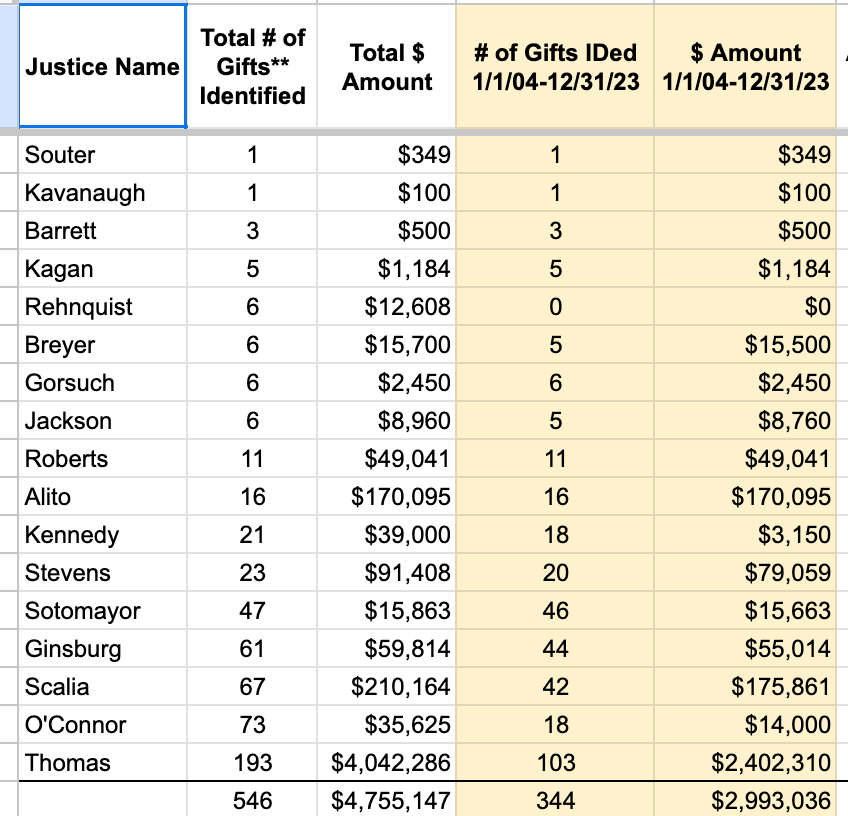
U.S. Supreme Court justices have received millions of dollars in gifts over the past two decades—with far-right Justice Clarence Thomas being the main beneficiary of this largesse, according to a detailed analysis published Thursday.

The advocacy group Fix the Court published a database listing 546 total gifts valued at over $4.7 million given to 18 current and former justices mostly between 2004 and 2023, as identified by the U.S. Federal Trade Commission (FTC). The database also lists "likely" gifts received by the justices and their estimated values, bringing the grand total to 672 gifts valued at nearly $6.6 million.

The database was published a day before the justices are expected to release their financial disclosure reports.


"Supreme Court justices should not be accepting gifts, let alone the hundreds of freebies worth millions of dollars they've received over the years," Fix the Court executive director Gabe Roth said in a statement Thursday.

Sunday, June 9, 2024

Nearly-$14B budget plan breezes through Rhode Island House on 69-5 vote Friday

New budget even draws a few GOP votes

By Nancy Lavin, Rhode Island Current

Finalizing the state’s annual spending plan is often a contentious, drawn-out process.

Not this year. A $13.96 billion fiscal 2025 budget breezed through the Rhode Island House of Representatives Friday night.

The 69-5 vote came after a mere 3 1/2 hours of discussion that included high praise for funding of critical and often contested issues like state pensions for retirees, K-12 education and health care provider rates. 

“Through this budget, we are emphasizing education at every level and supporting children,” House Speaker K. Joseph Shekarchi said in a statement Friday night. 

“This budget is the result of a truly collaborative process between my colleagues here in the House, the dedicated members of the House Finance Committee, our partners in the Senate and Governor McKee and his team to carefully create a plan that meets Rhode Island’s needs for education, students and children first, while addressing our challenges, such as housing and health care.”

The $13.96 billion spending plan falls just shy of the $14 billion high water mark that characterized fiscal 2024’s approved spending plan, but is $271 million more than what Gov. Dan McKee proposed in January. 

Four of the nine Republican members, including House Minority Leader Mike Chippendale, also voted for the revised spending plan. Chippendale credited Shekarchi and the leadership team for giving deference, and a listening ear, to his party’s priorities.

Amen

Hurricane season is here. Be prepared