Menu Bar

Home           Calendar           Topics          Just Charlestown          About Us

Saturday, March 23, 2024

Would you bank on Walmart?

Walmart bought a finance app and reduced fraud protections. Guess what happened next?

by Craig Silverman and Peter Elkind for ProPublica
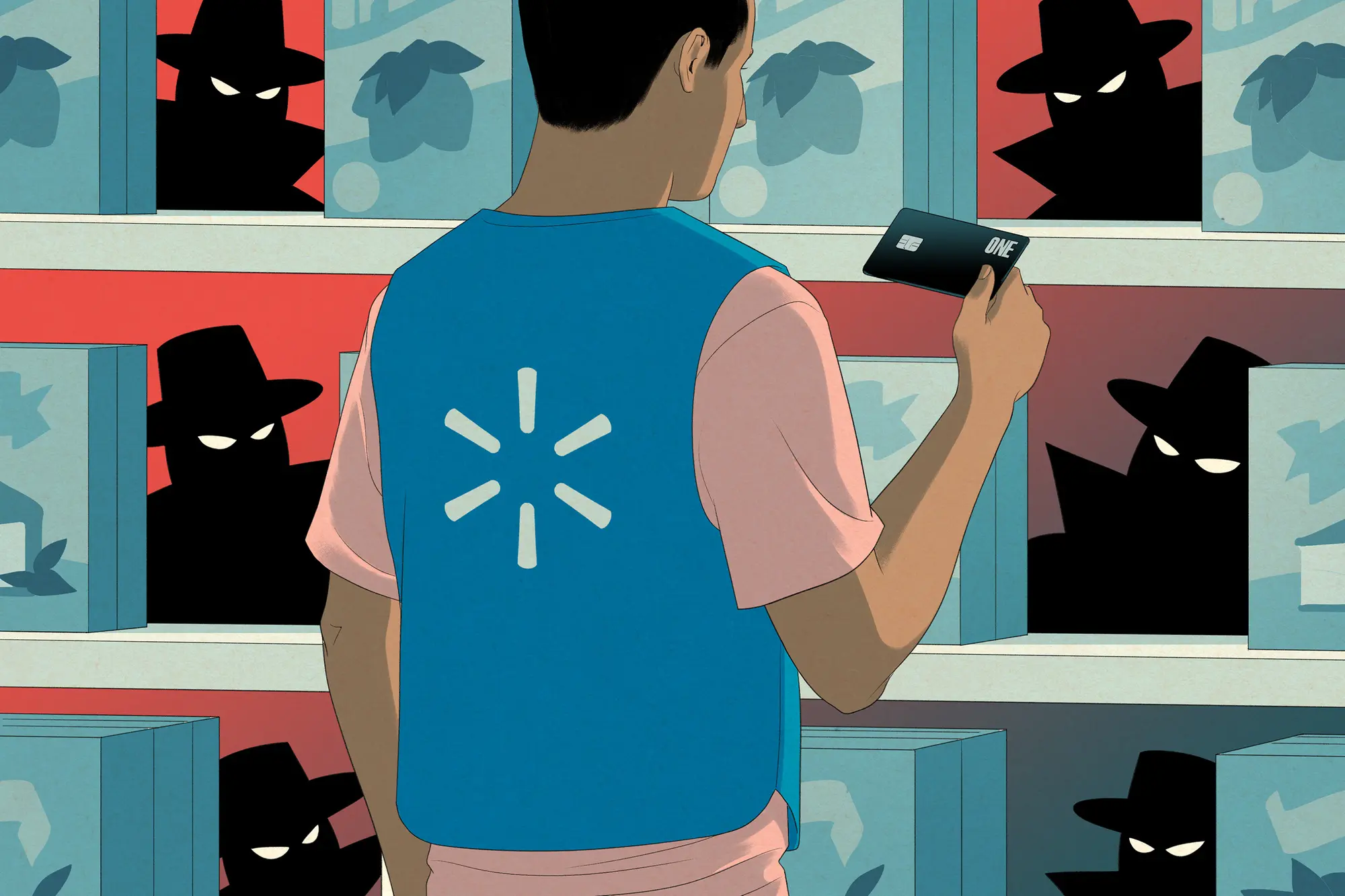
Only a few hours elapsed between the time that Carl’s pay landed in his checking account and when online thieves pilfered it. “They took all of it but like 67 cents,” he said. Months before, Carl had signed up for One Finance, a banking app. It’s owned and promoted by Walmart, where Carl works in a grocery department.

He was enticed by features like cash back on purchases at Walmart and the chance to receive his pay two days early, as well as by low fees and high interest rates. Everything was fine until Carl used his One debit card — for the very first time — to buy a video game at Walmart last fall. 

The next time he checked the app, he saw a series of unauthorized transactions that had drained his account. To get by, he tapped his savings, which he said was “just enough to cover everything.” Carl asked to be identified by first name only out of concern for his job security.

Carl’s experience has been distressingly common. One Finance was plagued by fraud and customer dissatisfaction after a Walmart-controlled partnership acquired it in 2022. As Walmart began touting One to employees and others, the “neobank” — as such ultraconvenient, lightly regulated apps are called — weakened user security and outsourced customer support. 

Con artists took advantage, spurring a litany of customer complaints to regulators and the Better Business Bureau and across social media platforms. One froze some accounts and blocked access to its app and website from several countries, according to current and former customers and employees.

Frustrated users tanked One’s rating on Google Play from 4.6 to 2.8 stars. So many complaints inundated a Reddit community for One users that moderators made the page private “due to ONE fraud issue and their lack of customer support.” One’s Better Business Bureau page warns that scammers are using the One name and logo to steal money via “loan and impersonation scams.”

One’s problems echo the fraud and compliance issues revealed in a recent ProPublica investigation of Walmart’s financial services business. That article found that the company resisted calls to rein in fraud and skimped on employee training as more than $1 billion in consumer fraud losses were routed through Walmart’s financial systems over the past decade.

Friday, March 22, 2024

DO NOT let him do it again

Trump nearly derailed democracy once 

Richard L. Abel, University of California, Los Angeles

Elections are the bedrock of democracy, essential for choosing representatives and holding them accountable.

The U.S. is a flawed democracy. The Electoral College and the Senate make voters in less populous states far more influential than those in the more populous: Wyoming residents have almost four times the voting power of Californians.

Ever since the Civil War, however, reforms have sought to remedy other flaws, ensuring that citizenship’s full benefits, including the right to vote, were provided to formerly enslaved people, women and Native Americans; establishing the constitutional standard of one person, one vote; and eliminating barriers to voting through the 1965 Voting Rights Act.

But the Supreme Court has, in recent years, narrowly construed the Voting Rights Act and limited courts’ ability to redress gerrymandering, the drawing of voting districts to ensure one party wins.

The 2020 election revealed even more disturbing threats to democracy. As I explain in my book, “How Autocrats Seek Power,” Donald Trump lost his reelection bid in 2020 but refused to accept the results. He tried every trick in the book – and then some – to alter the outcome of this bedrock exercise in democracy.

A recent New York Times story reports that when it comes to Trump’s time in office and his attempt to overturn the 2020 election, “voters often have a hazy recall of one of the most tumultuous periods in modern politics.” This, then, is a refresher about Trump’s handling of the election, both before and after Nov. 3, 2020.

Trump began with a classic autocrat’s strategy – casting doubt on elections in advance to lay the groundwork for challenging an unfavorable outcome.

Despite his efforts, Trump was unable to control or change the election results. And that was because of the work of others to stop him.

Here are four things Trump tried to do to flip the election in his favor – and examples of how he was stopped, both by individuals and democratic institutions.

Honest Don needs you

Wow. Just wow.

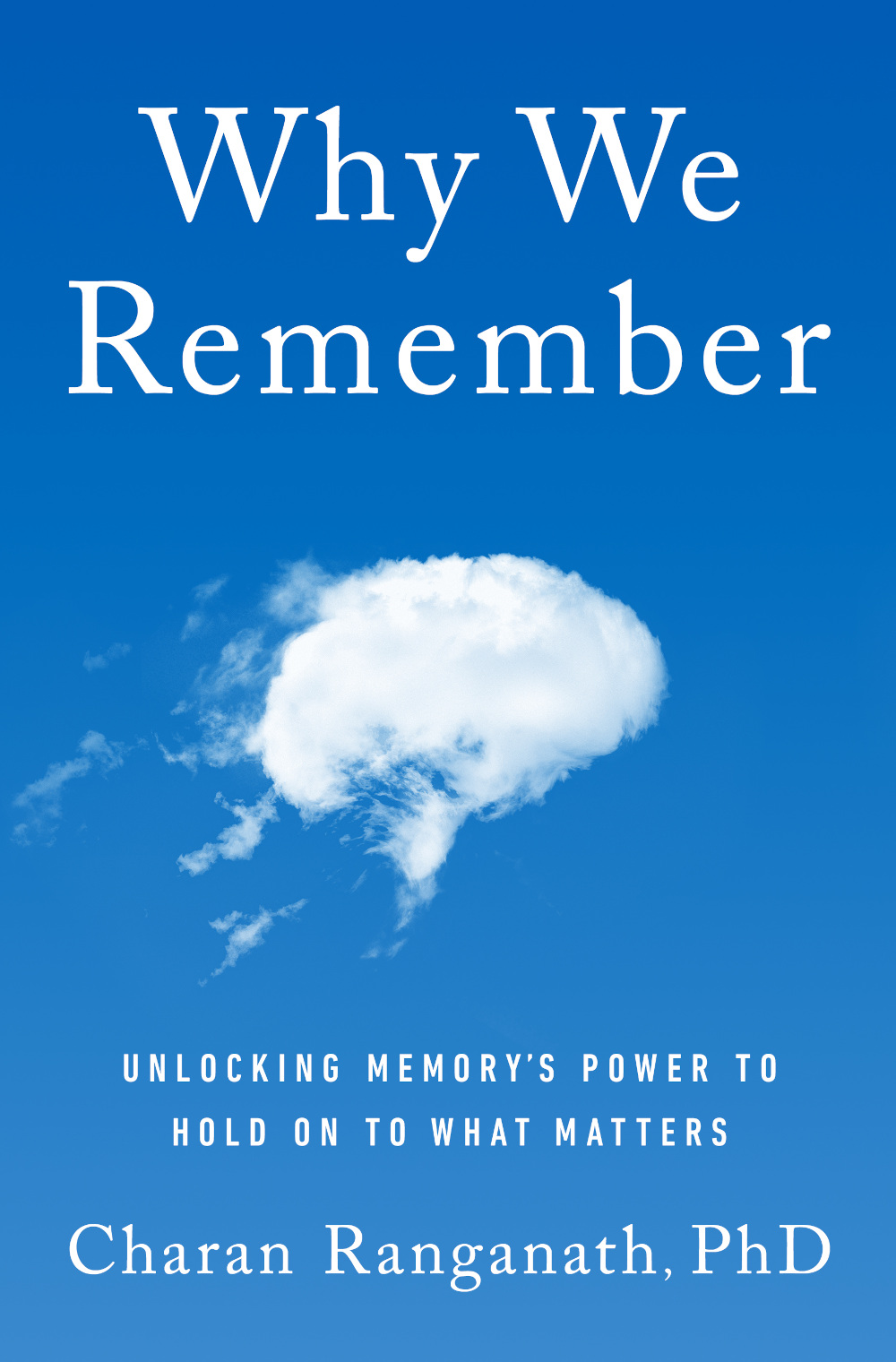
Why we remember

Book Review: The Mysteries and Quirks of Human Memory

By Erica Goode

BOOK REVIEW — “Why We Remember: Unlocking
Memory’s Power to Hold on to What Matters,”
by Charan Ranganath (Doubleday, 304 pages).
Authors don’t get to choose what’s going on in the world when their books are published. More than a few luckless writers ended up with a publication date of Sept. 11, 2001, or perhaps Nov. 8, 2016, the day Donald Trump was elected.

But Charan Ranganath, the author of “Why We Remember: Unlocking Memory’s Power to Hold on to What Matters,”was more fortunate. 

His book went on sale last month, not long after the Department of Justice released a report describing President Joe Biden as an “elderly man with a poor memory” who, in interviews, was “struggling to remember events,” including the year that his son Beau died.

The special counsel’s report immediately became a topic of intense discussion — disputed by the White House, seized on by many Republicans, analyzed by media commentators, and satirized by late-night television hosts.

But for Ranganath, a psychologist and neuroscientist at the University of California, Davis, who for decades has been studying the workings of memory, the report’s release was a stroke of luck. His book, which dispels many widespread but wrongheaded assumptions about memory — including some to which that special counsel Robert K. Hur appears to subscribe — could easily have been written as a corrective response.

If Ranganath has a central message, it is that we are far too concerned about forgetting.

Study Shows a Healthy Diet is Linked with a Slower Pace of Aging, Reduced Dementia Risk

Stick to the Med diet

COLUMBIA UNIVERSITY'S MAILMAN SCHOOL OF PUBLIC HEALTH


A healthier diet is associated with a reduced dementia risk and slower pace of aging, according to a new study at Columbia University Mailman School of Public Health and The Robert Butler Columbia Aging Center. The findings show that a diet-dementia association was at least partially facilitated by multi-system processes of aging. 

While literature had suggested that people who followed a healthy diet experienced a slowdown in the processes of biological aging and were less likely to develop dementia, until now the biological mechanism of this protection was not well understood. The results are published in the Annals of Neurology(link is external and opens in a new window).

“Much attention to nutrition in dementia research focuses on the way specific nutrients affect the brain” said Daniel Belsky, PhD, associate professor of Epidemiology at Columbia School of Public Health and the Columbia Aging Center, and a senior author of the study. 

“We tested the hypothesis that healthy diet protects against dementia by slowing down the body’s overall pace of biological aging.”

Majority of Americans Agree: Decline of Unions Bad for Country

Pew found that most U.S. adults, especially Democrats, see the trend as bad for working people.

THOR BENSON for Common Dreams

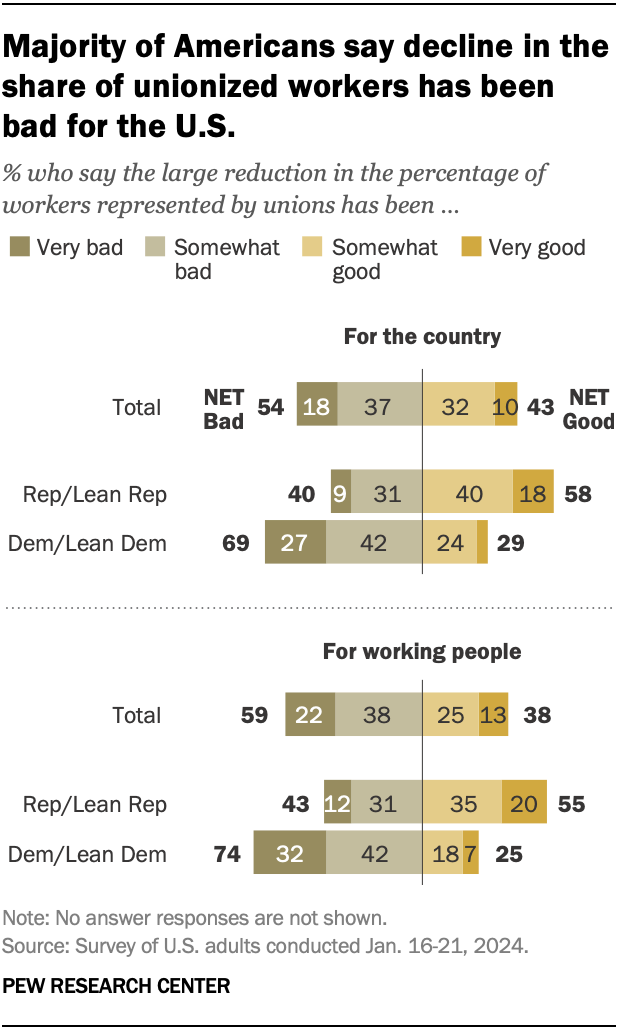
Most Americans think the declining number of unionized workers over the past few decades has been bad for the country, according to a poll released from the Pew Research Center.

Pew found 54% of U.S. adults say the decline has been bad for the country, and 59% say it has been bad for working people. The center found 69% of Democrats think the decline has been bad for the country, and 40% of Republicans felt that way.

"A majority of conservative Republicans (60%) say the decline in organized labor membership has been at least somewhat good for working people, including 24% who say this has been very good," the report states.

"Across ideological groups, large majorities of Democrats say the decline in the percentage of workers represented by unions has been bad for working people. But liberal Democrats (85%) are more likely than conservative and moderate Democrats (66%) to say this."

Union membership dropped to a record low last year—partially thanks to some red states limiting or banning the unionization of government workers. While recent reporting has tracked many stories of people fighting to unionize, only 10% of American adults belong to a union.

Thursday, March 21, 2024

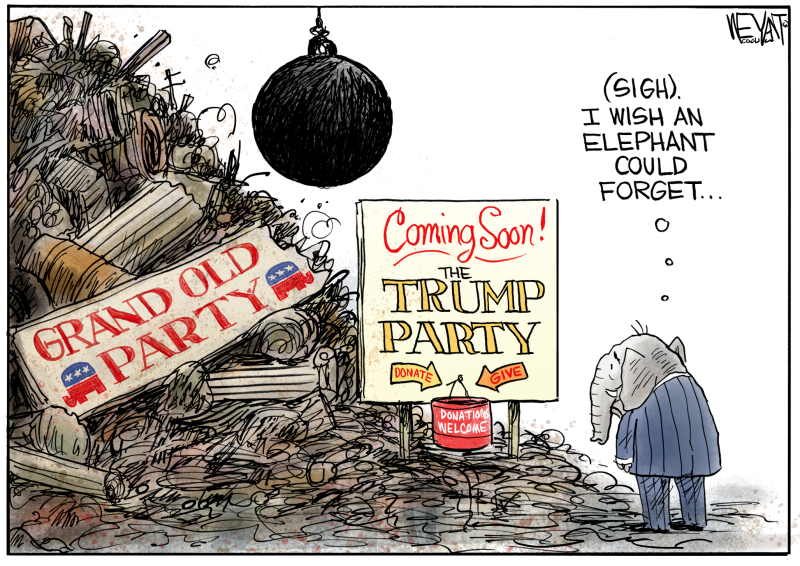
Only Trumpers are allowed to be Republicans

The Republican Party is going through a nasty divorce

By Kerry Eleveld for Daily Kos

When former Vice President Mike Pence said last Friday that he would not be endorsing his old boss Donald Trump for a second term as president, it made for a good chuckle: Pence wouldn't be backing the guy who tried to have him hanged on Jan. 6, 2021.

But zoom out a bit and Pence's rejection of his former boss comes amid a potentially meaningful groundswell of opposition from many of those who worked closest with Trump—including his former top aides and Cabinet members.

The Biden campaign sure thinks it’s notable. Shortly after Pence's statement, the campaign's rapid response director, Ammar Moussa, blasted out a list to reporters of former Trump staffers who don't think Trump and his autocratic agenda should be "anywhere near the Oval Office."

Pence topped the list, followed by former U.N. ambassador and Republican presidential candidate Nikki Haley—but let's put a pin in that for a moment.

Other former senior Trump officials who made Team Biden's "short list" were:

The biggest grift yet?

By Clay Bennett

Exactly the right question

Charlestown icon Charlie Beck died suddenly

Charles W. Beck, May 18, 1950 ~ March 19, 2024

Charlie championed electronic waste recycling 
by hosting free drop-off days every few months in the
Mini-Super parking lot. He started that in 2014 when the
CCA's Town Administrator Mark Stankiewicz cancelled
free drop-off at the town's transfer station. Pick up was 
done by Charlestown local business Indie Cycle.
Charles W. Beck, 73, “The Unofficial Mayor of Charlestown, RI” died suddenly on Tuesday March 19, 2024, at Rhode Island Hospital.

Born in Hartford, CT on May 18, 1950, he was the son of the late Charles J. and Elenor (Kautz) Beck.

Charlie graduated from Roberts Wesleyan University in Rochester, NY. In the 1980’s he became co-owner of the Charlestown Mini Super and was still working at the time of his passing.

Mr. Beck was an active in the Town of Charlestown civic affairs and had been past President of the Charlestown Town Council. He was currently Charlestown's Town Moderator. He also was a long-time member of the South County Tourism Association.

Charlie loved playing golf and had played his last round on Monday afternoon at Pinecrest Golf Course. He was a member of the South County Umpires Association officiating at many baseball and softball games.

Charlie will be remembered for good character, sense of humor and his unwavering selflessness.

He was the proud loving father of his two sons, Calvin Beck and Cooper Beck. He also leaves his sisters and brother, Deborah Berry of Bloomfield, CT, Timothy Beck of Charlestown, RI and Kathleen Beck of Westminster, MA. He was the longtime dear friend and companion of Darlene DeSantis. He also leaves his former wife Wendy Beck.

A celebration of Charlie’s life will be held on Friday March 22, 2024 at 11:00 AM at St. Andrews Lutheran Church, 15 East Beach Rd, Charlestown, RI. Calling hours are respectfully omitted.

In lieu of flowers, donations in Charlie’s memory may be made to St. Andrews Church, Food Pantry.

Wind and dry conditions create Charlestown fire hazard

10 acres of Charlestown brush land burned on Wednesday

By Will Collette

Richmond Carolina Fire Department photo
Ⓒ provided by WPRI-Providence
 
The dry and windy weather that caused a major brushfire in Charlestown yesterday are present again today. 

According to the National Weather Service, no precipitation is forecast until around 3 AM Saturday morning when there is a 30% chance of rain or snow.

Until then, the NWS warns:

ELEVATED FIRE WEATHER CONCERNS TODAY...

The combination of gusty winds and an anomalously dry airmass for March will result in elevated fire weather concerns for all of Connecticut, Massachusetts, and Rhode Island from late morning through late afternoon.

Today, minimum relative humidity values range 20 to 35 percent and winds are gusty from the west/northwest at 35 to 50 mph.

Underscoring the hazard, fire crews from Charlestown and Richmond, aided by DEM and neighboring departments, fought a 10-acre brushfire near the AMTRAK tracks and south of Route 91 on Wednesday.

Though no injuries were reported, the work was arduous and long as firefighters needed to trek through the brush with their equipment to extinguish the fire.

So be careful out there and, of course, you should refrain from any outside burning – and don’t pitch lit cigarettes out your car window, please.

The visual effect of wind turbines on property values is small and diminishing in space and time

Anti-wind NIMBYs grossly exaggerate their effect

Wei Guo, Leonie Wenz  and Maximilian Auffhammer 

A substantial expansion of renewable energy generation is necessary for decarbonizing the U.S. economy. Wind power is the fastest-growing renewable source of electricity in the United States. 

It has been argued that wind turbines are a visual disamenity. We statistically estimate the impact of having at least one wind turbine within sight on home values, using data from more than 300 million home sales and 60,000 wind turbines in the United States from 1997 to 2020. 

We find robust evidence of a 1% drop of home values within a wind turbine’s viewshed. The effect is larger for homes closer to more wind turbines, but is no longer detectable by the end of the 20-y period covered by our data.

Wednesday, March 20, 2024

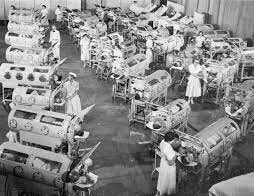
Make America Great Again by bringing back polio

Trump wants to end mandatory vaccinations nationwide

Those of us of a certain age remember how great America was before the polio vaccine:


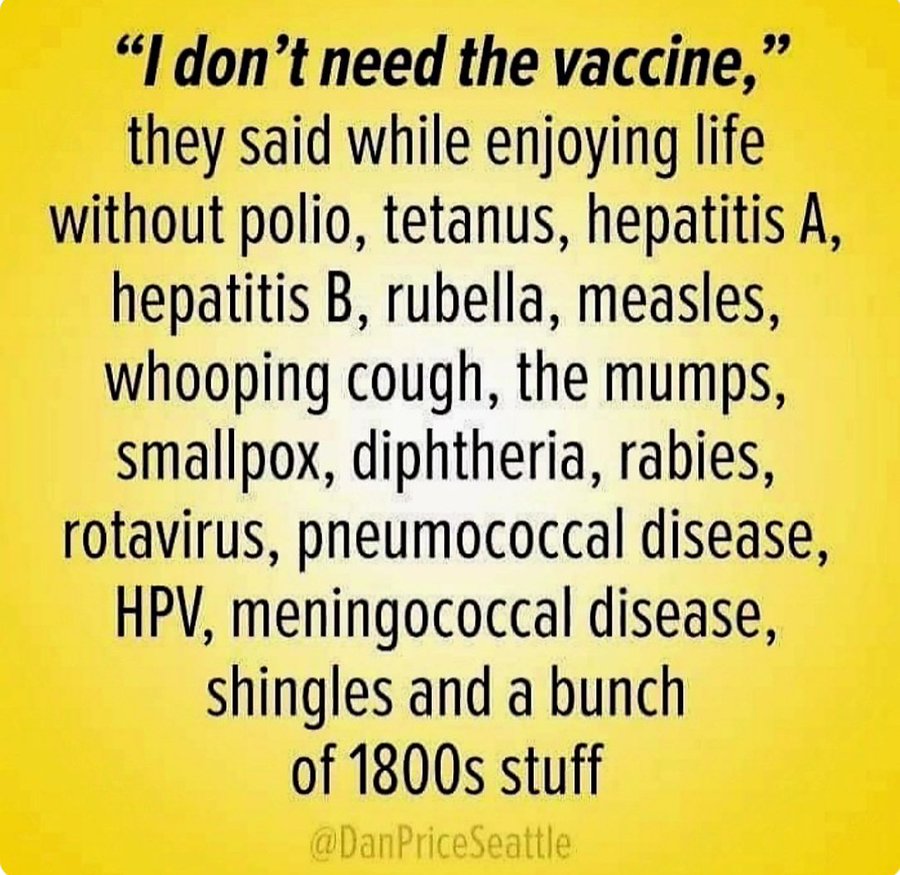
And then there are all the other great diseases Trump wants to bring back:

How it works