Menu Bar

Home           Calendar           Topics          Just Charlestown          About Us

Tuesday, September 24, 2024

Immigrants are unsung heroes of global trade and value creation

We are a nation of immigrants

Bedassa Tadesse, University of Minnesota Duluth and Roger White, Whittier College

In nearly every country that hosts foreign-born citizens, immigration emerges as a lightning rod for controversy. The economic realities of immigration, however, are far more complex than the negative sound bites suggest.

Far from being a burden, as critics claim, immigrants play pivotal roles in driving innovation, enhancing productivity and fostering economic growth in their adopted countries. They also elevate their adopted and origin countries’ standings in global value chains, contributing to economic resilience.

We are economists who study global trade and migration, and our recent work reveals that immigrants contribute far more to the economic fabric of nations than previously understood.

By facilitating what’s known as “trade in value added,” or TiVA, immigrants play a crucial role in helping countries specialize their production, move up the value chain and significantly enhance trade sophistication.

Moving up the value chain means progressing from producing basic, low-value goods to more complex, higher-value products. This shift involves improving skills, technology and production techniques, allowing a country to capture more economic value and develop advanced industries.

So, what exactly is trade in value added, and why is it important?

In today’s global economy, products are rarely made entirely in one country. Instead, different stages of production occur across multiple nations. TiVA measures each country’s contribution to a final product, providing clearer insight into global value chains. For instance, while an iPhone may be assembled in China, its components come from various countries, each adding value.

Hey, independents!

Simple and reasonable

Vote YES on Question 2 for more funding for higher education

Bond issue goes before voters at Nov. 5 general election

Gov. Dan McKee, University of Rhode Island President Marc Parlange, and Rhode Island College President Jack Warner kicked off the campaign – Yes on 2 – on Tuesday morning to promote a $160.5 million bond issue that will bring major advances in the life sciences and cybersecurity if approved by voters in November.

The campaign launch, which included former Congressman James Langevin, Rhode Island Life Science Hub Interim President Patrice Milos, and URI and RIC students, was hosted virtually with speakers and supporters at URI’s Kingston Campus and RIC’s Providence campus.

In the Nov. 5 general election, Question 2 will ask voters to approve a $160.5 million higher education bond—$87.5 million to be used for the construction of a new biomedical sciences building at URI’s Kingston Campus, and $73 million to modernize and transform Whipple Hall at RIC into a dedicated home for the Institute for Cybersecurity & Emerging Technologies. 

As the state’s flagship public research university, URI is leading cutting-edge research and education in the biomedical sciences, including neuroscience. Researchers at the University’s George and Anne Ryan Institute for Neuroscience are advancing transformative work in the prevention and treatment of neurodegenerative diseases, including Alzheimer’s and amyotrophic lateral sclerosis (ALS), aging-related illness and other central nervous system disorders. Faculty and students across URI’s campuses, including in health sciences, pharmacy, and nursing, are pioneering solutions in biomedicine, disease and pathology, including studying tick-borne illnesses and more. 

Moderate coffee and caffeine consumption is associated with lower risk of developing multiple cardiometabolic diseases

Studies continue to find positive and negative coffee drinking effects 

The Endocrine Society

Consuming moderate amounts of coffee and caffeine regularly may offer a protective effect against developing multiple cardiometabolic diseases, including type 2 diabetes, coronary heart disease and stroke, according to new research published in the Endocrine Society’s Journal of Clinical Endocrinology & Metabolism.

Researchers found that regular coffee or caffeine intake, especially at moderate levels, was associated with a lower risk of new-onset cardiometabolic multimorbidity (CM), which refers to the coexistence of at least two cardiometabolic diseases.

The prevalence of individuals with multiple cardiometabolic diseases, or CM, is becoming an increasing public health concern as populations age around the world, notes the study.

Coffee and caffeine consumption could play an important protective role in almost all phases of CM development, researchers found.

RI Citizens for Responsible Government launches ad campaign urging Rhode Island voters to reject Question 1

 Don't let big money and the far-right endanger Rhode Islanders' basic rights!

Rhode Island Citizens for Responsible Government, a diverse coalition of Rhode Island individuals and organizations opposing a Constitutional Convention, today launched a paid advertising campaign urging Rhode Island voters to reject Question 1 on the ballot in this November’s general election. 

The ads released by the campaign highlight the threat that a Constitutional Convention will pose to civil rights, the potential for big-money special interests to influence elections and buy our Constitution, and wasted taxpayer dollars.

“The release of these ads is the first phase of our paid advertising campaign to educate Rhode Island voters about the significant dangers of a Constitutional Convention,” stated coalition Chair Vimala Phongsavanh, who is also Senior Director, External Affairs of Planned Parenthood of Southern New England. 

"Our REJECT Question 1 ad campaign will specifically highlight the threat a Constitutional Convention will pose to reproductive rights and family planning decisions, worker rights, LGBTQ+ rights, and minority rights. A Constitutional Convention will jeopardize our democratic process and can potentially sway outcomes away from the will of the people and towards narrow ideological agendas. Once Rhode Islanders understand that wealthy, out-of-state special interests will have no limits on what they can spend to influence our elections and effectively buy our Constitution, we believe they will overwhelmingly reject a Constitutional Convention, just as they did in 2014.” 

Monday, September 23, 2024

R.I. Energy’s seasonal electric rate hikes will be partially offset by $27M refund

Charlestown should consider joining our neighbors to get better electricity rates

By Nancy Lavin, Rhode Island Current

These communities work together through Good Energy
to get better electricity rates for resident
In the end, the much-maligned winter electric rate hikes won’t be as burdensome as initial calculations suggested, thanks to a nearly $27 million refund distributed to Rhode Island Energy customers.

Still, the 500,000 state residents who opt to get their electricity from Rhode Island Energy — rather than an outside supplier — will see their electric bills go up starting Oct. 1, under seasonal rate hikes approved by the Rhode Island Public Utilities Commission on Thursday. 

Based on calculations submitted by Rhode Island Energy, the average residential customer will see their monthly electric bill increase about 23%, or $31. Business and industrial customers would also see their bills rise, with the increase dependent upon usage.

The seasonal, six-month increase is not unexpected; rates typically increase in the winter due to higher demand and limited supply. State law prevents Rhode Island Energy, the primary utility provider for the state, from profiting off the energy it purchases from third-party suppliers.

The upcoming rate hikes are also slightly lower than rates from last winter.

And, customers will also get separate bill credits to refund them for the $27 million they were overcharged by the company in 2023 due to accounting errors

For most residential customers, the refund will be given as a one-time credit of $68.60 on their December bills. Low-income customers will get an even higher refund of roughly $140, spread out in monthly installments of $23.47 from November 2024 through April 2025.

The extra refund for customers who qualify for income-restricted government assistance programs attempts to ease the pain for the state’s most vulnerable residents, many of whom are already struggling to afford basic needs. The impact of higher winter utility bills on low income families was the central focus of a public hearing on Sept. 9, in which critics, including affected residents, lamented the increasing costs of food, rent and utilities.

“I think this is the fairest way to do it,” Commission Chairman Ron Gerwatowski said Thursday. 

Commercial and industrial customers will also get a one-time refund on their bills, with the amount based on usage.

Customers in seven municipalities — Barrington, Central Falls, Narragansett, Newport, Portsmouth, Providence, and South Kingstown — can opt out of Rhode Island Energy electric prices and participate instead in a community aggregation plan that leverages bulk buying power to secure lower-priced electricity for its residents. 

Trump works on the most important issue

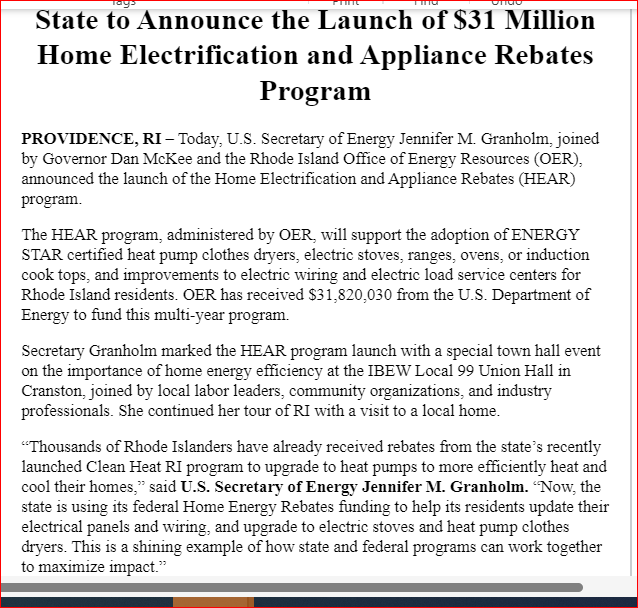
New energy efficiency program coming to Rhode Island

EPA Scientists Said They Were Pressured to Downplay Harms From Chemicals Under Trump.

A Watchdog Found They Were Retaliated Against.

By Sharon Lerner for ProPublica

More than three years ago, a small group of government scientists came forward with disturbing allegations.

During President Donald Trump’s administration, they said, their managers at the Environmental Protection Agency began pressuring them to make new chemicals they were vetting seem safer than they really were. 

They were encouraged to delete evidence of chemicals’ harms, including cancer, miscarriage and neurological problems, from their reports — and in some cases, they said, their managers deleted the information themselves.

After the scientists pushed back, they received negative performance reviews and three of them were removed from their positions in the EPA’s division of new chemicals and reassigned to jobs elsewhere in the agency.

On September 18, the EPA inspector general announced that it had found that some of the treatment experienced by three of those scientists — Martin Phillips, Sarah Gallagher and William Irwin — amounted to retaliation.

Three reports issued by the inspector general confirmed that the scientists’ negative performance reviews as well as a reassignment and the denial of an award that can be used for cash or time off were retaliatory. They also detailed personal attacks by supervisors, who called them “stupid,” “piranhas” and “pot-stirrers.”

Your gas stove might be making your asthma worse.

Here’s what you can do about it

Nusrat HomairaUNSW Sydney

Kwon Junho/Unsplash
We may think of air pollution as an outdoor problem, made up of car exhaust and smog. But if the air inside our homes is polluted, this can also affect our health.

In Australia, around 12% of childhood asthma can be attributed to gas stoves and the toxic chemicals they release into the air. And while there’s a growing push to phase out gas indoors, some 38% of Australian households rely on natural gas for cooking.

Recommended interventions – such as replacing a gas stove with electric – may not be possible for those who are renting or struggling with the cost of living. This is important because, as our research shows, childhood asthma is more common in socioeconomically disadvantaged areas.

If you’re living with gas, here’s how it can affect you or your child’s asthma, and what you can do to improve air quality.

Cyberattacks Plague the Health Industry.

Cruel and dangerous


Ortho RI's system was impaired from September 9 - 17. 
Central Oregon Pathology Consultants has been in business for nearly 60 years, offering molecular testing and other diagnostic services east of the Cascade Range.

Beginning last winter, it operated for months without being paid, surviving on cash on hand, practice manager Julie Tracewell said. The practice is caught up in the aftermath of one of the most significant digital attacks in American history: the February hack of payments manager Change Healthcare.

COPC recently learned Change has started processing some of the outstanding claims, which numbered roughly 20,000 as of July, but Tracewell doesn’t know which ones, she said. The patient payment portal remains down, meaning customers are unable to settle their accounts.

“It will take months to be able to calculate the total loss of this downtime,” she said.

Health care is the most frequent target for ransomware attacks: In 2023, the FBI says, 249 of them targeted health institutions — the most of any sector.

And health executives, lawyers, and those in the halls of Congress are worried that the federal government’s response is underpowered, underfunded, and overly focused on protecting hospitals — even as Change proved that weaknesses are widespread.

The Health and Human Services Department’s “current approach to healthcare cybersecurity — self-regulation and voluntary best practices — is woefully inadequate and has left the health care system vulnerable to criminals and foreign government hackers,” Sen. Ron Wyden (D-Ore.), chair of the Senate Finance Committee, wrote in a recent letter to the agency.

The money isn’t there, said Mark Montgomery, senior director at the Foundation for Defense of Democracies’ Center on Cyber and Technology Innovation. “We’ve seen extremely incremental to almost nonexistent efforts” to invest more in security, he said.

Sunday, September 22, 2024

Comparing Trump's and Harris's actual records on health care

Skip the rhetoric and look at the facts

Zachary W. SchulzAuburn University

The presidential debate on Sept. 10, 2024, did not add much context to what
the two candidates would do on health care beyond their own records. 
Visual China Group/Getty Images
Health care is a defining issue in the 2024 election – Democratic presidential nominee Kamala Harris and Republican contender Donald Trump have starkly different records on the issue. 

Rather than focusing on what they promise to do, let’s examine what their past actions reveal about their approaches to Medicare, the Affordable Care Act, public health infrastructure, drug policy and child abuse and domestic violence prevention.

As a specialist in public health history and policy, I have carefully examined both candidates’ records on American health care. With years of experience in the health care field and being a cystic fibrosis patient myself, I have developed a deep understanding of our health care system and the political dynamics that shape it.

For me, as for many other Americans, health care is more than just a political issue; it is a deeply personal one.

Two different paths to the White House

Upcoming Charlestown Town Council meeting