We All Have to Die of Something
But in the meantime, we don’t have to give up on living
Unbiased
Science and Jess Steier,
DrPH

Why do we buckle our seatbelts? Why do we install smoke
detectors, strap our kids into car seats, and grab their hands in a parking
lot? Nobody watches a toddler choke on a grape and says, “Well, we all have to
die of something.” We know we’ll die. When and how come down to odds, and
public health is about shifting those odds. Let’s discuss…
A century ago, most people died of infections, and often
young
In 1900, the leading causes of death in the U.S. were pneumonia, tuberculosis, and diarrheal disease. Tuberculosis was often called “consumption” because it seemed to eat people away from the inside, as they lost weight and coughed for months or years, sometimes even bringing up blood. Diarrheal disease hit babies and young children hardest, draining so much fluid that a child could die of dehydration and electrolyte imbalance within days.
Historian Leigh
Shaw-Taylor notes that for most of human history, most people died of
infections like these, and only a minority lived long enough to develop the
chronic diseases that kill most of us today, like heart
disease and cancer. Vaccines, antibiotics, clean water, and better
living conditions all helped change that.
So, yes, we are trading one way of dying for another. A
child who doesn’t die of Hib or measles will eventually die of something else,
and the difference is whether that happens at 2 or at 82. CDC estimates that
among the roughly 117 million children born between 1994 and 2023, routine
childhood vaccines will have prevented 508 million
illnesses, 32 million hospitalizations, and more than 1.1 million deaths.
Every one of those people will still die someday, just with decades of life
first.
Heart disease and cancer can be delayed, too
Living long enough to develop heart disease or cancer
doesn’t mean we’ve swapped a quick death for a slow, painful one. Much of
public health and medicine today focuses on chronic disease, too, from helping
people quit smoking, cut back on alcohol (even moderate drinking raises the
risk of some cancers), and eat nutritious food, to keeping blood pressure and
cholesterol in check and catching cancers early through screening. None of us
expects that getting everyone to quit smoking, drink less, and eat well would
mean people live forever. The goal is to delay illness and, ideally, shorten
the years spent living with it. In 1980, physician James Fries called this the “compression of morbidity.”
In an ideal world, we’d all be among the lucky ones whose
obituary says we died peacefully in our sleep after a long, healthy life. My
dad didn’t get that. He started smoking as a teenager, like so many other
people of his generation, and I watched emphysema take him slowly over more
than a decade, a cascade of health issues that ended with him unable to walk
more than a few feet without gasping for air, dependent on an oxygen tank,
unable to lift his grandbabies in his arms, and then diagnosed with bladder
cancer on top of it all. That decade is what comes to mind when someone tells
me we all have to die of something.
Prevention also protects our health along the way
Infections and chronic disease overlap more than most people
realize. HPV and hepatitis B infections can lead to cancer years later, and a Canadian study found
that heart attack admissions were six times higher in the week after a positive
flu test (one more reason preventing flu may pay off beyond the infection
itself). Measles can kill years after the infection itself. Subacute sclerosing
panencephalitis (SSPE) is a rare brain disease that typically shows up close to
a decade after measles, and it’s almost always fatal. One California
analysis estimated it developed in about 1 in 609 children who caught
measles before their first birthday, when they were too young to be vaccinated.
With more than
5,400 measles cases in the U.S. this year and our measles
elimination status gone, any SSPE cases from these outbreaks won’t show up
for years.
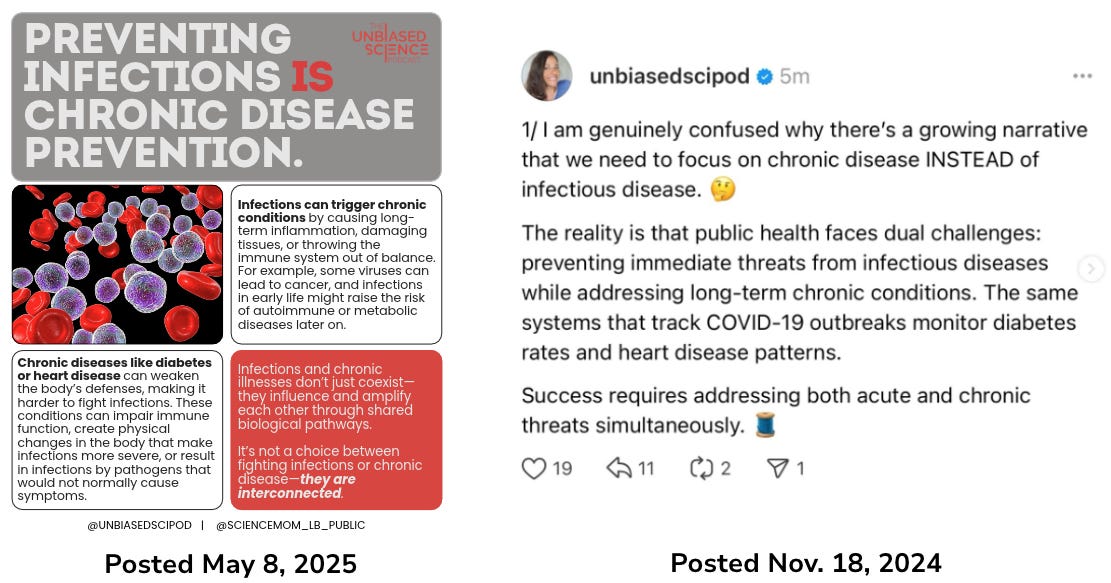
Originally posted on Unbiased Science social media platforms
on May
8, 2025 and November
18, 2024, respectively.
Most of what we try to prevent doesn’t kill people outright,
either. Vaccines prevent paralysis from polio and hearing loss after Hib
meningitis. Raw milk can carry E. coli strains that cause hemolytic uremic
syndrome (HUS), which can lead to kidney failure. In a raw
milk cheese outbreak this fall, half of the 18 sick people were
hospitalized, 3 developed HUS, and the median age was 4. Nobody died, and that
outbreak still meant hospital stays for kids too young to choose what they ate.
What about the healthy person who dies young anyway?
Someone always knows a grandpa who smoked a pack a day and
lived to 95. Most of us also know someone who did everything right and still
got sick, like the marathon runner who had a heart attack at 50 or the lifelong
nonsmoker diagnosed with lung cancer. Stories like these stick with us because
they’re unusual, and none of them tell us much about our own odds. Seatbelts
don’t save everyone in every crash, and they still cut
the risk of death by 45% for front-seat passenger car occupants. Prevention
lowers the odds of a bad outcome without eliminating them.
Sometimes the person taking the risk isn’t the one who
pays for it
The risk also doesn’t always fall on the person who decides
to take it. Babies too young to be vaccinated don’t get to decide whether
they’re exposed to measles, newborns don’t get a say in whether they receive
the vitamin K shot that prevents dangerous bleeding, and young children don’t
choose whether the milk or cheese they’re served is pasteurized. When our
choices affect other people, especially people who can’t protect themselves,
“we’re gonna go somehow” becomes a much harder position to defend.
Why the phrase is so tempting
In a small 2019
study, researchers in Israel found that the brain seems to file death as
something that happens to other people. The study’s lead
author noted that death used to happen all around us, and today it mostly
happens out of sight, in hospitals and care homes. When prevention works,
nothing happens, and a generation of parents (and plenty of clinicians) grew up
never seeing measles, Hib, or polio up close, which makes it a lot easier to
shrug at the risk. The phrase sounds carefree, though taken literally it’s an
argument for giving up time we could have had.
We all accept some risk, and the numbers matter
Accepting that we’re going to die is different from deciding
it doesn’t matter when or how. Plenty of people are at peace with their
mortality and still get vaccinated, get screened, and buckle up (if anything,
knowing our time is limited is a good reason to protect it).
None of us lives in a bubble, either. I drive every day, I
eat sushi, and I still enjoy a glass of wine, even knowing that moderate
drinking raises the risk of some cancers. Those are risks I’ve chosen to accept
for things I value, and I’m making that choice with a realistic sense of how
big they are. Prevention comes with tradeoffs, too, and not every precaution is
worth taking (some screening tests lead to false positives or treatment people
didn’t need). Reasonable people can weigh all of this differently.
That’s part of why it boggles my mind that the MMR vaccine,
about as close to a magic bullet as prevention gets, has become controversial.
Two doses of MMR are 97%
effective at preventing measles, and CDC considers people who get both
doses protected for life. Very few things we do for our health come anywhere
close to that.
Those tradeoffs only work when the numbers are right,
though. We can disagree about how much risk is acceptable, but we can’t each
choose our own facts about how big a risk is. A lot of confusion comes from
mixing up hazard and risk. A hazard is anything that could cause harm, while
risk is how likely that harm is at the amount and exposure we actually face.
Some ingredients on a vaccine label sound alarming (that’s the hazard), while
the risk from the tiny amounts in a vaccine is very small, especially next to
the risk from measles itself.
It’s also a big part of why so many of us in public health
bristle at the unproven wellness products overtaking our social media feeds.
Some of the same people who shrug at measles with “we all have to die of
something” will inject unapproved peptides in hopes of living longer, which
tells me they care a lot about when and how they die. Their math is off,
though, when a well-studied vaccine gets treated as the bigger danger and an
untested product gets treated as the safer bet.
So, the next time someone tells you we all have to die of
something, it’s fair to ask whether they’d rather it happen at 60 or at 90, and
whether they’d like the years in between to be healthy ones. None of these
choices make anyone immortal. A vaccine, a glass of pasteurized milk, or a
screening on schedule gives us better odds of more years, and healthier ones,
with fewer of them lost to illness we could have prevented. That’s the same
thing we ask of every seatbelt, smoke detector, and car seat. We’re all going
to die of something, and that’s no reason to stop doing our best to extend both
the quantity and the quality of our lives, within reason and as much as we can.
Stay Curious.

