
Thursday, August 6, 2015
The opposite of “death panels”
Legislation that Could End Unwanted Medical Treatment
 By Daniel Wilson
 Roughly 25 million Americans have been subjected to unwanted medical treatment at some point in their lives, and that means we have a healthcare system that is not listening to patients.
We all say we believe in patient-centered health
care, and now we have a bill in the U.S. Congress that would put our money
where our mouths are. Literally.
Senators
Mark Warner (D-VA) and Johnny Isakson (R-GA) introduced legislation this month
that would make sure Medicare recipients and their doctors know how much or how
little treatment those patients would want as they approach the end of life.
The Care Planning Act of 2015 would specifically create a Medicare benefit for
people facing grave illness to work with their doctor to define, articulate and
document their personal goals for treatment.


And then we invented Cracker Jacks®
How
Corn Became King
From: Kelly
April Tyrrell, University of Wisconsin-Madison

Ten thousand years ago, a golden grain got naked, brought people together and grew to become one of the top agricultural commodities on the planet.
Now, University of Wisconsin-Madison researchers have found that
just a single letter change in the genetic script of corn's ancestor, teosinte,
helped make it all possible.
Publishing in the journal Genetics this
month, UW-Madison genetics Professor John Doebley and a
team of researchers describe how, during the domestication of corn, a single
nucleotide change in the teosinte glume architectural gene (tga1) stripped away
the hard, inedible casing of this wild grass, ultimately exposing the edible
golden kernel.
"A huge proportion of the world is economically dependent on
the crop and understanding how it was constructed 10,000 years ago is more than
just intellectually satisfying," Doebley says. He has spent his long
career studying the evolution of maize, the plant from which corn grows.
"It tells us something about how important this genetic change was."
Rolling Up Some Common Sense with Willie Nelson
The
legendary singer and activist is cooking up his own brand of sustainable legal
pot.
By
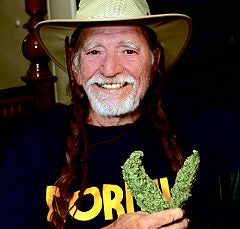 With marijuana prohibition finally ending in states and cities
across the land — including full legalization in Alaska, Colorado, Washington
State, Oregon, and Washington, D.C. — who could be better than my friend
Willie Nelson to lead the way for weed quality and social responsibility?
With marijuana prohibition finally ending in states and cities
across the land — including full legalization in Alaska, Colorado, Washington
State, Oregon, and Washington, D.C. — who could be better than my friend
Willie Nelson to lead the way for weed quality and social responsibility?
Wednesday, August 5, 2015
The only laws broken were those broken by the anti-choice activists

Obviously this is untrue, but of course the “stop abortion at all
costs” crowd doesn’t care about that. Well, it turns out that what these people
are doing is not only dangerous to women and, of course, downright crazy– it is
also criminal.
The “Center for
Medical Progress” is the nutty organization behind those now-infamous videos.
Well, a suit has been filed against them, courtesy of the National Abortion
Foundation, to keep them from making videos of meetings public. The restraining
order prohibiting the release of the footage has been granted. From RH Reality Check:


A toast to good health!
Cancer Research UK
 Resveratrol, a chemical found in red grapes, is more effective
in smaller doses at preventing bowel cancer in mice than high doses, according
to new research* published today (Wednesday) in the journal Science
Translational Medicine.
Resveratrol, a chemical found in red grapes, is more effective
in smaller doses at preventing bowel cancer in mice than high doses, according
to new research* published today (Wednesday) in the journal Science
Translational Medicine.
Previous research looked at high doses of purified resveratrol
to study its potential to prevent cancer. This is the first study to look at
the effects of a lower daily dose -- equivalent to the amount of resveratrol
found in one large (approx. 250ml) glass of red wine -- comparing it with a
dose 200 times higher.
Results from bowel cancer-prone mice given the smaller dose
showed a 50 per cent reduction in tumour size while the high dose showed a 25
per cent reduction. Lower doses of resveratrol were twice as effective as the
higher dose in stopping tumours growing, although this effect was only seen in
animals fed a high-fat diet.
Samples of tumours from bowel cancer patients given different
doses of resveratrol showed that even lower doses can get into cancer cells and
potentially affect processes involved in tumour growth.
Social Impact Bonds Can Help Solve Difficult Social Problems
 Capital is one of the biggest hurdles
By Greg Keesling
Addressing societal issues is both a moral and fiscal imperative for our country. High recidivism rates, low educational attainment, and high incidents of preventable diseases are just a few of the harmful and costly issues communities face nationwide. Though governments bear the brunt of these problems by having to allocate an ever-increasing share of taxpayer funds for remediation, businesses increasingly feel the effects.
Areas
with high levels of crime or an undertrained or unhealthy workforce are
unattractive places to conduct business. When public sector resources are
stretched thinner and thinner, the fiscal burden is often passed along to
business owners in the form of tax increases.
It's worth noting that while
governments are usually responsible for remedying the harmful effects of
societal issues, it is the private sector that often has the dynamism and
dexterity needed to address their root causes.
Tuesday, August 4, 2015
How RI found a new education commissioner
Searching for Dr. Wagner
By Wendy Holmes in Rhode Island’s Future

Deborah Gist’s Ocean State Voyage has ended and her replacement Dr. Ken Wagner begins his tenure as Rhode Island’s Commissioner of Elementary and Secondary Education. The hiring process, with its “listening sessions” and its search for a gentler more accommodating commissioner, signals a departure from the Gist/Mancuso regime.
It remains to be seen if this difference is substantive or merely cosmetic. Governor Raimondo promised an open and inclusive hiring process.
Students, teachers, parents, school committee representatives, board members, administrators, charter school advocates and union leaders known or recommended to the Governor were invited to attend so-called “listening sessions” and make their views known. Nine listening sessions were held with the Governor and the new Board of Education Chairwoman Barbara Cottam, among the listeners.
Discussions focused on the desirable characteristics of a prospective commissioner. Participation was by invitation only.
Raimondo took charge of the search for Gist’s replacement with the blessing of the BOE and its new chairwoman. In May, Brad Inman, the governor’s Director of Constituent Services, wrote in response to my queries: “The Board of Education asked the Governor’s office to do the initial vetting and present the Board with a list of finalists for their consideration. It will then be the Board who selects the Commissioner.”
By Wendy Holmes in Rhode Island’s Future

Deborah Gist’s Ocean State Voyage has ended and her replacement Dr. Ken Wagner begins his tenure as Rhode Island’s Commissioner of Elementary and Secondary Education. The hiring process, with its “listening sessions” and its search for a gentler more accommodating commissioner, signals a departure from the Gist/Mancuso regime.
It remains to be seen if this difference is substantive or merely cosmetic. Governor Raimondo promised an open and inclusive hiring process.
Students, teachers, parents, school committee representatives, board members, administrators, charter school advocates and union leaders known or recommended to the Governor were invited to attend so-called “listening sessions” and make their views known. Nine listening sessions were held with the Governor and the new Board of Education Chairwoman Barbara Cottam, among the listeners.
Discussions focused on the desirable characteristics of a prospective commissioner. Participation was by invitation only.
Raimondo took charge of the search for Gist’s replacement with the blessing of the BOE and its new chairwoman. In May, Brad Inman, the governor’s Director of Constituent Services, wrote in response to my queries: “The Board of Education asked the Governor’s office to do the initial vetting and present the Board with a list of finalists for their consideration. It will then be the Board who selects the Commissioner.”

Arrowhead is doing it again this Saturday!
Charlestown's first "Hometown Hero" offers another day of totally free dental care to the community
And congratulations again to Drs. Gouin (father and son) and Dr. Nectara Stefano for being named among Rhode Island's top dentists by Rhode Island Monthly.

And congratulations again to Drs. Gouin (father and son) and Dr. Nectara Stefano for being named among Rhode Island's top dentists by Rhode Island Monthly.

URI research professor, colleagues launch campaign to fight cervical cancer
HPV vaccine offered at Dr. Annie De Groot’s Clinica
Esperanza, Aug. 14

KINGSTON, R.I. –When a University of Rhode Island research professor and her colleagues launch a campaign to fight cervical cancer in August volunteers will be wearing colorful handmade scrubs.
Look closely at the medical tops and you’ll see images of the human papillomavirus, or HPV, that can cause the deadly cancer. The scrubs are African storytelling cloths, which are helping to wipe out the disease in Rhode Island.
The first of three shots of the HPV vaccine will be offered for free to uninsured men and women, ages 19 to 26, from 2 to 7 p.m., Aug. 14 at Clinica Esperanza/Hope Clinic, a free clinic at 60 Valley St., Providence.
Dr. Annie De Groot, clinic founder and director and a URI vaccine researcher, has been working closely with health officials in the West African country of Mali to screen women for cervical cancer.
Charlestown whacked by fast and furious storm
Hurricane-strength for half an hour
 By Will Collette
If you live in Charlestown and are reading this, it means you have a back-up generator (or getting it on your cell phone) since the whole town is pretty much powerless.
According to National Grid's power outage map, will remain so until about 2:30 PM.
The storm raged through after 6 AM and lasted only about 20 minutes.
It downed trees and branches, killed the power and dumped a lot of rain.
The Providence Journal cites a DEM report that a "number of campers were injured" at Burlingame Park, but had no further details.
The Westerly Sun says it was ten injured, with two transported to Westerly Hospital, five to South County and three treated on the scene.
The Boston Globe reported that "One observer reported a wind gust of 83 miles per hour in Charlestown, R.I."

If you live in Charlestown and are reading this, it means you have a back-up generator (or getting it on your cell phone) since the whole town is pretty much powerless.
According to National Grid's power outage map, will remain so until about 2:30 PM.
The storm raged through after 6 AM and lasted only about 20 minutes.
It downed trees and branches, killed the power and dumped a lot of rain.
The Providence Journal cites a DEM report that a "number of campers were injured" at Burlingame Park, but had no further details.
The Westerly Sun says it was ten injured, with two transported to Westerly Hospital, five to South County and three treated on the scene.
The Boston Globe reported that "One observer reported a wind gust of 83 miles per hour in Charlestown, R.I."
We don't make it into the Boston Globe very often.
Serve them with fava beans and a fine chianti
 Long-time
readers of this blog know that we have had a more or less steady procession of
trolls who have inhabited these precincts. They lurk. They come and go. Some
are grumpy. Some argue; some take a thread and take it off point.
Long-time
readers of this blog know that we have had a more or less steady procession of
trolls who have inhabited these precincts. They lurk. They come and go. Some
are grumpy. Some argue; some take a thread and take it off point.
Some are
annoying. I leave them alone so long as they live within the rules of the blog
(no insulting your host because you are in my living room, no cursing, no
conspiracy-mongering, a basic level of civility—and no monopolizing the
comments section).
I
have never asked others who blog what they do with their trolls. I just play it
by ear. On severe; occasions, I have banned them when they broke the rules.
Sometimes I put them in a queue to moderate their comments before they are
posted to make sure they don’t continue their bad behavior. I give them a
warning before there are consequences. But I am generally very tolerant.
It
turns out that there are people who actually study troll behavior and offer
advice about how to deal with them. The New York Times recently published an article on
“the epidemic of facelessness.” This is a phenomenon new to our age, in which
people communicate without having face-to-face contact.
Much online interaction
is between complete strangers. Online interactions can sometimes allow
people–in their anonymity–to unleash a level of rage and hostility that they
would never express in a face-to-face encounter. Some people have received
death threats or rape threats online from total strangers, which happens to be
criminal activity.
Stephen
Marche writes:
Subscribe to:
Posts (Atom)