Menu Bar

Home           Calendar           Topics          Just Charlestown          About Us

Tuesday, June 7, 2016

Huckster in Chief

President or Pitchman?
By Phil Mattera in the Dirt Diggers Digest

In submitting his new financial disclosure form to the Federal Election Commission, Donald Trump described it as “the largest in the history of the FEC.” 

Aside from being another example of his compulsive need to boast, the statement seems to demonstrate an astounding ignorance of what the disclosure process is all about.

It also raises questions as to what Trump’s entire candidacy is all about. 

Since announcing his bid for the Republican nomination last June, Trump has made countless statements about his supposed business prowess and the success of his various enterprises.

He even insisted that multiple corporate bankruptcies were indications of shrewdness rather than failure, and he downplayed the long series of controversies and scandals that have marked his business career.


Monday, June 6, 2016

Do FORENSIC science at home

Do Science At Home

Nope, he won't change us

Pic of the Moment

Under pressure

Penn State

Credit: Penn State University
A new, high-pressure technique may allow the production of huge sheets of thin-film silicon semiconductors at low temperatures in simple reactors at a fraction of the size and cost of current technology.

A paper describing the research by scientists at Penn State University was published on May 13, 2016, in the journal Advanced Materials.

"We have developed a new, high-pressure, plasma-free approach to creating large-area, thin-film semiconductors," said John Badding, professor of chemistry, physics, and materials science and engineering at Penn State and the leader of the research team.

"By putting the process under high pressure, our new technique could make it less expensive and easier to create the large, flexible semiconductors that are used in flat-panel monitors and solar cells and are the second most commercially important semiconductors."


Chemical giants carry lots of baggage to their wedding

Monsanto’s German Suitor Has Its Own Tainted Record
By Phil Mattera in Dirt Diggers Digest

Monsanto, one of the most controversial corporations in the United States, now finds itself the target of a takeover campaign by German pharmaceutical and chemical giant Bayer. Would a change in ownership improve the behavior of the biotechnology company dubbed “Mutanto” by its critics?

Answering that question requires a look at Bayer’s own track record, which is far from unblemished. 

Most Americans associate Bayer with aspirin. The company created the analgesic in 1899, but during World War I the U.S. government seized Bayer’s American assets and allowed other firms to sell aspirin under the Bayer name until the German company bought back the rights in 1994.

In the 1920s Bayer was absorbed into the massive IG Farben cartel, which used slave labor and supported the Nazi regime.

After the Second World War it re-emerged as one of the companies created through the break-up of IG Farben. During the 1950s it began to return to the U.S. market through efforts such as a joint venture with Monsanto (in its pre-agribusiness era) called Mobay Chemical.

As Bayer has stepped up its U.S. involvement over the past two decades it has gotten embroiled in one scandal after another.


The next one - looks like another miss


Red Cross messes up again

After Mississippi Flooding, Red Cross Stumbles Again
by Sarah Smith for ProPublica

When record-high floodwaters hit counties across Mississippi in March, over 650 homes sustained major damage or were destroyed entirely. People fled for shelters, and roadways were washed out. State officials told the press the damage was the most widespread they'd seen since Hurricane Katrina.

The American Red Cross quickly dispatched volunteers. Two of them arrived in Sunflower County in the Mississippi Delta looking to hand out clean-up kits to flood victims.

The only problem: They weren't anywhere near the parts of Sunflower affected by flooding, according to Ben Grant, the county's director of emergency management.

Grant spotted the volunteers while driving in an unaffected area. Once he figured out what they were doing, he told them they were in the wrong place.


Sunday, June 5, 2016

Some people don’t want you to vote YES to save the General Stanton Inn

And they are willing to commit criminal acts to “convince” you
By Will Collette

Unless it was done by a passing bus tour from the Nordic Lodge, it appears that some Charlestown residents engaged in a lot of vandalism and theft sometime Friday night to make a negative political point. 

Nearly all the yard signs supporting town purchase of the General Stanton Inn were vandalized wih spray-paint or stolen.

Charlestown Police have been notified. Theft and vandalism are crimes under Title 11 of the RI General Laws.

In 2014, there was a lot of sign theft, especially of signs for Democratic candidates. The CCA Party’s signs seemed to remain largely untouched. 

It bodes ill for this current campaign season to see this kind of thug behavior happen so early and against such as innocuous campaign as the one to Save the General Stanton Inn.

The yard sign in front of my house was one of those hit by vandals with a spray paint can. 

I’m leaving the sign up, graffiti and all, so town residents can see the kind of people who are opposed to a town citizens’ initiative for historic preservation.


Saving gas


And so it goes

they hate us cause they anus

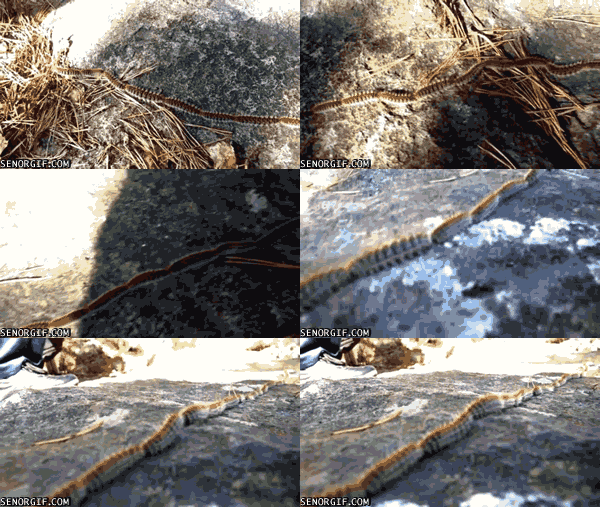
Caterpillars bugging us

BUT DEM Says Conditions Expected to Improve Next Month

bug insect caterpillar

The Rhode Island Department of Environmental Management (DEM) is advising homeowners that high concentrations of caterpillars observed statewide may cause short-term defoliation of trees over the next few weeks.

Typical damage, most commonly to oaks and other hardwood species, includes small holes in leaves or leaves that have been chewed down to the veins. 

These conditions are temporary and should not cause long-term damage to otherwise healthy trees. 

By the end of next month, impacted trees should start to re-foliate with the proper care. 

Watering trees during times of drought is advised during recovery from defoliation. Applying fertilizer is not recommended for trees that have been defoliated.


“Champion Trees” few and far between

By FRANK CARINI/ecoRI News staff

This European beech, on Old Post Road in Charlestown, is one of Rhode Island’s grandest trees. (R.I. Tree Council)

By his own count, Rhode Island has about 700 “champions.” John Campanini Jr. should know; he’s spent the past 25 years traveling the state’s back roads, main roads, dirt roads and hiking trials searching for them.

Development, disease and natural disasters have wiped out many of Rhode Island’s grandest trees. Trees with significant trunks — measured 4.5 feet above the ground — majestically tall and with impressive crown spreads account for only a small percentage of the state’s canopy cover, according to the longtime director of the Rhode Island Tree Council.

“The 1938 hurricane is the new starting point because the storm was so destructive,” Campanini said. “Only about 5 percent of the trees that survived that hurricane were of the spectacular variety. There’s not many of them left.”

In the 1930s, likely due in part to the decline of the American elm, searching for spectacular trees became a hobby, as tree enthusiasts began recording the biggest trees in their city, town and state. The earliest tree measurement Rhode Island has on record was made March 16, 1931 by Hope resident John B. Hudson, for a black oak.


How the Tea Party got thrown overboard. At us.


Every time I run into Jeff Nesbit, he makes another implausible claim about some accomplishment in his life: He helped FDA Commissioner David Kessler roll Big Tobacco on regulations. 

He was a Washington correspondent and a writer of 19 inspirational novels. He’s in the record books for a 24-foot long jump for Duke’s track team. He helped the National Science Foundation fend off a very un-sciencey George W. Bush Administration and Congress. And he was Vice President Dan Quayle’s chief spokesman.

Each time I resist the temptation to stage an impromptu intervention to get this poor man out of Walter Mittyville. The problem is he’s actually done all of these things. 

Now, along comes one more:

Poison Tea is his new investigative book, and let’s just say it’s less inspirational and more infuriating than his other books. Nesbit, who now runs the influential climate communications group Climate Nexus, was in a position to write this book because he was once a communications consultant for a wildly successful Koch Brothers front group.

Really.

Saturday, June 4, 2016

What's NOT in the Charlestown budget

Full time residents in Narragansett will get a tax break but not in Charlestown
By Will Collette

"I just love Charlestown where us summer people are treated like kings"
In 2011, Charlestown Democrats optimistically proposed a property tax reform that is pretty common in Rhode Island and elsewhere in the US, especially in municipalities with large percentages of part-time owners: the Homestead Tax Credit.

Charlestown, like other towns, already gives tax credits to veterans, the blind and disabled, low-income senior citizens, private owners of farms, woodland and open space, and to religious and non-profit groups.

So why not give a tax credit to those of us who make Charlestown our home? Well, that proposal for tax relief for Charlestown residents went down to crashing defeat in an event often referred to as “The Riot of the Rich.”

Scores of non-residents and supporters organized by the RI Statewide Coalition and its spawn the Charlestown Citizens Alliance (CCA Party), stormed the Town Council chambers. They condemned the idea of making our summer beach front property owners pay a little more to give Charlestown working families a break as the worst thing since the Russian Revolution.

Soon to be $10.22 under the proposed budget up for a vote on Monday
All this despite the carefully researched presentation by the Charlestown Democrats showing that the concept was well-tested, compatible with Charlestown’s existing system of tax exemptions and actually very modest in cost.

The fact that most of the campaign funding for the Charlestown Citizens Alliance comes from non-residents may have had something to do with the CCA Party's violent reaction.

I started thinking about that awful experience as I looked carefully at Charlestown’s new budget which is coming up for a vote on Monday. 

It contains the eighth consecutive property tax rate hike, one in each year the CCA Party has controlled town government.

I also received the following news release that reported how the town of Narragansett, with demographics similar to Charlestown, is about to give its citizens a Homestead tax break. Enabling legislation by their state Representative Carol Hagan McEntee has passed the House and is heading for likely Senate approval.

Read this:

What's your blood type?

Determine Your Blood Type