In the days before Labor Day became
an “off ramp” from summer to fall
By Scott Molloy
Two thousand workers
marched in to history 125 years ago when they participated in the state’s first
Labor Day parade in 1893 in Providence, while a crowd of ten thousand watched
and eventually made their way to Rocky Point. In the midst of the
financial panic of 1893 Rhode Island workers secured a long-sought ambition—the
establishment of the first Monday in September as a legal holiday.
The state’s horny-fisted
sons and daughters of toil had marched, petitioned, and agitated for over a
decade. Rhode Island workers witnessed New York and Oregon pass holiday
legislation in 1887 and by the spring of 1893 most other states had followed
suit. The General Assembly, under the prodding of elected representatives from
various mill towns, finally joined the bandwagon. Governor Russell Brown signed
the authorization.
Monday, September 4,
1893 was a beautiful day by all accounts. Tens of thousands of Rhode Islanders
walked or took a horsecar or electric trolley to the capital city. Three
thousand union members lined up in divisions behind the Caledonia Fife and Drum
Band, the 12-piece Olneyville Cadet Corps, L’Harmonie Canadienne Band and
several other musical groups.
Both the cigarmakers and the horseshoers fielded
floats. The cigarmakers contrasted the favorable conditions in a union shop
against the unregulated toil in a tenement sweatshop in a vivid display.
The Rhode Island Central
Labor Union, predecessor to the state AFL-CIO today, sponsored the parade.
Eighteen skilled unions participated including the Carpenters Local 94,
Painters and Decorators Number 195, and Providence Typographical Union Local
33. Those three unions still exist a century later.
Other organizations like
the Cornice Workers, Mule Spinners and Pavers and Pounders Union have long
since affiliated with other labor groups as technology altered jobs over the
years. Many participating unions that day carried sparkling new banners; the
printers wore fancy badges that cost eight cents each; and the Plasterers
donned white hats, aprons and canes.
The march began at 9:30
and “put all previous civic processions in the shade.” Starting from Market
Square, the procession tramped to a reviewing stand in Exchange Place and then
snaked its way through downtown, countermarching on several packed
thoroughfares.
Enthusiastic working people cheered their class colleagues the
entire route.
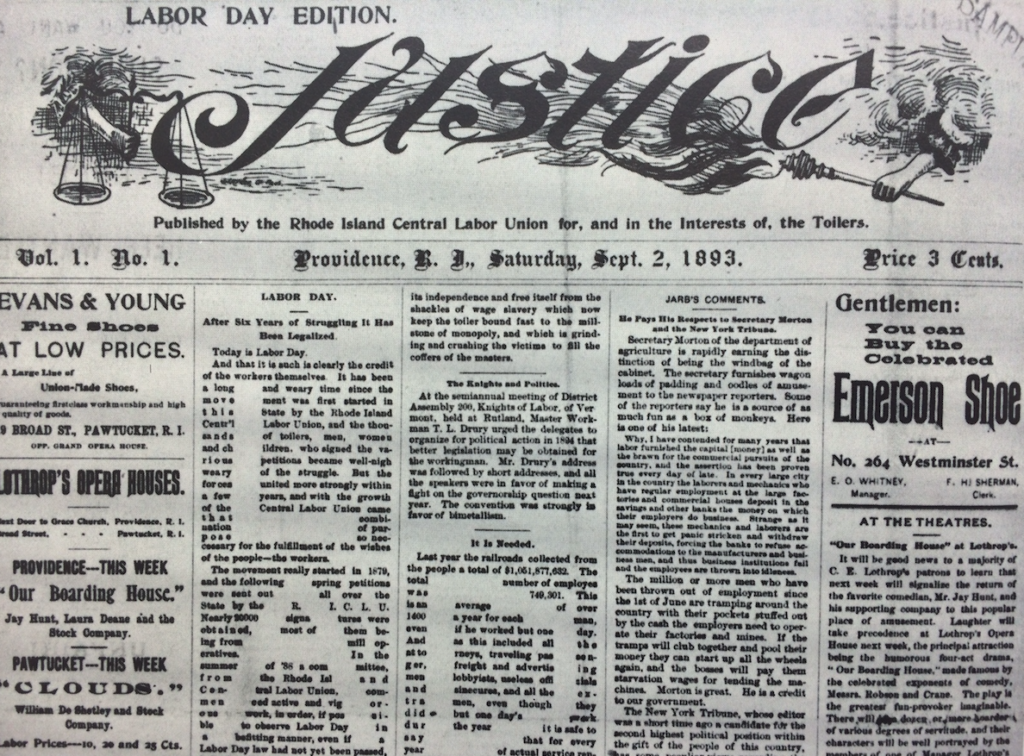
 The local union newspaper, Justice, remarked with
male conceit that “the principal streets were, packed by the crowds of wives,
sisters and sweethearts of the toilers.” An estimated 10,000 spectators jammed
the city wharves off Dyer Street at the parade’s end to embark on a steamboat
trip to Rocky Point.
The local union newspaper, Justice, remarked with
male conceit that “the principal streets were, packed by the crowds of wives,
sisters and sweethearts of the toilers.” An estimated 10,000 spectators jammed
the city wharves off Dyer Street at the parade’s end to embark on a steamboat
trip to Rocky Point.
The throng of revelers
was so immense that the Continental Steamboat Company had to engage several of
its competitors to handle the crowd, the largest of the season at the Rocky
Point amusement park.
Upon arrival, the marchers reassembled and trooped to a
grove near the park pavilion for a two hour rally. Speeches by labor notables
from around New England invigorated the listeners by lambasting the ruling
industrial elite. After the formalities, guests filled every available seat in
the dining hall for the obligatory Rhode Island clam dinner. Visitors then
patronized the amusement rides or nearby ballfield “and saw the victors in the
various games wipe the ground with their opponents.”
The editors of the Providence
Journal marveled, although not directly, about the exemplary behavior
of the working class crowd. No arrests or trouble marred labor’s first official
holiday in Rhode Island. Both Capital and Labor, however, felt a deep
uneasiness about conditions in the state and the nation.
Although there had
been a few good economic years of late, the lingering memory of the drawn-out
panic of 1877 and a string of subsequent recessions heightened the uneasy truce
between the two.
Employer-employee
friction was certainly not unique to Rhode Island, but several local conditions
stoked the fires of class antagonism. A half century earlier workers mobilized
and even armed themselves in the legendary Dorr War of 1842. They attempted to end
political discrimination against the working class by altering the State
constitution to allow poor citizens to vote. Rhode Island authorities called
out the militia, split native born workers from their Irish-born allies, and
quelled the artisan traditions by banding together in the years before and
after the Civil War. Factory hands waged spontaneous walkouts for a ten hour
workday throughout the 1870s. In 1885, District 99, the Rhode Island branch of
the Noble and Holy Order of the Knights of Labor went public and shook the
state’s power structure.
The state’s Yankee
manufacturers had aligned themselves into an informal ruling, political party.
With the demobilization of the militia after the Dorr War in 1842 the mill
barons employed the columns of the Providence Journal to demonstrate
that the power of the pen was greater than the sword at least in quieter times.
The nascent Republican Party became the standard bearer of genteel and corrupt
rule in postbellum Rhode Island. Influential politicos like Henry Bowen
Anthony, Charles “Boss” Brayton and U.S. Senator Nelson Aldrich maintained the
constitutional machinery of minority rule while imaginatively scheming to
perpetuate that control over future generations. On a day-to-day level mill
owners and foremen controlled the workday, company housing and factory stores.
 No simple trade unionism
could undermine such a malignant system. The Knights, however, aimed beyond
mere labor reform. They envisioned a new commonwealth where all shared in
America’s bounty. The Knights enrolled women, African-Americans and immigrants
along-side the predominantly white male workforce.
No simple trade unionism
could undermine such a malignant system. The Knights, however, aimed beyond
mere labor reform. They envisioned a new commonwealth where all shared in
America’s bounty. The Knights enrolled women, African-Americans and immigrants
along-side the predominantly white male workforce.
They organized cooperative
stores for inexpensive products; ran a string of union-endorsed restaurants for
workers; and even operated a children’s nursery in Olneyville. In the shops
they established grievance procedures, democratic practices and even controlled
production in a few places.
Politically the Knights agitated for the passage of
the Bourn Amendment, ‘a state Bureau of Labor Statistics, and safety
legislation. Although the grand vision eventually failed, in the late 1800s due
to a variety of factors, a local writer for the Knights exclaimed that “One
need not go to the state house to perceive that labor breathes freer in Rhode
Island than ever before.”
The Knights bequeathed
their legacy of industrial democracy to the Rhode Island Central Labor Union,
an amalgamation of skilled trades, which the Holy Order helped form in 1884.
The symbolic concept of the labor parade, festival, and holiday was well known
to both groups. In fact Rhode Island labor unions hosted a mammoth parade and
excursion to Rocky Point on August 23, 1882—just two weeks before the “first”
Labor Day parade stepped off in New York City. Throughout the 1880s local
unions marched, sponsored picnics, and petitioned the Legislature for a legal
holiday.
When the General
Assembly and the -Republican machine capitulated to labor’s demand for its own
holiday, in 1893, the surrender was only a strategic retreat. There were
neither penalties for staying open nor any compensation for lost time. With the
specter of the Knights of Labor still haunting the industrial establishment,
the powers-that-be probably figured that a tactful concession on the issue of a
legal Labor Day might serve as an escape valve for disenchanted workers and
their leaders during hard, economic times.
Some factory owners
diplomatically welcomed the opportunity to provide a payless holiday. Already
local firms were cutting wages and shortening hours. At Gorham’s, 200 out of
1,500 were on layoff while those on the job tolled only four days a week at
Brown and Sharpe more than half of the 1,100 workers were out. The Journal editors
fretted about labor-led unemployment demonstration in New York City and
predicted “it is probable that the tide of business depression may yet rise
high enough to cause trouble in New England.”
Labor, for its part, had
circled the wagons. The Rhode Island Central Labor Union affiliated with Samuel
Gompers’s American Federation of Labor in February, 1893, as a way to
strengthen, national solidarity. The building trades had formed a protective
council in the state in April in order to foster greater cooperation among
construction unions. However, despite the militant rhetoric that still sallied
forth from a united movement, a great change had occurred since the recent
demise of the Knights and the ascendancy of the Central Labor Union.
At its peak the Knights
claimed 12,000 members scattered among a far-flung Rhode Island workforce that
would be characterized today as “multi-cultural.” On the other hand, the new AF
of L affiliate could claim only 5,000 workers, heavily concentrated among the
skilled. Their predominantly white, male members represented what historians
would later call the “old immigrants” English, Irish, and German craftsmen.
Most jobs in the state were unskilled ones, symbolized by faceless mill hands
increasingly drawn from eastern and Southern Europe and French-Canada—America’s
“new immigrants.” The Knight’s inclusive solid phalanx gave way to the
well-organized but narrowly drawn population of the American Federation of
Labor. This union wanted a piece of the pie certainly, but not the whole
pastry.
As Rhode Island workers
marched into history that beautiful Monday morning, September 4, 1893, sweating
editors at the Providence Journal dripped acid on their
written opinion of the festivities. “If workingmen would employ Labor Day in
reflecting on how much has been accomplished for labor in the last five
centuries and how little of it has been accomplished by the quarrels and
struggles of labor and capital, the holiday would be a good deal more
beneficial than it is to be feared its present method of observance makes it.”
Not to be outdone, a set of equally opinionated editors wrote in the first
issue of the Central Labor Union’s own weekly newspaper, Justice:
“Labor Day is frowned upon only by those who wish to live upon (other’s) labor.
And they know that when Labor once recognizes its rights, it will assert its
independence and free itself from the shackles of wage slavery which now keep
the toiler bound fast to the millstone of monopoly and which is grinding and
crushing the victims to fill the coffers of its masters.” With those editorial
outbursts Labor Day began its initial observance in Rhode Island.
This year marks the
125th anniversary of the state’s first Labor Day parade. Over the years,
organized labor transformed the traditional working class into a reputable
middle class.
During the Great Depression the Congress of Industrial
Organization signed up the unskilled Americans left behind by the older
federation. In 1955 both the AF of L and the CIO ended the cleavage through a
merger.
As union members gained respectability and lost their grandparents’
fervor, parades and picnics came into disfavor. As early as 1937 the Rhode
Island Labor News complained that “with the coming of the automobile, which
afforded opportunities to workers to take their families out for a weekend
trip, it became more and more difficult to secure large numbers as participants
in parades.” The holiday became the exit ramp from summer one last three day
weekend to mark the passing of seasons.
In recent years the
labor movement, led by the Rhode Island Labor History Society, has held an
annual event on Labor Day at Moshassuck Cemetery in Central Falls, site of the
infamous Saylesville Massacre in 1934 when three mill operatives actually died
there while seeking shelter from the state National Guard during the national
textile walkout.
The speaker, chosen by the Society, usually combines labor
history with the current state of the unions–Rhode Island is still one of the
most heavily organized states in the country. The Society placed a beautiful
granite monument there several years ago. Some of the gravestones still contain
bullet marks as a reminder of more bitter times.
 If
we proactively implement effective fisheries management and limit global
temperature rise, the world’s oceans still have the potential to be
significantly more plentiful in the future than today, despite climate change.
If
we proactively implement effective fisheries management and limit global
temperature rise, the world’s oceans still have the potential to be
significantly more plentiful in the future than today, despite climate change. 




/cdn.vox-cdn.com/uploads/chorus_asset/file/12669761/Summer_2018_White_House_intern_class.jpg)