Menu Bar

Home           Calendar           Topics          Just Charlestown          About Us

Friday, September 3, 2021

Thank you, Ida – shellfishing ban at local salt ponds till next week

Remnants of Hurricane Ida Rainfall Necessitate Shellfish Harvest Closures

The Rhode Island Department of Environmental Management (DEM) is announcing that the excessive rain from the remnants of Hurricane Ida have necessitated closures of shellfish harvesting for many of the state's shellfish harvest areas in Narragansett Bay and the coastal salt ponds.

Coastal salt ponds: Shellfish harvest in the coastal salt ponds (Point Judith Pond, Potter Pond, Ninigret Pond, Quonochontaug Pond, and Winnapaug Pond) closed at noon today and is scheduled to reopen at noon on Thursday, Sept. 9.

Narragansett Bay: Upper Bay shellfish conditional Area A, and Upper Bay Area B closed today at noon and will remain closed until Sunday, Sept. 12, at noon. Greenwich Bay closed today at noon and is scheduled to reopen at noon on Thursday, Sept. 9. In addition, the waters south of Conditional Area B to a line from Quonset Point to the southern tip of Prudence Island to Carr Point in Portsmouth closed at noon today and are scheduled to reopen at noon on Thursday, Sept. 9. Mount Hope Bay and the Kickemuit River closed today at noon and are closed until further notice.

The shellfish harvest closures were put into effect after the remnants of Hurricane Ida passed through the area and dropped about four to eight inches of rain in Rhode Island. This excessive rain caused extreme stormwater runoff and, in some areas, triggered wastewater treatment bypasses, combined sewer overflows, and sewer system overflows that can convey contaminants into shellfish harvest areas.

For people who really love square food

And really care about the production chain's automatization and marketing investments

Squareat news release

Healthy, tasty, naturally long lasting and with well preserved nutrients.
EDITOR'S NOTE: This is an actual company news release for an actual product. I did not make this up. Credit to Dave Barry's blog for spotting this item.  - Will Collette

Squeareat's fundraising on the Wefunder platform, already reached the minimum target (100,000 dollars) and new investors continue every day to believe in the project by bringing the company closer to the final goal of $700,000 dollars.

Squareat is an innovative startup created to revolutionize the "ready to eat" food industryHow?

The answer is modular squared food.

Squareat's unique production chain allows the transformation of raw food into standardized 50-gram squares that are healthy, naturally long lasting, tasty and easy to store and deliver.

Squareat transforms raw food into "ready to eat" 50gr squares.

How?

The answer is modular squared food.

"We have experienced first-hand the inefficiencies of traditional meal plan services and have seen a clear possibility of disruption in bringing a complete transformation to a sector that is growing tremendously fast, introducing a brand-new concept. Thanks to the Squared shape we are able to run a mass production while using gourmet techniques. Thermal shocking conservation, low temperature cooking, and vacuum sealing packing allow us to produce superior quality food and sell it at an affordable price." Paolo Cadegiani, Founder and CEO of the company, explains.


Unverified reports of vaccine side effects in VAERS aren’t the smoking guns portrayed by right-wing media outlets

They can offer insight into vaccine hesitancy


Studying trends in public adverse event reporting could help
researchers address vaccine hesitancy and misinformation. 
Pict Rider/iStock via Getty Images Plus
Chances are you may not be not familiar with the Vaccine Adverse Event Reporting System, or VAERS. Co-managed by the U.S. Centers for Disease Control and Prevention and the Food and Drug Administration, VAERS was established in 1990 to detect possible safety problems with vaccines.

Unfortunately, the anti-vaccine movement has used this once-obscure database to spread misinformation about the COVID-19 vaccine.

VAERS is ripe for exploitation because it relies on unverified self-reports of side effects. 

Anyone who received a vaccine can submit a report. And because this information is publicly available, misinterpretations of its data has been used to amplify COVID-19 misinformation through dubious social media channels and mass media, including one of the most popular shows on cable news.

We are political scientists who study the social, political and psychological underpinnings of vaccine hesitancy in the U.S. In our recently published research, we argue that VAERS, despite its limitations, can teach us about more than just vaccine side effects – it can also offer powerful new insights into the origins of vaccine hesitancy in the U.S.

Thursday, September 2, 2021

Cruelty toward the powerless

The New Republican Supreme Court

By Robert Reich

The U.S. Supreme Court won’t block a Texas law that allows private individuals to sue to enforce a ban on abortion after about six weeks of pregnancy – before many women are even aware they’re pregnant. The law went into effect Wednesday, September 1. 

It’s the most restrictive abortion law in the country, imposing a huge burden on women without the means or money to travel to another state where later abortions are legal.

It’s also a sign that the Republican-appointed justices, who now hold six of nine seats on the Court, are ready to overturn the Court’s 1973 decision in Roe v. Wade, striking down anti-abortion laws across the nation as violating a woman’s right to privacy under the fourteenth amendment to the Constitution.

Last week the Court held that Biden’s moratorium on evictions was illegal. A few days before, it refused to stay a lower court decision that people seeking asylum at the southern border must remain in Mexico until their cases are heard – often subjecting them to great hardship or violence.

What links these cases? Cruelty toward the powerless.

Just get the f****g shot

By John ColeThe Times-Tribune


How do you argue with this logic?


COVID vaccine clinics on September 8 and 11 in Bradford

Get your shots locally 

Wood River Health Services (WRHS) has partnered with The RI Department of Health, Westerly Hospital and the Town of Westerly to host two walk-in vaccine clinics this month. 

The clinics will be held at Bradford Elementary School at 15 Church Street in Bradford on September 8 from 3PM to 6PM and September 11 from 9AM to 12PM. Vaccines are free and any individual aged 12 and over can receive one.

“As a doctor, I am asked every day by patients about the safety of COVID-19 vaccines,” stated Dr. Lisa Menard-Manlove, a Board-Certified Family Medicine Physician who has worked for WRHS since 2003. 

“I tell them: the vaccines are safe and effective. In my medical opinion, anyone 12 or older should get one. It is only with vaccinations that we will be able to achieve herd immunity and bring an end to this pandemic.”

No appointment is necessary to secure a vaccine at the clinic. Individuals should arrive during the appointed times on September 8 or 11. They will be given information about what to expect after receiving the vaccine and monitored for 15-30 minutes after their dose. Recipients will be provided with a vaccination card and scheduled for their second dose in 3-4 weeks.

Bat speak?

Bat pups babble and bat moms use baby talk, hinting at the evolution of human language


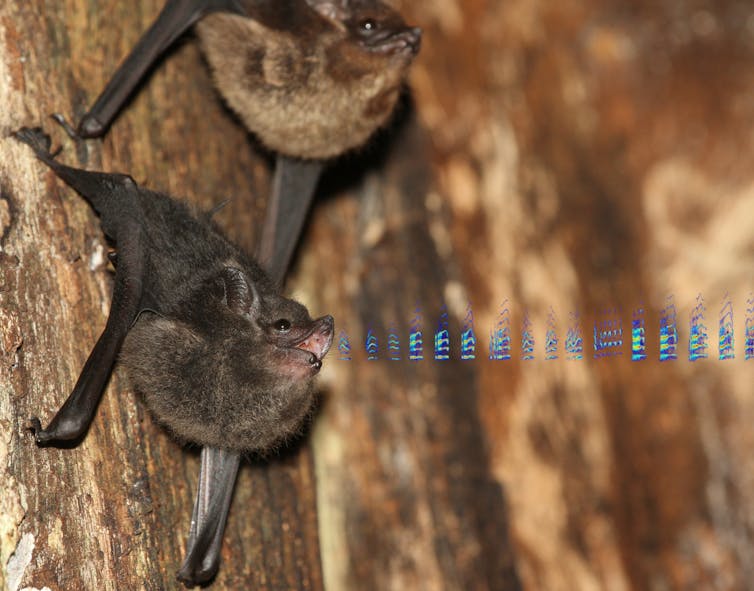
A babbling pup produces distinct syllables, visualized in this composite image. Michael Stifter and Ahana FernandezCC BY-ND

“Mamama,” “dadada,” “bababa” – parents usually welcome with enthusiasm the sounds of a baby’s babble. Babbling is the first milestone when learning to speak. All typically developing infants babble, no matter which language they’re learning.

Speech, the oral output of language, requires precise control over the lips, tongue and jaw to produce one of the basic speech subunits: the syllable, like “ba,” “da,” “ma.” Babbling is characterized by universal features – for example, repetition of syllables and use of rhythm. It lets an infant practice and playfully learn how to control their vocal apparatus to correctly produce the desired syllables.

More than anything else, language defines human nature. But its evolutionary origins have puzzled scientists for decades. Investigating the biological foundations of language across species – as I do in bats – is a promising way to gain insights into key features of human language.

I’m a behavioral biologist who has spent many months of 10-hour days sitting in front of bat colonies in Panama and Costa Rica recording the animals’ vocalizations. My colleagues and I have found striking parallels between the babbling produced by these bat pups and that by human infants. Identifying a mammal that shares similar brain structure with human beings and is also capable of vocal imitation may help us understand the cognitive and neuromolecular foundations of vocal learning.

Whale of a Mess

Beluga Dies, Another Falls Ill at Mystic Aquarium

By CYNTHIA DRUMMOND/ecoRI News contributor

Children watch beluga whales swimming in their tank at the Mystic Aquarium. The Connecticut aquarium recently imported five belugas from Marineland in Canada, one of which has since died. (Cynthia Drummond/for ecoRI News)

It was a plan with worthy objectives: Remove five beluga whales from a crowded, substandard facility in Ontario, Canada, and bring them to the Mystic Aquarium where they would have more space. The whales would be part of Mystic’s ongoing research program, the goal of which is to better understand the charismatic and endangered white whales and possibly help improve the survival of wild populations.

It hasn’t worked out that way. One of the Canadian whales, a male, died a few months after arriving in Mystic and now a second animal, a female, is, according to a recent aquarium social media post, “extremely ill and failing.”

These unfortunate developments have prompted questions about the health of the whales before they were transported, the stress of being moved and whether officials in the United States and Canada should have allowed the transfer in the first place.

Permits issued

After lengthy hearings, which included numerous objections from animal welfare groups and marine mammal scientists in both countries, the National Oceanic and Atmospheric Administrations (NOAA) approved the permit to import five belugas for research. 

But even before the whales left Canada’s Marineland, Katherine Brogan, acting director of public affairs for NOAA Fisheries, said Mystic Aquarium asked to substitute different whales for three of the five original belugas, because they were reported to be in ill health.

Wednesday, September 1, 2021

Is Big Business an Agent of Social Change?

Short answer? No.

By Phil Mattera for the Dirt Diggers Digest

In the wake of the killing of George Floyd by Minneapolis police in May 2020, Corporate America pledged to spend billions of dollars to address systemic racism. 

new analysis by the Washington Post raises questions both about those commitments and the entire idea of relying on big business to address social problems.

Surveying the 50 U.S. largest companies (based on stock market valuation), the Post found that 44 of them pledged a total of $4.2 billion in donations and committed another $45.2 billion in loans, investments and other initiatives. More than one year later, the companies reported disbursing only $1.7 billion.

The slow movement of the funds should not be taken as an indication that the commitments were a burden on the firms. As the Post points out, the $4 billion cash portion represented less than one percent of the aggregate annual profits of the 50 companies.

Much of the $45 billion in other commitments, 90 percent of which came from Bank of America and JPMorgan Chase, represented loans and investments on which the companies would make a profit. 

Moreover, providing home mortgages and other financial services in Black and Latino neighborhoods is something the banks were already supposed to be doing under federal laws such as the Community Reinvestment Act.

All this goes to show that the companies were not sacrificing very much in their racial justice commitments. Yet many of them have still dawdled in writing the checks. For example, the Post notes that Chuck Robbins, the CEO of Cisco Systems, tweeted in June 2020 that his company would be contributing $5 million to a handful of groups such as Black Lives Matter. The newspaper found that Black Lives Matter has not yet received any money.

Freedom bags!

For more cartoons by Jen Sorenson, CLICK HERE.


Texas sharia


Land Trust job opening in South Kingstown

They’re looking for a new Director of Land Protection

Rhode Island Community Jobs

The South Kingstown Land Trust (SKLT) is an accredited, not-for-profit land trust that permanently protects land in and around South Kingstown, Rhode Island, for the enduring benefit of the community. 

This part time position is a unique opportunity for a committed conservationist to join a team of professionals as we protect and steward forests, farms, meadows, watersheds, and cultural landscapes. The work serves a diversity of partners and communities, and we hope to attract an individual who will assist us in deepening our connections with and relevance to diverse communities. 

Since its founding in 1983, the South Kingstown Land Trust has held land protection as a priority and has completed over 170 projects and protected over 2900 acres. In addition, we have worked with partner organizations to ensure the protection of numerous other properties throughout the community. 

We are seeking an engaged, experienced professional with a great sense of humor and a passion for the mission to conserve priority lands, both fee simple and conservation easements. 

In tandem with the Executive Director and other members of the staff, the Director of Land Protection will work with willing landowners to ensure clean air, clean water, and fertile soils that will equitably support environmental health and well-being for current and future generations of flora and fauna. 

Eating more plant-based foods may lower heart disease risk in young adults, older women

Veggies really are good for you, and taste good too

American Heart Association


Eating a plant-centered diet during young adulthood is associated with a lower risk of heart disease in middle age, according to a long-term study with about 30 years of follow-up. 

A separate study with about 15 years of follow-up found that eating more plant-based foods that have been shown to lower cholesterol, called the 'Portfolio Diet', is associated with lower risk of cardiovascular disease in postmenopausal women.

In two separate studies analyzing different measures of healthy plant food consumption, researchers found that both young adults and postmenopausal women had fewer heart attacks and were less likely to develop cardiovascular disease when they ate more healthy plant foods.

The American Heart Association Diet and Lifestyle Recommendations suggest an overall healthy dietary pattern that emphasizes a variety of fruits and vegetables, whole grains, low-fat dairy products, skinless poultry and fish, nuts and legumes and non-tropical vegetable oils. It also advises limited consumption of saturated fat, trans fat, sodium, red meat, sweets and sugary drinks.

The banning of chlorpyrifos, finally

EPA bans a pesticide widely used on food crops after 14 years of pressure from environmental and labor groups

Gina SolomonUniversity of California, San Francisco

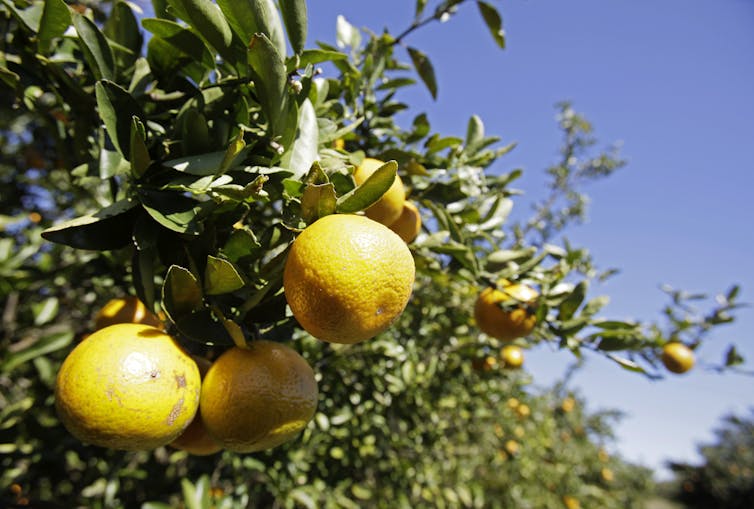
Chlorpyrifos is widely used on crops, including fruits, vegetables,
nuts, corn and soybeans. AP Photo/John Raoux
On Aug. 18, 2021, the U.S. Environmental Protection Agency announced that it will end use of chlorpyrifos – a pesticide associated with neurodevelopmental problems and impaired brain function in children – on all food products nationwide

Gina Solomon, a principal investigator at the Public Health Institute, clinical professor at the University of California, San Francisco and former deputy secretary at the California Environmental Protection Agency, explains the scientific evidence that led California to ban chlorpyrifos in 2020 and why the EPA is now following suit.

1. What is chlorpyrifos, and how is it used?

Chlorpyrifos is an inexpensive and effective pesticide that has been on the market since 1965. According to the EPA, approximately 5.1 million pounds of chlorpyrifos have been used annually in recent years (2014-2018) on a wide range of crops, including many different vegetables, corn, soybeans, cotton and fruit and nut trees.

Like other organophosphate insecticides, chlorpyrifos is designed to kill insects by blocking an enzyme called acetylcholinesterase. This enzyme normally breaks down acetylcholine, a chemical that the body uses to transmit nerve impulses. Blocking the enzyme causes insects to have convulsions and die. All organophosphate insecticides are also toxic and potentially lethal to humans.

Until 2000, chlorpyrifos was also used in homes for pest control. It was banned for indoor use after passage of the 1996 Food Quality Protection Act, which required additional protection of children’s health. Residues left after indoor use were quite high, and toddlers who crawled on the floor and put their hands in their mouth were found to be at risk of poisoning.

Despite the ban on household use and the fact that chlorpyrifos doesn’t linger in the body, over 75% of people in the U.S. still have traces of chlorpyrifos in their bodies, mostly due to residues on food. Higher exposures have been documented in farm workers and people who live or work near agricultural fields.