Menu Bar

Home           Calendar           Topics          Just Charlestown          About Us

Sunday, April 3, 2022

USDA Inspection of Mystic Aquarium After Whale’s Death Found ‘Critical Violations’

Second beluga imported from Canada has since died, and another is reportedly ill

By Cynthia Drummond / ecoRI News contributor

The beluga whales imported from an aquarium in Canada joined other belugas that are featured in the Mystic Aquarium’s Arctic Coast exhibit. (Cynthia Drummond photos)

The U.S. Department of Agriculture found three “critical violations” of the federal Animal Welfare Act during an inspection of Mystic Aquarium after the August 2021 death of a beluga whale imported from Canada.

Since that inspection, in September of 2021, another imported beluga whale died, on Feb. 11.

Paula Gladue, attending veterinarian for the USDA’s Animal and Plant Health Inspection Service (APHIS), inspected the aquarium’s beluga facility last year. She was accompanied by Tonya Hadjis, a supervisory animal-care specialist, and Carolyn McKinnie, senior veterinary medical officer for Marine Mammals and Exotics.

The inspection followed the death of Havok, one of five beluga whales imported last May by Mystic Aquarium from Marineland in Ontario, Canada. Marineland is the last aquarium in Canada that continue to exhibit whales and dolphins. The facility is permitted to keep them but prohibited from acquiring new animals or allowing the resident animals to breed.

Naomi Rose, a whale biologist and marine mammal scientist with the Washington, D.C.-based advocacy group the Animal Welfare Institute, said the USDA inspection of Mystic Aquarium was not routine.

“The reason they did that was because these animals were imported under a research permit,” she said. The Marine Mammal Protection Act, adopted in 1972, regulates the importation of marine mammals and marine mammal products into the United States. Because the Mystic Aquarium belugas were imported on a research permit, “APHIS went in to look at the records very thoroughly after Havok died and what they found in those records was actually quite a surprise to everybody,” Rose said.

The neglected role of food processing companies in shaping human and planetary health

Large-scale food conglomerates exert outsized influence over what is produced and eaten around the world. 

Abrania Marrero for the Environmental Health News

Source: USDA, 2021

The concept of a food system in research classically follows a simple progression: a one-track path from farms to plates.

Equal space and weight are often given to stops along the way, including food processing, transportation, and retail. The diagrams also typically float aloof in space—unattached to any legal system, economy, or private entity. Despite their alluring simplicity, these characterizations fail to capture true imbalances of power and responsibility in food production, standing in stark contrast to modern food industry realities.

Large-scale food and beverage companies, engaged in processing and manufacturing raw agricultural materials for profit in global markets, are not just another step in the food system path. They play an outsized role in driving disparities in human health and environmental sustainability.

Food processing companies currently make one fourth of every dollar spent on groceries in the U.S., with just a handful of companies controlling as much as 98.4% of the market share in some categories of prepared foods. By comparison, the country’s more than 2.5 million farmworkers, the majority of which are undocumented and unprotected by fair wage laws, get just eight cents for every dollar spent on groceries.

New NOAA Climate Projections Forecast Increase in Southern New England Flooding

The question for us is what we're going to do about it

By Frank Carini / ecoRI News staff

Setups like this one on the coast of South Kingstown, R.I., will do little to impede the sea’s advancement during the next three decades (Frank Carini/ecoRI News)

The climate crisis has taken root. The United Nations’ latest climate report explains how deep this worldwide problem is embedded.

Closer to home, another report published last month is equally alarming, for the present and future of southern New England. The National Oceanic and Atmospheric Administration’s 2022 Sea Level Rise Technical Report warns that the United States will see as much sea-level rise, about a foot, in the next three decades as it did during the entire previous century.

Rhode Island, Massachusetts and Connecticut, like much of the rest of the Atlantic Coast, is a sea level-rise hot spot. The National Aeronautics and Space Administration notes that every inch of sea-level rise results in the loss of about 100 inches (8.3 feet) of beach. Locally, sea levels have already risen nearly a foot since the 1930s.

Thirty years, the length of a standard mortgage, is not a long time in the scope of hundreds or even thousands of years often referenced in climate research. But both February reports feature an abundance of detailed scientific information that can no longer be ignored.

Saturday, April 2, 2022

Workers Vote to Form Amazon's First-Ever Union in US

Amazon workers’ astounding win, and how corporate America is trying to take back power

By Robert Reich

Joshua Bessex/AP

On Friday, April 1, Amazon – America’s wealthiest, most powerful, and fiercest anti-union corporation, with the second-largest workforce in the nation (union-busting Walmart being the largest), lost out to a group of warehouse workers in New York who voted to form a union.

By Matt Davies
If anyone had any doubts about Amazon’s determination to prevent this from ever happening, its scorched-earth anti-union campaign last fall in its Bessemer, Alabama warehouse should have put those doubts to rest.

In New York, Amazon used every tool it had used in Alabama. Many of them are illegal under the National Labor Relations Act but Amazon couldn’t care less. It’s rich enough to pay any fine or bear any public relations hit.

The company has repeatedly fired workers who speak out about unsafe working conditions or who even suggest that workers need a voice.

As its corporate coffers bulge with profits — and its founder and executive chairman practices conspicuous consumption on the scale not seen since the robber barons of the late 19th century — Amazon has become the poster child for 21st-century corporate capitalism run amok.

His fault

By Mike Luckovich


They don't care


URI speaker gives times on how to spot fake news

ProPublica’s Craig Silverman discusses effect of fake news on Ukraine, online

By Kate LeBlanc

Award-winning journalist and fake-news expert Craig Silverman discussed the role of misinformation and fake news in the Ukraine/Russia crisis as the keynote speaker at the Harrington School of Communication and Media’s event on “How to be Media Literate Citizens.” 

Silverman, who joined ProPublica last year, won a George Polk Award in 2020 for a series of stories he produced while at Buzzfeed News about fake news and scams on Facebook. He was also awarded the 2018 Carey McWilliams Award from the American Political Science Association, which honors “a major journalistic contribution to our understanding of politics.”

The online talk, entitled “The Global Disinformation Trade: From the Pandemic to the War in Ukraine,” examined global media and how it has been affected by politics and a drive for profit. It was the last event in the half-day conference around the heightened presence of misinformation and conspiracy theories. 

Plant-Derived Fatty Acid Reduces Heart Disease Risk, New Review Says

Practical alternative to fish oil for getting essential Omega-3

By Science News Staff / Source

Alpha-linolenic acid, a type of omega-3 fatty acid, is found in flaxseed oil as well as canola, soy, perilla, and walnut oils. Image credit: Handwerker / CC BY-SA 3.0.

“Given the evidence of the health benefits of plant-based diets and long-chain n-3 fatty acids, there is keen interest in better understanding the role of alpha-linolenic acid (ALA), a plant-derived n-3 fatty acid, on cardiometabolic diseases and cognition,” said lead author Dr. Aleix Sala-Vila, a researcher at the Institut Hospital del Mar d’Investigacions Mèdiques-Barcelona, and colleagues.

“There is increasing evidence for ALA largely based on its major food sources (i.e., walnuts and flaxseed); however, this lags behind our understanding of long-chain n-3 fatty acids.”

For their review, the authors analyzed data from previous studies to evaluate the effects of ALA on heart disease and heart disease risk factors like blood pressure and inflammation.

They analyzed included both randomized controlled trials and observational studies.

Coastal home buyers are ignoring rising flood risks

Despite clear warnings and rising insurance premiums, buyers flock to the shore

Takeaway for Charlestown waterfront owners: sell while you can

Risa PalmGeorgia State University and Toby W. BolsenGeorgia State University

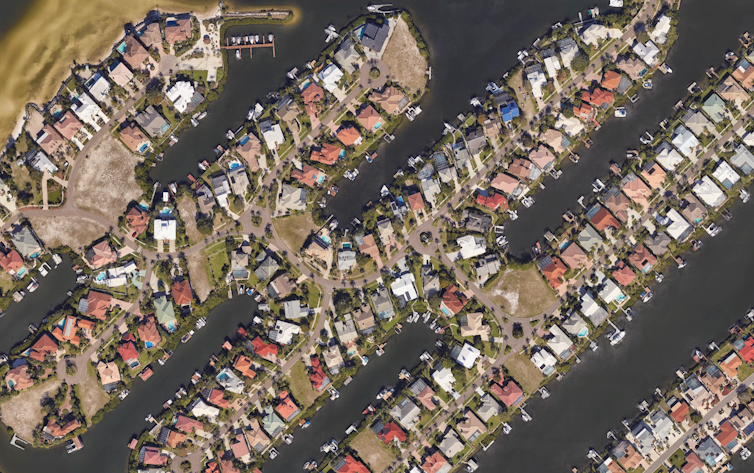
Apollo Beach, Fla., averages 3 feet above sea level, with many homes
directly on the water. Google Earth
Apollo Beach, Florida, is a maze of canals lined with hundreds of houses perched right near the water’s edge. The whole community, just south of Tampa, is only about 3 feet above sea level, meaning it’s at risk from storm surge as sea levels rise.

Homebuyers along the U.S. coasts can check each property’s flood risk as easily as they check the size of the bedrooms – most coastal real estate listings now include future flood risk details that take climate change into account. In Apollo Beach, for example, many of the properties are at least 9 out of 10 on the flood risk scale.

That knowledge isn’t stopping homebuyers, though.

Waterfront homes are selling within days of going on the market, and the same story is playing out all along the South Florida coast at a time when scientific reports are warning about the rising risks of coastal flooding as the planet warms.

We are professors of urban geography and American politics who follow the real estate industry. To understand why people are ignoring a risk that could lead to expensive damage and eventually lower their property value, we talked to hundreds of Florida real estate agents about their clients’ motivations and concerns.

Here’s what we learned.

Friday, April 1, 2022

Robots are coming for white-collar jobs

CEOs are speeding up the adoption of automation to replace employees once assumed to be immune from it. 

By Jim Hightower 

In corporate speak, there are no “job cuts.”

Instead, firings are blandly referred to as “employment adjustments.” Now though, corporate wordsmiths will need a whole new thesaurus of euphemisms for the massive job cuts coming in the higher echelons of the corporate structure.

Don’t look now, but an unanticipated result of the ongoing pandemic is that it’s given cover for CEOs to speed up the adoption of highly-advanced “Robotic Process Automation,” or RPAs, to replace employees once assumed to be immune from displacement.

As one analyst told a New York Times reporter, “With RPA you can build a bot that costs $10,000 a year and take out two to four humans.”

Prior to the COVID crisis, many top executives feared a public backlash if they pushed automation too far too fast. But ironically, the economic backpedaling caused by the pandemic has so discombobulated the workplace and diverted public attention that corporate bosses have been emboldened to rush ahead.

Hide!

By Adam Zyglis


A good day to give

401GIves Special Day Of Giving Is Here!

Everyone knows that exercise helps us feel good. The same goes for the pets in our lives, as you can see from these pics of ARRI trainer Kate working with athletic pup Foley here in ARRI’s main yard!


This 401Gives day, ARRI is raising funds to purchase new agility and enrichment equipment for the pets in our care, and you can have a Feel Good Friday right now by making a contribution! 

Thank you in advance for your generosity - it means the world to our cats and dogs in need!
 

*GIVE A GIFT, GET A GIFT*
For a donation of $150 or more, ARRI will honor you and/or your pet on our Brick Walk of Fame! A staff member will contact you after your donation for your choice of inscription. 

                 Thank You!

                                     506B Curtis Corner Rd. | Wakefield, Rhode Island 02879

Animal Rescue Rhode Island is a 501(c)(3) organization. All gifts are tax deductible to the full extent of the law.


Wood-Pawcatuck Watershed Association Plans Inaugural 7 Rivers Festival in June

Rivers keep on rolling

By Blake Rogers / ecoRI News contributor

Only 20 percent of the Wood-Pawcatuck watershed is developed. Along the upper Wood River, houses are few and far between. (Caitlin Faulds/ecoRI News)

To celebrate the designation of the Wood-Pawcatuck watershed as a National Wild & Scenic River, the watershed association is planning the first 7 Rivers Festival in June.

The Wood-Pawcatuck watershed encompasses a 300-square-mile area of land in southwestern Rhode Island and southeastern Connecticut. Its seven major drainage basins include the Queen, Wood, Chickasheen, Chipuxet, Shunock, Green Falls, and Pawcatuck rivers and their tributaries. 

The rivers in the watershed meander through 12 towns in two states: Charlestown, Exeter, Hopkinton, North Kingstown, Richmond, South Kingstown, West Greenwich and Westerly in Rhode Island, and North Stonington, Stonington, Sterling and Voluntown in Connecticut. 

According to the Wood-Pawcatuck Watershed Association (WPWA), it is one of the few remaining relatively pristine natural areas along the northeast corridor between New York and Boston.

The Wood River — the largest of six tributaries that link up with the Pawcatuck River to eventually spill into Little Narragansett Bay — is New England’s most biodiverse river, according to a National Park Service (NPS) survey in the early 1980s. The survey, in addition to pointing out the river’s attributes, sparked interest in the watershed’s potential and set in motion a decades-long drive toward preservation.

Good news for coffee lovers: Daily coffee may benefit the heart

Drinking two to three cups a day was associated with greatest heart benefits

American College of Cardiology

Drinking coffee -- particularly two to three cups a day -- is not only associated with a lower risk of heart disease and dangerous heart rhythms but also with living longer, according to studies being presented at the American College of Cardiology's 71st Annual Scientific Session. 

These trends held true for both people with and without cardiovascular disease. Researchers said the analyses -- the largest to look at coffee's potential role in heart disease and death -- provide reassurance that coffee isn't tied to new or worsening heart disease and may actually be heart protective.

In World-Historic First, Microplastics Detected in Human Blood

We've fouled the food chain and reap what we sow

KENNY STANCIL for Common Dreams

A biologist looks at microplastics found in sea species at the Hellenic Centre for Marine Research near Athens, Greece on November 26, 2019. (Photo: Louisa Gouliamaki/AFP via Getty Images)

A team of toxicologists found microplastics in nearly 80% of the healthy adult blood samples it analyzed, marking the first time that tiny polymer fragments—measuring less than 5mm in size—have been detected in human blood, The Guardian reported March 24.

Using techniques that allowed them to detect particles as small as 0.0007mm, the scientists, whose research was published in the peer-reviewed journal Environment International, examined blood samples provided by 22 anonymous donors in good health and discovered microplastics in 17 of them.

According to The Guardian, "Half the samples contained PET plastic, which is commonly used in drinks bottles, while a third contained polystyrene, used for packaging food and other products. A quarter of the blood samples contained polyethylene, from which plastic carrier bags are made."