Menu Bar

Home           Calendar           Topics          Just Charlestown          About Us

Sunday, December 10, 2023

The high cost of low holiday prices

Give a gift to the starving workers who made your favorite holiday sweater — tell their employers to pay up.

By Sonali Kolhatkar 

Garment workers in Bangladesh take part in a “Make Amazon Pay” demonstration on November 25, 2022. 

 (Photo: UNI Global Union/Twitter)

’Tis the season for holiday sales. But on the other side of the planet, there’s a high cost for those low prices. This is especially true for “fast fashion,” the clothing equivalent of a Big Mac: attractive, affordable, and throwaway.

The Bangladeshi women who toil as underpaid garment workers so we can wear disposable outfits are making their voices heard loudly enough to reverberate across oceans. Mass protests for higher wages have roiled the South Asian country.

Bangladesh is the world’s second-largest exporter of apparel in the world, after China. Recognizable name brands like H&M, Zara, Calvin Klein, American Eagle, and Tommy Hilfiger, among others, rely on Bangladeshi garment factories.

The country’s 4 million garment workers, most of whom are women, until recently took home a meager pay of just $75 a month and hadn’t gotten a raise in years. By one estimate, the cost of living for a single person in Bangladesh is about $360 a month, not including rent.

Workers have demanded a modest $205 a month, but pay increases offered by the country’s manufacturers totaled barely half that.

As protests intensified, Prime Minister Sheikh Hasina — once hailed as a liberal leader — unleashed security forces that have intimidated and attacked union organizers. Police recently fatally shot a 23-year-old mother and sewing machine operator named Anjuara Khatun after firing at protesters.

On the surface, U.S. brands who purchase their inventories from Bangladesh’s factories appear to be on the right side of the fight. The American Apparel and Footwear Association (AAFA), an industry trade group, wrote a joint letter urging Hasina to “raise the minimum wage to a level… sufficient to cover workers’ basic needs.”

New merit badge

Tyson Cole

Trump only plagiarizes the best

URI scientist Peter Paton recognized as a top naturalist in Rhode Island

Natural Resources Science department chair recognized for study of natural world, work with students 

For the past 30 years Paton, shown here at Napatree Point,
has helped to run the Kingston Wildlife Research Station,
the longest-running bird-banding operation in North America.
 (Photo courtesy Keith Killingbeck)
A veteran faculty member in the University of Rhode Island’s College of the Environment and Life Sciences has been recognized by the Rhode Island Natural History Survey as a top naturalist in Rhode Island. Richmond resident Peter Paton, chair of the Department of Natural Resources Science (NRS), was honored in November with the Distinguished Naturalist Award.  

In addition to his ornithological research, Paton teaches popular field courses at URI in ornithology, wetland wildlife management, and management of migratory birds. 

“Peter has instilled a love of birds and wetland habitats in hundreds of students,” says his NRS colleague and professor emeritus Art Gold. “His field courses are always over-subscribed and his students come back from each field trip bubbling with excitement.” 

Throughout his career, including the past nearly 30 years at URI, Paton has been a leading researcher and an influential teacher. He worked as a federal wildlife biologist and contract biologist for 10 years before joining the URI faculty in 1995.  

Paton also invests a great deal of  time helping local communities develop a deeper appreciation for nature, through walks and talks for organizations such as the Audubon Society of Rhode Island, Watch Hill Conservancy, and the U.S. Fish and Wildlife Service. 

Yogurt’s Hidden Superpower Uncovered

A Natural Guard Against Depression and Anxiety

By UNIVERSITY OF VIRGINIA HEALTH SYSTEM

University of Virginia School of Medicine researchers have discovered how Lactobacillus, a bacterium found in fermented foods and yogurt, helps the body manage stress and may help prevent depression and anxiety. 

The findings open the door to new therapies to treat anxiety, depression, and other mental health conditions.

Role of Lactobacillus in Mental Health

The new research from UVA’s Alban Gaultier, Ph.D., and collaborators is notable because it pinpoints the role of Lactobacillus, separating it out from all the other microorganisms that naturally live in and on our bodies. These organisms are collectively known as the microbiota, and scientists have increasingly sought to target them to battle disease and improve our health. 

UVA’s new research represents a major step forward in that effort, providing scientists an innovative new approach to understand the role of individual microbes that could facilitate the development of new treatments and cures for a wide variety of diseases, both mental and physical.

Your car might be watching you to keep you safe − at the expense of your privacy

Your car, the spy

M. Hadi Amini, Florida International University

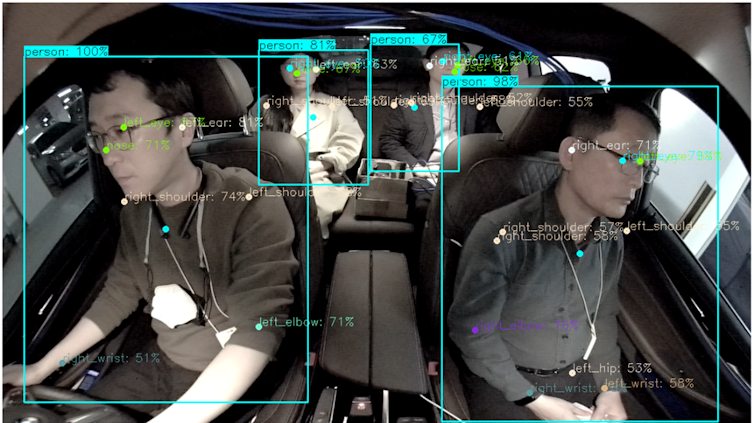
Many modern cars watch occupants – a plus for safety
but not so much for privacy. Courtesy LG
Depending on which late-model vehicle you own, your car might be watching you – literally and figuratively – as you drive down the road. It’s watching you with cameras that monitor the cabin and track where you’re looking, and with sensors that track your speed, lane position and rate of acceleration.

Your car uses this data to make your ride safe, comfortable and convenient. For example, the cameras can tell when you’ve been distracted and need to bring your attention back to the road. They can also identify when you are speeding by verifying the speed limit from your GPS position or traffic signs along the road and warn you to slow down. 

Some carmakers are also beginning to incorporate similar features for convenience, such as unlocking your car by scanning your face or fingerprint. Your car may also transmit some of this data to the manufacturer’s data centers, where the company uses it to improve your driving experience or provide you with personalized services.

In addition to providing these benefits, this data collection is a potential privacy nightmare. The information can reveal your identity, your habits when you’re in your car, how safely you drive, where you’ve been and where you regularly go. 

A report by the Mozilla Foundation, a nonprofit technology research and advocacy organization, found that carmakers’ privacy policies are exceedingly lax. The study identified cars as the “worst category of products for privacy that we have ever reviewed.” U.S. Sen. Ed Markey wrote a letter to U.S. automakers on Nov. 30, 2023, asking a lengthy set of questions about their data practices.

Saturday, December 9, 2023

Bezos is a hypocrite, not a hero

Jeff Bezos Donates $120 Million to Fight Homelessness, Then Invests $500 Million to Make It Worse

JON QUEALLY for Common Dreams

Amanda Northrop/Vox
Among the three richest people on the planet, mega-billionaire Amazon founder Jeff Bezos received some praise last week for announcing approximately $120 million in donations to a number of groups fighting the scourge of homelessness in the United States.

"It's a privilege to support these orgs in their inspiring mission to help families regain stability," Bezos wrote in an Instagram post touting the multiple grants to 38 individual nonprofits in 22 states.

But hold your applause.

Just days after word of the charitable gifts—a minuscule drop in the bucket compared to the estimated $170 billion fortune he possesses—a Bezos-controlled company called Arrived dropped $500 million of new investment in single-family homes with a venture fund that critics warn will make the nation's housing crisis even worse.

According to GV Wire:

Since its inception in 2021, Arrived has attracted nearly a half a million customers, operating as a fractional real estate investing platform. The company’s model is similar to buying a slice of the American pie, allowing investors to purchase shares of single-family rentals for as little as $100.

The fund itself—called the Single Family Residential Fund—allows investors to purchase portions of various homes and later trade, hold, or redeem their "chips" on a rolling basis like players at a casino.

While many Americans, especially younger people and working-class families, have been steadily priced out of homeownership by soaring costs and, more recently, higher interest rates, Arrived preys on that reality by selling the idea that owning a piece of a home as an investment is an "American Dream" akin to owning the home one lives in.

Republican Christmas

Clay Bennett

Stand by for an important message


Treasurer reunites thousands of Rhode Islanders with unclaimed property funds in time for holidays

$2.5 million is a nice Christmas present 

By Janine L. Weisman, Rhode Island Current

 (Christopher Shea/Rhode Island Current)
Nearly 9,000 Rhode Island residents will soon receive checks from the state as it returns over $2.4 million in unclaimed property funds to their rightful owners.

The office of General Treasurer James Diossa announced Wednesday that checks of up to $2,500 will be mailed to individuals starting this week under the Rhode Island Treasury’s Your Money program. 

Unclaimed property consists of abandoned financial assets, including checking and savings accounts, unpaid wages, securities, life insurance payouts, uncashed checks, and the proceeds of inactive safe deposit boxes. No real estate or vehicles are included.

Before this week, Diossa’s office had already distributed $16.6 million in unclaimed funds this calendar year.

“The holiday season is all about giving back, and my team has worked day and night to make sure unclaimed property is wrapped and delivered to thousands of households across the Ocean State,” Diossa said in a statement released by his office.

“Putting money back in the pockets of Rhode Islanders means more money to support our state’s economy, especially during this time of year.”

Often, people are unaware that they have unclaimed property. Anyone can search their name on the state database to see if there is money they can be reunited with and then file a claim for free at: findrimoney.com. You can also check the status of a claim. 

Telephone inquiries can also be made at the Rhode Island Unclaimed Property Division at (401) 462-7676.

GET THE MORNING HEADLINES DELIVERED TO YOUR INBOX

SUBSCRIBE

Rhode Island Current is part of States Newsroom, a network of news bureaus supported by grants and a coalition of donors as a 501c(3) public charity. Rhode Island Current maintains editorial independence. Contact Editor Janine L. Weisman for questions: info@rhodeislandcurrent.com. Follow Rhode Island Current on Facebook and Twitter.

Package maker ordered to stop using toxic chemical

EPA orders company to stop making plastic containers that leach toxic PFAS

SHANNON KELLEHER  0

The US Environmental Protection Agency (EPA) has ordered a major company to stop producing hundreds of millions of plastic containers each year that contain toxic per- and polyfluoroalkyl substances (PFAS), which leach into countless products.

The so-called “forever chemicals” are produced by a fluorination technique that Inhance Technologies uses to prevent liquids from leaking out of high-density polyethylene (HDPE) plastic containers. 

The PFAS can leach into pesticides, personal care products, household cleaners, condiments, and many other liquids stored within the containers.

“I’m stunned but pleased that EPA took such strong action and hoping the decision remains intact through whatever court case Inhance is going to bring,” said Kyla Bennett, the science policy director for the watchdog group Public Employees for Environmental Responsibility (PEER) and a former EPA employee. “It wasn’t easy getting them there, but they got there and that’s what matters.”

Inhance is “basically the only one in the world” that uses this particular fluorination process to treat plastic containers, Bennett said, adding that plastic containers from two ounces up to 55 gallon drums are affected and “we’re talking about really all sectors of the economy.”

The order, issued Dec. 1 under the Toxic Substances Control Act (TSCA), states that nine long-chain PFAS chemicals have been identified in Inhance containers, including perfluorooctanoic acid (PFOA), which was recently classified as carcinogenic to humans by the International Agency for Research on Cancer (IARC), an arm of the World Health Organization (WHO). The order will go into effect Feb. 28, 2024.

Getting Tougher on Product Safety

Finally, the CPSC is focused on its reason for being

By Philip Mattera, director of the Corporate Research Project, for the Dirt Diggers Digest

For most of its history, the Consumer Product Safety Commission has not been the most aggressive federal regulator. 

Created in 1972, the agency has depended primarily on voluntary recalls of dangerous products by manufacturers. Its budget is below $200 million and its staff numbers around 500, both tiny by DC standards.

While the CPSC has the ability to use monetary penalties when companies fail to disclose hazards, it is relatively restrained in its use of that power. As shown in Violation Tracker, the agency has imposed a total of $397 million in fines against companies since 2000. 

More than half of that total has come since the Biden Administration took office. By comparison, the Consumer Financial Protection Bureau, which started operating in 2011, has racked up more than $17 billion in fines and settlements.

For all these reasons, it is significant that the CPSC and the Justice Department recently announced that a federal jury in Los Angeles had returned a guilty verdict in the first-ever criminal prosecution brought against corporate executives under the Consumer Product Safety Act.

The defendants in the case were the chief administrative officer and the chief executive officer of Gree USA, Inc., a subsidiary of the Chinese-owned Hong Kong Gree Electric Appliances Sales Co., Ltd. 

Friday, December 8, 2023

Senator Whitehouse Rips GOP Deficit Hawks Over Trillions in Tax Cuts for Rich

"Some billion-dollar corporations pay no income taxes at all."

JAKE JOHNSON

The Democratic chair of the Senate Budget Committee rebuked his Republican colleagues on Thursday for demanding action to reduce the U.S. debt after adding roughly $10 trillion to it with tax cuts for the rich and large corporations.

Sen. Sheldon Whitehouse (D-R.I.) was responding to a letter he received earlier this week from Republican members of the budget committee, who criticized the chair for dedicating "significant time and attention to climate issues" while purportedly neglecting "the impending budgetary and fiscal crisis facing our nation."

In a written reply, Whitehouse noted that "if not for the Bush tax cuts, their extensions, and then the Trump tax cuts, the U.S. debt-to-GDP ratio would be declining indefinitely."

The Bush administration's decision to launch the so-called "war on terror"—which received bipartisan support in Congress—also cost the U.S. upwards of $8 trillion, Brown University's Costs of War project has estimated.

Whitehouse described Republicans' proposed solutions, such as their balanced budget plan, as "magical thinking," pointing to the Congressional Budget Office's recent conclusion that the GOP push to balance the federal budget within the next decade would not be possible without cuts to Social Security and Medicare—programs that are currently in the right-wing party's crosshairs.

Totally logical


By Matt Davies

Great gift opportunities from Charlestown Gallery


Charlestown Gallery

 End of Year SALE

All Persian Rugs 25% Off

And all Jewelry 20% and more Off

And of course lots of great paintings & sculpture!


 Gallery Open FRIDAY, SATURDAY and SUNDAY

11 - 4


Always Open by Appointment


Charlestown Gallery | 401-364-0120 | 5000 South County Trail, Charlestown, RI| http://www.charlestowngalleryri.com


Facebook Instagram