
Thursday, August 28, 2025

Private companies gather weather info and sell it to Weather Service since Trump budget cuts hobble NWS ability to collect it themselves
Call it weather grifting, and we could see it coming

When staffing shortages caused the National Weather Service (NWS) to suspend weather balloon launches at its Kotzebue, Alaska, station earlier this year, a startup deploying next-generation weather balloons, WindBorne Systems, stepped up to fill the void.
The company began selling its western Alaskan atmospheric data to the NWS in February, plugging what could have been a critical data gap in weather forecasting.
Weather balloons collect real-time atmospheric temperature, humidity, wind speed and pressure data that meteorologists use to predict the weather and understand longer-term changes to the climate. The Alaska office was one of about a dozen to suspend or scale back balloon launches in response to deep staffing cuts instituted by the Trump administration’s Department of Government Efficiency (DOGE).
Critics claim that the cuts have weakened the NWS’ forecasting capacity as hurricane season bears down and extreme weather events, like the floods that ripped through Texas, claim lives and destroy property.


Bobby Junior's lunatic leadership leads to 'Wednesday Night Massacre at CDC'
Chaos Erupts as RFK Jr. Accused of Destroying Agency From Within
Jon
Queally for Common Dreams

Total "chaos" erupted at the Centers for Disease
Control on Wednesday after the forced removal of CDC Director Susan Monarez,
handpicked by Donald Trump just
months ago, was followed by the disgruntled resignations of other top officials
at the agency who openly warned that health secretary Robert F. Kennedy
Jr. is running the place into the ground while putting the nation's public
health system at risk of collapse and threaten millions of lives.
That Monarez was no longer the director was announced by the
Department of Health and Human Services, led by RFK Jr., via social media on
Wednesday afternoon. Hours later, lawyers for Monarez said her removal was a
firing, not a resignation, and they accused the director of "weaponizing
public health for political gain" after she clashed with Kennedy over new
immunization guidelines related to the Covid-19 vaccine.

Her ouster, her legal team said, "is about the
systematic dismantling of public health institutions, the silencing of experts,
and the dangerous politicization of science. The attack on Dr. Monarez is a
warning to every American: Our evidence-based systems are being undermined from
within."
In an announcement earlier Wednesday, the Food and Drug
Administration (FDA) narrowed the kinds of conditions people need to have in
order to receive approval for available Covid-19 vaccines.
As the Washington Post reports, the new FDA guidance sparked concern among public
health experts who say the policy shift "injects uncertainty for Americans
not considered high-risk who want to get another coronavirus vaccine. They said
it's not clear who will ultimately be able to get the shot, whether insurance
will cover it and whether they can get vaccinated at their local
pharmacy."
In response to Monarez's firing—and other underlying issues
at the agency under RFK Jr.'s leadership, at least four other top CDC officials
resigned in protest Wednesday night.
Demetre C. Daskalakis, director of the National Center for
Immunization and Respiratory Diseases; Daniel Jernigan, director of the
National Center for Emerging and Zoonotic Infectious Diseases; Dr. Jennifer
Layden, who led the office of public health data; and CDC Chief Medical Officer
Debra Houry all submitted their resignations.
Dr. Richard Pan, a pediatrician and a former Democratic
state senator in California, was among those who declared the events should be
seen as the "Wednesday Night Massacre at the CDC"—a reference to the
infamous Saturday Night Massacre during the Watergate scandal under President
Richard Nixon in 1973.
In his explosive resignation
letter made public, Dr. Daskalakis said he did not make the decision
lightly.
"However," he stated, "after much
contemplation and reflection on recent developments and perspectives brought to
light by Secretary Robert F. Kennedy Jr., I find that the views he and his
staff have shared challenge my ability to continue in my current role at the
agency and in the service of the health of the American people. Enough is
enough."
The letter continues:
I am unable to serve in an environment that treats CDC as a tool to generate policies and materials that do not reflect scientific reality and are designed to hurt rather than to improve the public’s health.
The recent change in the adult and children’s immunization schedule threaten the lives of the youngest Americans and pregnant people. The data analyses that supported this decision have never been shared with CDC despite my respectful requests to HHS and other leadership.
This lack of meaningful engagement was further compounded by a “frequently asked questions” document written to support the Secretary’s directive that was circulated by HHS without input from CDC subject matter experts and that cited studies that did not support the conclusions that were attributed to these authors.
Having worked in local and national public health for years, I have never experienced such radical non-transparency, nor have I seen such unskilled manipulation of data to achieve a political end rather than the good of the American people.
It is untenable to serve in an organization that is not afforded the opportunity to discuss decisions of scientific and public health importance released under the moniker of CDC. The lack of communication by HHS and other CDC political leadership that culminates in social media posts announcing major policy changes without prior notice demonstrate a disregard of normal communication channels and common sense.
Having to retrofit analyses and policy actions to match inadequately thought-out announcements in poorly scripted videos or page long X posts should not be how organizations responsible for the health of people should function.
Critics of RFK Jr. and Trump, including public health
advocates and Democratic lawmakers charged with oversight, slammed the chaos
and the deeper threat to the American people that the administration's
misguided attacks on the CDC have triggered.
"President Trump and Sec. Kennedy are trying to purge
anyone who stands up against their anti-science agenda at the CDC," said Sen.
Rafael Warnock (D-Ga.). "They're risking disease outbreak and another
pandemic just to advance their own extremist goals."
Sen. Bernie Sanders (I-Vt.)
called for an immediate hearing before the Committee on Health, Education,
Labor, and Pensions (HELP), of which he is the ranking member. "It's
outrageous that Sec. Kennedy is trying to fire the CDC Director—after only a
few weeks on the job—for her commitment to public health and vaccines,"
said Sanders. "Vaccines save lives. Period."
One former CDC staffer, who went unnamed, told Rolling Stone that what's happening
now at the agency is "the work of a death cult."
According to Dr. Georges C. Benjamin, MD, executive director
of the American Public Health Association, the ouster of Monarez, just weeks
after her confirmation in the US Senate, "is yet another glaring sign of
Secretary Kennedy’s failed leadership and reckless mismanagement. His tenure
has been marked by chaos, disorganization, and a blatant disregard for science
and evidence-based public health."
The episode, Benjamin continued, "underscores his
administrative incompetence and his disdain for the expertise that the public
and our public health agencies rely on. RFK Jr. must be removed from his
position."
He wasn't the only one calling for Kennedy's immediate
removal. "Fire him," declared Sen. Patty Murray (D-Wash.) in a social
media post.
"We cannot let RFK Jr. burn what's left of the CDC and
our other critical health agencies to the ground—he must be fired," Murray
said in a separate statement. "I hope my Republican colleagues who have
come to regret their vote to confirm RFK Jr. will join me in calling for his
immediate termination from office."
Dr. Robert Steinbrook, the health research director for
Public Citizen, said, "Ousting the first Senate-confirmed CDC director
weeks into the start of her tenure makes absolutely no sense and underscores
the destructive chaos at RFK Jr.'s Department of Health and Human
Services."
"The CDC is being decapitated," warned Steinbrook.
"This is an absolute disaster for public health."
Data that taxpayers have paid for and rely on is disappearing
Wiping out information sources that might challenge Trump disinformation
People rely on data from federal agencies every day – often without realizing it.
Trump, as usual, has NO evidence to back up these attacks
Rural residents use groundwater level data from the U.S. geological survey’s National Water Information System to decide where to dig wells. High school coaches turn to weather apps supported by data from the National Weather Service to decide when to move practice inside to avoid life-threatening heat. Emergency managers use data from the Census Bureau’s American Community Survey to ensure that residents without vehicles have seats on evacuation buses during local emergencies.
On Jan. 31, 2025, websites and datasets from across the federal government began to disappear. As that happened, archivists and researchers from around the world sprang into action, grabbing what they could before it was gone.
Trust in the federal statistical system took another hit when Bureau of Labor Statistics Commissioner Erika McEntarfer was fired on the heels of a dismal Aug. 1, 2025, employment report.
And reduced data collection at the bureau was already causing concern before her dismissal. The bureau has ceased collection of critical inputs to the Consumer Price Index, likely reducing that inflation indicator’s accuracy, especially at the level of specific locations and products.
As researchers of economics and epidemiology at the University of Michigan, we have spent years working with data, often from the federal government. When data and information began to disappear, we were spurred into action to preserve these important public goods.
The Inter-university Consortium for Political and Social Research, where we work – commonly known as ICPSR – has been making data from governments and researchers available for more than 60 years. We are stewards of this data, preserving it and ensuring that it is accessible in a safe and responsible manner.
Unfortunately, government data is now at risk of becoming less available or disappearing. But there are steps that researchers – and the public – can take to reduce that risk.
Wednesday, August 27, 2025
Trump and Bobby Kennedy Jr. are destroying global science
A return to the Dark Ages
Elizabeth Finkel, La Trobe University

Eight months into Donald Trump’s second presidency of the United States, truth and science are again under attack – with global consequences. USAID, which tackled HIV, TB, malaria and child malnutrition is gone. Funding has been withdrawn from GAVI, a public–private global alliance that helps buy vaccines for the world’s poorest children. Malnourished children are already dying.
 Besides these brutal consequences, the scientific machine that delivered America’s scientific and technological dominance is being ruthlessly dismantled.

Eight months into Donald Trump’s second presidency of the United States, truth and science are again under attack – with global consequences. USAID, which tackled HIV, TB, malaria and child malnutrition is gone. Funding has been withdrawn from GAVI, a public–private global alliance that helps buy vaccines for the world’s poorest children. Malnourished children are already dying.

Any research project that mentions diversity, equity and inclusion (DEI), climate change or addresses the causes of vaccine hesitancy is a prime target. But even US space science, once the pride of the nation, is facing “an extinction-level event,” according to the US Planetary Society.
Across the spectrum of science, some 4,000 research grants have been cancelled. Unbelievably, bird-flu experts were fired in the middle of an outbreak. That was topped last May by cancelling a US$600M grant to the company Moderna to develop an mRNA vaccine against bird flu.
And on August 5, US$500 million was cancelled for 22 more projects developing mRNA vaccines. Bear in mind that under Operation Warp Speed, the first Trump administration funded the development of Moderna’s mRNA vaccine against COVID. Moderna and Pfizer-BioNTech both delivered mRNA vaccines in the record time of less than a year, winning mRNA vaccine technology a Nobel Prize in 2023.
It’s not just American science that’s being dismantled.


Enrollment now open though September 6 for Salt Pond Smart
New program to protect Rhode Island’s coastal waters

Enrollment is now open
through Sept. 6 to join Salt
Pond Smart, a new community engagement initiative offered through the
University of Rhode Island Cooperative
Extension. Designed for homeowners along Rhode Island’s southern coast,
Salt Pond Smart empowers residents to take meaningful action to protect and
improve water quality in the state’s treasured coastal salt ponds.
Aging septic systems and fertilizer use, especially in densely developed areas, contribute excess nutrients, bacteria, and other pollutants to the salt ponds. These problems have led to shellfish closures, algal blooms, and damage to the ponds’ ecosystems. Salt Pond Smart helps residents make property management decisions that reduce nutrient pollution, which is essential to safeguarding public health and preserving the ecological integrity of these fragile environments.
Surprising finding could pave way for universal cancer vaccine
Except Bobby Kennedy Jr. has cancelled federal funding for mRNA research
By Michelle Jaffee, University of Florida
.jpg)
Published in Nature Biomedical Engineering, the
University of Florida study showed that like a one-two punch, pairing the test
vaccine with common anticancer drugs called immune checkpoint inhibitors
triggered a strong antitumor response.
A surprising element, researchers said, was that they
achieved the promising results not by attacking a specific target protein
expressed in the tumor, but by simply revving up the immune system — spurring
it to respond as if fighting a virus. They did this by stimulating the
expression of a protein called PD-L1 inside of tumors, making them more
receptive to treatment. The research was supported by multiple federal agencies
and foundations, including the National Institutes of Health.
Senior author Elias Sayour, M.D., Ph.D.,
a UF Health pediatric oncologist and the Stop Children's Cancer/Bonnie R.
Freeman Professor for Pediatric Oncology Research, said the results reveal a
potential future treatment path — an alternative to surgery, radiation and
chemotherapy — with broad implications for battling many types of
treatment-resistant tumors.
“This paper describes a very unexpected and exciting
observation: that even a vaccine not specific to any particular tumor or virus
— so long as it is an mRNA vaccine — could lead to tumor-specific effects,”
said Sayour, principal investigator at the RNA Engineering Laboratory within
UF’s Preston
A. Wells Jr. Center for Brain Tumor Therapy.
“This finding is a proof of concept that these vaccines
potentially could be commercialized as universal cancer vaccines to sensitize
the immune system against a patient’s individual tumor,” said Sayour, a McKnight Brain Institute investigator
and co-leader of a program in immuno-oncology and microbiome research.
Get information about UF Health brain tumor clinical
trials here.
The costs of sabotaging science
Turbulent research landscape imperils US brain gain − and ultimately American prosperity
Marc Zimmer, Connecticut College
 Despite representing only 4% of the world’s population, the United States accounts for over half of science Nobel Prizes awarded since 2000, hosts seven of The Times Higher Education Top 10 science universities, and incubates firms such as Alphabet (Google), Meta and Pfizer that turn federally funded discoveries into billion-dollar markets.
The domestic STEM talent pool alone cannot sustain this research output. The U.S. is reliant on a steady and strong influx of foreign scientists – a brain gain. In 2021, foreign-born people constituted 43% of doctorate-level scientists and engineers in the U.S. They make up a significant share of America’s elite researchers: Since 2000, 37 of the 104 U.S. Nobel laureates in the hard sciences, more than a third, were born outside the country.
China, the U.S.’s largest competitor in science, technology, engineering and math endeavors, has a population that is 4.1 times larger than that of the U.S. and so has a larger pool of homegrown talent. Each year, three times as many Chinese citizens (77,000) are awarded STEM Ph.D.s as American citizens (23,000).
To remain preeminent, the U.S. will need to keep attracting exceptional foreign graduate students, budding entrepreneurs and established scientific leaders.
Tuesday, August 26, 2025
"This is bullshit."
Labor & political leaders oppose Trump's Revolution Wind stop-work order
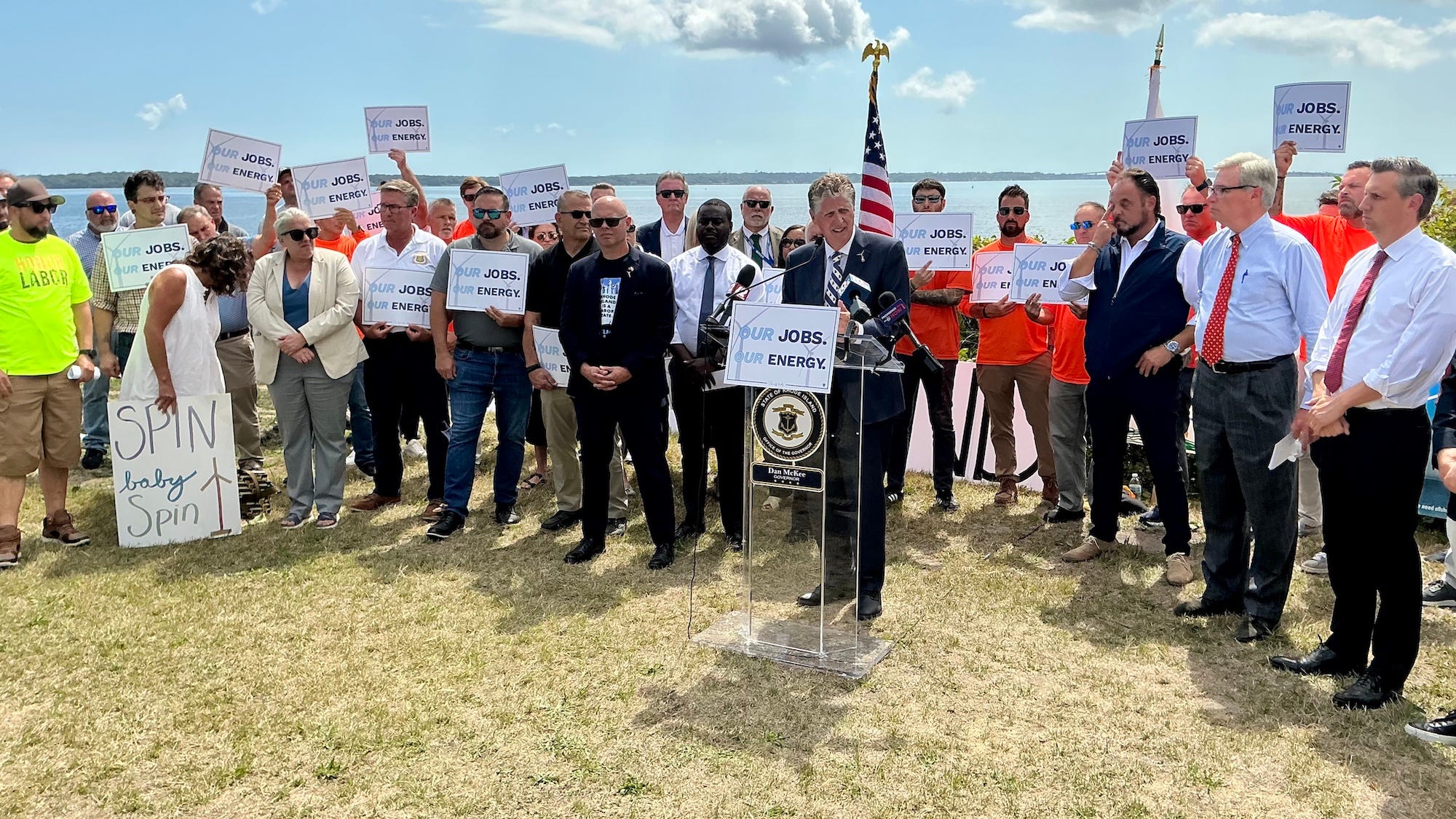
“We are here for what I call a reckless move by the current administration that will have a detrimental impact not only on Rhode Island, but on our renewable energy quest up and down the East Coast,” said Michael Sabitoni, General Secretary-Treasurer of LiUNA and President of the Rhode Island Building and Construction Trades Council. [It will halt] “the momentum that started here almost 20 years ago with the vision and the courage to address Rhode Island’s energy needs and all the hard work that went into building an offshore wind industry from scratch, with both Republican and Democratic administrations over the last 20 years...”
Sabitoni was speaking at a press conference held in Quonset,
home to Ørsted’s Regional Offshore Wind Logistics and
Operations Hub and several Rhode Island-built crew transfer vessels
supporting the project.
“We’ve got a massive energy project offshore that is 80%
complete, employing hundreds of tradesmen and women, that we are counting on to
deliver almost 700 megawatts of much-needed power to our grid,” continued
Sabitoni. “This is bullshit.”
The press conference, which included political and labor
leaders, as well as construction workers, was held to condemn Donald
Trump’s reckless stop-work order halting construction on Revolution
Wind - a multibillion dollar offshore wind development that is 80%
complete (with 506 megawatts installed of the 704 megawatt system) and critical
to the region’s economy and energy future. The Trump administration’s effort to
abruptly halt the project threatens thousands of local jobs, jeopardizes
hundreds of millions of dollars in economic investment, and would increase
electricity prices and impact grid reliability across New England.
“Hardworking men and women have dedicated time, effort, and training in a very difficult environment to build this complex offshore wind project,” continued Sabitoni. “The biggest little state in the union has a saying, ‘We are small, but extremely sophisticated.’ Rhode Island is the birthplace of the offshore wind industry, and it’s going to be Rhode Island that sends a message that this is our energy future. We need to continue to provide reliable, cost-effective energy for the citizens of Rhode Island and the New England region.”
Also speaking were Governor Daniel McKee, U.S.
Senators Jack Reed and Sheldon Whitehouse,
Congressmen Seth Magaziner and Gabe Amo, Patrick
Crowley, President of the Rhode Island AFL-CIO and
Co-chair of Climate Jobs RI, and Rachel Miller, Chief
External Relations Officer at Building Futures. Dozens of union
workers and climate advocates were also in attendance.
Here’s the video:


Sorting Out Covid Vaccine Confusion: New and Conflicting Federal Policies Raise Questions
COVID has killed 1.1 million Americans already so get vaccinated to not become a statistic

Health and Human Services Secretary Robert F. Kennedy Jr., a longtime anti-vaccine activist, has upended the way covid vaccines are approved and for whom they’re recommended, creating uncertainty where coverage was routine.
Agencies within HHS responsible for spelling out who should get vaccinated aren’t necessarily in sync, issuing seemingly contradictory recommendations based on age or risk factors for serious disease.
But the ambiguity may not affect your coverage, at least this year.
“I think in 2025 it’s highly likely that the employer plans will cover” the covid vaccines, said Jeff Levin-Scherz, a primary care doctor who is the population health leader for the management consultancy WTW and an assistant professor at Harvard’s T.H. Chan School of Public Health. They’ve already budgeted for it, “and it would be a large administrative effort to try to exclude coverage for those not at increased risk,” he said.
With so much in flux, it’s important to check with your employer or insurer about coverage policies before you roll up your sleeve.
Here’s what we know so far, and what remains unclear.
Subscribe to:
Posts (Atom)