Tuesday, January 28, 2020
Brown medical anthropologist weighs in on coronavirus in China
“No
evidence of a real crisis yet”
Brown
University
“I got evacuated by the program that was
sponsoring me,” she said. “When I returned to the United States, my parents
tried to quarantine me in my sister’s apartment.”
Between 2002 and 2004, SARS killed at
least 774 people worldwide and instilled fear in the hearts of Americans early
in its spread. But that fear, Mason observed, didn’t strike China as
quickly.
“So many flu-like viruses come through
that part of China that they didn’t start panicking until it began to spread
all over the world,” she said.
Mason, who had majored in molecular
biology, became interested in this cultural gulf between two nations grappling
with the same virus. Today, she is an assistant professor of anthropology at
Brown and a leading expert on the historical, social and political context
of public health in China.
Her 2016 book, “Infectious Change: Reinventing Chinese Public Health After an Epidemic,” examines how the outbreak of SARS “reimagined public health as a professionalized, biomedicalized and technological machine — one that has frequently failed to serve the Chinese people.”
Now, Mason has joined millions of
medical professionals, scholars and members of the public in closely following
the trajectory of another illness — a type of coronavirus that broke out
in Wuhan in December 2019 and has since spread to at least six countries,
according to the World Health Organization (WHO).
There NEEDS to be a free lunch
Why Do We Have School Lunch Debt at All?
A Fredonia, New
York man paid off $2,000 in school lunch debt in his area,
helping 140 families. A Rigby, Idaho tattoo
shop raised $1,200. Nationally, a charity called School Lunch Fairy has raised nearly
$150,000 to pay off the school lunch debt of children in need.
These
stories are heartwarming, and the people who donate are angels. But let’s look
at the bigger picture: Why is there school lunch debt in the first place?
In
2008, Mark Winne wrote in his book Closing
the Food Gap that he knew how to end hunger. I was impressed. What
could it be? I figured the answer must be terribly complex.
But
it wasn’t. End poverty, Winne wrote.
This
ties back to the work of Amartya Sen, the Nobel laureate in economics who found
that hunger was not due to a lack of food,
but a lack of a right to
food. If you lack the ability to buy food or grow your own food, and nobody
gives you food, then in a capitalist economy, you are not legally entitled to
food.
Or,
in this case, if your parents cannot afford food, then children are not legally
entitled to eat at school.
It's not over till it's over
Dramatic dismissal of landmark youth climate lawsuit might not close the book on that case
Mary Wood, University of Oregon and Michael C. Blumm, Lewis & Clark
A sharply divided panel of three federal judges on Jan. 17 dismissed a high-profile climate lawsuit brought on behalf of 21 young people against the federal government.
The Ninth Circuit Federal Court of Appeals’ ruling accepted with unusual bluntness that the federal government’s climate policies may pose “clear and present danger” capable of destroying the nation, but said it’s up to the federal government and Congress, not the U.S. courts, to do something about it.
The three judges agreed that the young plaintiffs have constitutional rights to a stable climate system, but judges Andrew D. Hurwitz and Mary H. Murguia said that courts have no role in bringing that about.
Likely remedies would involve changes in transportation and energy policies, along with public lands management.
Lawyers for the youth plaintiffs in Juliana v. United States said that they aren’t giving up. They plan to petition the full court of 29 active Ninth Circuit court judges to review the case.
As environmental law professors, we often write and teach students about this groundbreaking case.
In our view, this case is important not only because it seeks to force the federal government to phase out fossil fuels, but also because it frames the climate crisis in terms of fundamental constitutional rights.
Mary Wood, University of Oregon and Michael C. Blumm, Lewis & Clark
![]() |
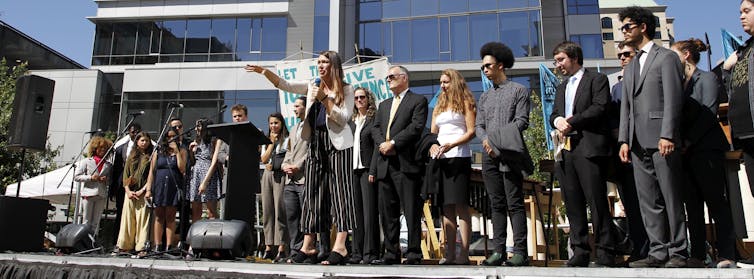
| The legal battle these young plaintiffs are waging might not be over yet. AP Photo/Steve Dipaola |
The Ninth Circuit Federal Court of Appeals’ ruling accepted with unusual bluntness that the federal government’s climate policies may pose “clear and present danger” capable of destroying the nation, but said it’s up to the federal government and Congress, not the U.S. courts, to do something about it.
The three judges agreed that the young plaintiffs have constitutional rights to a stable climate system, but judges Andrew D. Hurwitz and Mary H. Murguia said that courts have no role in bringing that about.
Likely remedies would involve changes in transportation and energy policies, along with public lands management.
Lawyers for the youth plaintiffs in Juliana v. United States said that they aren’t giving up. They plan to petition the full court of 29 active Ninth Circuit court judges to review the case.
As environmental law professors, we often write and teach students about this groundbreaking case.
In our view, this case is important not only because it seeks to force the federal government to phase out fossil fuels, but also because it frames the climate crisis in terms of fundamental constitutional rights.
Monday, January 27, 2020
Charlestown conspicuous by its absence
By FRANK CARINI/ecoRI
News staff
EDITOR'S NOTE: Congrats to ecoRI for surveying all RI municipalities. Charlestown and several other municipalities did NOT respond. The lack of response speaks volumes.
In the interest of space, I have deleted those towns from the compendium of RI cities and towns below, only including those municipalities who actually reported on their plans and training. You can read them all, including the non-respondents, in Frank's original article.
- Will Collette
In the interest of space, I have deleted those towns from the compendium of RI cities and towns below, only including those municipalities who actually reported on their plans and training. You can read them all, including the non-respondents, in Frank's original article.
- Will Collette
During a week-long bonus
session of the General Assembly in September 2017, both the House
and Senate approved bills that require Rhode Island municipal planning board
members to undergo training related to the impacts of sea-level rise and building
in floodplains.
The training is a free two-hour course required once every two years for both
coastal and inland municipalities. Every municipal official mandated to
participate was required to undergo the training by Sept. 30, 2019 and file a
statement asserting that the training was completed. To meet this requirement,
planning board/commission members can watch educational modules online.
The legislation, signed by the governor on Oct. 5, 2017, was one of the
recommendations made in a 2016 report by a special legislative commission that studied the economic
risks of flooding and sea-level rise. The 11-member commission “focused on risk
assessment to identify vulnerabilities that would make business assets more
susceptible to damage” from flooding and rising seas.
The commission found
that many policymakers in municipal and state government are unaware of
the threat of sea-level rise — Rhode Island has 21 coastal municipalities — and
increased flooding.
RI Community Food Bank seeks volunteers
|
||||||||||||||||||
| ||||||||||||||||||
|
Dog of the week
Meet
Rufus.
Animal
Rescue RI
He
just loves attention, being with people and has wonderful manners.
Do
you have room in your home and your heart for our friend Rufus?
Are you in danger of catching the coronavirus?
Key questions answered
William Petri, University of Virginia
Editor’s note: The Chinese government has quarantined Wuhan, a port city of 11 million people, and it has restricted travel to and from several other cities, including Beijing, to contain the coronavirus that has sickened more than 800 people and killed at least 25 as of Jan. 23, 2020.
A case has been reported in Seattle, and officials are monitoring a patient with a possible case in College Station, Texas.
This raises the question: Will this spread – to me?
Am I at risk?
Not now, because currently every case of the novel coronavirus is linked to Wuhan.
There are lots of different coronaviruses that group into three types. The common cold can be caused by both alpha and betacoronaviruses.
Coronavirus was never really taken that seriously until 2003, when a coronavirus jumped species – likely from bats to humans via civets – and led to SARS, or severe acute respiratory syndrome.
This species-jumping ability of coronaviruses is being observed again, now in Wuhan at the seafood market. This coronavirus is in the betacoronavirus group. China has now put travel restrictions in place to limit spread from Wuhan.
William Petri, University of Virginia
![]() |
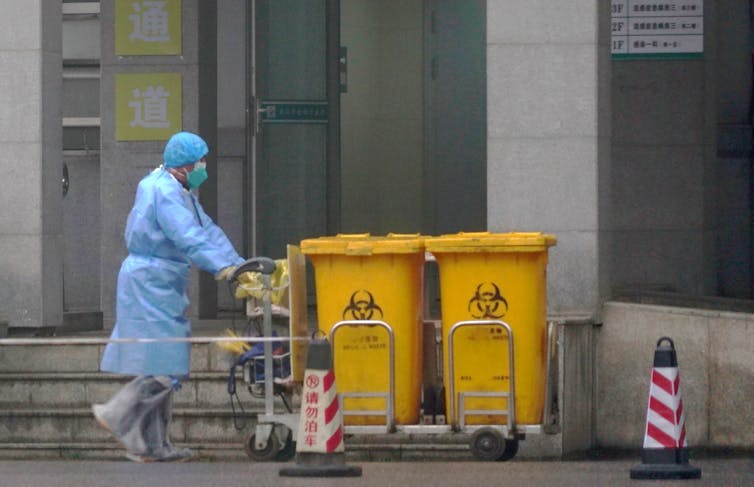
| A worker in Wuhan, China removes biomedical waste from the Wuhan Medical Treatment Center, where many patients of the coronavirus have been treated, on Jan. 22, 2020. Dake Kang/AP Photo |
A case has been reported in Seattle, and officials are monitoring a patient with a possible case in College Station, Texas.
This raises the question: Will this spread – to me?
Am I at risk?
Not now, because currently every case of the novel coronavirus is linked to Wuhan.
There are lots of different coronaviruses that group into three types. The common cold can be caused by both alpha and betacoronaviruses.
Coronavirus was never really taken that seriously until 2003, when a coronavirus jumped species – likely from bats to humans via civets – and led to SARS, or severe acute respiratory syndrome.
This species-jumping ability of coronaviruses is being observed again, now in Wuhan at the seafood market. This coronavirus is in the betacoronavirus group. China has now put travel restrictions in place to limit spread from Wuhan.
Inequality fuels unrest
| Photo: AFP |
The events are not unrelated. Trump
is charged with abusing his power.
Capitalism’s global elite is under assault for abusing its power as well: fueling inequality, fostering corruption and doing squat about climate change.
Chief executives of the largest
global corporations are raking in more money and at a larger multiple of their
workers’ pay than at any time in history. The world’s leading financiers are
pocketing even more. The 26 richest people on Earth now own as much as the 3.8
billion who form the poorer half of the planet’s population.
Concentrated wealth on this scale
invites corruption. Across the world, big money is buying off politicians to
procure favors that further enlarge the wealth of those at the top, while
siphoning off resources from everyone else.
Corruption makes it impossible to
fight stagnant wages, climate change or any other problem facing the vast
majority of the world’s population that would require some sacrifice by the
rich.
Popular anger is boiling over
against elites seen as irredeemably greedy, corrupt and indifferent to the
plight of most people struggling to get by.
The anger has fueled uprisings in Chile, Spain, Ecuador, Lebanon, Egypt and Bolivia; environmental protests in the UK, Germany, Austria, France and New Zealand; and xenophobic politics in the US, the UK, Brazil and Hungary.
Trump’s support comes largely from
America’s working class whose wages haven’t risen in decades, whose jobs are
less secure than ever and whose political voice has been drowned out by big
money.
Although Trump has given corporations and Wall Street everything they’ve wanted and nothing has trickled down to his supporters, he has convinced those supporters he’s on their side by channeling their rage on to foreigners, immigrants, minorities and “deep state” bureaucrats.
Sunday, January 26, 2020
New legislation would expand women’s right to choose and improve equity
Commemorating
Roe v. Wade and closing the gaps on access to abortion
On the 47th anniversary of the landmark Roe v. Wade
decision protecting the
right to choose an abortion, Sen. Bridget Valverde
and Rep. Liana Cassar announced legislation that will lift the ban on
abortion coverage for state employee health plans and ensure that abortion care
is covered by Medicaid.

“Abortion is basic health care and should be covered by your health insurance
no matter how much money you make or where you work. Right now, we have an
unfair, discriminatory system in place here in Rhode Island. State employees and Medicaid patients deserve the
same coverage as everyone else, but the law prohibits
their insurance from providing it.
"These policies result in people and their families being denied access to health care, and in this case, those impacted are disproportionately poorer Rhode Islanders. We believe that every person has the right to make their own reproductive health decisions, but these Rhode Islanders cannot do that when their insurance is expressly prohibited from covering their choice,” said Senator Valverde (D-Dist. 35, North Kingstown, East Greenwich, Narragansett, South Kingstown).
The bill would add Rhode Island to the ranks of 16 states,
including Massachusetts, Connecticut, Vermont and Maine, whose Medicaid programs cover abortion.
DNA Damage to Breast Cells from chemicals in some cosmetics, sunscreens
Study
found two cosmetics chemicals damage DNA of breast cells at low doses
University
of Massachusetts Amherst
A
new approach to studying the effects of two common chemicals used in cosmetics
and sunscreens found they can cause DNA damage in breast cells at surprisingly
low concentrations, while the same dose did not harm cells without estrogen
receptors.
The
research, published Jan. 15 in Environmental Health Perspectives,
identifies a new mechanism by which estrogens and xenoestrogens --
environmental chemicals that act like estrogens -- may promote breast cancer,
says breast cancer researcher D. Joseph Jerry, professor of veterinary and
animal sciences at the University of Massachusetts Amherst.
"The new research offers more sensitive tools to screen for the potential deleterious effects of environmental chemicals, which would be overlooked by methods currently used," Jerry explains.
He notes that federal agencies, such as the Food and Drug Administration (FDA), typically screen for toxicity of these chemicals in cell lines that don't have estrogen receptors.
"The new research offers more sensitive tools to screen for the potential deleterious effects of environmental chemicals, which would be overlooked by methods currently used," Jerry explains.
He notes that federal agencies, such as the Food and Drug Administration (FDA), typically screen for toxicity of these chemicals in cell lines that don't have estrogen receptors.
The
two compounds -- examined in cells grown in the lab and in the mammary glands
of mice -- were the ultraviolet filter benzophenone-3 (BP-3), also known as
oxybenzone, and propylparaben (PP), an antimicrobial preservative found in
cosmetics and other personal care products.
Subscribe to:
Posts (Atom)