Menu Bar

Home           Calendar           Topics          Just Charlestown          About Us

Sunday, December 17, 2023

Trees are in trouble

Scientists flip the script, revealing trees in wetter regions are more sensitive to drought

Harrison Tasoff

This holiday season brings surprising news about your Christmas tree. Scientists just discovered that globally, trees growing in wetter regions are more sensitive to drought. That means if your tree hails from a more humid clime, it’s likely been spoiled for generations.

Scientists have long debated whether arid conditions make trees more or less resilient to drought. It seems intuitive that trees living at their biological limits will be most vulnerable to climate change, since even just a little extra stress could tip them past the brink. On the other hand, these populations have adapted to a harsher setting, so they might be more capable of withstanding a drought.

According to a new study in the journal Science by researchers at UC Santa Barbara and UC Davis, greater water availability could “spoil” trees by reducing their adaptations to drought. “And that’s really critical to understand when we’re thinking about the global vulnerability of forest carbon stocks and forest health,” said ecologist Joan Dudney, an assistant professor at UCSB’s Bren School of Environmental Science & Management and in the Environmental Studies Program. “You don’t want to be a ‘spoiled’ tree when facing a major drought.”

Winter brings more than just ugly sweaters

Here’s how the season can affect your mind and behavior

Michael Varnum, Arizona State University and Ian Hohm, University of British Columbia

What comes to mind when you think about winter? Snowflakes? Mittens? Reindeer? 

In much of the Northern Hemisphere, winter means colder temperatures, shorter days and year-end holidays.

Along with these changes, a growing body of research in psychology and related fields suggests that winter also brings some profound changes in how people think, feel and behave.

While it’s one thing to identify seasonal tendencies in the population, it’s much trickier to try to untangle why they exist. Some of winter’s effects have been tied to cultural norms and practices, while others likely reflect our bodies’ innate biological responses to changing meteorological and ecological conditions. 

The natural and cultural changes that come with winter often occur simultaneously, making it challenging to tease apart the causes underlying these seasonal swings.

With our colleagues Alexandra Wormley and Mark Schaller, we recently conducted an extensive survey of these findings.

Saturday, December 16, 2023

Rift Over When to Use N95s Puts Health Workers at Risk Again

Regulators snake-bit into inaction


Three years after more than 3,600 health workers died of covid-19, occupational safety experts warn that those on the front lines may once again be at risk if the Centers for Disease Control and Prevention takes its committee’s advice on infection control guidelines in health care settings, including hospitals, nursing homes, and jails. 

In early November, the committee released a controversial set of recommendations the CDC is considering, which would update those established some 16 years ago.

The pandemic illustrated how a rift between the CDC and workplace safety officials can have serious repercussions. Most recently, the giant hospital system Sutter Health in California appealed a citation from the state’s Division of Occupational Safety and Health, known as Cal/OSHA, by pointing to the CDC’s shifting advice on when and whether N95 masks were needed at the start of the pandemic. 

By contrast, Cal/OSHA requires employers in high-risk settings like hospitals to improve ventilation, use air filtration, and provide N95s to all staff exposed to diseases that are — or may be — airborne.

The agencies are once again at odds. The CDC’s advisory committee prescribes varying degrees of protection based on ill-defined categories, such as whether a virus or bacteria is considered common or how far it seems to travel in the air. As a result, occupational safety experts warn that choices on how to categorize covid, influenza, and other airborne diseases — and the corresponding levels of protection — may once again be left to administrators at hospitals, nursing homes, and jails or prisons.

Eric Berg, deputy chief of health at Cal/OSHA, warned the CDC in November that, if it accepted its committee’s recommendations, the guidelines would “create confusion and result in workers being not adequately protected.”

Business, not personal

Paul Noth 

Ill-suited


DEM Reminds Public that Plastic Waste Reduction Act Regulations Go Into Effect in the New Year

Stop and Shop is already charging for paper bags even though that's not part of the law

The Rhode Island Department of Environmental Management (DEM) is reminding the public that the Plastic Waste Reduction Act passed by the Rhode Island General Assembly in the 2022 session and signed into law by Governor Dan McKee, will go into effect on Jan. 1, 2024. 

The law bans retail establishments from providing single-use plastic bags to customers at the point of sale. Eighteen of 39 Rhode Island communities have passed similar plastic bag bans. The law ensures a uniform and consistent legal standard statewide on plastic bags. Click here to view the regulations.

The law, authored by Senate President Dominick J. Ruggerio and Representative Carol Hagan McEntee, directed DEM to conduct a cost benefit analysis along with drafting regulations to implement the law. DEM held a hearing on the regulations on Sept. 26 and the public comment period closed on Oct. 1. DEM has engaged in outreach to industry and businesses to remind them of the regulations.

With the holiday shopping season in full swing, DEM reminds consumers that by bringing their own reusable bag whenever they shop, they are doing their part to reduce litter and waste and help lessen the harmful effects of single-use plastics on Rhode Island’s environment. 

Health misinformation is rampant on social media

Thousands of lives lost to internet lies about health care

Monica Wang, Boston University

David Sipress
The global anti-vaccine movement and vaccine hesitancy that accelerated during the COVID-19 pandemic show no signs of abating.

According to a survey of U.S. adults, Americans in October 2023 were less likely to view approved vaccines as safe than they were in April 2021. As vaccine confidence falls, health misinformation continues to spread like wildfire on social media and in real life.

I am a public health expert in health misinformation, science communication and health behavior change.

In my view, we cannot underestimate the dangers of health misinformation and the need to understand why it spreads and what we can do about it. Health misinformation is defined as any health-related claim that is false based on current scientific consensus.

Friday, December 15, 2023

Reclaiming the Newsroom

It’s Time for Journalists to Make Their Return

By JACK WALSH

It’s no secret that newsrooms countrywide are beginning to expect less of their staff regarding in person workflow. Although now, some outlets hardly even meet face-to-face at all — even when they are capable of doing so.

Traditionally, the newsroom is supposed to be a place of collaboration between reporters and editorial teams. While work can certainly be completed remotely in an efficient manner, all news organizations should push staff members to come into work — which benefits the outlet as a whole.

The overall efficiency of news organizations are in jeopardy, and a remote newsroom just doesn’t do the proper justice to those committed to working in the field. This is especially true for young journalists in need of editorial assistance and guidance.

Going into 2022, about 34% of news organizations were using a fully-remote or hybrid work model, with 57% still figuring out how to implement a hybrid-work day.

It’s time to get back to work.

The Boston Globe is one of the finest news outlets in the U.S., with roughly 282,000 digital weekday subscribers. They lead New England in coverage among daily papers. Reporters at the Boston Globe — which falls under Boston Globe Media’s ownership — are expected to come into the office at least three days out of the week in a hybrid work model.

Justice denied

To-do list


Popular Myth Debunked

Scientists Find That Opposites Don’t Actually Attract

By UNIVERSITY OF COLORADO AT BOULDER

Contrary to popular belief, opposites don’t actually attract. That’s the takeaway from a sweeping CU Boulder analysis of more than 130 traits and including millions of couples over more than a century.

“Our findings demonstrate that birds of a feather are indeed more likely to flock together,” said first author Tanya Horwitz, a doctoral candidate in the Department of Psychology and Neuroscience and the Institute for Behavioral Genetics (IBG).

The study, published Aug. 31 in the journal Nature Human Behaviour, confirms what individual studies have hinted at for decades, defying the age-old adage that “opposites attract.” It found that for between 82% and 89% of traits analyzed—ranging from political leanings to age of first intercourse to substance use habits—partners were more likely than not to be similar.

For only 3% of traits, and only in one part of their analysis, did individuals tend to partner with those who were different than them. Aside from shedding light on unseen forces that may shape human relationships, the research has important implications for the field of genetic research.

How cinnamon, nutmeg and ginger became the scents of winter holidays, far from their tropical origins

Not only tasty but healthy, too

Serina DeSalvio, Texas A&M University

Nutmeg, ginger, cinnamon and other gingerbread
 spices. Almaje/iStock via Getty Images
Regardless of how you celebrate end-of-year holidays, food is probably central to your winter festivities. And a trio of spices – cinnamon, nutmeg and ginger – feature in many dishes and drinks and are an unmistakable part of the scent profile we associate with the holiday season.

As a plant scientist, I was curious to know how these spices, grown in the tropics, became so closely associated with the Northern Hemisphere’s winter holidays. Just as cranberries’ fall harvest makes them a natural choice for Thanksgiving, I thought that perhaps the seasonality of spice harvest had something to do with their use during the winter months.

However, this doesn’t appear to be the case. When it comes to growing spices, producers are playing the long game.

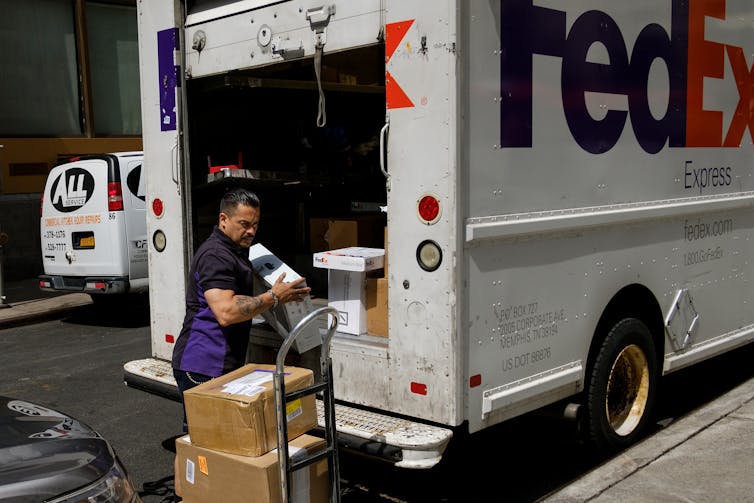
Could UPS and FedEx get holiday packages to their destinations faster?

This research suggests yes

Toyin Clottey, Wayne State University

The real heroes of the holidays. Drew Angerer/Getty Images
Every year, parcel delivery companies – think UPS and FedEx – hire tens of thousands of seasonal driver helpers to handle the deluge of presents that arrive with the holidays. 

At peak times, shipping firms depend on their helpers just as much as Santa depends on his elves. And those companies could save millions of dollars each year – and shave time off their deliveries – simply by tweaking the roles they gave those workers to be more efficient, my colleagues and I recently found.

As a a professor of supply chain management, I’m interested in how shipping companies can reach complex logistical goals. And there are few goals more challenging than getting 90 million parcels to their destinations every day, which was the industrywide average during the 2022 U.S. holiday season.

So, when a major shipping company asked for some fellow researchers and me to find ways to improve the system, we jumped at the chance. Using mathematical models and a field experiment in a small Midwestern city, we found that reassigning these workers could unlock major efficiency gains.

Thursday, December 14, 2023

Weekapaug fake fire district plays dirty

ACLU asks phony fire district to withdraw letters to donors supporting Spring Ave. extension fundraising campaign

By Rob Smith / ecoRI News staff

Photo by Alex Nunes, The Public's Radio
The Rhode Island American Civil Liberties Union is wading into a shoreline access dispute, telling a high-profile fire district to knock it off.

Steven Brown, executive director of the state’s ACLU branch, sent a formal letter to the Weekapaug Fire District in Westerly, asking it to rescind a number of letters notifying shoreline access activists who donated to a specific GoFundMe that they may be called to testify in the legal dispute over the Spring Avenue Extension right of way.

In his letter to the fire district, Brown described the effect of the letters sent by Joseph A. Farside Jr., a partner at the Providence-based law firm Locke Lord and attorney for the fire district, as having a chilling effect on the donors’ First Amendment rights.

“Singling out these donations as a justification to threaten the contributors with compulsory process and interrogation under oath could easily be interpreted as an attempt to chill core First Amendment activity,” Brown wrote.

The ACLU is asking the fire district to withdraw any current letters sent to donors, and for the fire district to disavow “this effort to chill public support for a position it opposes based solely on participation in a GoFundMe campaign.”

In an emailed statement to ecoRI News, the Weekapaug Fire District said it shared the ACLU’s commitment to transparency. “We contacted individuals who made their donation information public through the GoFundMe because they are meaningfully engaged in the issue and may have information that is relevant to the case,” the fire district wrote.

The Weekapaug Fire District, a quasi-government organization that acts more like a homeowners’ association than it does anything to do with fire suppression, is contesting a popular public access point in Westerly known as the Spring Avenue Extension. The fire district claims it owns the right of way (ROW), and that it’s private, not open to the public. The matter is pending before the Coastal Resources Management Council.

Why he makes me sick