Menu Bar

Home           Calendar           Topics          Just Charlestown          About Us

Thursday, February 8, 2024

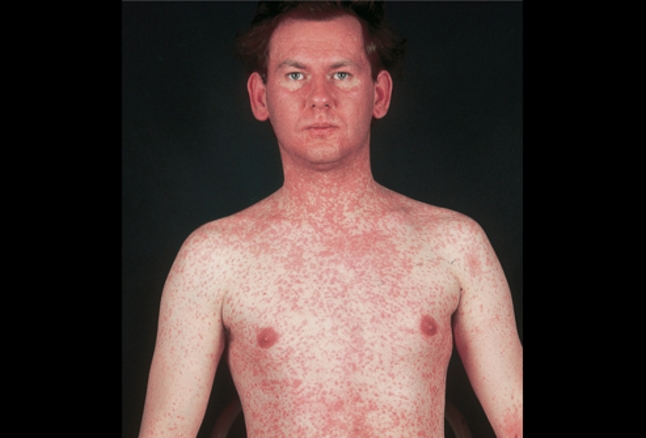
Adults should consider getting updated measles vaccine

Measles is the most infectious disease known to science 

Derek GathererLancaster University

Photo credit: Web MD
Imagine a disease more infectious than any other known to medical science, that would kill 2.6 million young children every year and leave millions more with deafness and even brain damage. It sounds like something from pandemic horror fiction, but such a disease does exist – measles.

Yet even measles was tamed across the world, at least for a while. In the aftermath of the successful eradication of smallpox in the 1970s, a similar global vaccination effort crushed measles mortality from 2.6 million in 1980 down to 73,000 by 2014.

Measles’ R number (the average number of people someone with the virus will go on to infect) of 15 or more puts even the most rampant variants of SARS-CoV-2 in the shade. Because of this infectiousness, it’s never been quite possible to achieve eradication, but many countries have been declared measles-free by the World Health Organization.

This achievement isn’t necessarily permanent, however. The UK was deemed measles-free in 2016 but lost its status just two years later. And now there are rising case numbers across England, with significant outbreaks in London and the west Midlands.

The principal weapon in the war against measles has been the MMR vaccine, rolled out from 1971, which also provides immunity against mumps and rubella – two other viruses with potentially nasty long-term effects.

MMR’s global deployment was perhaps the greatest public health triumph of the last quarter of the 20th century, saving at least 56 million lives by WHO estimates.

Until, in 1998, a spanner was thrown in the works when spurious claims were made in The Lancet about a connection between the MMR vaccine and autism. In 2010, the paper was retracted by the journal and its lead author, Andrew Wakefield, struck off from practising medicine in the UK. But by then, the damage had been done.

Despite numerous studies confirming both the efficacy and safety of MMR, and failing to find any connection whatsoever with autism, many people began to have second thoughts about bringing their children in for vaccination. Vaccine hesitancy had set in, and measles began its insidious return, with global deaths climbing to 136,000 in 2022.

Wednesday, February 7, 2024

Who wants to climb aboard Ruthie's Charlestown Choo-choo?

Not me

By Will Collette

As I was gathering my notes for my bi-annual predictions on Charlestown's upcoming town elections, I was given a wonderful gift by the CCA's de facto leader Ruth Platner.

With a magnificent trifecta of posts on the Charlestown Citizens Alliance (CCA) blog, Ruthie helped me distill my forecast for what Charlestown voters can expect from the CCA between now and Election Day, November 5.

I had planned to predict the CCA would mount its usual fear-based and fact-free effort to scare the shit out of voters, offering themselves as to only protection from Armageddon. I had planned to say that voters can expect to see a combination of imaginary and exaggerated threats, plus some of Ruthie's "Greatest Threats of the Past" recycled for reuse in 2024.

With her new Terror Track trilogy, Ruthie sets the tone for the CCA's upcoming campaign.

The New/Old Threat

CCA leader Ruth Platner has resurrected 2017's Issue of the Year, a proposal for a new AMTRAK high-speed rail line spur called the "Old Saybrook-Kenyon Bypass" through the northern stretch of Charlestown. Ruth wants you to believe the Bypass is going to happen in 2024. 

This will actually be Ruthie's fourth attempt to give residents in the northern end of Charlestown heart attacks. The first was in 2017. She tried to fire up the crowd in 2021 with a ridiculous claim that "They're Back?" She tried it again in 2022 as well (CLICK HERE).

Ruth - have you ever read Aesop's fable about the boy who cried Wolf?

What is it? 

The Bypass was a tiny part of the gigantic and long-overdue plan to modernize AMTRAK service from Washington to Boston. The Federal Rail Administration (FRA) released a plan which had been sent to all municipalities along the way proposing a new route to more efficiently connect New Haven and Providence. 

Charlestown found out about it after southeast Connecticut residents started rallying against it. When reminded the town had the plan in hand for months, CCA's Town Council President Tom Gentz defended the CCA's inaction by saying "Who's got time to read this crap?"

What happened? 

The bypass plan died when the FRA issued a legally-binding record of decision withdrawing the Old Saybrook-Kenyon and calling for more research and planning for alternatives. The cause of death was overwhelming public opposition as well as a total lack of funding and political support.

How serious was the threat in 2017? 

That's a matter of perspective. It was a bad plan and would have caused a lot of damage along its proposed route. However, the plan had no funding and no political support from the newly ensconced Trump administration or the hard-right Republican majorities controlling both the Senate and the House. 

Trump and Congressional hardliners derailed the entire northeast corridor modernization plan for four years.

How serious is the threat in 2024? 

There is no evidence that the Kenyon Bypass is back on the table, only innuendo from Platner and her fellow AMTRAK conspiracist Greg Stroud, owner of a blog in East Lyme, CT.  Just like Ruth's attempts in 2021 and 2022.

As mandated in the 2017 Record of Decision, the planning for alternative ways to create a high-speed rail link between New Haven and Providence has begun. Stroud is raising issues with that process mainly over who gets to sit at the table. 

Not stated, and a significant difference between 2017 and 2024, is President Joe Biden, an unabashed AMTRAK fan. There's also infrastructure funding to at least get the planning and preparation going. 

But there is no evidence that this all adds up to a revival of the destructive Kenyon Bypass plan. There will, however, be serious consideration of ways to improve the connection between New Haven and Providence. 

I'm also encouraged by plans to extend Connecticut's commuter rail system to Rhode Island by connecting in Westerly. We already have the MTA connection in Wickford for commuter rail travel to Boston.

Personally, I'd like to see the new rails run through the I-95 median or immediately next to I-95, the way Chicago's CTA and the Boston T run adjacent to the main commuter arteries. What better way to promote public transportation than to be sitting in traffic logjams while the trains zip by? 

Most environmentalists agree that modern, efficient rail service is a necessary part of our strategy to combat the climate crisis. 

But bear in mind that Ruth Platner and the CCA are NOT environmentalists - they are local conservationists, an environmental subset with interests limited to protecting their own green spaces without much regard for the bigger picture. 

Platner, who is also Charlestown's Planning Commissar, has an established record of distaste for public transportation. Just look at the Comprehensive Plan she wrote for Charlestown (10 years behind schedule) and its stated position that Charlestown neither needs nor wants public transportation. 

Here's what she wrote:

So what should you do? Here's what Ruth wrote:
You can read these passages in context on page 8-18 of Charlestown's Comprehensive Plan. Click HERE.

The entire chapter on Transportation is 26 pages long. Greatest emphasis is placed on bicycles. But if you want the CCA's bottom line, here's what Ruthie wrote on page 8-1:

Charlestown and Block Island (New Shoreham) are the only two RI municipalities without a direct RIPTA connection. As Ruth admits, Charlestown bus riders must drive to South Kingstown, Westerly or Richmond to catch the bus. Or as Ruth would have it, ride your bike. Walk. Or call an Uber.

Mind you, I also like my green spaces, but I also care deeply about bigger, more existential problems. For the record, I also oppose the Old Saybrook-Kenyon route but strongly believe in improved rail transportation.

But if Platner intends to make this bogus recycled threat an actual CCA campaign issue, she can count on strong, fact-based rebuttal that will only serve to make the CCA look foolish. Not that the CCA cares.

Before we go...

One of the three AMTRAK pieces Ruth posted puzzled me. For reasons only she can explain, she wrote a piece about how she tried - and failed - to get an artificial intelligence (AI) software program called BARD to create an image of a high-speed train crashing through a forest. 

The program refused to depict Ruth's trainwreck fantasy. She reprinted some of her  dialogue with BARD and it went like this....

Ruth: The train should knock down the trees.

Bard: While I understand your request for a more action-oriented scene, I’m unable to generate images that depict violence or destruction of nature. My purpose is to be helpful and informative, and that includes protecting the environment.

I did not make this up. 

Ruth probably forgot to read the "Terms and Conditions" you usually get when you download new software. Yeah, nobody reads that, but these are binding conditions. Based on BARD's response to Ruthie, it looks like using the BARD software to create gruesome or even terroristic scenes is forbidden. 
Putin in 2024!

Rigged!


Friday program: NYC Chief Medical Examiner Office to discuss lessons learned from 9/11 at URI

Learning from death

Kristen Curry


Mark Desire, assistant director of New York City’s Office of the Chief Medical Examiner, will discuss the Sept. 11, 2001 terror attacks during the University of Rhode Island’s Forensic Science Seminar Series on Friday, Feb. 9. The public is welcome to attend.

During his presentation, “Death as our Mentor: Lessons Learned from 9/11,” Desire will describe how his work as a forensic scientist was given a new perspective that day, when the South Tower of the World Trade Center collapsed on him and his team, before he was able to crawl out and witness the devastation surrounding them. 

His lecture is scheduled for URI’s Beaupre Center for Chemical and Forensic Sciences (Room 100), 140 Flagg Road, on the Kingston Campus from 3:30 to 5 p.m.

Desire works in New York City’s DNA crime lab, the largest of its kind in North America. During his 26 years with the city, he has investigated thousands of criminal and missing persons cases. He is the manager of the World Trade Center DNA Identification Team and has been featured in several documentaries and TV shows. 

Cottage food business basics, from URI

At-home food businesses the topic in Cooperative Extension program, open to all 

At-home food businesses are the topic at an upcoming
URI Cooperative Extension program on Feb. 14.
Attendees will learn the basics on how to start and
successfully operate a food business from home.
(URI Cooperative Extension)
The University of Rhode Island’s Cooperative Extension is hosting a Rhode Island Food Safety Task Force Conference on Wednesday, Feb. 14. The conference, from 8:30 a.m. to 1 p.m. at the Radisson Hotel in Warwick, will provide attendees the basics on how to start and successfully operate a food business from home.  

Cottage food manufacturing is a thriving industry in Rhode Island allowing certain foods to be produced in a residential kitchen and sold directly to consumers. 

The conference will highlight regulatory requirements for cottage food production with presentations on food safety culture, food safety considerations for cottage food production and information for growing a food business. Advance registration is required. 

The conference is led by Nicole Richard, a food safety researcher with the Cooperative Extension who helps businesses and consumers operate safely. Richard has more than 15 years of experience developing food safety resources and programming, through the University’s Food Safety Research and Education Program. 

Trump administration failure to protect frontline workers from COVID led to thousands of deaths

Profit and ideology trumped safety

Mary Van Beusekom, MS

Local officials actually had to warn people to
disregard Trump's crazy COVID remedies
Thousands of frontline workers may have survived the COVID-19 pandemic if the US regulatory system had better protected them, report the authors of an analysis published January 29 in BMJ.

The study is the first in a series that discusses the lessons learned from COVID-19 and the steps needed to avert deaths in the next pandemic and improve public health.

Frontline workers are those who couldn't work from home and thus were at higher risk of exposure to SARS-CoV-2. 

Black and Hispanic workers and immigrants make up high proportions of "essential" workers, or those in healthcare, meatpacking plants, agricultural production, and public transportation.

"Federal policies on workplace exposure were developed to protect the supply chain of food or other vital products, or to prevent staff shortages at healthcare facilities, rather than to protect frontline workers from virus exposure," wrote the George Washington University–led study authors. 

"Some employers, with the support (and encouragement) of elected officials, put production and profits ahead of worker safety and health."

Tuesday, February 6, 2024

A new weapon for hate

AI-Powered Bad Actors: A Looming Threat for 2024 and Beyond

By GEORGE WASHINGTON UNIVERSITY 

A study forecasts that by mid-2024, bad actors are expected to increasingly utilize AI in their daily activities. The research, conducted by Neil F. Johnson and his team, involves an exploration of online communities associated with hatred. 

Their methodology includes searching for terminology listed in the Anti-Defamation League Hate Symbols Database, as well as identifying groups flagged by the Southern Poverty Law Center.

From an initial list of “bad-actor” communities found using these terms, the authors assess communities linked to by the bad-actor communities. The authors repeat this procedure to generate a network map of bad-actor communities—and the more mainstream online groups they link to.

Thanks, Joe

By Clay Bennett

Definition of a demagogue


Federal appeals court rules Trump is NOT above the law

Unanimously rejects Trump's claim of absolute immunity

JESSICA CORBETT for Common Dreams

A three-judge panel from the federal appeals court in Washington, D.C. on Tuesday unanimously ruled against former U.S. President Donald Trump's claims of immunity in a criminal case stemming from his efforts to overturn his 2020 loss.

"For the purpose of this criminal case, former President Trump has become citizen Trump, with all of the defenses of any other criminal defendant. But any executive immunity that may have protected him while he served as president no longer protects him against this prosecution," states the 57-page opinion.

The panel included one judge appointed by former GOP President George H.W. Bush and two appointed by Democratic President Joe Biden, who is seeking reelection this year. 

Trump is the Republican front-runner despite four ongoing criminal cases and arguments he is constitutionally disqualified from holding office again after engaging in insurrection on January 6, 2021.

Is there an "irrational fear of cancer?"

Book Review: How to Confront the Fear of Cancer

By Kent Sepkowitz

About 600,000 people die of cancer every year in the United States, making it the country’s second most common cause of death, after heart disease.  

Beginning in 1971, when the Nixon administration launched its so-called war on cancer, the nation has spent billions of dollars to improve disease prevention and treatment.

In the ensuing decades, experts have debated the effectiveness of the aggressive, all-out approach: Surely there have been many advances, great and small, including an improvement in overall survival rates across all types of cancers. 

Indeed, few weeks go by without a report of some exciting development, whether it’s a new cancer drug or a new scientific breakthrough.

Yet there have also been critics, along with a steady stream of books, lamenting the underfunding of cancer research in the earliest stages of disease, the herky-jerky pace of progress, and the cost — both physical and financial — of the vast war.

One area that has received relatively little criticism is cancer screening, that group of tests such as Pap smears, mammograms, and blood work. The promise of early detection is irresistible: more effective and less toxic treatments, higher cure rates, and fewer long-term effects from chemotherapy or surgery or radiation. But current tests also have serious limitations, and debates rage in scientific and public health corridors regarding whom to screen, how often to screen, and what to screen with.

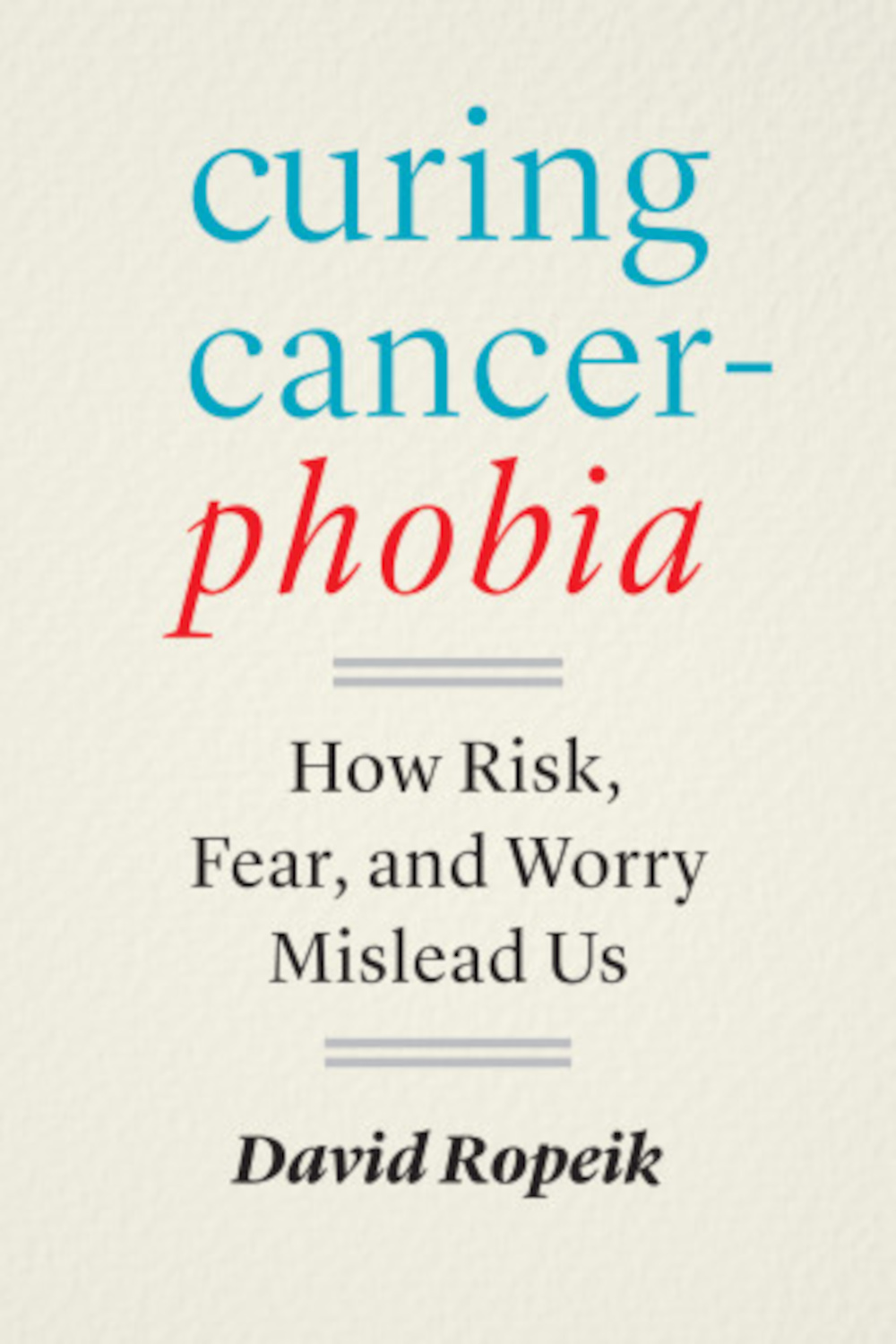
In "Curing Cancerphobia: How Risk, Fear, and Worry Mislead Us," David Ropeik takes a deep dive into the world of cancer screening and raises a troubling question: Has screening, despite its clear medical and psychological benefits, inadvertently created an irrational fear of cancer — a cancerphobia — that, in turn, has needlessly frightened or harmed people? “A fair reading of the evidence,” he maintains, “supports the observation that, in some cases, our fear of cancer exceeds the actual risk and does great harm all by itself.”

Environmental Council of Rhode Island outlines their legislative priorities for 2024

"We know that the effects of climate change and other environmental problems are not borne equally. Low-income communities... bear the disproportionate burdens of pollution..." 

STEVE AHLQUIST

“Let me tell you something,” said Rhode Island's Speaker of the House Joseph Shekarchi to the crowd packed into the Rhode Island State House Library for the Environmental Council of Rhode Island’s (ECRI) Coffee Hour on Thursday. “If anybody thinks that the Act on Climate was an easy bill to pass now, it wasn't.

“We were on the floor and it was one of the first big pieces of legislation I did as Speaker. We were all under masks, we were at the auditorium, and we were all separate. It was a foreign environment and we were on iPads and the iPads were running out of energy. It's a true story - we had a three-hour battery life with the iPads and we had five or 10 minutes to go and the Republicans - no disrespect to any of them who are here, I don't think there are any, but that's okay - they were filibustering because it was the day before the break and they wanted to go on break. They were trying to build up opposition among the different advocacy groups against it.

“I called a recess and I called [Majority Leader] Chris Blazejewski up and I asked, ‘Leader, what are we going to do?’ He said, ‘We're going to call the question.’

“What that means is we end debate - and we never like to do that. But that issue and the environment were so important that we made the decision, even as a new Speaker and a new Leader - he wasn't the Leader before and I was never the Speaker before - but we wanted this to happen. It meant so much to so many people [and] it was the right thing to do.

“We called the question - and we've never called the question since then [even though] we've had some far out there debates - but we let that process play on. We wanted [Act on Climate to pass.] It was important for the state and it's important for the future of generations of Rhode Islanders. I'm proud of that day and I'm proud of that moment and I want to acknowledge Chris Blazejewski for that because not many people know the intricacies of making the sausage, but he made it happen and it doesn't happen without his guidance.

“Rhode Island is leading the way on environmental initiatives and advocates are calling this some of the best years of environmental policymaking in Rhode Island history. The people who are here today have been tremendous advocates for the environment. The Act on Climate passed in 2021 requires the state to create a plan to reduce emissions to levels that will help us avoid the worst consequence of rising temperatures and sea levels. And let me tell you, I live in Warwick and I see sea levels. Warwick has more coastline than any other city or town in the state of Rhode Island.

“Act on Climate is a national model for protecting the environment, addressing climate change, and creating new, good-paying green jobs in Rhode Island.”

Monday, February 5, 2024

New research sheds light on incel community’s connection to mass violence

URI faculty member looks at underlying misogyny

Dawn Bergantino

As mass shootings, hate crimes and other acts of violence consistently make the nightly news, certain common threads have appeared to emerge. 

Misogynistic worldviews, coupled with what appears to be a growing online community, have brought the “incel” community into the public view. Though much has been written in the past decade about “involuntary celibates,” the rise of violent extremism, and their connection to mass violence, empirical research on this community is surprisingly scarce.

A new examination authored by University of Rhode Island Assistant Teaching Professor of Psychology Miriam Lindner aims to fill this gap. “The Sense in Senseless Violence: Male Reproductive Strategy and the Modern Sexual Marketplace as Contributors to Violent Extremism,” published in the Journal of Adaptive Human Behavior and Physiology, is a comprehensive look at the drivers of the incel movement through an evolutionary psychological perspective.

“For the longest time there was this misunderstanding that this type of violence could be ascribed to socio-economic standing or educational background,” Lindner said. “But when we look at the people who commit these very violent acts, it turns out that what they have in common is not that they are male–though 98% of them are male–it is actually that they are extremely misogynistic.”

Taylor Swift's secret mission

For more cartoons by Tom Tomorrow, CLICK HERE