Menu Bar

Home           Calendar           Topics          Just Charlestown          About Us

Sunday, May 3, 2020

Bad decision for Rhode Island's air quality

By TIM FAULKNER/ecoRI News staff

Air Pollution Smoke GIF by INTO ACT!ONThe drop in demand for fossil fuels is creating a glut of gasoline and coal, prompting relief by the Environmental Protection Agency (EPA) and state agencies, including in Rhode Island, that is likely to worsen air pollution.

The U.S. Energy Information Administration (EIA) reports that coal extraction is down 35 percent from a year ago. The reduced demand has led to layoffs and some mines shutting down temporarily because of the coronavirus pandemic.

Coal was struggling before the global health crisis, as other power sources, such as solar, wind, and natural gas, attained a greater share of energy production.

Last year, coal accounted for 23.5 percent of U.S. power generation. But during the week of April 8, coal fell to 15 percent of energy production, dropping below renewable-energy production for the first time, according to a report by the Rhodium Group.

Coal-energy analysts say coal plants may simply operate at a loss to burn off their excess stockpiles, or the plants may be retired, as several have in recent years.


Confronting the chemicals that are worsening COVID-19

To weather future pandemics, US agencies need to start using modern science to establish what is safe and what is not.
    
COVID-19 Risk Factors: Health Conditions That Increase RiskWhat affects how likely you are to die from the novel coronavirus?

The answer is clear: The older you are and the more health problems that afflict you, the more likely you won't make it.

We can't do anything about getting older except age with grace and tolerate the excesses of youth (as long as they honor social distancing). 

Health problems, however, are another thing, because they may have causes that can be prevented and/or treated.

Which health problems stand out as likely to make your COVID-19 experience deadly?

Diabetes, obesity, heart disease, high blood pressure, and reduced immunity, among others. These are diseases that develop over a lifetime, and so you won't be able to change them in the course of the current pandemic. If you have one or more of these diseases, protect yourself by taking your meds as directed, and follow all the social distancing recommendations issued by public health officials.

But if there's one certainty about this, it is that this will not be the last pandemic. That's guaranteed by a growing human population, global integration of society (especially by airplanes), and features of today's civilization that make it more likely that animal diseases will infect humans. 


The perils of making decisions in the dark

Following Trump’s “hunches” is not enough
    
Veep Mike Pence, maskless at the Mayo Clinic in violation of their (and his
own) rules. Pence said he didn't wear a mask because he wanted to look
health workers and researchers "in the eye and say thank you." Seems
that Pence, leader of the Administration's COVID-19 taskforce,
thinks face masks cover the entire face.
The COVID-19 crisis has revealed the harmful consequences of leaders making critical decisions based on insufficient data, which end up hurting the most vulnerable communities.

With many people impatient to get back to work and businesses eager to re-open, experts agree that widespread and ongoing diagnostic and antibody testing for COVID-19 are essential for any plan to return to normal.

However, there are major hurdles to overcome, from having accurate data on infections and better demographics data on those most affected, to a better understanding of how the virus spreads and the variation in severity of cases.

Unfortunately, as some states move to re-open, they are making these decisions in the dark and putting people's lives at risk.

The U.S. had a slow start rolling out testing, hindering data on COVID-19 infections early on. The first batch of tests made in mid-February by the Centers for Disease Control and Prevention (CDC) were unusable because the CDC didn't follow its own protocol and contaminated the tests. 

Now with ramped up testing, private labs are facing major backlogs because they didn't want to turn away business, even though they lacked the capacity to run all the tests they accepted.

There is concern that because most states are not providing information on pending tests, the extent of outbreaks is being under-reported. Meanwhile, academic labs are operating below capacity

Further, the tests require validation, as some have poor accuracy and could dangerously lead to false negatives.

While this train wreck is on public display, it's a familiar landscape to those of us who work in the field of chemical regulation.


Saturday, May 2, 2020

Income and jobs that won’t disappear

Our recovery needs to be green

DC passed the most ambitious clean energy law in the US. Now what ...Rhode Islanders are hungry and having trouble paying their bills. 180,000 workers have lost their jobs. 

We’re in a recession, and economists believe we’re on a path toward a depression.

The White House and Senate majority aren’t helping us like they should, and our state government is barely staying afloat. 

How many more Rhode Islanders will suffer and struggle before we find our way out of this economic downturn?

We have no doubt that we’ll recover from this, but we also know that we’ll come out of this in worse condition than when we went in because that’s how it works in Rhode Island. Our economy is fragile and blows to our economy only make it less strong.

But it doesn’t have to be this way. The world is changing, and we can seize that change and use it to make our lives better.

Fossil fuels are crashing, and our economy, which is tied to fossil fuels, is falling with it. At the same time, clean energy is rising. There’s strength in clean energy, and by grabbing onto it, we can pull ourselves up, gain huge economic benefits, and start creating a stronger Rhode Island.

If Rhode Island builds a new, state-owned clean energy system, we can have an economic boom that will benefit every citizen in the Ocean State. 


Yes, we can kill COVID-19


For more cartoons by Tom Tomorrow, CLICK HERE.

CRU asks you to participate in Charlestown Town Council budget hearing on Monday


Friends,

The Town's Budget Public Hearing is coming up on Monday, May 4, at 7 pm.
This proposed budget calls for a 7.4% increase in town spending over this year. This spending level will draw $3 million out of our Unassigned Surplus (Emergency Reserve) fund and still increase taxes by several hundred dollars for many of our homeowners. Due to the economic uncertainty surrounding the pandemic, Charlestown Residents United does not support a spending increase of this magnitude.

Additionally, this budget takes $3 million out of the Unassigned Surplus. Last year, voters set aside $74,000 to survey taxpayers and residents to determine what we want to do with this money. This budget decides for us where the money will be spent, before we are even asked.

There are items that can be removed from the budget this year, to reduce the draw-down of the town's Unassigned Surplus. Town Council Vice President Deb Carney drafted an article (you can read it here) that outlines some of these items.

Your opportunity to express your thoughts on this will be on Monday, May 4th, or you can email the Town Council before the Budget Public Hearing.

The Budget Public Hearing will be held this Monday, May 4th. This year will be a Virtual Meeting. You must register in advance to participate; instructions are included below.

After this public hearing, the Town Council will vote, at their May 11 meeting,
on the budget for the Town Financial Referendum, to be held June 1, 2020.

CRU does not support a 7.4% increase in the budget during this time of economic uncertainty. CRU also does not support withdrawing as much as $3 million from our Unassigned Surplus at this time.

We encourage people to let your voice be heard, either by attending the Virtual Budget Public Hearing or by emailing the Town Council.

Information for participating in the online budget hearing

The public hearing on the town budget will be online through WebEx.

Participants (to either view the meeting or comment during the meeting) must register in advance by going to this webpage. Several informational items in the registration must be completed for a registered voter to be verified and count toward the required quorum.

All participants/viewers must register to gain access to the meeting.

Registration can be completed anytime. People are encouraged to register early.

See you (virtually) Monday night!

Jodi Frank, Chairperson, Charlestown Residents United


Charlestown Residents United (CRU) is a Political Action Committee dedicated to providing a voice to all Charlestown residents.


Paid for by
Charlestown Residents United
P.O. Box 412
Charlestown, RI 02813

URI ship Endeavor – at sea during pandemic outbreak – finally makes it home

Scientific team completes its research

Endeavor returns to the Bay Campus
The URI research vessel Endeavor returns to the Bay Campus after an extended trip from Barbados to Cape Verde during the emergence of the COVID-19 pandemic. Photo by Nora Lewis.

When University of Rhode Island oceanographers Rainer Lohmann and Rob Pockalny flew to Barbados in February to board the research ship Endeavor for the beginning of a 22-day expedition across the Atlantic, their only health concern was whether they needed a vaccination for yellow fever. COVID-19 wasn’t even on their mind.

But as they monitored the news during the ensuing weeks, they began to worry.

“We heard about the virus situation in northern Italy and then Spain, and then Trump issued the travel ban and URI canceled classes,” Lohmann said. “That’s when we realized that things were really in bad shape, and our anxiety started to rise about how we were going to get home.

“When we left, everything was normal,” he added, “and then we read about toilet paper hoarding and pasta flying off the shelves. It was like being in a strange film; you don’t know if it’s real.”


Talk about fresh fish!

New temporary license lets commercial fishermen sell some types of seafood directly to consumers, retailers

Following the fish, and defining local markets for scup in Rhode ...To help foster the continued viability of the Rhode Island commercial seafood industry during the COVID-19 public health crisis, the Department of Environmental Management (DEM) has enacted a new, no-cost Direct Sale Dealer License. 

It authorizes commercial fishermen in Rhode Island to sell certain species of finfish, and to sell and transport for sale live lobsters and crabs, directly to consumers and licensed seafood retailers from the vessel on which they were harvested.

"There is a growing demand for local seafood during this critical time, and we're fortunate that our commercial harvesters are able to meet the needs of residents with the abundant seafood resources available off our coast," said DEM Director Janet Coit. 

"Rhode Islanders can take pride in knowing that when they purchase fresh local seafood, at local retailers or right off the boat from harvesters, they are helping to keep a vital part of our economy – our commercial fishing and seafood industry – up and running."


Are anti-vaxxers a “national security threat” during pandemic?

FBI-Affiliated group warned of danger of anti-vaccine movement during pandemic
Anti-Vaxxers Latch Onto Coronavirus to Bolster Their Movement ...
US News and World Report
As the anti-vaccine movement joins right-wing protests against coronavirus social distancing measures and concerns are rising around the world over a potential decline in vaccinations for measles and polio, a little-noticed report from an FBI-affiliated group in June 2019 on the danger of "anti-vaxxers" in the time of a pandemic is receiving new attention. 

"The biggest threat in controlling an outbreak comes from those who categorically reject vaccination," wrote the report's co-authors, Norwell Health senior vice president Mark Jarrett and healthcare cybersecurity consultant Christine Sublett.

The authors are both members of the Department of Health and Human Services' Public Health Emergency Health Care Industry Cybersecurity Task Force.

"The Anti-Vaxxers Movement and National Security" (pdf) was published last year in InfraGard, the journal of a national security analysis non-profit tied to the FBI. The Guardian reported on the study, citing its eerie applicability to the coronavirus outbreak and the behavior of the anti-vaxxer movement amid the pandemic. 


Friday, May 1, 2020

The Ghosts of Earth Day

The spirits of Earth Days Past, Present and Future give us a perspective on environmental politics.

the voice trees GIF by NBCSuppose they gave an Earth Day and nobody came?

Last Wednesday's 50th Anniversary of Earth Day was an afterthought, a non-event in a world so preoccupied with surviving to 2021 that surviving to 2100 doesn't move the needle.

So let's shoehorn this annual event into a Dickensian model and look at the spirits of Earth Days' Past, Present and Future.

Earth Day's 1970 debut and its 20th Anniversary in 1990 were high marks, as I discussed two weeks ago.


Encore! Encore!


For more cartoons by Nick Anderson, CLICK HERE.

Oh please, rally some more

Image may contain: 4 people, text

UPDATED: Short Takes #12: Rhode Island’s war against the coronavirus

Of metrics and misery
By Will Collette

While you're social distancing, you can
have some fun with shrubbery.
It seems relatively easier to adjust to our strange new world of COVID-19 social distancing when you are already retired, as I am.

But for older people, there is the knowledge that if you are old enough to retire, you are at much higher risk of critical illness or death than younger people.

At least that’s what the statistics say. For example, 73% of Rhode Island’s coronavirus hospitalizations were people aged 50 and older. ALL RI’s COVID-19 dead were aged 50 and up; 94% of the dead were aged 60+.

The virus is decimating nursing homes and cases are growing at the RI Veterans home, group homes, as well as the state prison and the private Wyatt prison in Central Falls.

Two South County nursing homes show up on the Health Department’s list of facilities with high COVID-19 stats. 

Scalabrini Villa in North Kingstown has had between 60-64 coronavirus cases and 5-9 deaths. 

The South Kingstown Nursing and Rehabilitation Center has had 10-14 cases and less than 5 deaths.

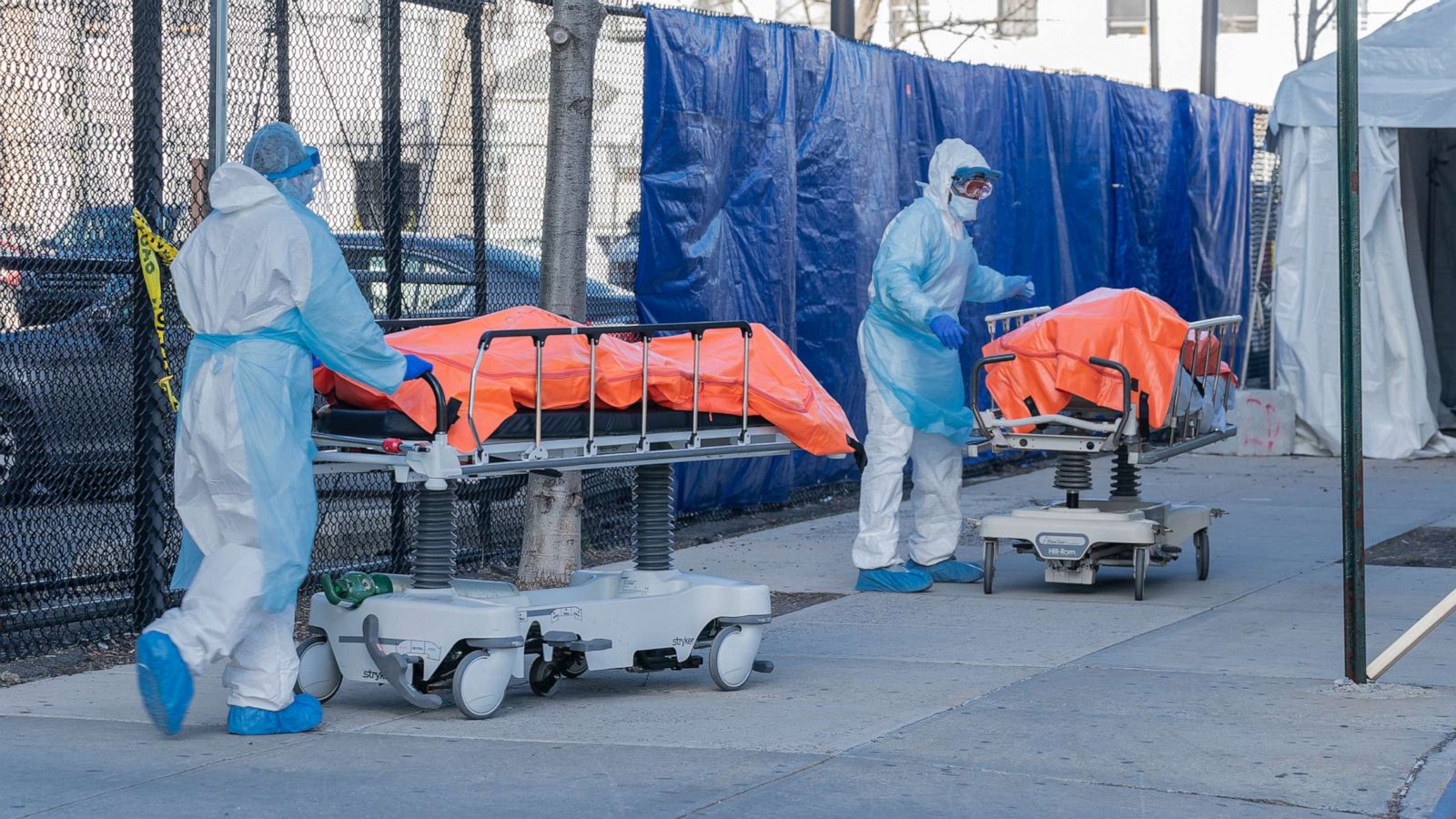
Good News: you’re discharged. Bad News: you’re dead

NYC's grim contingency as coronavirus deaths rise: Temporary mass ...
Two more patients being discharged (ABC News)
Of course, statistics can be deceiving. 

WPRI learned that when you are a hospitalized COVID-19 patient, being “discharged” is not necessarily a good thing.

Of 466 coronavirus patients who were “discharged” from the hospital, 86 of them were discharged because they were dead.

Later, the Health Department explained that hospitals have an array of “discharge codes” and, for some reason, being discharged for being dead was included in the tally. RIDOH has since subtracted those 86 from the “discharged” tally and will not count the dead as “discharged” in the future.

Charlestown’s numbers

The number of confirmed coronavirus cases in Charlestown has risen to 10. However, we are still far better off than the rest of the state. If you discount Block Island which has no confirmed cases, Charlestown and Hopkinton have the lowest per capita rate of infection in the state with less than one per 1000 residents. CORRECTION: in the last day, Charlestown cases jumped to 14.

We really don’t know the true numbers for Charlestown or Rhode Island or the nation. It takes a lot of testing to identify those currently infected (including the asymptomatic) and reliable anti-body testing to determine who has already had COVID-19.

Despite Trump's outlandish claims on testing to the contrary, we simply are not there yet.

The burdens of youth
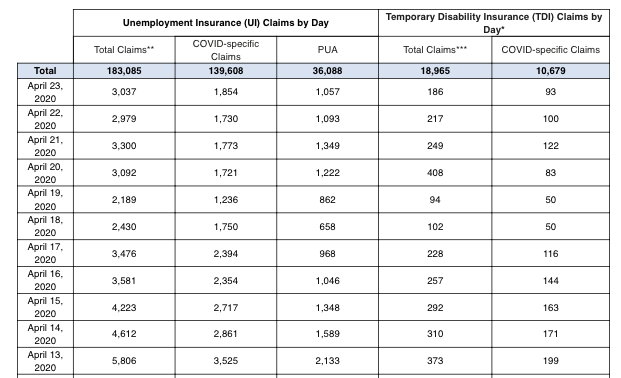
UNEMPLOYMENT CLAIMS due to COVID-19 increased to 139,608 Thursday. / COURTESY R.I. DEPARTMENT OF LABOR AND TRAINING

Younger people face the crushing levels of unemployment this pandemic has caused. In February, the RI Department of Labor and Training pegged the size of the state’s active workforce at 558,531 with an unemployment rate of 3.2%.

As of April 23, unemployment is way over 32% with 180,000 seeking unemployment benefits. Add another 40,000 self-employed and gig workers who have applied for the new Pandemic benefits and the 20,000 seeking coverage under the state Temporary Disability Program.

That’s almost a quarter of a million RI workers hurt by the pandemic and let’s not forget their families. 

UPDATED: as of May 1, the number of Rhode Islanders who have applied for benefits reached 270,541. According to GoLocalProv, that's more than half the workforce, given at 540,300.

That's technically accurate. On my calculator, it comes to 50.072367203%.

Despite the obvious economic pain Raimondo’s executive orders have caused, she has the public’s support.

Image may contain: possible text that says 'Whenever they tell you: iT's GIVE ME LIBERTY OR GIVE ME "It's to keep you BEWARE! DEATH Below is as shared in a FB post by Senator Elaine Morgan: (15 mins) MY PHRASE OF THE DAY: Stay SAFE: S=Sabotage S= A=American F=Freedom AND AND E=Economy Sabotage American Freedom & Economy NOT TAKE MY LIBERTIES TO KEEP ME SAFE quickumeme.com'
Sen. Elaine Morgan's contribution to the debate
I believe that's because people understand it could be a lot worse. 

Even though far right-wing Trumpniks like Charlestown’s state Senator Elaine Morgan are apoplectic over Gina Raimondo’s aggressive pandemic suppression measures, she has slowed the growth of our hospitalizations and the spread of the disease.

You can’t earn a living if you’re in intensive care or dead.

Quiet Ninigret

It’s too soon to tell if Raimondo’s approval will take a hit after her new Executive Order banning major public events this summer.

Though much media attention has focused on the Newport Jazz and Folk Festivals, Charlestown will not see its annual Seafood Festival or Rhythm and Roots this year; both have been cancelled. Other public events in the Park are also likely to be cancelled or not scheduled – any event that gathers more than 50 people would violate the Governor’s order.

The traditional Memorial Day Parade in Charlestown isn’t going to happen either unless parade organizer Jim Mageau decides to defy the Governor. If you’ve followed Jim Mageau over the years (as we have), it’s easy to imagine Jim picking a fight with Raimondo.

It will be interesting to see the reaction of the Charlestown Citizens Alliance to this order. They control town government and have relentlessly campaigned to curb public activity in Ninigret Park.

Ways that Rhode Island has been helpful, large and small.

Rhode Island compares very favorably on a number of factors when compared to other states. For example, according to WalletHub, Rhode Island is one of the easiest states to do social distancing. We are the third best state for providing COVID-19 support.

An example of a small but really nice thing, the Health Department has put up a new online Covid Self-Check. CLICK HERE. It’s really user-friendly. In general, the Department has done some nice work, including making access to health information, including statistics, a whole lot easier.

One really major thing is Raimondo’s April 27 Executive Order on health benefits. Here are the major bullet points:
  • Your out-of-pocket prescription costs cannot be increased nor can an insurer drop medication you need from coverage. In general, insurers can only make changes to your drug coverage that benefit YOU (not them).
  • Insurers are directed to loosen their rules on provider referrals. You will NOT be required to get a referral for a “tele-health” visit. An earlier executive order made these types of visits fully covered under all plans.
  • In similar fashion, prior authorizations must be handled quickly and without stress on patients about who is going to pay. There may be no prior authorizations required for COVID-19 testing or treatment.
  • Under her order, people needing mental health care will not be required to get referrals or other benefit review approvals.
Also, in an order issued on April 28, Raimondo created a 90-day grace period for motorists whose licenses and registrations expire in May, so they won’t have to be renewed until August. She had already granted a three-month grace period for those whose licenses expire in March and April.

Finally, on a trip to CVS a couple days ago, I noticed the State Police coronavirus checkpoint on Route 1 just north of Westerly Airport was gone. Personally, I think they should make those checkpoints for out-of-state visitors permanent or at least during the summer.

What does junk food have to do with COVID-19 deaths?

CDC cites high levels of obesity and diabetes in pandemic victims.
Progressive Charlestown: Trump's junk food diet may be one of the ...Each story is heartbreaking.

A five-year-old Michigan girl died on April 19 after being diagnosed with COVID-19. A 50-year-old bus driver, also from Michigan, died on April 1 from complications of the virus. And a 95-year-old Kansas woman who lived in a retirement community died on March 27.

With stunning speed, the novel coronavirus has killed more than 56,000 people living in the United States so far this year. Though most of the more than 1 million known to be infected do not become seriously ill (many do not even show symptoms) those who are hardest hit often suffer frighteningly rapid declines.

As scientists struggle to understand the overall magnitude of the virus and how to best address it, there are certain established truths that we can no longer afford to take for granted when it comes to protecting our health in the future.

One key truth: The quality of our food is essential to the quality of our health.


Brown University prez argues colleges have a DUTY to re-open ASAP

Paxson pens op-ed in the New York Times
Brown University

At discussion among R.I. leaders, higher education takes center ...
Brown University photo
In an opinion piece published by the New York Times on Sunday, April 26, Brown University President Christina H. Paxson argues that the reopening of college and university campuses in the fall should be a national priority and that institutions must develop public health plans in response to the novel coronavirus now.

“These plans must be based on the reality that there will be upticks or resurgences in infection until a vaccine is developed, even after we succeed in flattening the curve,” Paxson wrote. 

“Colleges and universities must be able to safely handle the possibility of infection on campus while maintaining the continuity of their core academic functions.”

The publication of Paxson’s guest column follows her announcement to the Brown community on April 13 of the creation of the University’s Healthy Fall 2020 Task Force. The task force is a joint group of administrators, researchers and students charged with charting a path to the safe reopening of the University’s campus in fall 2020.

Paxson describes in the New York Times a range of adjustments to campus life that students, faculty and staff will have to expect when on-campus operations resume. Brown moved to remote instruction in mid-March to reduce the spread of novel coronavirus amid the global pandemic, and all employees who could perform their work remotely began telecommuting.

Paxson points out in her column that campuses were among the first to move to remote operations during the Covid-19 pandemic.

“The rapid response that occurred across the country stemmed from our concern for the health of our students and communities, and our recognition that college campuses pose special challenges for addressing infectious disease,” she wrote. “Our duty now is to marshal the resources and expertise to make it possible to reopen our campuses, safely, as soon as possible.”

The full column is available via the New York Times website, and is appended, as published, below.
*******