|
||||||||||||||||||||||||
Friday, July 3, 2020
They're Back!




We can do better than just “get back to normal”
The fallacy of “back to normal” thinking
 |
| Joel Pett, The Virginian-Pilot |
The failure of higher
education in the United States was made clear by the COVID-19 virus pandemic.
From the president down, too many elected officials with college degrees have been ignorant of or defiant toward the lessons of the biological and social sciences.
From the president down, too many elected officials with college degrees have been ignorant of or defiant toward the lessons of the biological and social sciences.
Ill-advised reassurances
in the initial stages of the pandemic ignored or denied the significance of
exponential growth. Leaders exploited the human tendency to accept uncritically
information that one is motivated to believe.
Indeed, as the dimensions
of the problem became clearer, the Trump Administration increasingly abandoned
efforts to provide the public with the information and guidance that
epidemiologists were offering.
Tens of thousands of
Americans are dying because of the failure to act early and inform accurately,
and this burden is falling disproportionately on minorities and the poor.
Even more depressing has
been the failure of millions of people to see through the Trump
Administration's too-early promotion of "re-opening" the country and
returning to "normal."
The relaxing of social
distancing and use of masks is an attempt to bolster the stock market in the
short run rather than protect the long-term health of both our citizenry and
our economy.
From the Ozarks to
southern California beaches to the Trump Tulsa rally, crowds of people have
clustered together, apparently unaware of, or unconcerned about, the threat
their behavior poses to them and to their friends, relatives, and neighbors.
This situation has been
greatly exacerbated by the justifiable and important but vulnerable large
crowds protesting against police brutality and structural racism, symptoms of
the inequity that President Trump has encouraged rather than disapproved.
How we can learn from the screw-up in Texas
What went wrong, and what other states can learn as younger people get sick
Murray J. Côté, Texas A&M University and Tiffany A. Radcliff, Texas A&M University
The July 4 holiday weekend usually means cookouts and big gatherings in Texas, but right now, the state is facing a public health catastrophe.
Hospitals in Dallas and Houston are nearing ICU capacity as the number of COVID-19 cases spikes across the state. The death toll from the virus is up 50% from a month ago.
It did not begin like this. Texas had lower COVID-19 rates and case counts than many other large states through most of the spring.
What happened, and what can be done to turn it around now? As Gov. Greg Abbott halts plans to further reopen the economy, orders bars closed and limits large gatherings, the answers to both of those questions may hold lessons for other states.
As public health researchers and professors at Texas A&M University, we have been monitoring the shifting dynamics of the disease’s spread to help county and state officials plan for increasing health care and other needs related to COVID-19.
Murray J. Côté, Texas A&M University and Tiffany A. Radcliff, Texas A&M University
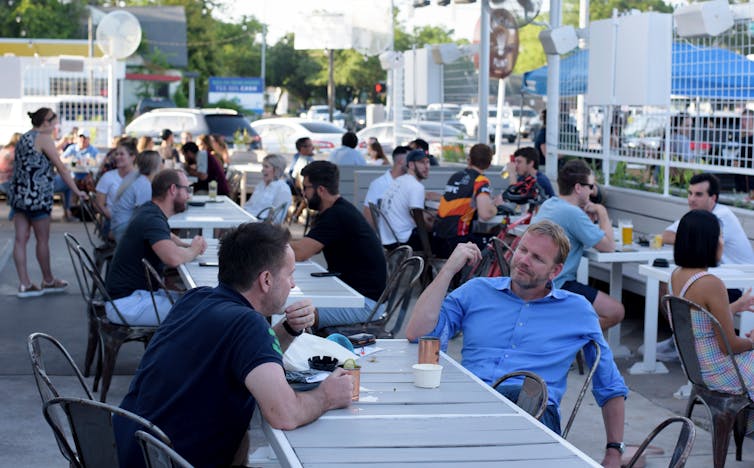 |
| On June 26, Texas’ governor ordered bars to close as COVID-19 case numbers spiked, particularly among younger adults. This Houston bar, photographed in late May, voluntarily shut down shortly before the order after two staff members tested positive for the coronavirus. Mark Felix/AFP/Getty Images |
Hospitals in Dallas and Houston are nearing ICU capacity as the number of COVID-19 cases spikes across the state. The death toll from the virus is up 50% from a month ago.
It did not begin like this. Texas had lower COVID-19 rates and case counts than many other large states through most of the spring.
What happened, and what can be done to turn it around now? As Gov. Greg Abbott halts plans to further reopen the economy, orders bars closed and limits large gatherings, the answers to both of those questions may hold lessons for other states.
As public health researchers and professors at Texas A&M University, we have been monitoring the shifting dynamics of the disease’s spread to help county and state officials plan for increasing health care and other needs related to COVID-19.
Thursday, July 2, 2020
Trump’s death wish
Why
Is Trump So Enthusiastic About Americans Dying?
 Two
weeks after America diagnosed its first case of COVID-19, Republicans in the
United States Senate (with the single exception of Mitt Romney) refuse to vote to
impeach Donald Trump.
Two
weeks after America diagnosed its first case of COVID-19, Republicans in the
United States Senate (with the single exception of Mitt Romney) refuse to vote to
impeach Donald Trump.
They
decided he couldn’t do much more damage than he already has, and, as Senator
Susan Collins suggested, he would back down from his most outrageous behavior
because his hands had been slapped by the House of Representatives.
Now,
newly empowered and feeling invincible, he seems hellbent on a crusade to kill
hundreds of thousands of Americans.
Nobody
knows why Trump is so enthusiastic about encouraging people to get sick and die
from COVID-19, although there are a couple possibly viable theories.
Trump’s
and Republicans’ rhetoric all shifted a day or two after April 7, the day that
the New York Times, the Washington Post, CNN and other national media reported
that Black and Hispanic people were dying of COVID at about twice the rate of
white people.
Is it possible Trump and the racists in his Party think this is a good way to reduce the Black and Hispanics population, or at least that it’s not an issue for white people?
Is it possible Trump and the racists in his Party think this is a good way to reduce the Black and Hispanics population, or at least that it’s not an issue for white people?
Another
possibility has to do with Freedomworks, the group that was largely raised to
prominence by rightwing billionaires and helped fund the so-called Tea Party
movement.
Billionaires want their people back at work, be they in refineries or meat processing plants or retail stores, and they know that if some of those workers get sick and die there’s a never-ending supply of poor, unemployed people willing to replace them.
Billionaires want their people back at work, be they in refineries or meat processing plants or retail stores, and they know that if some of those workers get sick and die there’s a never-ending supply of poor, unemployed people willing to replace them.
MUSIC VIDEO: Cover Your Freaking Face
To watch this video on YouTube: https://www.youtube.com/watch?v=6kOesPt7iBY

Local birders go wild
By TODD McLEISH/ecoRI News contributor
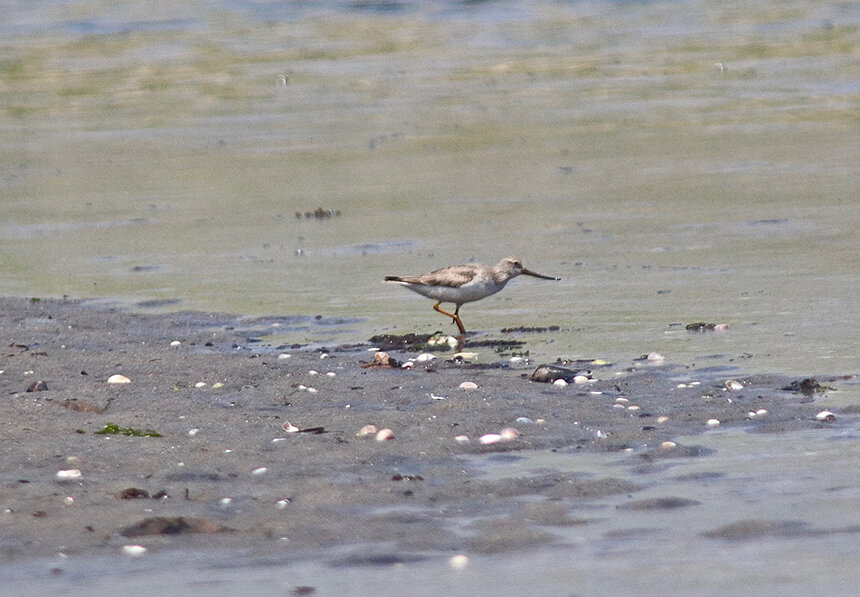 |
| The super-rare Terek sandpiper, to Rhode Island anyway, was spotted in late June hanging out at the end of Napatree Point by avid birder Jan St. Jean. (Carlos Pedro photos) |
The mile-long pilgrimage out to the tip of Napatree Point in
Westerly, the southwestern-most point in the Ocean State, is a common hike for
birdwatchers in spring and late summer, as it’s one of the best locations to
find migrating shorebirds.
But during the last few days of June, hundreds more
birders than usual made the trek after an extremely rare bird — a “mega-rarity”
in birdwatching lingo — was discovered there.
A Terek sandpiper, distinctive for its long, upturned beak and
yellow-orange legs, was observed Sunday morning, June 28, by Jan St. Jean, a
Charlestown resident and avid birder. It is the first documented sighting of
the species in Rhode Island and is considered by some to be the rarest bird to
show up in the Ocean State in decades.
“I first saw it behind a mound of seaweed, and it bobbed up and
down like a spotted sandpiper,” she said, referring to a commonly seen species
at Napatree. “But then I saw that bill and thought, ‘Oh my god, this is
something really good.’ But I didn’t have my scope to get a better look.”
She texted several birding friends, one of whom, Carlos Pedro, was
birding in nearby Charlestown and happened to have a field guide to European
birds with him.
Beware of alien invaders
International
team of scientists warns of increasing threats posed by invasive species
Todd
McLeish
 In a new study, scientists from around the world –
including a professor at the University of Rhode Island – warn that the threats
posed by invasive alien species are increasing. They say that urgent action is
required to prevent, detect and control invaders at both local and global
levels.
In a new study, scientists from around the world –
including a professor at the University of Rhode Island – warn that the threats
posed by invasive alien species are increasing. They say that urgent action is
required to prevent, detect and control invaders at both local and global
levels.
In a new study, scientists from around the world –
including a professor at the University of Rhode Island – warn that the threats
posed by invasive alien species are increasing. They say that urgent action is
required to prevent, detect and control invaders at both local and global
levels.
Alien
species are plants, animals and microbes that are introduced by people,
accidentally or intentionally, into areas where they do not naturally occur.
Many of them thrive, spreading widely with harmful effects on the environment,
economy, or human health.
The
study, published in the journal Biological Reviews,
was carried out by a team of researchers from 13 countries across Africa, Asia,
Australasia, Europe, and North and South America. It states that the number of
invasive alien species is increasing rapidly, with more than 18,000 currently
listed around the world.
According
to Laura Meyerson, URI associate professor of natural resources science, the
escalation in biological invasions is due to the increase in the number and
variety of pathways along which species spread, and to the increasing volume of
traffic associated with those pathways.
For example, she notes the role played by emerging pathways such as the online trade in unusual pets and the transport of species across oceans on rafts of plastic.
For example, she notes the role played by emerging pathways such as the online trade in unusual pets and the transport of species across oceans on rafts of plastic.
The
researchers note that the scale of the problem is enormous. A 2017 analysis of
global extinctions revealed that alien species contributed to 25 percent of
plant extinctions and 33 percent of terrestrial and freshwater animal
extinctions.
Meanwhile, annual environmental losses caused by introduced species in the United States, United Kingdom, Australia, South Africa, India and Brazil have been calculated at more than $100 billion.
Meanwhile, annual environmental losses caused by introduced species in the United States, United Kingdom, Australia, South Africa, India and Brazil have been calculated at more than $100 billion.
Why are so many people lighting off fireworks?
Too much time on their hands?
Jay L. Zagorsky, Boston University
 The number of fireworks being lit off at night is out of control this year.
While people often light off fireworks close to the Fourth of July, this year fireworks have been lit in large numbers starting weeks earlier.
New York City had a 4,000% increase in fireworks complaints in the first two weeks of June compared with last year. This prompted Mayor Bill de Blasio to vow a crackdown on illegal fireworks.
Complaints about fireworks are not confined to just New York City, but in cities across the country like San Francisco, Denver, Harrisburg, Albuquerque, Providence and many other places. This has led to a rise in conspiracy theories, including one that the nightly noise is an elaborate government plot to create confusion in neighborhoods.
I am an economist who has spoken and written about fireworks for years. After hearing a constant barrage nightly for weeks, I began wondering why so many people are lighting off fireworks this year.
Jay L. Zagorsky, Boston University
The number of fireworks being lit off at night is out of control this year.While people often light off fireworks close to the Fourth of July, this year fireworks have been lit in large numbers starting weeks earlier.
New York City had a 4,000% increase in fireworks complaints in the first two weeks of June compared with last year. This prompted Mayor Bill de Blasio to vow a crackdown on illegal fireworks.
Complaints about fireworks are not confined to just New York City, but in cities across the country like San Francisco, Denver, Harrisburg, Albuquerque, Providence and many other places. This has led to a rise in conspiracy theories, including one that the nightly noise is an elaborate government plot to create confusion in neighborhoods.
I am an economist who has spoken and written about fireworks for years. After hearing a constant barrage nightly for weeks, I began wondering why so many people are lighting off fireworks this year.
Wednesday, July 1, 2020
VIDEO: How 2020 exposed America
To Watch this video on YouTube: https://www.youtube.com/watch?v=xbE8gfoYrec&feature=emb_title

Don't toss that turtle!
By TODD McLEISH/ecoRI News contributor

A non-native red-eared
slider, front, shares a Blackstone River log with two eastern painted turtles.
(Todd McLeish/ecoRI News)
They are the most popular
pet turtle in the United States and available at pet shops around the world,
but because red-eared sliders live for about 30 years, they are often released
where they don’t belong after pet owners tire of them.
As a result, they are considered one of the world’s 100 most invasive species by the International Union for the Conservation of Nature.
As a result, they are considered one of the world’s 100 most invasive species by the International Union for the Conservation of Nature.
Southern New England
isn’t immune to the problems they cause.
“I hear the same story
again and again,” said herpetologist Scott Buchanan, a wildlife biologist for
the Rhode Island Department of Environmental Management. “‘We bought this
turtle for a few dollars when Johnny was 8, he had it for 10 years and now he’s
going to college, so we put it in a local pond.’ That’s been the story for
hundreds and thousands of kids in recent decades.”
Red-eared sliders are native to the Southeast
and south-central United States and northern Mexico, where they are commonly
found in a variety of ponds and wetlands. Buchanan said they are tolerant of
human disturbance and tolerant of pollution, and they are dietary generalists,
so they can live almost anywhere. And they do.
They breed throughout
much of Australia as a result of pets being released, and in Southeast Asia
they are raised as an agricultural crop and have displaced numerous native
species.
In the Northeast, they live in the same habitat as eastern painted turtles, one of the area’s most common species, but they grow about 50 percent larger.
Numerous studies suggest that sliders outcompete native turtles for food, nesting, and basking sites.
In the Northeast, they live in the same habitat as eastern painted turtles, one of the area’s most common species, but they grow about 50 percent larger.
Numerous studies suggest that sliders outcompete native turtles for food, nesting, and basking sites.
Advertising for sugary drinks increased to $1 billion from 2013 to 2018
Black
and Latino youth were prime targets of sugary drink advertising, say
researchers.
 Despite
rampant diet-related disease in the U.S., a new report finds that
soft-drink companies—led by corporate giants PepsiCo and CocaCola—are ramping
up efforts to promote sugary drinks to the tune of $1 billion per year.
Despite
rampant diet-related disease in the U.S., a new report finds that
soft-drink companies—led by corporate giants PepsiCo and CocaCola—are ramping
up efforts to promote sugary drinks to the tune of $1 billion per year.
That
advertising, according to researchers at the UConn Rudd Center for Food Policy
& Obesity, increasingly targets communities of color.
The
regular consumption of sugary beverages such as soda is associated with increased risk of
heart disease, type 2 diabetes, and even premature death. Soft drink companies
have resisted policy measures to reduce consumption and mitigate harm, such as
New York City's attempt to ban extra-large sodas in 2012, and Philadelphia's soft drink tax that
took effect in 2017.
Companies
such as PepsiCo and Coca-Cola instead
advocate for consumer choice based solutions and point toward the companies'
no-and low-calorie drink options as evidence for their commitment to public
health.
The
current COVID-19 pandemic has intensified the spotlight on diet-related disease
as the U.S. Centers for Disease Control and Prevention (CDC) has cited high levels of obesity and diabetes in
victims of the virus.
The
new report, which evaluated the advertising behavior of 48 beverage companies,
found that they had collectively increased advertising for sugary, sport, and
energy drinks by 26 percent between 2013 and 2018.
UPDATED: Who is running and who is not
Changes coming for Charlestown town government
By Will Collette

The November 3 election will bring change to the make-up of
Charlestown’s town government. At minimum, there will be a number of new faces.
There might even be a change in control.
Two of the Charlestown Citizens Alliance (CCA Party) town
council members, Council President Virginia Lee and Julie Carroccia will not be running for re-election.
Council Vice-Chair Deb Carney, one of the founders of
Charlestown Residents United (CRU) will be running as an endorsed Democrat. CCA
Party members Bonnie Van Slyke and
David Wilkinson are also seeking re-election.
CRU is also endorsing Democrats Scott Keeley and Jodi Frank
and Republicans Grace Klinger and Stephen Stokes for Town Council.
 |
| The CCA Party will be fighting to keep its control of Charlestown in the November 3 election |
Jacob A. Wolfgang is also listed as having filed to qualify
for the ballot to run as an independent for Town Council. I don’t know if he
has a relationship with either of Charlestown’s political action committees or
political parties.
The CCA Party candidates for the supposedly non-partisan Planning Commission are Gordon Foer, Walter (Peter) Mahony, Ruth Platner, and
Frances Topping.
Howard T. Stephens and Patricia
A. Stamps have filed papers to also run for Planning Commission under the CRU banner.
In case you didn’t know: Charlestown is the only municipality in Rhode Island that elects its Planning Commission or Board. These are appointed positions everywhere else.
In case you didn’t know: Charlestown is the only municipality in Rhode Island that elects its Planning Commission or Board. These are appointed positions everywhere else.
Subscribe to:
Posts (Atom)