Menu Bar

Home           Calendar           Topics          Just Charlestown          About Us

Sunday, September 5, 2021

On Labor Day, 46,000 Rhode Islanders are losing their unemployment benefits

All but a dozen Charlestown residents on unemployment will suffer benefit cuts

By Will Collette


Part of what kept the US economy from crashing during the height of the pandemic was the extra federal unemployment assistance given to the many who lost their jobs.

While job numbers and overall economic trends have been positive since January, progress has slowed and we are far from over the pandemic and the economic hardship it caused. The Delta variant may even push us back.

Screen grab from WPRI graphic
At peak, Charlestown saw its highest level of unemployment since the state first started keeping statistics. Our unemployment rate is still high at 6.7%, which is higher than the national (5.4%), state (5.8%) and South County averages.

According to the most recent state numbers, Charlestown had 271 residents collecting unemployment insurance in July. But that problem is about to be “solved” because, according to data compiled by WPRI, 259 are going to lose their benefits.

Magically, only a dozen Charlestown residents will still be unemployed when the sun comes up on Tuesday. 

But of course, that’s an illusion, maybe even a statistical glitch. All those people – and more who have already fallen off the statistics tables when their benefits expired – are still going to be out of work. The big difference is they will also be out of money.

Around 46,000 Rhode Islanders are in the same boat due to the expiration of the special unemployment benefit programs for the self-employed and gig workers.

Dan McGowan of the Boston Globe puts the RI losses at 28,767 gig workers and independent contractors who are on the Pandemic Unemployment Assistance program and 16,855 people on Pandemic Emergency Unemployment Compensation. They all will be completely cut off.

On top of that, the federal $300 pandemic bonus most unemployed have been receiving is also expiring.

WPRI’s data notes that most of those losing their benefits now are women, young and low income.

Local programs like RI-CAN, the WARM Center, the Jonnycake Centers, churches and others will no doubt do their best, but this was a foreseeable – and preventable – tragedy.

The theory behind allowing these benefits to expire now was that with the arrival of safe and effective vaccines, most people would get the shots, the pandemic would be beaten and things would get back to normal.

Except that has not happened.

The theory fails because it didn’t account for millions of COVIDiots who won’t get the shots even though the new COVID Delta variant is killing more than a 1,100 per day. Hiring has fallen off. Consumer confidence has dropped.

On top of all that, Rhode Island’s transmission rate for COVID is terrible, classified as “high transmission” making Rhode Island one of the only Red Zones in the Northeast. We can thank our wussy accidental Governor Dan McKee for that.

At the end of June, our transmission rate was 12 per 100,000 of population - that was the justification for re-opening. As of Friday, our rate has risen to 204.8 per 100,000. That’s a 1,700% increase and it has been going up daily.

When the Delta surge began right after July 4, McKee should have restored the statewide mask mandate as well as imposed a vaccine mandate on public workers, state contractors and anyone else under state authority. He should have reinstated the ban on travelers from states with higher infection rates than ours, especially Florida.

We can’t get back to anything like “normal” until we get the pandemic under control. McKee is doing no favors for his precious small businesses by failing to take overdue action to stem the pandemic.

And let’s not forget what Charlestown can do to help Charlestown. Just to remind you, Charlestown has received almost $11 million in pandemic relief. $8.3 million went to local businesses and $2.3 is going directly to the town.

Some of those businesses used the $8.3 million to stay open and keep at least some of their workers in jobs, though I would love to see an actual breakdown. 

As for the $2.3 million earmarked for the town, why doesn’t Charlestown have a plan to create jobs and economic opportunity, rather than just buy more land and remove it from the tax rolls as open space?

CCA's anointed: Bonnie Van Slyke, Cody Clarkin and Susan Cooper.
They take their orders from the CCA clubhouse
We’ve all seen how jobs and the economy are not priorities for our ruling Charlestown Citizens Alliance (CCA). 

One of the most recent ways they show it is the CCA’s insistence on putting their Nobel laureate Mike Chambers on the Economic Improvement Commission rather than any of the other competitors who actually know something about economic improvement.

The Charlestown Town Council currently has a CCA majority consisting of Arnolda Über alles diehard Bonnie Van Slyke, former Eagle Scout Cody Clarkin and newcomer Susan Cooper. While they cast the actual votes on the Council, their choices are directed by the mysterious CCA Steering Committee that meets in secret to make all the decisions for the town.

That $2.3 million in pandemic relief could do a lot of good for the town, but that’s just not a CCA priority. If we don’t use it to buy more open space, then the CCA will want to spend it fighting the unsubstantiated threat they’ve conjured upfrom AMTRAK. Or maybe a raise for Joe Larisa, the attorney Charlestown retains for the sole purpose of messing with the Narragansett Indian Tribe.

That $2.3 million could be used, for example, to start a Charlestown Conservation Corps to create jobs for those who need them. Or a Charlestown Service Corps to augment SRIV (Southern Rhode Island Volunteers) to help the elderly, the handicapped and families in need.

Taliban takes Texas


"Solving" the labor shortage


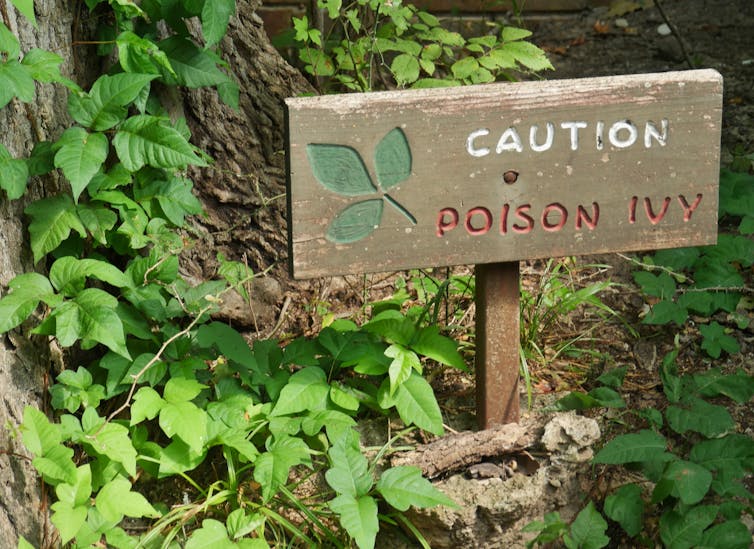
Poison ivy can work itchy evil on your skin

How to recognize and deal with it

Arthur SamiaUniversity of Florida and Marjorie Montanez-WiscovichUniversity of Florida

Be on the lookout for poison ivy’s three leaves on a reddish stem.
 raksybH/iStock via Getty Images Plus
A patient recently came in to our dermatology clinic with a rash and a story similar to so many others. He had been out camping with friends a few days earlier and helped carry some logs to stoke the fire. 

Little did he know he was going to pay for lending a helping hand. A couple days later, red patches appeared on his forearms and chest, which soon began to itch miserably and form water blisters.

If you have ever spent any time outdoors – in the woods, working in the yard, even at the edges of a playground – maybe you’ve experienced something similar after encountering poison ivy. It’s not easy to forget.

What's the cost of self-control? New study tabulates the bill

Research focuses on what dieters will pay to avoid temptation

New York University

A team of researchers has identified measures we take in order to skirt having to exert self-control in our daily lives -- findings that offer new insights into what motivates human behavior.

"The failure to use self-control is a problem that humans face every day, but we know little about the cognitive processes that lie beneath it or the lengths we'll go to avoid needing to implement it," explains Candace Raio, an assistant professor of research in the Department of Psychiatry at NYU Grossman School of Medicine and the lead author of the paper, which appears in the journal Proceedings of the National Academy of Sciences (PNAS). 

"In this study, we were able to determine the price people are willing to pay to eliminate the need for self-control and measure how it changes under different levels of temptation, motivational incentives, and exposure to stress."

One in three Americans had COVID-19 by the end of 2020, study estimates

Undocumented infections accounted for estimated three-quarters of infections last year

Columbia University's Mailman School of Public Health


A new study published in the journal Nature estimates that 103 million Americans, or 31 percent of the U.S. population, had been infected with SARS-CoV-2 by the end of 2020. Columbia University Mailman School of Public Health researchers modeled the spread of the coronavirus, finding that fewer than one-quarter of infections (22%) were accounted for in cases confirmed through public health reports based on testing.

The study is the first to comprehensively quantify the overall burden and characteristics of COVID-19 in the U.S. during 2020. The researchers simulated the transmission of SARS-CoV-2 within and between all 3,142 U.S. counties using population, mobility, and confirmed case data.

Saturday, September 4, 2021

We can’t let the Big Lie disenfranchise 2022 voters

Unless we debunk the lies about 2020, the next election may be a lot less fair.

By Jill Richardson

Right now our nation still has two competing narratives about the 2020 election.

One is that Joe Biden legitimately won and that Donald Trump encouraged a false narrative, known as the Big Lie, that Biden’s win was fraudulent. The other is that Joe Biden did not win the election, and Trump’s claims of voter fraud are true.

For each, ask: What would have to be true for this to be accurate? How do you know you know? What information can you personally confirm from the evidence you have access to?

If you learn something secondhand, where did it originate — and would someone who said it personally gain by convincing the public it is true? How can you interpret their statement in the context of what you know about them?

For instance, have you ever seen Trump admit to losing anything? He craves public approval and he hates looking weak. Falsely claiming a win is in line with his character.

I’ll put my cards on the table.

I’ve been a poll worker in Wisconsin before, and so have several friends in multiple states. All poll workers are sworn in, and politicking is prohibited in the polling area. The penalties for tampering with an election are steep, and there are a lot of eyes on you at all times.

Q's new drug of choice

By Ann Telnaes, Washington Post


Your body, my choice


DEM Announces $250,000 in Grants to Spur Growth of Agriculture, Aquaculture, and Seafood Sectors

None to Charlestown, but several grants in South County

The Rhode Island Department of Environmental Management (DEM) announced $250,000 in grant awards aimed at spurring growth in the agriculture, aquaculture, and seafood sectors of the economy.

The grants are funded by the state through the Local Agriculture and Seafood Act (LASA), which directly benefits and strengthens the local food system by helping new and existing small businesses and food initiatives take root and prosper. Now in its seventh year, LASA has provided more than $1.4 million – through grants up to $20,000 – to support the growth of Rhode Island's local food economy.

"DEM is always working to get more home-grown food on the table and by supporting local farmers and fishers in growing their businesses, the LASA grants help achieve this," said DEM Acting Director Terry Gray.

"Growing local and eating local, fresh, sustainable food minimizes transportation costs, reduces carbon emissions, and boosts the local economy while providing the freshest product possible to the consumer."

The 2021 LASA grantees

Researchers find mechanism driving COVID-19 mortality

Like Venom Coursing Through the Body

By  

Researchers have identified what may be the key molecular mechanism responsible for COVID-19 mortality – an enzyme related to neurotoxins found in rattlesnake venom.

An enzyme with an elusive role in severe inflammation may be a key mechanism driving COVID-19 severity and could provide a new therapeutic target to reduce COVID-19 mortality, according to a study published in the Journal of Clinical Investigation.

Researchers from the University of Arizona, in collaboration with Stony Brook University and Wake Forest University School of Medicine, analyzed blood samples from two COVID-19 patient cohorts and found that circulation of the enzyme – secreted phospholipase A2 group IIA, or sPLA2-IIA – may be the most important factor in predicting which patients with severe COVID-19 eventually succumb to the virus.

sPLA2-IIA, which has similarities to an active enzyme in rattlesnake venom, is found in low concentrations in healthy individuals and has long been known to play a critical role in defense against bacterial infections, destroying microbial cell membranes.

When the activated enzyme circulates at high levels, it has the capacity to “shred” the membranes of vital organs, said Floyd (Ski) Chilton, senior author on the paper and director of the UArizona Precision Nutrition and Wellness Initiative housed in the university’s College of Agriculture and Life Sciences.

Friday, September 3, 2021

RI needs to change how it regulates Pharmacy Benefit Managers

The mystery bureaucrats managing your prescription drugs

By Linda L Ujifusa, Esq & J Mark Ryan, MD FACP in UpRiseRI

SHORT ATTENTION SPAN ALERT: 

This is a long article. It needs to be. If you can only handle Tweet-length pieces, you should move along now. However, if you live in Rhode Island and take prescription medicines through any insurance plan, including Medicare D, this article discusses issues that directly affect you and also offers suggestions for actions you should take.  - Will Collette

SUMMARY: 

About 40% of Americans struggle to afford their regular prescription medicines – with 1/3 saying they have skipped filling a prescription one or more times, because of the cost. COVID-19 has exacerbated the problem by causing job and health insurance loss and delaying routine care.

Rhode Island policymakers know skyrocketing prescription drug prices must be better controlled.

Unfortunately, they have ignored a key cost driver: Pharmacy Benefit Managers (PBMs).

PBMs such as CVS Caremark, Express Scripts and OptumRx “manage” prescription drug benefits on behalf of insurers and siphon off enormous revenues in the complex non-transparent system that gets drugs from manufacturers to patients.

Other states are doing a much better job monitoring and controlling PBMs and have saved consumers and tax payers hundreds of millions of dollars.

Rhode Island should follow their lead.

To urge RI policymakers to take action, please sign this petition.

A fully footnoted version of this article is available to download here.

What are PBMs?

In between most patients and healthcare providers are middlemen health insurers (“payers”) who take money from patients, pay some to healthcare providers, and keep some for themselves. These multiple payers cause the United States to spend about twice per capita what other industrialized nations with “single payer” spend and they get better universal healthcare.

In the middle of payers, patients and pharmacies, there are Pharmacy Benefit Managers (PBMs).

PBMs: Middlemen for middlemen

PBMs are for-profit companies that “manage” prescription drug benefits for more than 266 million Americans on behalf of payers, including private insurers, Medicare Part D drug plans, government employee plans, large employers, and Medicaid Managed Care Organizations (MCOs).

PBMs help payers:

  1. create a list of covered drugs for plans (“a formulary”);
  2. manage drug utilization by enrollees (e.g., by setting co-pays, prior authorization policies, etc.);
  3. reimburse pharmacies for providing the enrollee drugs.

This article will focus on:

  • Who are Pharmacy Benefit Managers (PBMs)
  • How PBMs Harm Consumers and Taxpayers
  • PBM Oversight in Other States
  • Potential Roadblocks to RI Reforms
  • How RI Can Rein in PBMs

WHO ARE PHARMACY BENEFIT MANAGERS (PBMS)

PBMs began in the 1970s as small independent middlemen between insurers and pharmacies, taking a set fee for processing claims.

Today, three PBMs control 80% of the market and are part of large vertically integrated conglomerates that include health insurance companies and pharmacies (including “specialty pharmacies”)

Last priority

By Mike LuckovichAtlanta Journal-Constitution


I remember this, too


Whales seem OK with wind farms

Right Whale Use of Southern New England Wind Energy Areas Increasing

NOAA

Two North Atlantic right whales, 2018.
Credit: NOAA Fisheries/Tim Cole

Southern New England habitat is important to the North Atlantic right whale. With offshore wind energy development planned in the region, working with stakeholders to minimize potential impacts on right whales and other protected species is crucial.

Right whales are increasing their use of southern New England waters, including regions slated for offshore wind energy development, according to aerial survey data collected during the last decade. Offshore wind energy installations are proposed in waters off the south coasts of Massachusetts and Rhode Island. 

Understanding and minimizing the potential impacts from construction noise, increased vessel traffic, and habitat alteration will be crucial to protecting and conserving this endangered species. This research supports the Administration’s goal of deploying offshore wind while protecting biodiversity and promoting ocean co-use.

The study was published July 29 in Endangered Species Research. Marine mammal researchers from NOAA Fisheries and colleagues at the New England Aquarium and the Center for Coastal Studies examined aerial survey data collected between 20112015 and 20172019.

The data was collected in offshore waters including the Massachusetts and Rhode Island Wind Energy Area. The data from these two time periods were used to quantify right whale distribution, residency, demographics, and movements in the region.