Inconvenient
Truths
By Stephen Hoff
Introduction
On January10, 2022, the Charlestown Town
Council is expected to consider at least one proposal to solve the absence of
an actual policy for dealing with our large and growing Unassigned Fund Balance
(UFB). I discussed this issue in Part 1 (CLICK HERE to read it).
In this installment, I will walk you through
the four competing versions of a new Charlestown Fund Balance Policy. How many
of these will actually be on the agenda won’t be decided until the Council
holds its agenda meeting on January 5th.
Charlestown
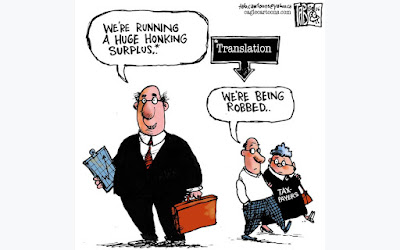
collects significantly more money every year than it budgets, but rather
than lower taxes, the Town Council, controlled by the Charlestown Citizens
Alliance (CCA), chooses to let our Unassigned Fund Balance grow, as well as
other surplus pockets of cash inside and outside the General Fund. At issue are four very different views about
how to deal with YOUR money that range from the sensible to the ridiculous.
Here is my best effort to help you understand
the differences in the four proposals so you can decide for yourself and
hopefully weigh in.
Here we go.
There are a number of
Inconvenient Truths related to the Budget Commission’s Proposed Fund Balance Policy. The
key ones are:
First, the Town
Council has actually received four different proposals for Charlestown’s
first-ever Fund Balance Policy (FBP).
 |
Council President Carney's proposal was not even
considered by the Budget Commission |
Council President Deb Carney’s Draft proposal
was not even provided to the Budget Commission (BC) or to the Government
Finance Officers Association (GFOA) for evaluation, consideration, and
discussion as were the other three. The
4 documents in order of their submission were:
1. Council President Carney’s Fund Balance Policy Draft in October
2019
2. Town’s Staff Fund Balance Policy Draft sometime in 2020
3. Government Finance Officers’ Association (GFOA) Risk-Based Analysis
& Stress Test of General Fund Reserve Requirements in May 2021
4. Budget Commission’s Fund Balance Policy Draft in December 2021
Second, before
adopting Charlestown’s first Fund Balance Policy, Council and Budget Commission
members as well as taxpayers need to examine the major differences in the assumptions
made in these four documents, because some of them will lead to higher taxation
than needed.
Third, the
Budget Commission is wrong when it presumes its version of a Fund Balance
Policy is consistent with the GFOA’s Risk Management analysis and that it
vindicates their past financial policies and practices.
Fourth, the
Budget Commission provided no opportunity for public comment prior to formally
presenting their written fund balance policy draft to the Town Council for
approval. It was presented by Dick Sartor to the commission and adopted by the
Budget Commission members with less than 25 minutes of internal discussion
without making a single change.
This makes one wonder how often it may have
been previously discussed outside the public arena since their only previous
meeting was in June, six months earlier where consensus had not been
demonstrated.
At this point, we don’t know if the CCA
majority on the Council will simply vote on the commission’s proposal or give
the issue the care and attention, not to mention public involvement, it
deserves.
How the four proposals differ
How
much cash do the proposals recommend Charlestown keep in reserve?
1. President Carney’s Fund
Balance Policy (FBP) proposes a maximum of 25% of budgeted expenditures or ($7.5 million).
2. Town staff proposes neither
a maximum nor minimum. This is
surprising and concerning, because our professional staff should have had an
opinion long before the Budget Commission weighed in on this very important
issue. It’s their job and they should have done it even if it carried some
political risk for them, such as contradicting the CCA’s laissez-faire
attitude.
3. The GFOA analysis recommends
we hold a minimum of 14.3% of our budget - ($4.3 million based on the current
budget). It leaves the maximum level up to the town based on the town’s
confidence it has enough cash on hand to handle
reasonably foreseeable risks.
When the GFOA presented its Report to the
commission on May 19, 2021, the GFOA manager of the study stated that the
Town’s most efficient level of confidence was the range between 85% to 90% of budgeted expenditures or $5.5 million to $7.8 million (See video at time interval 37:30).
The GFOA pointed out that moving past a 90%
confidence level to just over a 91% confidence level is increasingly
unjustified on a cost benefit basis. For instance, increasing the confidence
level to just over 91% from 90% would require an additional cash reserve of $1.2 million or $9.0
million. Remember: the Fund Balance is YOUR
tax money. Is a 1% increase in confidence worth a permanent increase of
$1.2million in taxes?
Also note that this $9 million is still
below the BC’s recommendation of $10 million.
The "non-risk factor"
My theory to explain why the Budget Commission
proposes to put so much additional money away in cash reserves above what the
GFOA recommends relates to what the real risk factors are when calculating the
amount of cash required should one or more risks present themselves
unexpectedly.
The Budget Commission is including a non-risk
management factor that the GFOA did not itself adopt in its core
recommendation.
The risk management factors that the GFOA
considered were the types that actuaries consider such as the likelihood of
unusual and unexpected events such as hurricanes, floods, recessions, and sea
level rise to name just a few.
The Budget Commission appears to be including
at least $1 million of reserves to insure that it can always pay cash for large
capital projects instead of bonding them.
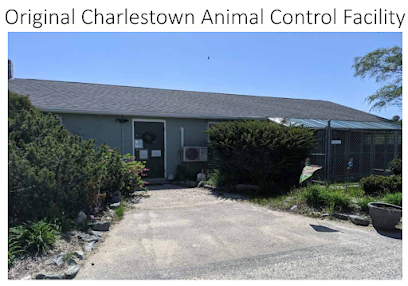 |
An example: We are paying cash for much needed renovation and
expansion of the town's animal shelter rather than funding it with a bond. |
This is not a traditional real risk factor and
that is probably why the GFOA didn’t include it in their core
recommendation. However, if the Budget
Commission's recommended fund balance policy is adopted, you will be taxed so
that there will always be surpluses so that this questionable financial
practice can be sustained.
For at least the past six years, the Town
continued to accumulate un-budgeted surpluses annually (averaging $1 million
per year) in order to pay cash for large capital projects instead of bonding
them.
The GFOA ultimately decided to
allow Charlestown to continue doing so, apparently because the BC wanted to
continue doing what it had been doing, and after all the Town was paying
$50,000 for their opinion.
This practice of paying cash for long-lasting
capital projects has been sold to taxpayers as prudent fiscal policy, except
that it’s not. The GFOA recommends a
Debt Management Policy as a best practice just as it recommends a Fund Balance
Policy as a best practice, surprisingly which neither have yet been adopted by
the town. The GFOA states:
“Utilizing municipal bonds to fund public
infrastructure is a valuable strategy for governments to spread the cost of
significant long term assets over their useful life. It is also important to involve all
stakeholders in the decision to issue debt.”
Why didn’t the Budget Commission or the
Council include those stakeholders in these decisions since they are the ones
actually paying the taxes?
The GFOA included the “allowance” for
Charlestown to continue to use cash instead of bonds only because that has been
Charlestown’s peculiar preference. However, it should be stressed that this
“allowance” is not a GFOA recommendation, but only an option if the Town
chooses to tax residents in advance to maintain it.
Page 7 of the GFOA’s proposal states:
“The Town might wish to use reserves for purposes other than mitigating risks - for example building a capital project using cash financing” as
opposed to bonding. Adopting this option in
the BC’s FBP would actually be a Debt Policy decision by the Town and not a FB
Policy decision. It makes absolutely no
sense to adopt a Debt Management Policy disguised as a Fund Balance Policy just
to perpetuate a previously unexamined past practice.
4. The Budget Commission’s Fund
Balance Policy proposes 33% of budgeted expenditures or ($10 million). That’s
33% of its annual expenditures or approximately $10 million. To find
out how much of that $10 million would be yours, simply divide your annual real
estate tax bill by 3. For a $300,000 property that would be $818 at this year’s
tax rate. $10 million
is over 250% more than the
Town maintained in 2014 which was $3.9 million.
How do the four
proposals take into account excess cash reserves held in OTHER accounts such as
legal
reserves, educational reserves, etc.?
1. President Carney’s FBP would keep 100% of the $7.5 million in the
Unassigned Fund Balance (a.k.a. surplus) of the General Fund.
Her policy states:
“All amounts approved for expenditure by referendum and
Transferred Out of the General Fund to Other Funds for various stated purposes
must be returned to the General Fund if those amounts are no longer required
for the reasons that they were originally appropriated.”
Carney’s proposal would
simply consolidate all the Town’s surplus cash in the General Fund’s Fund
Balance. Total Reserves would then be
used only for unexpected significant contingencies such as failed annual
budgets, catastrophic weather events, and other unusual occurrences including
the risk of rising sea levels, e.g. emergencies. It is no surprise why the CCA “disappeared” President Carney’s FBP.
Further, all town
surplus funds would as a result be made accessible and transparent. Currently,
taxpayers have to file an open records request and then be charged exorbitant
amounts just to see how much surplus the Town has in its various pockets in its
various Funds, assuming they know where to look.
What’s not to like
about the simplicity and elegance of this solution unless one has ulterior
motives?
2. Town staff’s Fund Balance Policy would keep identified cash in the
Unassigned Fund Balance of the General Fund but doesn’t discuss what to do with
the other possible pockets of cash inside or outside the GF such as counting
them toward the maximum surplus amount
ultimately determined by the Council to maintain.
3. The GFOA focused its analysis only on the General Fund. GFOA did acknowledge that the ultimate amount
required by the Town could be divided into more than one specific location if
the Town desired. Unfortunately,
this would reduce transparency and make it harder for taxpayers to keep track
of all the pockets of cash .
4. The Budget Commission’s proposal would turn the status quo into
formal policy without addressing all the problems I’ve identified above. It
also does not discuss how their recommended number would be adjusted, if at
all, if there are other pockets of cash previously set aside to address the
same risk factors that the GFOA proposal addressed.
How
much cash could be available for appropriation in each of the four Fund Balance
plans?
The amount of cash that could be appropriated
would be the difference between the bottom of the range in a FBP and the
maximum total amount of cash approved in the same FBP document.
In President Carney’s FBP, the cash available
could be $1.5 million ($7.5 less $6.0). Anything
in excess of $7.5 million would be used to lower the
tax rate in the following fiscal year and not be
available for other uses. If another use
were to be required, it could be easily included in the same budget where the
tax levy reduction would occur and be approved at referendum.
There would be no change in appropriation
procedures that call for a taxpayer referendum for any new capital project
costing less than $1 million. If over $1 million the capital project would be required to be presented as a separate
warrant item for taxpayer approval.
In the Town’s FBP, the cash available is
unknown because the amounts are not specified.
The GFOA’s analysis doesn’t apply.
In the Budget Commission’s proposal, the cash
available could be at least $3
million ($10 million less $7 million), and
perhaps more if any new un-budgeted surplus falling to FB causes UFB to exceed
$10 million.
The commission states, “Any portion of the
year-end operating surplus that contributes to the general fund unassigned fund
balance in excess of the minimum target range will be deemed available
for allocation to:
Replenish any other established assigned, committed, or restricted funds
Transfer to capital project funds for the capital improvement program
and/or deferred maintenance needs
Offset one-time shortfalls anticipated in the general fund operating
budget”
There is no provision to possibly return any surplus to
taxpayers. In fact, it is basically
forbidden by stating that the use of UFB in excess of target levels shall not
normally be applied to recurring annual operating expenditures.
The language above doesn’t discuss cash “available for appropriations” from UFB, but instead uses the term cash “available for allocation”. Does this new language
remove the taxpayers’ right to approve expenditures at a budget referendum or does the language allow for the TC to now approve the cash for
allocation by majority vote?
1. To put this in historical terms, could this allow the TC to move $3
million plus to a generic Construction Fund without taxpayer approval? Out of sight, out
of mind, and perhaps out of taxpayer control?
2. This new language changes and turns
on its head the concept of Unassigned Fund Balance being only for
“emergencies”. If this language is allowed to stand, and
this “allocation” is
made, it will soon follow that tax rates will be increased or remain high. That is because cash will be reduced in UFB
in the GF once it is reclassified, renamed, and/or Transferred Out of the GF
leaving a pocket no longer filled to its maximum. Voids and vacuums
will always be filled.
How
does each proposal plan handle all the cash scattered into “Other Funds” so
surpluses and appropriations can become more transparent and accountable to the
voters?
1. President Carney’s FBP
specifically addresses this issue. Anything in excess of $7.5 million would be
used to lower the tax rate in the following fiscal year and thus not be
available for other uses.” It also
requires any surpluses in any other funds outside the GF to be returned to the
GF, if not prohibited by Fund restrictions, if it is no longer needed for the
purpose for which it was originally appropriated.
2. Town’s Staff FBP does not
address this issue.
3. The GFOA’s document does not address this issue.
4. The BC’s FBP does not address this issue.
Currently, the budget referendum is the
primary way that cash moves from the General Fund to Other Funds outside the GF. It requires
taxpayer authorization. Once an annual
budget is approved, the TC by majority vote can move cash out of the GF to
Other Funds, as long as long as the total GF budget is not violated, and
authorize its expenditure in any way it sees fit.
Recently, the Town Council took the position that it by
majority vote can re-purpose cash outside the GF for uses other than those
approved by taxpayers at referendum, such as $415,000 to cover the 100%
unexpected increase in the Animal Control Building. By doing so, there is now an added
temptation for the TC to prefer surplus cash to be moved out of the GF to Other
Funds, thus giving the TC total control of spending decisions that no longer
would be required to be approved by taxpayers at a referendum.
That is why there needs to be a mechanism in
the Town’s 1st Fund Balance Policy that requires unneeded surplus cash to be returned to the
GF. That would allow taxpayers to regain their right to control spending
through the budget process or by ballot measure. By allowing the Town Council
to re-purpose how our budgeted cash is to be spent without taxpayer approval we
give them the incentive to continue setting taxes at higher levels than
necessary.
As we’ve seen, high surpluses get used as play
money by the Council for pet projects rather than taxpayer-approved projects.
What is the core of GFOA’s Risk Based
Analysis?
The GFOA’s Core Risk Based Analysis includes (1) Primary Risk Factor Extreme Events, such as hurricanes, coastal storms, floods, extreme snowfall,
extreme lawsuits, as well as sea level rise.
It also includes (2) General Fund Revenue
Volatility & Liquidity Risks, i.e. property
taxes, State Aid, other revenues, and liquidity risk. It also includes (3)
Extreme Events Risks, i.e. hurricanes and coastal
storms, flooding, extreme snowfall, sea level rise, lawsuits, and hazardous
material spills. All of these are core
risk management considerations identified by the GFOA.
Not known: why the GFOA has two categories (#1
and #3) for “Extreme Events.”
The GFOA analysis also analyzes (4) Secondary Risk Factors, i.e.
leverage, claims on Fund Balance, expenditure spikes, growth, microbursts, and
earthquakes. However, these risks are
not included in their core model recommendation because of their deemed low
probability of occurrence.
The GFOA analysis also discussed but did not
include in their Core Risk Analysis (5) Risk Factors
Not Included In Report, i.e. unknown unknowns,
non-historical data, and allowing reserves to be used for purposes other than
mitigating risks such as building a capital project using cash financing.
It is the use of this option that appears to
have caused the discrepancy between the GFOA’s core recommendation and the BC’s
claim that its proposed fund balance policy is fully supported by GFOA’s
recommendation.
The GFOA then determined that an:
85% confidence level requires $5.5 million
equal to 18.2% of the Unassigned Fund Balance (UFB)
90% confidence level requires $7.8 million
equal to 25.8% of UFB (an increase of
$2.3 million in reserves raises the
confidence level by 5.6%)
91%+ confidence level requires $9.0 million
equal to 29.8% of UFB which the GFOA considers to be questionable when
considering its cost/benefit
What types of expenditures should our
total cash reserve be used for?
|
Proposal
|
Type of expenditures
|
|
Deb Carney
proposal
|
Emergencies
|
|
Staff proposal
|
Emergencies
related to economic uncertainty, extreme events and working capital issues
(emergencies)
|
|
GFOA core
recommendations
|
Emergencies
|
|
GFOA Core plus
allowance for Budget Commission preferences
|
Emergencies,
surplus accumulations and capital projects
|
|
Budget
Commission draft
|
Emergencies,
surplus accumulations and capital projects
|
What
specific language concerns does the Budget Commission’s Fund Balance Policy
draft raise?
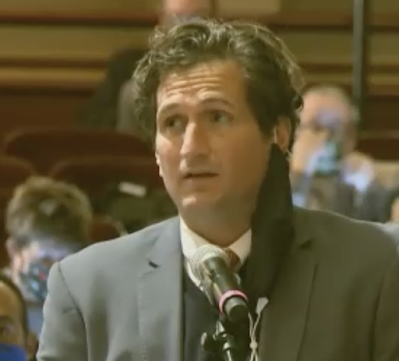
.JPG) |
Richard Sartor of the Charlestown Budget Commission
(photo by Will Collette) |
The GFOA Core Risk Analysis document addresses
a Total Reserve concept focused only on risk management variables. It recognized that the Town may have other
pockets of Reserves both inside and outside the GF, but it focused only on
emergency reserves in the General Fund.
The Commission draft seems intent on adding
non-risk management variables that help justify its past financial practice of
over-taxing residents annually and using the taxes raised to pay cash for large
capital projects instead of bonding them.
This additional focus by the BC will cost taxpayers several million
dollars more in UFB retention than would otherwise be required.
The BC FBP specifically states that any annual
audited GF surplus that normally would
automatically fall to UFB increasing it beyond the Minimum amount
required to be maintained, would be deemed available
for allocation and could therefore be “repurposed” by the TC either within
the GF or outside the GF, including ultimate allocation to capital projects not
as yet approved by taxpayers at referendum (think Community Center on steroids).
 |
In 2019, the CCA wanted to take $3 million from Charlestown's
budget to build a "community center" that was not needed and for
which there were no plans, designs or even location. This led to voters
rejecting the entire town budget for the first time in years. |
This, coupled with the BC’s statement that the
use of UFB in excess of target levels shall not normally be applied to
recurring annual operating expenditures virtually assures that any future
surplus could not be used to reduce a future tax levy. The Town has recorded a consistent average of
$1 million surplus each of the past 7 years.
This would not be expected to change if the
above language is adopted and thereby sanctioned by the Town Council. This represents
one example of how the Town’s UFB will be used independent of “emergency”
situations examined in the GFOA’s Risk Management analysis.
By annually transferring un-budgeted surplus’
out of the GF’s UFB into other pockets, the more possible taxation that can
occur. That is because the total surplus
cash available in all Town pockets could easily exceed $10
million because it would be considerably less
visible without any
prohibiting language.
Changing the allowance for repurposing surplus
cash available for allocation to amounts exceeding the Maximum instead of the
Minimum amount would be a constructive change to the currently proposed
language if an alternative is required, and there is no consensus that all
surplus reserves be maintained in the GF’s UFB.
The BC FBP also specifically states that the
Town shall also consider financial resources available in other funds in
assessing the adequacy of unassigned Fund Balance in the General Fund.
This is a good step, but falls short of
stating that their $7 million to $10 million proposed range of cash to maintain
is not just for the UFB of the GF, but would be reduced by the other of pockets
of cash that are also set aside for the same risks analyzed in the GFOA’s risk
management document, both in the GF and those Other Funds outside the GF.
This additional step would not be required if
the UFB in the GF were the only designated location to maintain “emergency”
reserves. This would eliminate a great
deal of confusion and debate as to what the true number was.
The BC FBP also specifically states, “The Town
will strive to maintain an unassigned fund balance in an amount equal to 23% to
33% of its annual operating expenditures and a cumulative probability of
adequacy of 90+%.”
However, it should be noted that the
percentage of confidence determined by the GFOA to be 90+% confident is 29.8% of expenditures and not 33% of
expenditures or $9 million, a difference of $960,000 (See Page 6 of the GFOA
analysis).
The BC FBP also specifically states, “Year-end
surpluses are an appropriate source for replenishing Fund Balance.”
Yes, they can be, up to a point, but when they
are systemically large there is a problem.
Over-taxation is not fiction. It
can and does exist.
Adopting the above statement eliminates the
need for the BC to use a sharp pencil when they are recommending a budget, and
it allows the BC to feel justified in doing so.
If the Town needs to increase UFB to be in a
desired place within a desired range, then create an unbalanced budget with
more revenues (taxes) than expenditures showing that there is reason why a
surplus needs to be budgeted and taxed. The taxpayers did just that in reverse a
few years ago when $854,000 was brought back into the General Fund after the budget had
been voted down at referendum.
While the GFOA compared us to other Towns with similar
demographics, neither they or the BC ever listed even 1 town that had approved
a Fund Balance policy authorizing a 33% level, much less 3 or more towns. Nor did they
provide an example of another similar Town in demographics to Charlestown that
opted to allow un-budgeted surpluses to replace bonding for large capital
projects. In fact, the GFOA never even mentioned 33% in
its risk analysis document.
Despite the often-repeated claim that
Charlestown’s tax rates are very low, I hope I’ve made it clear that they can
and should be lower still. Simply put, our town leaders are holding on to far
more surplus cash than we need to meet foreseeable needs – and that’s OUR
money, and OUR money needs your voice.
Stephen
Hoff is a CPA with an MBA in Finance, a former municipal finance director who
has prepared municipal budgets, financial statements for audits and has
conducted municipal audits. He and his wife have lived full-time in Charlestown
since 2008 but have family ties going back to the 50’s.