Menu Bar

Home           Calendar           Topics          Just Charlestown          About Us

Wednesday, July 13, 2022

How Omicron dodges the immune system

And how do we plug the holes

Université de Genève

Meriem Bekliz, first author, with a plaque-reduction neutralization assay
used to determine the neutralizing capacity of antibodies.
 © HUG-UNIGE
The current wave of COVID-19 highlights a particularly high risk of reinfection by the Omicron variant of SARS-CoV-2. Why is this? 

A team from the Centre for Emerging Viral Diseases of the University of Geneva (UNIGE) and of the Geneva University Hospital (HUG) analysed the antibody neutralisation capacity of 120 people infected with the original SARS-CoV-2 strain, or with one of its Alpha, Beta, Gamma, Delta, Zeta or Omicron (sub-variant BA.1) variants.

 And unlike its predecessors, Omicron appears to be able to evade the antibodies generated by all other variants. In vaccinated individuals, while the neutralisation capacity is also reduced, it remains far superior to natural immunity alone. 

This could explain why Omicron is responsible for a net increase in vaccine break-through infections, but not in hospitalisations. These results can be read in the journal Nature Communications.

Tuesday, July 12, 2022

Time to talk Charlestown taxes

What better time than during an election year?

By Will Collette

This is an official Charlestown map from the town's Comprehensive
Plan showing the amount of "conservation and open space areas"
Charlestown property tax bills are arriving in residents’ mailboxes, making this a good time to talk about the issue of tax fairness and creativity.

The Charlestown Citizens Alliance (CCA) has made it a point of pride to brag that Charlestown has a very low tax RATE, which is true, while ignoring several important facts such as how little we actually get in municipal services for our money. 

Most routine municipal functions such as trash collection, water and sewage are extras that Charlestown taxpayers must pay for separately.

There’s also how we got to this year’s tax rate. It was a fanciful exercise in budget manipulation: the CCA-controlled Budget Commission and Town Council ignored the $3 million “oopsie” and through the use of federal American Rescue Plan money and an unassigned surplus, propped up the budget without an increase in the tax rate.

While our tax rate is artificially low, the other part of the tax equation, property assessments, are very high. 

$9.5 million! From Lila Delman 
The town is counting on higher collections due to the high prices out-of-state moguls are paying for beach property. Example: the record $9.5 million buy of an ocean front “cottage” in Quonnie (right 👉). The buyers paid $3 million more than the previous assessed value. On that one sale alone, Charlestown will get an additional $25,000 in tax revenue.

The buying-binge by rich out-of-staters is a mixed blessing. While it generates more tax revenue for the town, it also drives up property values generally, which is great if you are selling, but a living hell if you are buying but in either case, higher assessments mean higher taxes.

It makes Charlestown one of the least affordable towns in the state, forcing the grown-up children of Charlestown families to look elsewhere for housing. Plus, the next time the town reassesses property values, you’ll find yourself with a higher assessment and higher tax bill.

In fact, I received a July 1 letter from Tax Assessor Ken Swain saying that Charlestown will do a full, town-wide reassessment with inspectors coming to your door asking to take a look inside. NOTE that you are not required to allow the data collector in. If you refuse entry, they will look around outside and take measurements.

Your actual tax bill comes about is through a byzantine system of tax breaks. Only a minority of Charlestown property owners pay the full amount of tax on their land because most land in town is tax-exempt, tax-favored or the owners qualify for a broad range of tax breaks. 

This is another official town map showing taxable versus
non-taxable land. The CCA claims this map is unfair for some
reason. However, if you compare it to the map, above,
from Ruth Platner's Comprehensive Plan, you'll see the untaxed
land matches up with the open space and conservation properties.
 
More than 60% of Charlestown land is untaxed because it is owned by the town, the state or the federal government, by tax-exempt non-profits, by religious institutions and by phony fire districts. These untaxed properties are, by far, what drives most of your actual tax bill.

Many hundreds of other properties pay less than the full amount because the owners qualify for tax breaks for veterans, the handicapped, the blind, and low-income elderly. Plus many other property owners get tax breaks through conservation easements or by qualifying for the Farm, Forest and Open Space program.

Some property owners benefit from property that is mis-zoned, a problem that was first detailed by ex-Town Planner Ashley Hahn in 2012.

For example, when Charlestown zones some commercial property as "OS/R" (open space- recreational), the amount of tax can drop by as much as 75%.  Ashley offered three ways to resolve this problem: 

Former Town Planner Ashley Hahn's 2012 memo

Planning Commissar Ruth Platner promised she would fix this problem. That was 10 years ago. The problem has NOT been fixed.

While I do have major issues with fake fire districts that are little more than a tax rip-off and with our expensive habit of buying open space for the town even when the land is already protected, I do not begrudge the other tax breaks.

I do believe Charlestown should publicize its program of tax breaks so that those who qualify don’t have to find out by accident. It’s already too late to qualify for this year, but if you fall within any of the categories I listed, especially veterans and the disabled, you should contact Tax Assessor Ken Swain to apply.

Tax policy is a reflection of social values. We use tax breaks to reward the worthy (e.g. veterans, disabled, elderly) and encourage good behavior (conserving farms, woods and open space).

But in my opinion, we simply don’t go far enough.
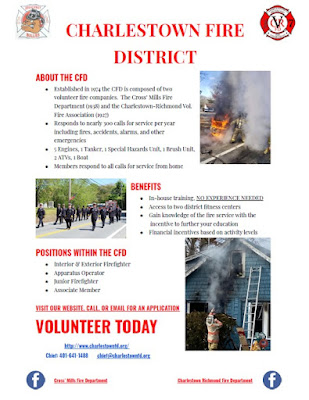
CFD needs volunteers
Bearing in mind again that our tax policy is a reflection of our values and needs, I think we should institute a new tax credit for volunteer firefighters. We have a shortage of volunteer firefighters and that endangers all of us.

To help with recruitment, as well as to reward firefighters for their service, we should award each active firefighter a substantial tax credit (maybe $500-$1000 a year or more) to reduce their property or car tax.

The climate crisis will hit Charlestown first and will hit it hard through severe storms and sea level rise. We can’t hold back the tide; seawalls are really not a very good option. However, we can all do our bit by installing green energy devices such as solar panels and residential wind power generators.

We’ll need to change Charlestown’s draconian anti-wind ordinance. With the emergence of vertical axis wind devices that resolve just about all of the anti-wind NIMBY objections to wind, it’s time to roll back the ordinance. Charlestown should craft a tax credit program that rewards residents who own, maintain or install green energy devices.

I also think Charlestown needs to give the Homestead Tax Credit another look – and a serious one this time. This issued was raised by Charlestown Democrats in 2011 and was thoroughly trashed by the CCA and a mob of angry absentee landowners. I called it “The Riot of the Rich.”

They claimed that giving permanent residents a $1000 tax credit was somehow unfair, even though such programs are prevalent in many of the states where our absentee property owners live (especially Florida). Further, homestead tax breaks partially make up for the cost to year-round residents of maintaining an infrastructure built to accommodate the tripling of the town’s population in the summer.

The rich rioters threatened that if full-time Charlestown residents got this credit, the out-of-state rich would stop giving to local charities and would no longer hire local workers for building, maintenance and housekeeping.

Such bullshit, as if (a) they gave much, if anything, to local charities and (b) they would mow their own grass, trim their own shrubbery, clean their own toilets, do their own plumbing and build their own additions to their beach “cottages.”

I think it’s very unlikely that seeing their tax bills rise by a few hundred dollars would make our rich summer people do any more than shrug.

Just recently, candidate for Congress, Second District Sarah Morgenthau had to explain yet another embarrassing fact that disclaims her alleged Rhode Island ties. WPRI investigators discovered that über-wealthy Morgenthau is still collecting a homestead property tax credit on her $3.2 million Washington DC home.

She will be applying to get North Kingstown’s recently enacted 5% pre-tax homestead exemption on assessed value for her new Saunderstown home.

Earlier in the campaign, on the defensive over her carpetbagger status, according to WPRI, Morgenthau brought up a family vacation house her family has owned in Saunderstown: “’I have been paying property taxes in the 2nd District for 40 years,’” Morgenthau said in April during an interview on 12 News at 4.”

The embarrassment to Morgenthau aside, homestead tax breaks are pretty commonplace and generally enjoy public approval – except in Charlestown. I have noted in several articles that Narragansett enacted a 10% pre-tax homestead exemption in 2017 that is quite popular and has not affected the town’s ability to pay its bills.

The CCA only wants to talk about the illusion of the low tax rate, as if that is the only thing that matters when it comes to your tax bill. But it’s just not that simple. It’s time to start looking beyond the CCA rhetoric and dig deep into the question of whether our taxes are fair and whether we are using our taxation policies for Charlestown’s betterment.

Coming soon


Who?


Is it a Trojan Horse or a Wolf in Sheep’s Clothing?

They won’t stop until they can control every aspect of your property.

By Margaret L. (Maggie) Hogan, Esq.

UPDATE: The first hearing on the CCA's proposed new development ordinance (actually, non-development since the ordinance is designed to create conditions making new developments virtually impossible) was held on July 11. Even with their 3-2 majority, the CCA was unable to bull their plan through. Thus, on Thursday, July 14, the Council will hold Part 2 of the hearing. 

The Town is giving the absolute minimum required notice since the CCA obviously wants to get this done with the least amount of public hassle. The original writing critiquing the CCA proposal appears after this notice:

Here is that notice:

PUBLIC NOTICE

TOWN OF CHARLESTOWN 

Notice is hereby given that the Town Council of the Town of Charlestown has continued a public hearing, opened on Monday, July 11, 2022, open to the public, to Thursday, July 14, 2022 at 7:00 p.m. 

**This meeting will be held in person at the Charlestown Town Hall, Council Chambers, 4540 South County Trail, Charlestown RI 02813. Comments from the Public will be accepted in person only.** 

At the continued public hearing noted above, the following proposed amendment to the Code of Ordinances will be considered. Opportunity shall be given to all persons interested to be heard upon the matter of the proposed ordinance. The following proposed amendments are under consideration and may be adopted and/or altered or amended prior to the close of the public hearing without further advertising, as a result of further study or because of the views expressed at the public hearing. Any person interested in viewing the proposed amendment may view same at the Town Clerk’s office of the Town of Charlestown or at charlestownri.gov prior to said hearing.  

The proposed ordinance may be accessed through the following link: 

https://charlestownri.gov/vertical/sites/%7BDF68A5B8-A4F3-47A1-AE87-B411E21C6E1C%7D/uploads/397_-_Chapter_218-52_Residential_Conservation_Development.pdf

The CCA used to HATE conservation developments but now say they love them.
This is the plan for a conservation development proposed in 2011. The Planning
Commission stomped it to death, leading to the "Y-Gate" scandal discussed
below. - W. Collette

This article ran as a Letter to the Editor of the Westerly Sun and is reprinted here with the permission of the author.

There’s a wolf in sheep’s clothing creeping into Charlestown under the cloak of the seemingly benign and friendly title of a “Conservation Design” amendment to the zoning ordinance.” 

There will be a Public Hearing on this scheme on Monday, July 11, 2022 at 7:00 PM at the Charlestown Council Chambers. 

Proposed by the Planning Commission, the long-standing cluster subdivision regulations (which also had problems) would be repealed and replaced.

The following changes would be enacted:

(1) From 50% to 70% (depending upon the zoning district) of a property owner’s developable property would be required to be set aside for “open space” owned by the Town, or a third party such as a non-profit. This is an increase from 40%, with no stated rationale.  

This land grab would be in addition to restrictions against development on “constrained lands” such as wetlands or slopes.  So, if you have a property with 10% undevelopable land, you will be left with only 20% land that you can develop.

(2)  Of the land that will be required to be “open space” only 10% of the land could be used for active recreation. This is a reduction from thirty-five percent under the current regulation, with no stated rationale for the change. 

And, only 5% of the land in open space will be permitted to be impervious (think basketball courts or tennis courts) which is a decrease from 25% under current regulations.  And, the type of recreation allowed will be determined by the Commission and may be disallowed if it finds the recreational uses “negatively impact the conservation values.” Again, no rationale for this change.

(3) Land which the Planning Commission deems to be “environmentally disturbed or damaged” will not be accepted for a conservation development until the land has been “restored to a condition satisfactory to the Planning Commission. 

The term “environmentally disturbed or damaged” is not defined in the ordinance and could easily be interpreted by this Commission to mean land that has had some or all trees previously removed.  Far too much “discretion” vested in the Commission will undoubtedly result in denial of rights.

(4)  Maximum lot coverage for 20,000 square foot lots will be 15%, whereas the same size lot in other areas of the town permit up to a 20% lot coverage.  No reason provided for treating the same size lot differently.

(5)  The Planning Commission proposes that it retain the right to limit private ownership of the open space and reject a homeowners’ association “where necessary to contribute to a connecting greenway system or to provide public access to open space.” This is clearly a taking of private property for a public purpose, without compensation!

(6) Only single family homes permitted, no duplexes. 

These enumerated items are simply the “highlights” of this overt land grab.  If you own land in Charlestown that you hoped to develop someday, you need to read this ordinance and take appropriate steps to protect your property rights.

The CCA's peculiar land use practices

Sidebar by Will Collette

In 2011, Ted Veasey proposed a 10-unit conservation development at the site of a derelict summer camp owned but abandoned by the Westerly YMCA. The site plan is shown above.

Not only did the CCA-controlled Planning Commission kill this proposal but their leader, Planning Commissar Ruth Platner, then embarked on a bold initiative to buy that same land for almost a million dollars in town and state funds which would be given to the Charlestown Land Trust.

This was the first major CCA scandal after the CCA consolidated its power after the 2010 election, power they have held ever since. 

The scandal was marked by bogus assessments, secret back door deals, conflicts of interest galor, political kick-backs - grifting on a grand scale. These practices have set the pattern the CCA has followed ever since: buying land the town doesn't need for incredibly inflated prices (CLICK HERE for a recent example) to benefit CCA-favored cronies (CLICK HERE for a recent example).

The Y-Gate scandal that emerged from Ted Veazey's conservation development proposal was Progressive Charlestown's first major series on a town scandal. The scheme was blocked by a lawsuit brought by the much-missed late Dr. Jack Donahue, represented by Maggie Hogan,  the author of this article.

That the CCA would today embrace the "conservation development" concept, though with the CCA's special twist of imposing such Draconian conditions that it's doubtful anyone would apply, is ironic considering what they did to Ted Veazey's conservation development proposal ten years ago.

How to Rewire Your Brain for Sleep

Stop worrying and get sleepy 

By SCITECHDAILY.COM 

Once your brain is wired to fret about being able to fall asleep, it takes effort to rewire neural pathways for restful sleep.

Insomnia can arise from several causes. However, worrying is one of the most frequent reasons people suffer from chronic sleep loss. If your mind boosts into overdrive when your head hits the pillow, conjuring mountains from molehills, no wonder you have difficulty getting to sleep.

Here’s how to stop anxiety stealing shuteye. First, though, you’re more likely to rewire your brain for sleep if you recognize why it’s currently wired for insomnia.

Repetition creates neural pathways

Repeated behaviors, such as worrying at night, turn into habits. Your brain is wired for insomnia if you’ve spent numerous nights wide awake, fretting about problems. Just as it takes time to generate neural pathways in the brain via repetition, it takes a while to override old tracks and create new, preferable ones.

The following tips can help you get to sleep, but they might not work instantly. Instead, be patient and carry them out until they are habitual. Once you’ve forged fresh neural connections, it will be easier to sleep every night.

It’s hard to sleep when you aren’t relaxed. It is hard to relax when you are anxious about falling asleep. It can take a while to break out of this negative spiral.

Browser cookies make people more cautious online

And for good reason

Elizabeth Stoycheff, Wayne State University

Cookie notifications become a ubiquitous aspect of online life. 
Mohssen Assanimoghaddam/picture alliance via Getty Images
Website cookies are online surveillance tools, and the commercial and government entities that use them would prefer people not read those notifications too closely. 

People who do read the notifications carefully will find that they have the option to say no to some or all cookies.

The problem is, without careful attention those notifications become an annoyance and a subtle reminder that your online activity can be tracked.

As a researcher who studies online surveillance, I’ve found that failing to read the notifications thoroughly can lead to negative emotions and affect what people do online.

Monday, July 11, 2022

Let’s end fake fire districts in 2023

New challenges to fake fire districts

By Will Collette

After state Superior Court Judge Sarah Taft-Carter ruled that the Bonnet Shores fake fire district violated the state Constitution by basing the right to vote on property ownership.

The RI ACLU reviewed the charters of other fire districts, both real and fake, to see how they determined who can vote in fire district elections.

The Boston Globe reported that the ACLU warned nine districts including several in our area, that they too could face a challenge over the constitutionality of their voting rules.

According to the Boston Globe:

“The Quonochontaug Central Beach Fire District’s clerk, Maud Bailey, said in an email that the district does allow non-property owners who reside in the district to vote — although property owners within the district get two votes to submit on behalf of their lot. That shoreline fire district, in Charlestown, does not have its own fire department, but it does issue beach passes, maintain a boat launch, and prohibit picnics on the beach.”

The Indian Lake Shores Fire District in South Kingstown and the Weekapaug Fire District in Westerly did not respond to the Globe’s request for comment.

Several fire districts said they either planned to or already had changed their voting practices to conform to the Constitution but not their charters.

ACLU volunteer lawyer Jamie Rhodes said that was the wrong answer: “If they know part of their charter is unconstitutional, they should go and change it.”

The Globe identified several more fire districts that aren’t actually fire districts beyond those uncovered by The Public’s Radio South County Bureau chief Alex Nunes in his Edward R. Murrow-award winning series on fake fire districts. See links below.

These are districts that act more like home owner associations for gated seaside communities or as public utilities, such as North Tiverton which acts as the town’s municipal water utility.

Phony fire districts like Quonnie and Shady Harbor also can own a lot of prime real estate and pay little or no municipal tax. They can provide wealthy residents with valuable income tax deductions for membership to such amenities as tennis courts, clubs, private beaches, swimming pools, boat launches and moorings, trash pick-up and snow plowing. But not fire protection.

I’ve researched and reported in this issue in Progressive Charlestown for several years. Now there have been multiple recent media exposés (see below). It is time for state legislation that requires any association that the benefits of being a fire district to devote a substantial part of its assets to fighting fires.

These fake fire districts are an insult to real firefighters and real fire districts.

They restrict beach access to their members only. They rob municipalities of property taxes as well as giving their members a way to cheat on federal and state income taxes.

The 2022 General Assembly session is over and we now move into election season. I’d like to see some of the candidates make the pledge to end the travesty of fake fire districts.

To learn more about fake fire districts and how they affect you through issues like shoreline access and taxes, check out the following links, beginning with the Edward R. Murrow Award winning articles by Alex Nunes, chief of the South County Bureau of the Public's Radio: https://explore.thepublicsradio.org/shoreline-access/. The Boston Globe and Providence Journal have also covered this issue

https://www.bostonglobe.com/2021/09/30/metro/finding-50-foot-wide-path-shore-westerly/

https://www.providencejournal.com/story/news/politics/2022/01/27/ri-judge-rules-against-bonnet-shores-fire-district-voting-rights-case/9246262002/?utm_source=providencejournal-Daily%20Briefing&utm_medium=email&utm_campaign=daily_briefing&utm_term=list_article_thumb&utm_content=RHODEISLAND-PROVIDENCE-NLETTER65

https://www.bostonglobe.com/2021/08/25/metro/an-argument-over-beach-access-ri-leads-libel-trespassing-lawsuits/?event=event12

https://www.bostonglobe.com/2021/08/26/metro/rhode-island-some-fire-districts-are-under-fire-over-beach-access/

https://www.providencejournal.com/story/news/politics/2021/06/28/political-scene-beach-access-politics-heating-up-summer/5343990001/ 

https://thepublicsradio.org/article/-they-want-us-out-of-here-how-private-interests-took-control-of-ri-s-most-exclusive-barrier-beach

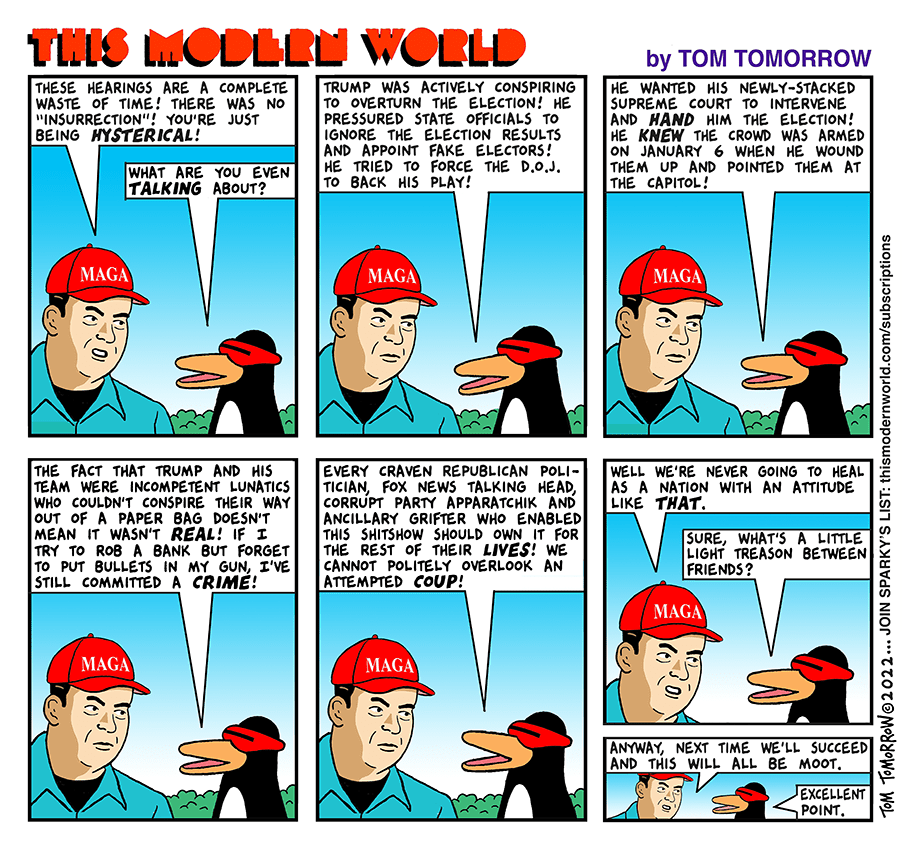
What's a little coup among friends?

For more cartoons by Tom Tomorrow, CLICK HERE.


July 16 artist reception at the Charlestown Gallery


July 16th 2022


Charlestown Gallery


Antonia Tyz Peeples

Artist Reception Saturday July 16th

2 - 6pm


Open - THURSDAY through SUNDAY

11 - 4


Always Open by Appointment


Charlestown Gallery | 401-364-0120 | 5000 South County Trail, Charlestown, R| http://www.charlestowngalleryri.com

Facebook‌ Instagram‌

Almost half of older adults are demented

40% of Older Adults: Newly Identified Form of Dementia Is Shockingly Common

By UNIVERSITY OF KENTUCKY 

The symptoms of Limbic-predominant age-related TDP-43 encephalopathy (LATE) are comparable to those of Alzheimer’s disease, involving memory loss and issues with thinking and reasoning in old age.

A recent study indicates the prevalence of brain changes from limbic-predominant age-related TDP-43 encephalopathy might be approximately 40% in older adults and as high as 50% in people with Alzheimer’s disease.

According to the researchers, the paper, which will soon be published in Acta Neuropathologica, is the most comprehensive evaluation of the incidence of a kind of dementia identified in 2019 and now known as LATE. According to the findings, the prevalence of LATE-related brain changes may be about 40% in older adults and up to 50% in patients with Alzheimer’s disease.

A Better Kind of Face Mask

Researchers Develop Virus Killing Masks

By RENSSELAER POLYTECHNIC INSTITUTE 

Researchers at Rensselaer Polytechnic Institute have created a practical method for producing N95 face masks that are both excellent germ barriers and on-contact germ killers. 

The antiviral and antibacterial masks may be worn for longer periods of time, which would result in less plastic waste as the masks would not need to be replaced as often.

In order to combat infectious respiratory diseases and environmental pollution, Helen Zha, assistant professor of chemical and biological engineering and a member of the Center for Biotechnology and Interdisciplinary Studies at Rensselaer (CBIS), worked with Edmund Palermo, associate professor of materials science and engineering and a member of the Center for Materials, Devices, and Integrated Systems (cMDIS) at Rensselaer.

Buying into conspiracy theories can be exciting

That’s what makes them dangerous

Donovan Schaefer, University of Pennsylvania

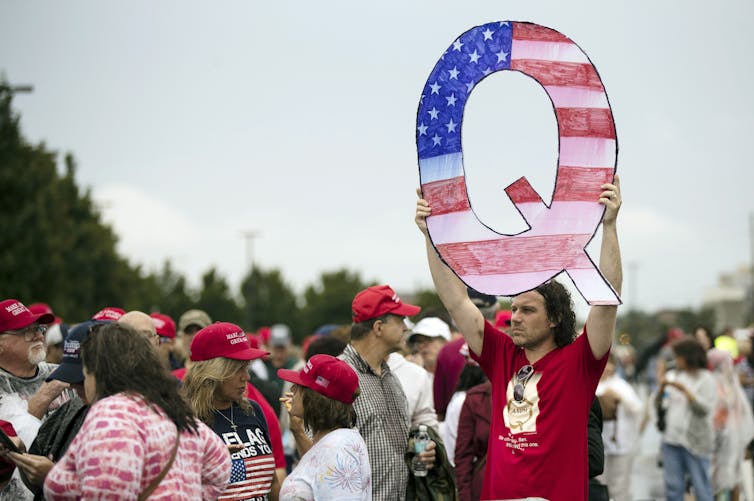
A protester holds a Q sign as he waits to enter a campaign rally
with then-President Donald Trump in Wilkes-Barre, Pa., in August 2018.
 AP Photo/Matt Rourke
Conspiracy theories have been around for centuries, from witch trials and antisemitic campaigns to beliefs that Freemasons were trying to topple European monarchies. 

In the mid-20th century, historian Richard Hofstadter described a “paranoid style” that he observed in right-wing U.S. politics and culture: a blend of “heated exaggeration, suspiciousness, and conspiratorial fantasy.”

But the “golden age” of conspiracy theories, it seems, is now. 

On June 24, 2022, the unknown leader of the QAnon conspiracy theory posted online for the first time in over a year. QAnon’s enthusiasts tend to be ardent supporters of Donald Trump, who made conspiracy theories a signature feature of his political brand, from Pizzagate and QAnon to “Stop the Steal” and the racist “birther” movement. 

Key themes in conspiracy theories – like a sinister network of “pedophiles” and “groomers,” shadowy “bankers” and “globalists” – have moved into the mainstream of right-wing talking points.

Much of the commentary on conspiracy theories presumes that followers simply have bad information, or not enough, and that they can be helped along with a better diet of facts.

But anyone who talks to conspiracy theorists knows that they’re never short on details, or at least “alternative facts.” They have plenty of information, but they insist that it be interpreted in a particular way – the way that feels most exciting.

My research focuses on how emotion drives human experience, including strong beliefs. In my latest book, I argue that confronting conspiracy theories requires understanding the feelings that make them so appealing – and the way those feelings shape what seems reasonable to devotees. 

If we want to understand why people believe what they believe, we need to look not just at the content of their thoughts, but how that information feels to them. Just as the “X-Files” predicted, conspiracy theories’ acolytes “want to believe.”