
Friday, April 28, 2023

How you make decisions
Where does your brain want to have lunch?
Cedars-Sinai Medical Center
.webp)
Published in the peer-reviewed journal Nature Human Behaviour, this study involved recording the activity of individual human neurons.
The study examined decisions called value-based choices, where there is
not necessarily a right or wrong option, according to Ueli Rutishauser, PhD,
senior author of the study, director of the Center for Neural Science and
Medicine, and professor of Neurology, Neurosurgery and Biomedical Sciences at
Cedars-Sinai.


URI researcher contributes to study confirming link between PFAS – ‘forever chemicals’ — in drinking water and weight gain
Study results published in prestigious journal Obesity

PFAS can enter groundwater and food sources which leads to human exposure through drinking contaminated tap water or eating contaminated fish. Graphic courtesy URI STEEP Superfund Research Program.
A University of Rhode Island researcher leads a study that confirms a direct link between certain chemicals in drinking water and human obesity – specifically that increased PFAS content in blood promotes weight gain and makes it harder to keep a lower body weight after weight loss.
Philippe Grandjean, M.D., PhD., is physician who holds a research professor
appointment within the URI College of Pharmacy and serves on STEEP, a special
URI-led science effort helping the public grapple with manmade PFAS (per-and
polyfluoroalkyl substances) pollution, including its presence in drinking water
resources.
“We’ve previously shown that children with increased PFAS concentrations tend to gain weight and develop higher levels of cholesterol in the blood,” said Grandjean, a professor of environmental medicine at the University of Southern Denmark, who has researched the human health impacts of PFAS in multiple countries and populations, including children, for decades.
“We now focused on adults who participated in an experimental study of five
different diets in regard to weight gain. Our results add to the concern that
environmental pollution may be affecting our metabolism, so that we tend to
gain weight.”
How you end up paying more for everything from pork to phones
Illegal Corporate Price-Fixing Conspiracies are Widespread in U.S. Economy
By Phil Marrera
Illegal pricing conspiracies have occurred in a wide range of industries, affecting the cost of products ranging from everyday grocery items and auto parts to life-saving medications and electronic components.
In industries such as financial services and pharmaceuticals, just about every major corporation (or a subsidiary) has been a defendant, often more than once. Banks, credit card companies and investment firms dominate the top tier, accounting for nine of the 10 most penalized corporations by total dollars.
These are the key findings of Conspiring Against Competition, a report published today by the Corporate Research Project of Good Jobs First, a non-profit research center focused on corporate accountability. The report, available at goodjobsfirst.org, draws on data collected from government agency announcements and court records for inclusion in the Violation Tracker database.
Thursday, April 27, 2023


AI-generated spam may soon be flooding your inbox
It will be personalized to be especially persuasive
 |
| AI may make spam more pervasive than ever. AP Photo/Gene J. Puskar |
Now, the arms race between spam blockers and spam senders is about to escalate with the emergence of a new weapon: generative artificial intelligence. With recent advances in AI made famous by ChatGPT, spammers could have new tools to evade filters, grab people’s attention and convince them to click, buy or give up personal information.
As director of the Advancing Human and Machine Reasoning lab at the University of South Florida, I research the intersection of artificial intelligence, natural language processing and human reasoning. I have studied how AI can learn the individual preferences, beliefs and personality quirks of people.
This can be used to better understand how to interact with people, help them learn or provide them with helpful suggestions. But this also means you should brace for smarter spam that knows your weak spots – and can use them against you.
Allergy season is getting more intense with climate change
We’re creating better pollen forecasts to help
 |
| Allergy season is here. Imgorthand/E+ via Getty Images |
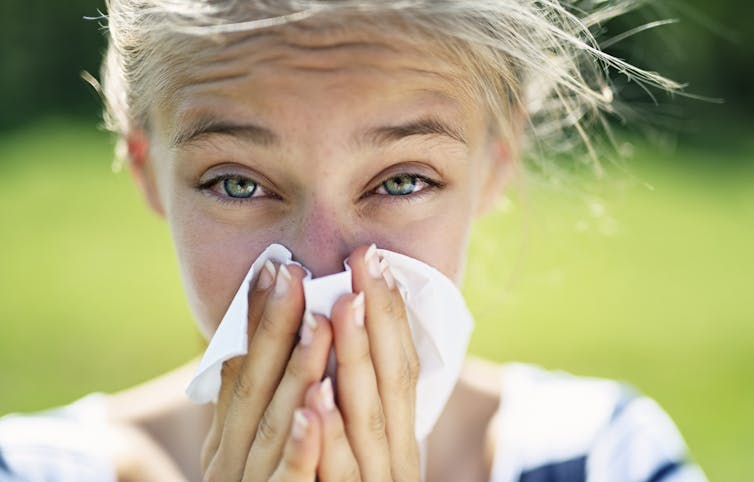
Pollen allergies affect over 30% of the global population, making them a significant public health and economic issue as people feel ill and miss work. Our research shows that, as greenhouse gases warm the planet, their effects are driving longer and more intense pollen seasons.
To help allergy sufferers manage their symptoms in our changing climate, we’re building better pollen forecasts for the future.
As atmospheric scientists, we study how the atmosphere and climate affect trees and plants. In a 2022 study, we found that the U.S. will face up to a 200% increase in total pollen this century if the world continues producing carbon dioxide emissions at a high rate. Pollen season in general will start up to 40 days earlier in the spring and last up to 19 days longer than today under that scenario.
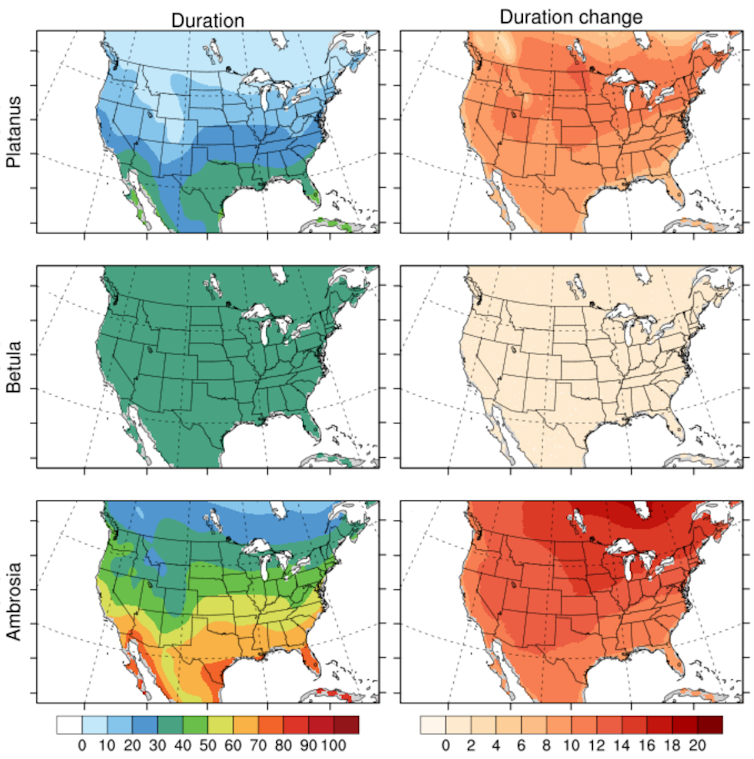 |
| The maps on the left show the recent average pollen season length in days for three types of plants: Platanus, or plane trees, such as sycamores; Betula, or birch; and Ambrosia, or ragweed. The maps on the right show the expected changes in total days by the end of the century if carbon dioxide emissions continue at a high rate. Zhang and Steiner, 2022 |
“Succession?”
URI business professor, colleagues look at mortality and leadership succession in family business
By Tony LaRoche

Many of those leaders don’t have a strategy for letting go of their business, turning it over to a successor, or selling it. While it is rare for an incumbent leader to die while in office, it is difficult for them to face their mortality.
Yet letting go and
the outsized effect of facing one’s mortality have not been examined closely
since early writings in family business.
Nancy Forster-Holt, assistant professor of innovation and
entrepreneurship in the University of Rhode Island College of Business, has
seen that up close. About 20 years ago, she and her husband bought a marine
products company from an aging owner, “Paul,” who hadn’t planned for his
eventual retirement.
“Very few business owners have an exit plan. When we bought our business, the owner told us, ‘I didn’t have an exit plan; I had a heart attack.’ That was so profound to me. That’s what led to my Ph.D. topic on the retirement of business owners.”
Wednesday, April 26, 2023
What Do Pornography, Ginni Thomas, & Thomas Jefferson Have In Common?
Judges and Authoritarianism
By Thom Hartmann for the Independent Media Institute

First, the backstories, one from 1803 and the other from 1968.
There’s always been an authoritarian streak in American politics: with studies showing about 20 percent of the population are “authoritarian followers,” it shouldn’t be a surprise that authoritarians would rise to political power and could even take over an entire political party through the force of will and wealth.
That’s
the story of authoritarian followers Clarence Thomas and his wife, Ginni, who
openly supported not just Trump’s authoritarianism but also his attempt to
overthrow the government of the United States. Thomas was the lone vote
on the Supreme Court in favor of Trump being able to conceal records from the
January 6th Committee. 
Liar
Thomas committed that flagrant violation of judicial ethics and unwillingness to recuse himself even after his wife, Ginni, actively worked to overturn the election, even going so far as to reach out to legislators in Arizona and Wisconsin (the ones we know about) encouraging them to ignore their states’ voters and award the Electoral College vote to Donald Trump.
But Thomas’ authoritarian streak isn’t limited to sucking up to Donald Trump. For decades he’s been taking tens of millions of dollars’ worth of gifts from a Texas billionaire who’s a major funder of Republican politicians and Nazi memorabilia collector, gave Ginni Thomas’ organization a half-million dollars to start her own rightwing advocacy group, and has supported sleazy organizations trying to pack the federal judiciary.
The last time an authoritarian toady on the Supreme Court was held to account was in 1803, and the analogies to today are startling.

Talk with Tina on Saturday

|

|
|
DEM Announces Bonuses of up to $1,000 for Lifeguards this Summer
Revs Up Recruitment for Key Seasonal Workforce to Staff State Beaches and Parks
 |
| DEM photo |
The Department of Environmental Management (DEM) announced today that it is offering one-time sign-on and retention bonuses of $500 each and hourly pay increases of between 10% and almost 15% to lifeguards this summer.
The agency views the incentives as critical to recruiting more lifeguards to staff state beaches and parks, which attract nearly 10 million visitors and add an estimated $300 million annually to the state economy, according to a URI study.
The historically tight national labor market, which continues to include a low labor force participation rate among teenagers 16 to 19, has affected practically every employer in the country, whether public or private sector.
Full-time lifeguard positions are available at all state swimming areas, including surf beaches such as Roger Wheeler and Misquamicut, non-surf beaches such as Goddard Memorial State Park, and freshwater beaches such as Burlingame Campground and Lincoln Woods State Park.
Optimally, DEM would hire a workforce of around 150 lifeguards; the agency had
about 85 in place for most of the 2022 summer. Despite this, DEM only had to
restrict swimming areas at a few beaches a handful of times last year.
Subscribe to:
Posts (Atom)