Menu Bar

Home           Calendar           Topics          Just Charlestown          About Us

Thursday, July 6, 2023

"I was just looking to pick up some milk"

Grocery store carts set to help diagnose common heart rhythm disorder and prevent stroke

European Society of Cardiology

It could be the shopping trip that saves your life: supermarket trolleys are helping to diagnose atrial fibrillation which can then be treated to prevent disabling or fatal strokes. 

The research is presented at ACNAP 2023, a scientific congress of the European Society of Cardiology (ESC).1

"This study shows the potential of taking health checks to the masses without disrupting daily routines," said study author Professor Ian Jones of Liverpool John Moores University, UK. 

"Over the course of two months, we identified 39 patients who were unaware that they had atrial fibrillation. That's 39 people at greater risk of stroke who received a cardiologist appointment."

More than 40 million people around the world have atrial fibrillation, the most common heart rhythm disorder.2 Atrial fibrillation increases the risk of stroke by five-fold. These strokes are often fatal or disabling. 

Anticoagulation substantially lowers risk, but many people only discover they have atrial fibrillation after they have a stroke.3 Screening programmes are therefore needed to identify people with the condition so they can receive preventive medication.

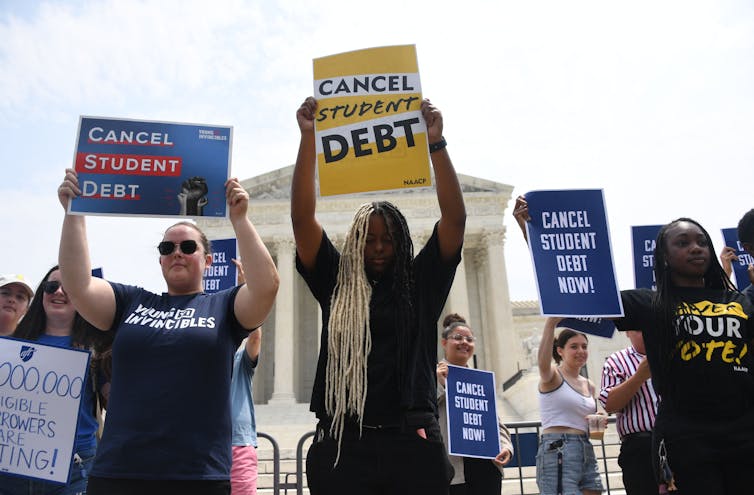
What's next, now that the Supreme Court has blocked Biden student debt plan?

Millions are asking, "now what?"

William ChittendenTexas State University

The Supreme Court rejected President Joe Biden’s plan
to eliminate $430 billion in student loan debt. 
Olivier Douliery/AFP via Getty Images
The Supreme Court has struck down the Biden administration’s student loan forgiveness plan. In Biden v. Nebraska, the court ruled 6-3 on June 30, 2023, that the secretary of education does not have the authority to forgive US$430 billion of student loans under the Health and Economic Recovery Omnibus Emergency Solutions Act.

That kills the president’s proposed plan to forgive up to $10,000 in student loans per borrower for those with incomes under $125,000 per year, or $250,000 per year for couples. Under the president’s plan, those who received Pell Grants would have been eligible to cancel up to an additional $10,000 in student loans.

Just hours after the decision, President Biden announced a new effort to forgive student loans under the Higher Education Act of 1965.

To give borrowers time to “get back up and running,” Biden stated that the Education Department won’t refer borrowers who don’t pay their student loan bills to credit agencies for 12 months.

Wednesday, July 5, 2023

My Love Affair with Print Newspapers

Lamenting great American newspapers

By Gerald E. Scorse, Progressive Charlestown guest columnist 

It all began with baseball. I was growing up in the 1940s in Rochester, N.Y., a farm team for the St. Louis Cardinals. I couldn’t get enough of them in the first newspaper I ever read, the Rochester Democrat and Chronicle. The instant it came I grabbed the sports pages, flopped myself down on the living room floor, and lost myself at the ballpark. 

Eight decades later the Cardinals are still my favorite team, but my heart has moved on. These days I’m clinging to a deeper love: print newspapers. 

We’ve lost more than 2,500 since 2005. They’re currently dying at the rate of over 100 a year. My heartthrob The New York Times has metamorphosed into a print/digital hybrid, testing my loyalty to print like never before. 

Back to the early days. My family moved to Erie, Pa. For years the Erie Daily Times tutored me in how the world turns—including the world of the Cardinals and their superstar, Stan (The Man) Musial. The Times also gave me my first real job, tossing newspapers onto lawns and front steps, knocking on doors once a month to collect from subscribers. 

Another move, to Jamestown, N.Y., put the bloom on my newsprint romance. I became a sports writer at the Jamestown Post-Journal. It was intoxicating: phones forever ringing, heads bent over typewriters, magic moments when each day’s paper was raced upstairs from the pressroom. I wrote articles, headlines, a column that included my picture. It couldn’t possibly get any better. 

And then it did. I took a new job writing for a bigger paper, the Syracuse, N.Y. Herald-Journal. I covered the Cornell-Syracuse football game. The star that day would be a star forever: the late Jim Brown, possibly the greatest football player of all time. I covered the Hall of Fame baseball game in Cooperstown, N.Y. My first-person story ran under the headline “Writer in love with slowed-up copy of ‘The Man’”. 

The draft intervened. The Army took me away for two years. It taught me, among other things, that sports weren’t the most important thing in the world. 

Home again in Jamestown, I switched from sports writing to cityside reporting. It pumped me up even more than before. I wrote about City Council meetings and the police department, crafted offbeat pieces for a feature called Talk of the Town. I loved print newspapers from two sides now, and I’ve never really stopped. 

I came to New York City with dreams of writing for a big-city daily. I remember seeing the city’s skyline for the first time, feeling the city’s energy for the first time. 

So much for my dreams. In December of 1962, a 114-day strike by the printers’ union shut down all seven of the city’s dailies and ultimately killed four of them. They were icons and then they were gone: the Herald Tribune, the World-Telegram & Sun, the Journal-American, the Mirror. 

Vanity Fair wrote this epitaph 50 years later: “As a newspaper town, New York was never the same again.” 

The union struck because the new technologies of offset printing and cold type were beginning to replace linotype presses and “hot” type. Today the new technology of digital printing is replacing type itself: instead of words on paper, we’re getting images on a screen. 

In my dinosaur world, digital newspapers are imitations of the real thing. 

The real thing is what my wife and I sit down to at the dining room table every morning. The New York Times comes in sections, which we swap back and forth until we’ve gone over all of them. We tell each other what looks most interesting or enlightening, what makes us laugh or touches our hearts. In other words, we communicate with each other while being communicated to; it gets our days off to a super-sweet start. 

Maybe not for much longer, though. The reasons just keep piling up, pushing a newsprint lover in the digital direction. 

The Times long ago stopped printing stock market tables, box scores, anything and everything with lots of numbers. TV watchers have been shorted as well: no more daily listing of the programs that are airing, on what channels, at what times. 

IMHO, I’m also seeing overlong stories over-illustrated with over-large photos. The baseball coverage comes up short in the opposite direction: there are days when The Times doesn’t print a word about the Yankees or the Mets or anybody else, throwing a shutout at all fans. (Note: In early 2022 the corporate New York Times went sports-digital as well as news-digital, buying out the online The Athletic for $550 million cash.) 

Lastly, the print Times is regularly being scooped by its digital offspring. Print subscribers get access to the digital version too, so of course I log in now and then. Time and again, I’ll read stories online that won’t appear in the paper for days. (Recent example: A June 8 piece about the author Joan Didion didn’t show up in print until June 17.)    

I cherish the old Times. We’ve had it home-delivered to our apartment on Manhattan’s Upper West Side for decades. Inflation has seriously upped the price, pushing it into four figures for the year—and it’ll likely go even higher. 

My head and my heart are locked in a one-on-one. My head is urging me to live in the 21st century. My heart, long in love with print, wants to keep having those sweet Times mornings. 

In the end my heart and my head will probably keep playing one-on-one. They’re torn by two very different newspaper worlds. Very torn.

Gerald E. Scorse helped pass the bill requiring basis reporting for capital gains. He writes on taxes. His articles have appeared often in Progressive Charlestown.

© 2023 Gerald E. Scorse

Supremely bigoted

By Matt Davies


Find the mistakes in this photo


By ‘helping’ wild animals, you could end their freedom or even their lives

When and how to help

Julian AveryPenn State

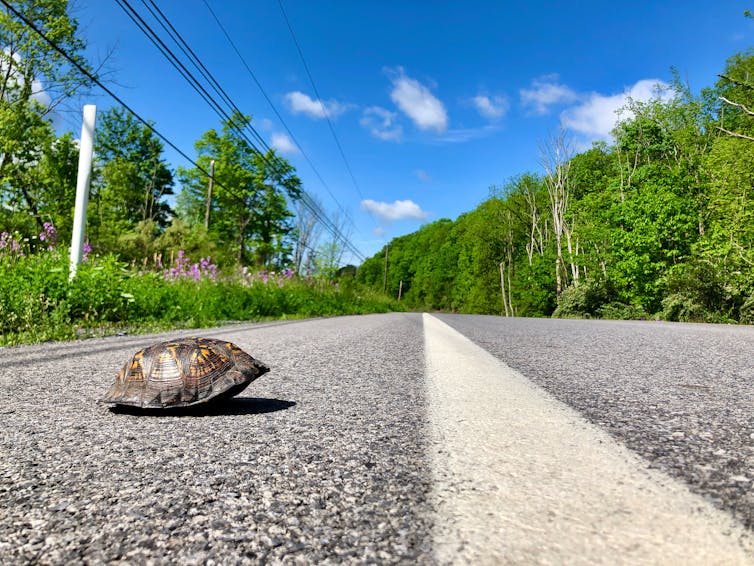
An eastern box turtle crossing a rural Pennsylvania road. 
Julian AveryCC BY-ND
For anyone who enjoys nature, summer is a fascinating time to be outside. Animals are on the move: Turtles are nesting, baby birds are testing their wings, snakes are foraging and young mammals are emerging.

In central Pennsylvania, where I live, last year’s hatchling painted turtles have overwintered in their nests and emerged looking like tiny helpless snacks for raccoons and ravens. 

I’ve already rescued a baby killdeer – a shorebird that nests in parking lots – that ran off the road and got stuck in a grate. And I’ve watched an eastern chipmunk prey on a nest of towhee chicks.

I moved the killdeer to safety because it had fallen into what we call an “ecological trap.” Humans create these traps when we degrade habitat that looks suitable to animals. For killdeer, parking pads and roofs give off all the vibes of a great nesting site – except for the drains – and they have less natural habitat available these days.

But I didn’t intervene with the towhees. Their exposed nest site may have been a bad parental decision, or perhaps the chicks’ begging called too much attention. 

Either way, natural selection helped ensure that these birds and their genes were unlikely to survive. Ultimately, that may be better for the population and species than if I had intervened.

As a wildlife biologist, I know that relocating animals can be bad from a scientific perspective. It also can easily harm the creature you want to help.

Based on my experience as a scientist and university teacher, I’ve developed guidelines for when to get involved in the lives of animals I encounter outside. 

When I do intervene, it is after carefully considering the potential reasons for the animal’s situation, the species’ population status and the potential harm my actions might inflict upon the whole population – not just on one adorable creature.

Can you really ‘address’ annoying eye floaters with a supplement?

You can get used to them. Almost.

Charlotte CodinaUniversity of Sheffield

Mayo Clinic
If you look up at the sky on a clear day, you might notice little cobweb-like structures drifting across your field of vision. They are known as floaters or, more formally, muscae volitantes – Latin for flying flies.

Like regular flies, muscae volitantes are rather pesky, so it’s not surprising that people want to banish them. A recent article in the Mirror, Eye floaters: What causes them and how to get rid of them naturally, claims to have a solution.

Sarah Brewer, a GP, is quoted in the article as saying that a supplement called Clearer, made by Theia Bio, is “a natural but effective solution to address annoying floaters”. Despite the promise in the headline, Dr Brewer does not talk about getting rid of floaters.

The Theia Bio website uses more precise language. It says: “Clearer contains a blend of antioxidants and antiglycation micronutrients that has been scientifically proven to reduce eye floater size and visual discomfort in around 70% of test subjects over six months.”

Before we look at the feasibility of a supplement to “address” annoying floaters or reduce their size, let’s look at what floaters are and why they occur.

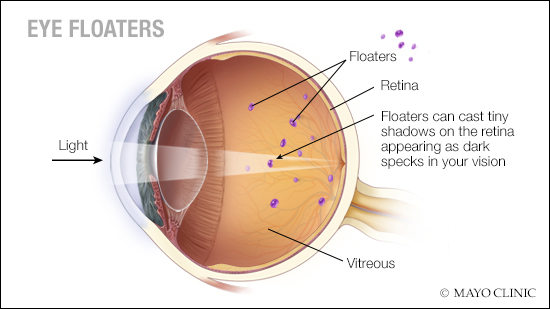
The main reason floaters occur is age. With age, the vitreous – a clear, gel-like substance inside the eye – starts to thicken and shrink. Vitreous consists mostly of water, collagens and an acid called hyaluronan. Over time, the vitreous degenerates slightly and little clumps of collagen begin to form. Floaters are the shadows these clumps cast on the retina.

With age, it’s normal for the vitreous to pull away from the back of the eye, a process called posterior vitreous detachment, and this causes more floaters.

Is it possible that vitamin supplements could affect the clumps and strands of collagen, to improve the vitreous? In 2022, researchers in Taiwan reported that taking high-dose mixed fruit enzyme supplements could reduce floaters, but it’s not clear how they measured the number of floaters, so it is difficult to judge this study properly without more information.

Court upholds RI right to regulate concealed guns

Superior Court judge denies constitutional challenges to state’s concealed-carry statutes

by Christopher Shea, Rhode Island Current

Rhode Island Attorney General Peter Neronha is celebrating a case his office said sought to challenge the state’s concealed carry laws, though gun-rights advocates say it’s not the victory the AG thinks it is.

At the center of this ruling were eight male defendants charged with carrying a pistol without a permit. They ranged in age from 19 to 35 and four were under 21 when they were arrested between 2021 and 2022. In Rhode Island, an individual must be at latest 21 to get a permit.

All eight defendants were arrested in individual instances by one of our law enforcement agencies — either Rhode Island State Police or the Providence, Pawtucket and Central Falls police departments.

According to the AG’s office, the defendants sought to get their cases dismissed. Their argument was that Rhode Island’s permitting statutes were unconstitutional because they violated their right to keep and bear arms under the Second Amendment.

All motions were denied by Superior Court Judge Kristen Rodgers in a bench ruling on June 23 — one year to the day the U.S. Supreme Court (SCOTUS) made its controversial New York State Rifle & Pistol Association v. Bruen decision. The June 2022 ruling held that the Second Amendment protects a person’s right to carry a handgun for self-defense outside the home.

As a result, the cases against the eight defendants can proceed.

Tuesday, July 4, 2023

Should Trump be allowed to run for office?


More money than sense

For more cartoons by Ruben Bolling, CLICK HERE

Looking for logic in all the wrong places


How can climate scientists better communicate risk?

Brown’s Baylor Fox-Kemper says scientists have to do better or we all suffer 

Brown University

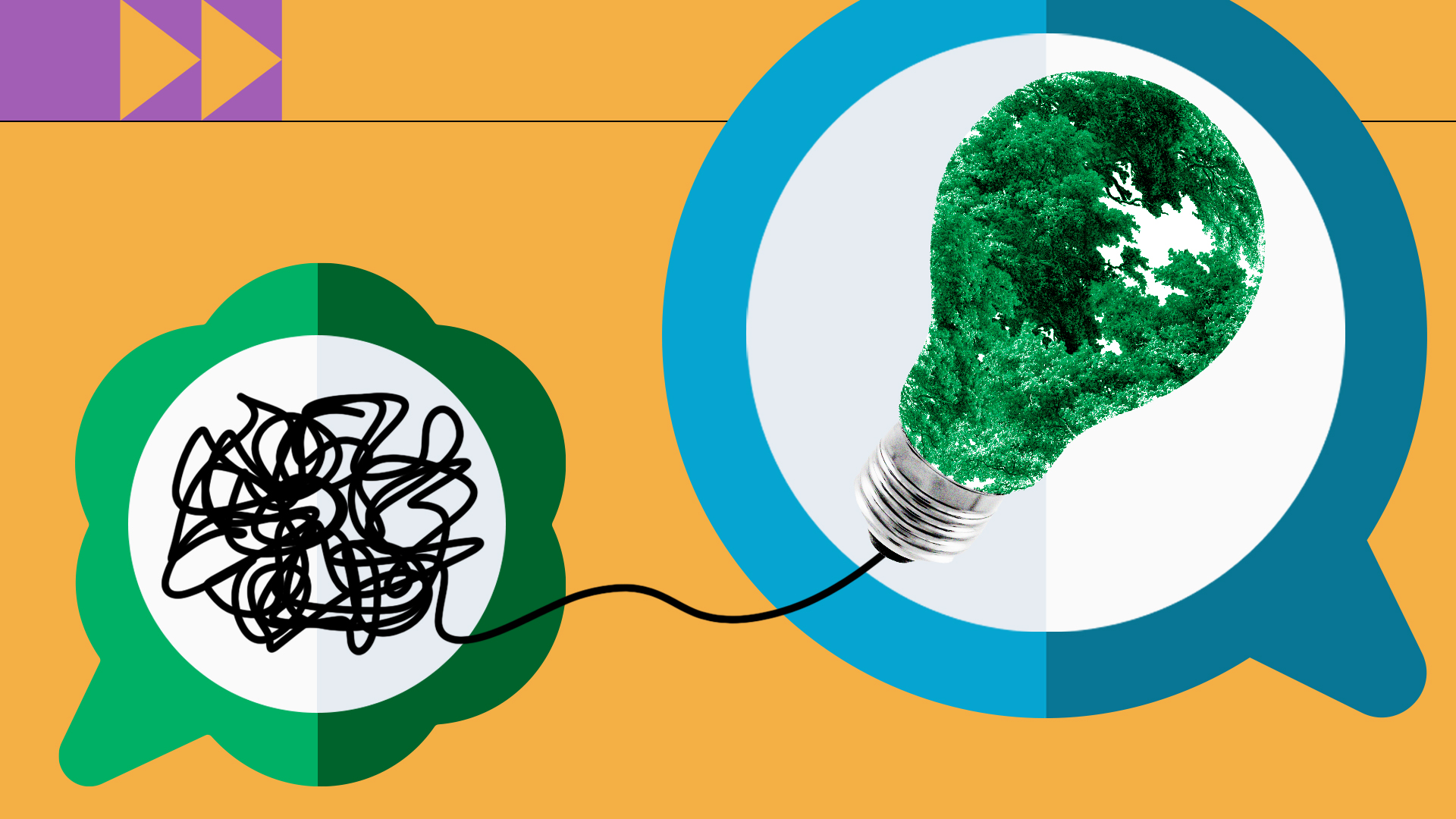
A new study authored by an international group of climate scientists, including an expert at Brown University, found that climate scientists have long struggled to find the best ways to present crucial facts about future sea level rise to policymakers, stakeholders and the general public.

But on a positive note, they have started to improve that ability in recent years.

The study analyzed decades of language and graphics used in the United Nations’ Intergovernmental Panel on Climate Change climate assessment reports, highlighting areas of success and identifying areas where language can be improved. 

This includes language communicating uncertainty that surrounds future sea level projections, which the analysis found has often been oversimplified or confusing in reports and could potentially lead policymakers to underestimate outcomes and alter plans that counter some of the worst effects of rising waters.

Baylor Fox-Kemper, a professor of Earth, environmental and planetary sciences who is affiliated with the Institute at Brown for Environment and Society, is among the authors of the new study, which was published in Nature Climate Change

Intermittent Fasting vs. Calorie Counting

What Is Best for Weight Loss According to Science
By AMERICAN COLLEGE OF PHYSICIANS

Obesity is a major health issue. Many traditional weight loss diets involve counting calories, which can be cumbersome and difficult to do well. Time-restricted eating, without calorie counting, has become a popular weight loss strategy because it is simple to do. Whether it’s effective in producing weight loss, especially beyond the short term, is unclear.

Researchers from the University of Illinois Chicago studied 90 adults with obesity from the Greater Chicago area to determine whether intermittent fasting or calorie-restricted eating would be more effective for weight control and cardiometabolic risk reduction.

Will toxic haze and the 2023 danger season make a difference?

Believing the evidence of your own eyes (and lungs)

Derrick Z. Jackson for the Environmental Health News


The year is only half done and the United States has already been enveloped by acrid orange skies in the East, battered by winter rains and floods in California, seared by record winter temperatures in the South, soaked by a record 26-inch April deluge in Fort Lauderdale, and broiled by record spring heat in the Pacific NorthwestTexas, and Puerto Rico.

The onslaught has led to another round of media headlines and press releases from environmental and public health groups asking whether the nation is at a tipping point of urgency to fight climate change.

A Los Angeles Times headline for reader letters on the floods said, “California rains are a wake-up call for climate upheaval to come.” Many other media outlets and advocacy groups, from Al Jazeera to the American Lung Association, speculated as to whether the recent smoke plumes may also be such a “wake-up call.”

A Vox headline on the orange skies from Canadian wildfires said, “Wildfire smoke reminded people about climate change. How soon will they forget?” A Washington Post story carried the headline: “How the Canadian wildfire smoke could shift Americans’ views on climate.” A Philadelphia Inquirer column carried the headline, “America sleepwalks through a climate crisis. Will this smoke alarm wake us up?”

So far, no alarm bell has been loud enough to stop the sleepwalking. Hurricane Katrina in 2005, Superstorm Sandy in 2012, Hurricanes Harvey and Irma in 2017, and Hurricane Irma in 2021 were all accompanied by the same question. After the 2021 “heat dome” that saw Portland, Oregon hit 116 degrees and Seattle soar to 106, a Los Angeles Times headline said: “Northwest heat wave swamped the vulnerable, was a harsh climate wake-up call.”

The usual and eventual response to such things was summed up in an Associated Press story five years after Superstorm Sandy. The headline was “5 years after Superstorm Sandy, the lessons haven’t sunk in.” It was about most plans for climate security in the New York City area being unrealized.

Monday, July 3, 2023

They are NOT the same

What is the difference between nationalism and patriotism?

Joshua HolzerWestminster College

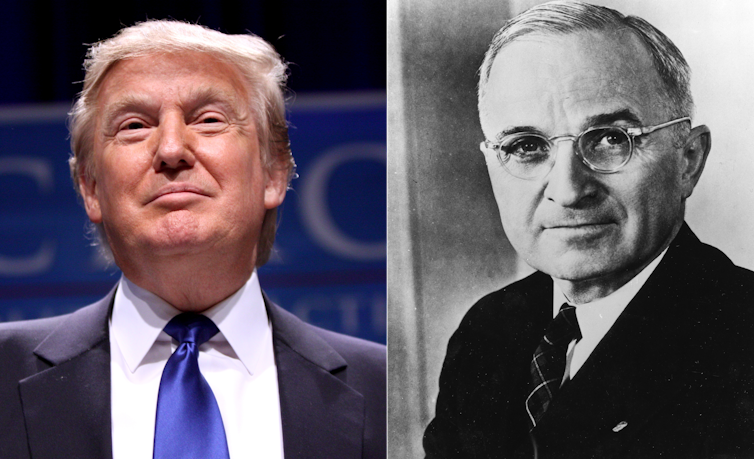
Donald Trump, left, and Harry Truman: Two former presidents who had different ideas about nationalism and patriotism. The Conversation, with images from Wikimedia CommonsCC BY-NC

During his presidency, Donald Trump said, “We’re putting America first … we’re taking care of ourselves for a change,” and then declared, “I’m a nationalist.” In another speech, he stated that under his watch, the U.S. had “embrace[d] the doctrine of patriotism.”

Trump is now running for president again. When he announced his candidacy, he stated that he “need[s] every patriot on board because this is not just a campaign, this is a quest to save our country.”

One week later he dined in Mar-a-Lago with Nick Fuentes, a self-described nationalist who’s been banned from Facebook, Instagram, Twitter, YouTube and other platforms for using racist and antisemitic language.

Afterward, Trump confirmed that meeting but did not denounce Fuentes, despite calls for him to do so.

The words nationalism and patriotism are sometimes used as synonyms, such as when Trump and his supporters describe his America First agenda. But many political scientists, including me, don’t typically see those two terms as equivalent – or even compatible.

There is a difference, and it’s important, not just to scholars but to regular citizens as well.