 |
| By RJ Matson |
Thursday, November 16, 2023

Another take on the idea of not raking up your leaves
Want a healthier lawn?
Susan Barton, University of DelawareAutumn is the season to gaze at gorgeous leaves of gold, yellow and orange as they flutter from the trees and fall on our yards – but then, of course, comes the tedious task of raking them up and trying to decide what to do with them. SciLine interviewed Susan Barton, a professor of plant and soil sciences at the University of Delaware, who says taking a lazy approach is actually a win for your garden and the critters that live there.
Below are some highlights from the interview. Answers have been edited for brevity and clarity.


Fishermen See Offshore Wind Coming and Buckle Down to Plan for Shared Future
You can fear the future or prepare for it
By Mary Lhowe / ecoRI News
contributor

Most Rhode Island commercial fishermen deeply dislike the prospect, even as a subset of people in the fishing industry has started planning to share the ocean with the three-armed giants.
“We need to find alternative ways to fish so that we
don’t end up with Point Judith as a ghost town,” said Fred Mattera, executive
director of the Commercial Fisheries Center of Rhode Island.
Some fishermen’s groups are going farther than exploring
new gear and techniques for fishing among offshore wind. These groups are
examining the carbon footprint of their industry and trying to envision a
future of less diesel fuel, less carbon exhaust, and greener technology, on the
water and on the shore. They say they are doing this not to undermine wind
power, but because of a responsibility to the environment.
“What Keeps You Up at Night?”
Dr. Fauci’s Newest Concern
By

“What keeps you up
at night?”
It’s
a question Anthony Fauci, MD, heard repeatedly throughout his almost forty-year
tenure as the director of the National Institute of Allergy and Infectious
Diseases under the National Institutes of Health
Now a Distinguished
University Professor at Georgetown University School of Medicine and the
McCourt School of Public Policy, Fauci says he realized his
worst nightmare — a twist on the usual question — in January 2020 when the type
of virus he most feared
triggered a worldwide pandemic.
Today, as the COVID-19 pandemic wanes, Fauci describes a new nemesis – a lack of “corporate memory.”
Wednesday, November 15, 2023


Major Sources of PFAS Contamination Identified in Rhode Island - includes Charlestown
Knowing where it is - a good start
By Rob Smith / ecoRI News staff
Environmental officials last week identified
six major sources of PFAS contamination as part of the state’s first
comprehensive investigation into how the substances have impacted drinking
water supplies.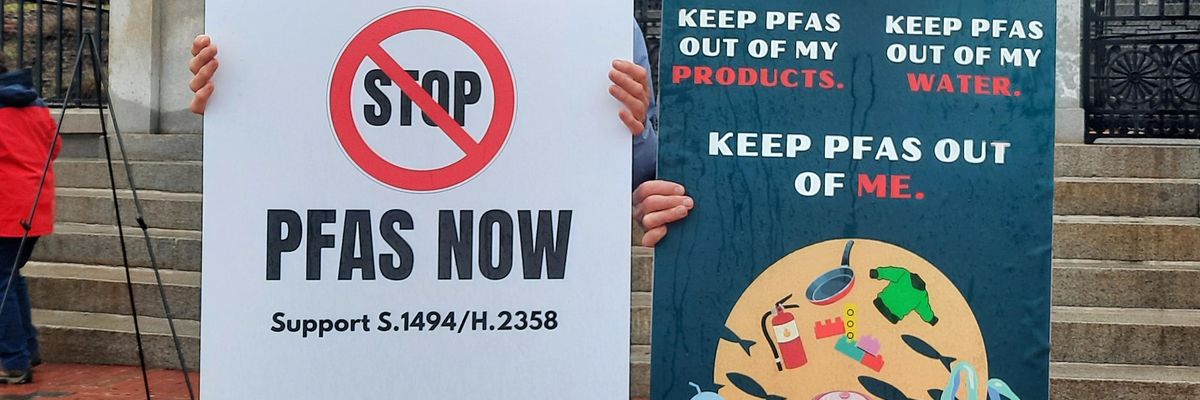
(Photo: Seaside Sustainability Inc./Twitter)
The 200-page draft report issued
by the Rhode Island Department of Environmental Management details where and
how the per- and polyfluoroalkyl substances (PFAS) have tainted locations and
environments around the state.
The investigation is part of a suite of actions from
state officials to respond to the growing number of PFAS detected, as required
by a state law passed in 2022. As of July, Rhode Island water systems are
required to test their drinking supplies for PFAS and report the results to the
state Department of Health (DOH).
According to the latest data from DOH, as of this year 11
water systems have exceeded the
state standard of 20 parts per trillion (ppt), with one additional system
containing PFAS levels in excess of 70 ppt.
PFAS, also known as “forever chemicals,” refer to a wide variety of synthetic chemicals that have existed in common household products for decades. From firefighting foam to floor wax to food packaging, PFAS substances can be found in any product that is grease-, stain- or water-resistant.
The chemicals are known for their hardy ability to
persist in the environment and inability to break down into further components.
It’s their persistence in the environment that’s led to their toxicity; PFAS
substances have been linked to several cancers, fertility issues, and
developmental delays in children, among other little understood health impacts.
“PFAS are one of the world’s most intractable pollutants,
highly complex, and found just about everywhere,” DEM director Terry Gray said
in a statement. “This report consolidates important scientific work on the
extent of PFAS contamination in Rhode Island.”
DEM identified the following areas as sources of PFAS
contamination around the state:
Department of Defense sites: Many locations around
the state that have been used by the U.S military, including the Navy and
National Guard, have had nearby water supplies test positive for PFAS. The
chemicals were often used in aqueous film-foaming foam (AFFF) and in
electroplating activities.
Naval Station Newport, singled out as one of the most
complex Superfund sites in Rhode Island, was historically used in World War II
as a refueling depot for the Navy. A 2.5 million gallon, partially underground
tank farm and fire suppression system is the main source of PFAS contamination
on the base, according to DEM’s report. Other sites of significant
contamination identified include the former Quonset Naval Air Station and
Charlestown Auxiliary Landing Field, thanks to their use as sites for fire training
and emergency response actions.
Are new drugs being properly tested?
The FDA Is Approving Drugs After Fewer Trials and Providing Less Information to the Public
By OREGON STATE UNIVERSITY

While experts agree on the importance of
fast-tracking potentially life-saving treatments, especially for critical
conditions such as cancer, they say their findings point to a need for greater
transparency around how drugs receive approval.
For many drugs that have been tested in
multiple clinical trials, pharmaceutical companies are only required to share
the results from two trials, leaving questions about why they chose those two
for submission and what happened in the other trials, study co-author Veronica
Irvin said.
“We’re not saying that cancer drugs need a
lot more studies; just that they should show all the results or trials that are
completed,” said Irvin, an associate professor in OSU’s College of Health. “It
doesn’t mean they wouldn’t get approved, but it means we’d have a more complete
picture.”
Republicans are more comfortable with lies
Democrats and Republicans have sharply different attitudes about removing misinformation from social media
 |
| Your political leanings go a long way to determine whether you think it’s a good or bad idea to take down misinformation. Johner Images via Getty Images |
Only three weeks after the Biden administration announced the Disinformation Governance Board in April 2022, the effort to develop best practices for countering disinformation was halted because of Republican concerns about its mission. Why do Democrats and Republicans have such different attitudes about content moderation?
My colleagues Jennifer Pan and Margaret E. Roberts and I found in a study published in the journal Science Advances that Democrats and Republicans not only disagree about what is true or false, they also differ in their internalized preferences for content moderation. Internalized preferences may be related to people’s moral values, identities or other psychological factors, or people internalizing the preferences of party elites.
And though people are sometimes strategic about wanting misinformation that counters their political views removed, internalized preferences are a much larger factor in the differing attitudes toward content moderation.
Tuesday, November 14, 2023
Why Is America So Vulnerable to Charlatans Like Trump?
He's a con man, liar, hate-mongerer whose lies have cost at least half a million American lives. Yet his MAGAnuts love him.

When Dustin Thompson was hauled before US
District Judge Reggie Walton for assaulting the Capitol police on January 6th,
his defense lawyer, Samuel Shamansky, argued about Trump:
“You had, frankly,
a gangster who was in power. The vulnerable are seduced by the strong. That’s
what happened.”
The jury didn’t buy the argument and sent
Thompson to prison, as US District Judge Reggie Walton, who was overseeing the
case, said:
“I think our
democracy is in trouble because, unfortunately, we have charlatans like our
former president who doesn’t, in my view, really care about democracy but only
about power.”
 And yet Trump remains popular with about 20 percent of the
American public, making up the majority of the Republican primary-voting base.
But why?
There’s nothing new about charlatans and
confidence men. Marco Antonio Bragadini (1545-1591) was one of
Europe’s most famous: he convinced both a pope and the government of Venice
that he could turn lead into gold and they financed a lavish lifestyle for most
of his life.
William Thompson was America’s first
labeled “confidence man” in New York in the 1840s because he’d approach wealthy
men, pretend they were old friends, and ask them if they had “the confidence”
to give him their gold watch for an hour: many did, and he ran the scam for years
before being busted.
Donald Trump
similarly convinced banks that he was had assets worth ten, twenty, sometimes
more than fifty times their real value as was revealed in court this week. The
self-proclaimed “king of debt” then used his borrowed money to support a
lifestyle that reinforced everybody’s belief that he was truly rich.
After American banks refused to lend Trump money, he and his
good friend Jeffrey Epstein turned to Deutsche Bank
and managed to extract over $2 billion from that institution with the help of
William Broeksmit, Thomas Bowers, and Justin Kennedy.

RIP, Donald Trump's older sister. Here's what she had to say about her brother:
 |
| She was a retired federal judge as well as a good judge of character |
Westerly to Hold Forum on Fate of Potter Hill Mill and Dam
Hopkinton will follow with its own forum at a later date
By Colleen Cronin / ecoRI News
staff
The former textile mill and the dam that used to power it
both fell into disrepair after the mill stopped operations in the 1950s. A
large fire destroyed much of the mill building in the ’70s.
A granite shell, rusted mill equipment, and heaps of
burned debris sit on the property, which is now enclosed by a locked,
chain-link fence, and vegetation permeates the dam.
Last year, the Town Council voted to demolish the old building to
create a recreational area but did not take action on the dam.
Proponents of full or partial removal say getting rid of
the dam, the last on the Pawcatuck River, will allow fish to move freely through the
river, restore wetlands downstream, and remove the hazard caused by
current hydraulics at the dam’s base.
Critics, some of whom are homeowners that live around the
river and mill, have voiced concerns about how lowering the water levels above
the dam may affect their wells and their recreation areas.
Subscribe to:
Posts (Atom)