
Tuesday, January 2, 2024

Protect your dog
Warning – Scientists Uncover Hidden Dangers of Feeding Dogs Raw Meat
By UNIVERSITY OF BRISTOL

E. coli, which can cause food poisoning, is also the UK’s most common cause of urinary tract and bloodstream infections, which can be life-threatening.
Ciprofloxacin belongs to a group of antibiotics called fluoroquinolones, which are used to treat a range of bacterial infections in humans and animals. The World Health Organisation classes these antibiotics among the highest-priority critically important antibiotics.


Robert F. Kennedy Jr. earns Polifact's 2023 "Lie of the Year"
RFK Jr.’s Campaign of Conspiracy Theories Is PolitiFact’s 2023 Lie of the Year
 |
| Credit: Dick Wright, PoliticalCartoons.com / CTNewsJunkie via Cagle Cartoons / ALL RIGHTS RESERVED |
His claims decrying vaccines have roiled scientists and medical experts and stoked anger over whether his work harms children. He has made suggestions about the cause of covid-19 that he acknowledges sound racist and antisemitic.
Bolstered by his famous name and family’s legacy, his campaign of conspiracy theories has gained an electoral and financial foothold. He is running as an independent — having abandoned his pursuit of the Democratic Party nomination — and raised more than $15 million. A political action committee pledged to spend between $10 million and $15 million to get his name on the ballot in 10 states.
Even though he spent the past two decades as a prominent leader of the anti-vaccine movement, Kennedy rejects a blanket “anti-vax” label that he told Fox News in July makes him “look crazy, like a conspiracy theorist.”
But Kennedy draws bogus conclusions from scientific work. He employs “circumstantial evidence” as if it is proof. In TV, podcast, and political appearances for his campaign in 2023, Kennedy steadfastly maintained:
- Vaccines cause autism.
- No childhood vaccines “have ever been tested in a safety study pre-licensing.”
- There is “tremendous circumstantial evidence” that psychiatric drugs cause mass shootings, and the National Institutes of Health refuses to research the link out of deference to pharmaceutical companies.
- Ivermectin and hydroxychloroquine were discredited as covid-19 treatments so covid vaccines could be granted emergency use authorization, a win for Big Pharma.
- Exposure to the pesticide atrazine contributes to gender dysphoria in children.
- Covid-19 is “targeted to attack Caucasians and Black people. The people who are most immune are Ashkenazi Jews and Chinese.”
Monday, January 1, 2024
Maine Bars Trump From Primary Ballot
'He Is Not Qualified':
JESSICA CORBETT for Common Dreams

Despite several ongoing criminal cases, Trump is
currently the Republican front-runner for next year's presidential contest, in
which Democratic President Joe Biden, who beat him in 2020, is seeking
reelection.
The decision in Maine comes just weeks away from the Iowa
caucuses and amid multiple legal battles aiming to boot Trump from ballots for
inciting the January 6, 2021 insurrection—including in Colorado, where the
state Supreme Court disqualified him last week, a decision
that could soon be
reviewed by the U.S. Supreme Court, to which he appointed three justices.
Bellows' move—which will ultimately be decided in the
courts—came in response to three challenges filed to Trump's nomination, two
based on the 14th Amendment and one citing the 22nd Amendment. The former bars
anyone who has taken an oath to the Constitution and then engaged in
insurrection from holding office again, while the latter sets a two-term limit
for presidents.


Anthrobots: not sure if this is good news or bad
Scientists build tiny biological robots from human cells
Tufts University

Three examples of Anthrobots with hair-like cilia in yellow. “It is fascinating and completely unexpected that normal patient tracheal cells, without modifying their DNA, can move on their own and encourage neuron growth across a region of damage,” said Michael Levin. Images: Gizem Gumuskaya
Researchers at Tufts University and Harvard
University's Wyss Institute have created tiny biological robots that they call
Anthrobots from human tracheal cells that can move across a surface and have
been found to encourage the growth of neurons across a region of damage in a
lab dish.
The multicellular robots, ranging in size
from the width of a human hair to the point of a sharpened pencil, were made to
self-assemble and shown to have a remarkable healing effect on other cells. The
discovery is a starting point for the researchers' vision to use
patient-derived biobots as new therapeutic tools for regeneration, healing, and
treatment of disease.
The work follows from earlier research in
the laboratories of Michael Levin, Vannevar Bush Professor of Biology at Tufts
University School of Arts & Sciences, and Josh Bongard at the University of
Vermont in which they created multicellular biological robots from frog embryo
cells called Xenobots, capable of navigating passageways, collecting material,
recording information, healing themselves from injury, and even replicating for
a few cycles on their own.
At the time, researchers did not know if
these capabilities were dependent on their being derived from an amphibian
embryo, or if biobots could be constructed from cells of other species.
In the current study, published in Advanced
Science, Levin, along with PhD student Gizem Gumuskaya discovered that bots
can in fact be created from adult human cells without any genetic modification
and they are demonstrating some capabilities beyond what was observed with the
Xenobots.
The discovery starts to answer a broader
question that the lab has posed -- what are the rules that govern how cells
assemble and work together in the body, and can the cells be taken out of their
natural context and recombined into different "body plans" to carry
out other functions by design?
In this case, researchers gave human cells,
after decades of quiet life in the trachea, a chance to reboot and find ways of
creating new structures and tasks. "We wanted to probe what cells can do
besides create default features in the body," said Gumuskaya, who earned a
degree in architecture before coming into biology.
Two more reasons why vulture capitalists should not own hospitals
Infections and falls more likely at private equity-owned hospitals
Patients at hospitals acquired by private equity firms
saw a 25% increase in adverse events, new research shows.
JAKE JOHNSON for Common Dreams
 |
| Roger Williams Medical Center in Providence is shown in June 2021. (Kenneth C. Zirkel/Creative Commons – https://creativecommons.org/licenses/by-sa/4.0/deed.en) |
EDITOR'S NOTE: These types of problems are evident at
A study published
Tuesday in the Journal of the American Medical Association found
that patients are more likely to fall or suffer infections at hospitals owned
by private equity firms, whose role in the U.S. healthcare system has grown exponentially in
recent years.
The study uses Medicare claims data from between 2009 and
2019 to compare patient complications at private equity-acquired hospitals and
control facilities not owned by private equity. Dr. Sneha Kannan, a critical
care physician and the study's lead author, told The New York
Times that she was surprised by the extent of the difference between
the two.
Patients at private equity-owned hospitals saw a 25.4%
increase in adverse events such as falls and dangerous central-line bloodstream
infections in the three years after the acquisition, according
to the new study—even though the private equity hospitals analyzed in the paper
tended to have younger and lower-risk patients.
Sunday, December 31, 2023
What progress in Charlestown looks like
Charlestown’s 2023 was busy but productive
By Deborah Carney, Charlestown Town Council President

The Town Council and the town’s dedicated
staff have had a busy and productive year!
We improved transparency and open government by holding two regular monthly meetings of reasonable length instead of one lengthy meeting, permitting more in-depth review of agenda items.
We now
require detailed minutes instead of a cursory reporting, to provide informed
transparency and historical recording.
We returned a voice to the people of Charlestown by reinstating the Charter Revision Advisory Committee to a “standing committee,” providing a vehicle for residents to seek charter changes.
The committee’s recommendations/suggestions for changes are due this
spring. The council will then decide which recommendations should be placed on
the ballot for the voters.
The council established an Ordinance Review Ad Hoc Committee to review and update Charlestown’s ordinances, some of which are outdated, unconstitutional or in violation of state law.
This comprehensive
review, with the assistance of General Code, is the first in approximately 20
years and was sorely overdue.
Through the Town Council Rules and
Procedures, the council also guaranteed all councilors equal rights to place
items on an agenda, without veto, reversing prior policy.
The Town Council contracted with Charlestown Ambulance Rescue Service, which, beginning in July of 2024, will provide critical funding for continued high-quality emergency services.
This
arrangement alleviates residents from paying directly for emergency services
and ensures that CARS remains adequately staffed 24 hours a day, seven days a
week.
The Town Council and town staff are
collaboratively examining possible improvements to provide safer travel for
pedestrians and bikers along Charlestown Beach Road. No decisions have yet been
made and all suggestions will be considered.
Recent discussions in Charlestown have centered on the required Ninigret Park Master Plan Update, which is five years past due. Contrary to online postings, the Town Council has not yet received the updated plan from the design consultant.
Further, the Town Council has not endorsed any construction plan for Ninigret Park, let alone one for $20 to $30 million, as has been rumored online.
It is important to note that the Master
Plan is simply a planning guideline for possible future park improvements. The
Town Council’s review of the consultant’s suggestions is anticipated to begin
early in 2024.
This upcoming year, the council will also discuss the possibility of Ninigret Park becoming the first stop on a newly created whimsical “Troll Trail,” an installation by internationally known artist Thomas Dambo, which would be sponsored by the South County Tourism Council.
The trolls are proposed to be created by collaboration between the
artist and local tradespersons and would provide a year-round attraction, at no
cost to the town.
In 2023, the council hired a new town
administrator, Jeffrey Allen, Charlestown’s former police chief. Mr. Allen
brings with him a firsthand knowledge and understanding of Charlestown and a
personal interest in working to make Charlestown an even better place to live.
In addition to Mr. Allen, the town also
welcomed newcomers Patrick Gormley, Jill Cuddy, Kristen Hemphill, Jan Lombardo,
Drew Perry, Shirell Perry and Jim Stepalavich to our staff. We said goodbye to
retirees Don Black, Lt. Kevin Kidd, Michele Voislow and Kim Wheeler and thank
them for their dedicated service.
Charlestown’s challenges for 2024 include filling its volunteer opportunities, particularly in its fire districts. For more information visit http://www.charlestownfd.org or send an email to chief@charlestownfd.org.
Affordable workforce rental housing and homeownership for families, in the face
of rising real estate valuations, will continue to be daunting, but must be
addressed.
As always, the Town Council encourages residents to apply for positions on boards and committees, attend Town Council meetings and/or view them via the town’s website at www.Charlestownri.gov.
We encourage our residents to reach out with comments, questions, and suggestions. By working together, we can accomplish many things in 2024.


Shut off the damned phone
Switching off from work has never been harder, or more necessary
Jane Gifkins, Griffith University
 |
| Apple TV+ |
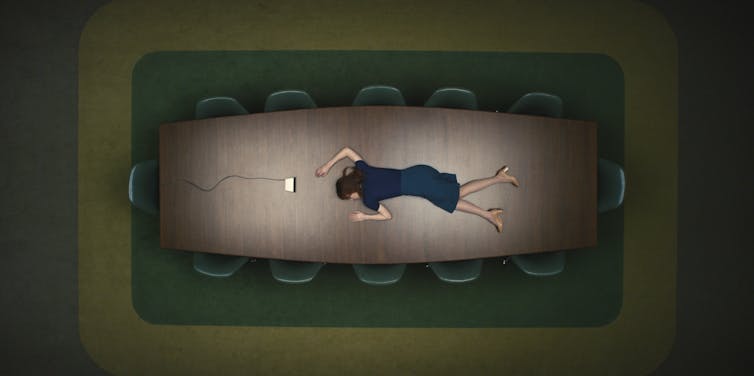
While the show explores the pitfalls of such a split in consciousness, there’s no denying it’s a tantalizing prospect to be able to “flick the off switch” and forget about work whenever you’re not actually supposed to be working.
This is known as “psychological detachment”. People who can do it are happier and healthier, and experience less fatigue. But many of us struggle to detach and disconnect mentally from work, particularly when our jobs are demanding and stressful.
It may not be enough simply to be physically away from work, particularly in an era when so many of us work from home. We also have to stop thinking about work when we’re not there – whether it’s fretting over your to-do list while out at dinner, thinking about your unanswered emails while you’re at your daughter’s soccer game, or lying in bed pondering what you’ll say at tomorrow’s board meeting.
Why Aren’t More People Buying Over-The-Counter Hearing Aids?
Price, confidence, reliability and consumer education all need to be improved

It was around that time that Lin became interested in otolaryngology, the study of the ears, nose, and throat. He would go on to study to be an ENT physician, which, he hoped, could equip him to help patients with similar age-related hardships.
Those aspirations sharpened during his residency at Johns Hopkins University School of Medicine in the late 2000s. Administering hearing tests in the clinic, Lin noticed that his colleagues had vastly different reactions to the same results in young versus old patients.
If mild deficits showed up in a kid, “it would be like, ‘Oh, that hearing is critically important,’” said Lin, who today is the director of the Cochlear Center for Hearing and Public Health at Hopkins. But when they saw that same mild to moderate hearing loss in a 70-something patient, many would downplay the findings.
Yet today, research increasingly suggests that untreated hearing loss puts people at higher risk for cognitive decline and dementia. And, unlike during Lin’s early training, many patients can now do something about it: They can assess their own hearing using online tests or mobile phone apps, and purchase over-the-counter hearing aids, which are generally more affordable their predecessors and came under regulation by the Food and Drug Administration in October 2022.
Despite this expanded accessibility, interest in direct-to-consumer hearing devices has lagged thus far — in part, experts suggest, due to physician inattention to adult hearing health, inadequate insurance coverage for hearing aids, and lingering stigma around the issue. (As Lin put it: “There’s always been this notion that everyone has it as you get older, how can it be important?”) Even now, hearing tests aren’t necessarily recommended for individuals unless they report a problem.
Meanwhile, interest has surged in other consumer audio products that are less expensive than most hearing aids and have features that may help with mild hearing loss: wearable devices like Apple’s AirPods and Sony’s LinkBuds. And this fall, the Consumer Technology Association, a trade group representing the $505 billion U.S. consumer technology industry, released a standard metric for consumer electronics products to report a person’s hearing status.
Saturday, December 30, 2023
What will it take to change Republicans’ minds about the climate crisis?
Nothing.
By MAX TAVES
Rome is burning. Republicans are twiddling their thumbs.
Cartoon by Tom Toles from the Washington Post
Scientists are loathe to give too much significance to
one event, but we’re not talking about one event anymore.
“This is climate change,” Michael Mann, a geophysicist and professor of environmental science at the University of Pennsylvania, put it bluntly.
“We’re seeing it now
in all of its forms in…the wildfires in Canada, what happened in Maui, the
flooding rains that we’re now seeing in California, you see greater extremes at
both ends of the spectrum.”
Just don’t expect these recent disasters — or, for that
matter, a consistent cascade of future precedent-setting fires, floods,
snowstorms, hurricanes or droughts — to move Republicans’ minds about the role
of climate change.
Consider an August analysis from the Pew Research Center.
While the percentage of Democrats describing climate
change as a major threat to the country’s well-being rose from 58 percent to 78
percent over the last decade, the share of Republicans who consider climate
change a major threat barely budged over the same time period, rising from 22
percent to 23 percent, per Pew.
The fact that Republicans’ opinions haven’t changed over
the last 10 years is startling when you take stock of the objective signs of a
changing climate during this same period.
Subscribe to:
Posts (Atom)