Menu Bar

Home           Calendar           Topics          Just Charlestown          About Us

Saturday, January 6, 2024

Maybe this should come in spray form, maybe mixed with Mace

Sniffing women’s tears reduces male aggression

By PLOS 

New research, published on December 21st in the open-access journal PLOS Biology, shows that tears from women contain chemicals that block aggression in men. 

The study led by Shani Agron at the Weizmann Institute of Science, Israel, finds that sniffing tears leads to reduced brain activity related to aggression, which results in less aggressive behavior.

Streaming services use old cable tricks to rip off customers

Pay more, put up with more ads or get less

Kathryn Cramer Brownell, Purdue University

U.S. Sen. John Kerry grills representatives from the cable
industry during a 1990 hearing on consumer protections.
 C-SPAN
There’s one thing that television viewers can count on in 2024: higher fees and more commercials.

The major streaming services – Amazon, Netflix, Hulu, Disney+ and Max – have all announced rate hikes and new advertising policies.

As I show in my new book, “24/7 Politics: Cable Television and the Fragmenting of America from Watergate to Fox News,” the streaming boom that has imperiled cable television is actually built upon the very same business model that made television viewers pay for monthly subscriptions decades ago.

Like their cable predecessors, streaming companies have lured people in with promises of a better and cheaper viewing experience. Now that they have a robust subscriber base, they’re in the process of raising rates while also introducing more commercials and bundling programming to make customers pay more and more.

There is a difference, though. When cable companies tried similar tactics in the late 1980s, there was an uproar from politicians who called such business practices “unfair” to their constituents. Now, there’s nary a peep – a sign of just how inured Americans have become to the whims of corporations trying to squeeze their customers.

Friday, January 5, 2024

Jan. 6 insurrection was an example of networked incitement

Will Trump do it again this year - or has he already begun?


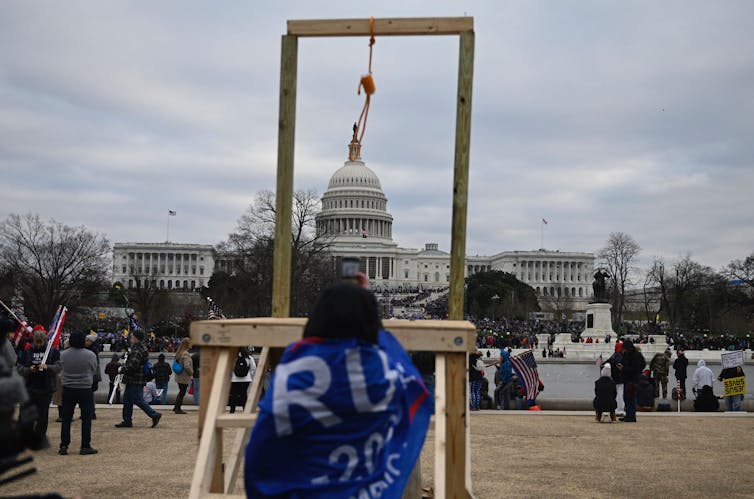
The shocking events of Jan. 6, 2021, signaled a major break from the nonviolent rallies that categorized most major protests over the past few decades.

What set Jan. 6 apart was the defeated president of the United States using his cellphone to direct an attack on the Capitol, and those who stormed the Capitol being wired and ready for insurrection.

My co-authors and I, a media and disinformation scholar, call this networked incitement: influential figures inciting large-scale political violence via social media. Networked incitement involves insurgents communicating across multiple platforms to command and coordinate mobilized social movements in the moment of action.

The reason there was not more bloodshed on Jan. 6 emerged through investigation into the Oath Keepers, a vigilante organization composed mostly of former military and police. During their trials for seditious conspiracy, members of the Oath Keepers testified about weapons caches in hotels and vans, stashed near Washington, D.C. As one member described it, “I had not seen that many weapons in one location since I was in the military.”

2024 election preview: for the country and for Charlestown

By Pat Bagley

Trump's lies about his friendship with Jeffrey debunked

He doesn't want you to see this one, either.


Alarming Study: Smoking Causes Brain Shrinkage

“It Sounds Bad, and It Is Bad”

By WASHINGTON UNIVERSITY SCHOOL OF MEDICINE 

Smoking shrinks the brain, according to a study by researchers at Washington University School of Medicine in St. Louis. 

The good news is that quitting smoking prevents further loss of brain tissue — but still, stopping smoking doesn’t restore the brain to its original size. Since people’s brains naturally lose volume with age, smoking effectively causes the brain to age prematurely, the researchers said.

The findings, published in Biological Psychiatry: Global Open Science, help explain why smokers are at high risk of age-related cognitive decline and Alzheimer’s disease.

Evaluating the truthfulness of fake news through online searches increases the chances of believing misinformation

Surprising study results show limits of using recommended steps to debunk false content

New York University

Conventional wisdom suggests that searching online to evaluate the veracity of misinformation would reduce belief in it. But a new study by a team of researchers shows the opposite occurs: Searching to evaluate the truthfulness of false news articles actually increases the probability of believing misinformation.

The findings, which appear in the journal Nature, offer insights into the impact of search engines' output on their users -- a relatively under-studied area.

Thursday, January 4, 2024

Charlestown Citizens Alliance blames others for its own mistakes

Van Slyke spins the facts about Charlestown

By Deborah Carney, Charlestown Town Council President

Bonnie Van Slyke’s letter to the editor (“Attacks against Charlestown staff need to stop,” Dec. 15) is her latest attempt to try and save the Charlestown Citizens Alliance’s crumbling legacy.  She won’t let the facts stand in the way of spinning her tall tales.

Be honest Bonnie, the CCA made mistakes. Stop trying to convince everyone that things in Charlestown were perfect under the CCA leadership. They were not. As issues come to light, this current Town Council is not sweeping them under the rug. We are addressing them, in public, as we should.

The buck stops with the Town Council, not the staff. The issue is not that there was a mistake, the issue is how you handle the mistake. The CCA handled mistakes by trying to convince people that everything was fine when it was not. Candidates endorsed by Charlestown Residents United face these issues in a transparent manner.

As to the assertions in her letter:

I never said the staff violated the Impact Fee Ordinance.  I said the town violated the ordinance.  That falls on past councils. CCA supporters can claim the impact fees have been handled properly, but no one can seem to find the required documentation for expenditures of this money.

The issue of the legality of an elected Planning Commission has been raised in the past but never decided by the courts.  A recent change in Rhode Island state law provides for applicants to appeal decisions of the Planning Commission directly to the Superior Court. It is highly likely that this issue will once again be raised by an applicant aggrieved by a Planning Commission decision. 

The Charlestown Affordable Housing Commission raised the issue of applications for Accessory Dwelling Units not being accepted by the town and requested the Town Council act upon this matter. The Town Council will hold a public hearing on the ADU ordinance amendments in January.

There was in fact a problem with the payroll, which was evidenced by the fact the council had to transfer a large sum of money to cover the shortfall.  The problem was addressed and corrected, not swept under the rug.

This Town Council is not afraid to discuss town issues in public. Nor will we sweep problems under the rug.  If something is not being done correctly, we will fix it. 

As mistakes come to light, the CCA desperately tries to convince the taxpayers that under their leadership everything was perfect, and they did everything correctly.  They did not.  Stop making statements that aren’t true as you try to divert attention away from what really happened.

To my fellow Charlestown residents, stay tuned, because we have also seen the CCA tall-tale machine spinning with regards to the Ninigret Master Plan Update. The truth will come out on that matter, despite their best efforts to the contrary.

Round and around

By Matt Davies

Yeah, guess which one

Another attempt to explain why people disagree

Rational Riddles: Unpacking the Puzzle of Political Polarization

By PETER DIZIKES, MASSACHUSETTS INSTITUTE OF TECHNOLOGY 

U.S. politics is heavily polarized. 

This is often regarded as a product of irrationality: People can be tribal, are influenced by their peers, and often get information from very different, sometimes inaccurate sources.

Tribalism and misinformation are real enough. But what if people are often acting rationally as well, even in the process of arriving at very different views? 

What if they are not being misled or too emotional, but are thinking logically?

Why Rudy Giuliani can declare bankruptcy while you can’t

He's rich but claims to be broke - and you're not

ROBERT REICH in Robertreich.Substack.Com

Getty Images
Within days of a nearly $150 million judgment against former New York Mayor Rudy Giuliani for defaming Ruby Freeman and Shaye Moss, the election workers Giuliani falsely claimed stole the 2020 election in Georgia for President Joe Biden, Giuliani filed for bankruptcy.

He thereby shielded himself from having to surrender his assets to fulfill the judgment, at least in the near term.

The long term may be quite long. Freeman and Moss may not see a penny of that judgment for many years, and when they do, it’s likely to be far less than $150 million.

One of the most basic of all questions in a market economy is what to do when someone can’t pay what they owe. The U.S. Constitution (Article I, Section 8, Clause 4) authorizes Congress to enact “uniform Laws on the subject of Bankruptcies throughout the United States.”

Congress has done so repeatedly. In the last few decades, Congress’ changes have reflected the demands of the wealthy, giant corporations, and Wall Street banks, which have made it harder for average people to declare bankruptcy but easier for themselves to do it.

Many people are too broke to go bankrupt. Filing for bankruptcy costs money, as does hiring an attorney (which is the best way to make sure you actually get debt relief). Because attorney fees, like other debts, are wiped out in a bankruptcy, most bankruptcy lawyers require clients to pay in full before filing.

Wednesday, January 3, 2024

The Big Lie

Voting fraud is demonstrably a trivially small phenomenon

By Mitchell Zimmerman, frequent Progressive Charlestown contributor

Many of those few cases that were prosecuted led to
convictions against Republicans
This article originally appeared in the Washington Post and is reprinted here with permission of the author

The Dec. 21 front-page article “GOP fraud units fail to find a vast voter plot” devastated phony Republican claims of voter fraud by showing that the efforts of right-wingers to generate evidence of significant voting misconduct have failed. 

Voting fraud is demonstrably a trivially small phenomenon. But the article erred in calling these phony efforts a “crackdown on voter fraud” and in referring to the state agencies as “election integrity units.”

Because voter fraud is insignificant, there was nothing to crack down on. The actual purpose of these units is not election integrity but voter suppression. 

They seek to deter people of color, young people and likely Democrats from voting by raising the specter of prosecution for imaginary violations of election law. 

In Florida, for example, many felons whose voting rights have been restored are nonetheless afraid of exercising their constitutional rights because of threats from these units.

Republicans aren’t disappointed by the laughably small number of prosecutions for voting misconduct because the very existence of these units tends to support the “big lie” and because attacking voting rights is now the leading strategy of the Republican Party. I appreciated this article for revealing the emptiness of this excuse.

Menu choices


Seven ways to beat Trump