Menu Bar

Home           Calendar           Topics          Just Charlestown          About Us

Friday, January 28, 2022

Another reason why guys need to get the shot

NIH-funded research shows infection can affect male fertility.

COVID-19 Vaccination Does Not Affect the Chances of Conceiving a Child

By NATIONAL INSTITUTES OF HEALTH

COVID-19 vaccination does not affect the chances of conceiving a child, according to a study of more than 2,000 couples that was funded by the National Institutes of Health. Researchers found no differences in the chances of conception if either male or female partner had been vaccinated, compared to unvaccinated couples. 

However, couples had a slightly lower chance of conception if the male partner had been infected with SARS-CoV-2 within 60 days before a menstrual cycle, suggesting that COVID-19 could temporarily reduce male fertility. The study was conducted by Amelia K. Wesselink, Ph.D., of Boston University, and colleagues. It appears in the American Journal of Epidemiology.

“The findings provide reassurance that vaccination for couples seeking pregnancy does not appear to impair fertility,” said Diana Bianchi, M.D., director of NIH’s Eunice Kennedy Shriver National Institute of Child Health and Human Development, which funded the study. “They also provide information for physicians who counsel patients hoping to conceive.”

Researchers analyzed data from the Pregnancy Study Online (PRESTO), an internet-based prospective cohort study of U.S. and Canadian couples trying to conceive without fertility treatment. PRESTO is led by Lauren A. Wise, Sc.D., of Boston University.

Thursday, January 27, 2022

Straw Law & Skip The Nips

Two things we can do without

By , Providence Daily Dose

STRAWS: Among the new RI laws that went into effect this month is one designed to limit the use of plastic straws: Bars and restaurants can no longer provide single-use plastic straws unless a customer specifically asks for one. (Anyone wondering why people get so worked up about these plastic straws has clearly not seen the sea turtle video.) 

Reduction is the only way forward: The recycling program turned out to be a cynical diversion perpetrated by the plastics industry and anyway, China has stopped buying our used plastic. We need to address this problem if only out of enlightened self-interest: We sit atop the food chain ingesting these microplastics which are now in your children’s food and tap water.

For example, seafood was estimated to have 1.48 microplastic particles per gram. The recommended weekly seafood intake for young men is 281 grams per week. So according to this, that person would be eating about 414 microplastic particles from seafood alone.

NIPS: A new law aimed at controlling plastic in the environment (as well as drunk driving etc.) is being introduced by Rep. David Bennett (D-Warwick). From the ProJo:

I fell so sorry for them

For more cartoons by Tom Tomorrow, CLICK HERE.


What exactly did she do on January 6?


RI Pension fund hits new record level

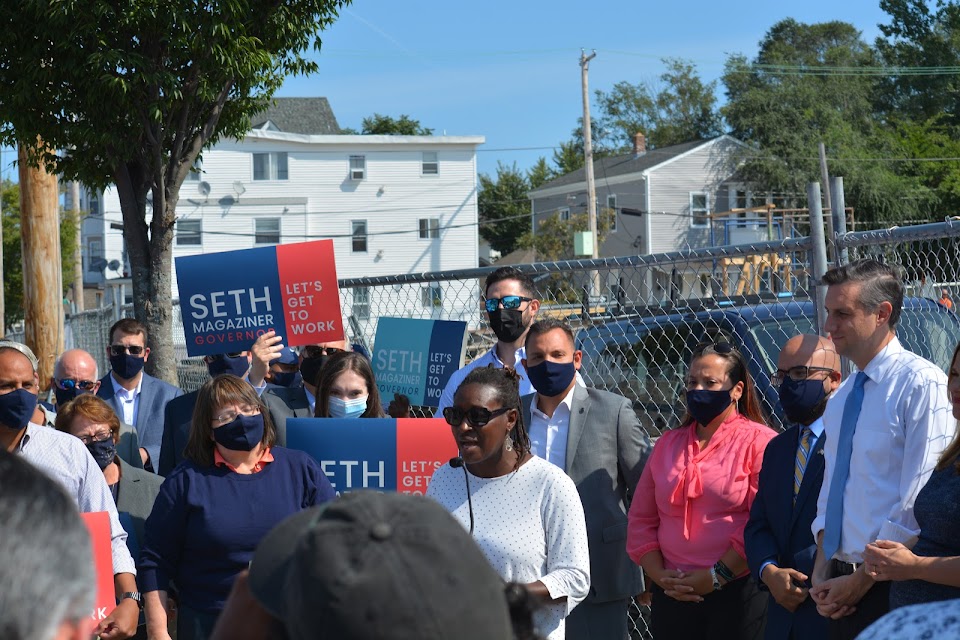
Treasurer Magaziner Announces Pension Fund Reaches New All-Time High of $10.79 Billion

Pension Fund achieves 17.27% annualized return during 2021, the highest annualized return in over a decade 

The Rhode Island pension fund continued its historically strong performance, finishing December 2021 with a new all-time high of approximately $10.79 billion after achieving an annualized return of 17.27% during 2021, the highest calendar year return since 2009.  

“My administration has prioritized strong investment performance for Rhode Island teachers, nurses, and first responders who deserve retirement security as well as all taxpayers who help fund the system,” said Rhode Island General Treasurer Seth Magaziner. “Our 'Back to Basics' investment strategy is helping the pension fund reach historic all-time highs while consistently outperforming our peers, supporting economic opportunity and providing thousands of Rhode Islanders with financial stability.”  

The pension fund’s annualized return of 17.27% significantly outperformed a traditional 60% stock / 40% bond portfolio return of 10.2%. During the month of December 2021, the pension fund grew 3.04%, outperforming a traditional 60% stock / 40% bond portfolio return of 2.3%.   

You have to stick with it

Mediterranean diet associated with a lower risk of mortality in older adults

University of Barcelona


A greater adherence to the Mediterranean diet which had been assessed through an index made with biomarkers during a 20-year scientific monitoring is associated with a lower mortality in adults over 65. 

This is one of the main conclusions of a study led by Cristina Andrés-Lacueva, head of the Research Group on Biomarkers and Nutritional & Food Metabolomics of the Faculty of Pharmacy and Food Sciences of the University of Barcelona (UB) and the CIBER on Fragility and Healthy Ageing (CIBERFES), also formed by the Food Innovation Network of Catalonia (XIA).

Election Police

Check Out the Republican Party's Newest Invention 

By Thom Hartmann for the Independent Media Institute

Republicans have been committing election fraud right out in the open since 1964 and covering it up by yelling about “voter fraud.” 

Remember the hours-long lines to vote we’ve seen on TV ever since the 60s in minority neighborhoods? Those are no accident: they’re part of a larger election fraud program the GOP has used to suppress the vote for sixty years now.

This election year Florida Governor Ron DeSantis is raising the stakes: he’s planning to put together a force of “election police” under his personal command to travel the state intimidating voters while pretending to look for “voter fraud.”

As The Washington Post reports:

“DeSantis is asking the GOP-controlled legislature to allocate nearly $6 million to hire 52 people to ‘investigate, detect, apprehend, and arrest anyone for an alleged violation’ of election laws. They would be stationed at unspecified ‘field offices throughout the state’ and act on tips from ‘government officials or any other person.’”

Meanwhile, the GOP in Texas is quietly recruiting 10,000 white volunteers “courageous” enough to go into Black and Hispanic polling places and confront people trying to vote.  As Jessica Corbett reported for Common Dreams:

“Common Cause Texas on Thursday shared a leaked video of a Harris County GOP official discussing plans to ‘build an army’ of 10,000 election workers and poll watchers, including some who ‘will have the confidence and courage’ to go into Black and Brown communities to address alleged voter fraud that analyses show does not actually exist.”

These efforts to intimidate voters are part of a much larger Republican campaign of widespread and systemic election fraud that the party has been running since the days of Barry Goldwater.  Democrats need to start calling it that.

Individual “voter fraud” doesn’t affect elections in modern America.  Every election year we hear about a handful of people busted for trying to vote twice or in the name of a deceased relative, but it’s so rare it has absolutely no impact on elections and hasn’t at any point in my 70 years on this planet.

Wednesday, January 26, 2022

Radicalization pipelines

How targeted advertising on social media drives people to extremes

Jeanna Matthews, Clarkson University

Many people are led to conspiracy theories and extremist views from less
extreme positions. Robert Nickelsberg/Getty Images
Have you had the experience of looking at some product online and then seeing ads for it all over your social media feed? 

Far from coincidence, these instances of eerily accurate advertising provide glimpses into the behind-the-scenes mechanisms that feed an item you search for on Google, “like” on social media or come across while browsing into custom advertising on social media.

Those mechanisms are increasingly being used for more nefarious purposes than aggressive advertising. The threat is in how this targeted advertising interacts with today’s extremely divisive political landscape. As a social media researcher, I see how people seeking to radicalize others use targeted advertising to readily move people to extreme views.

The secret of success


Free tests


Looking for ways to fix the CRMC

Initial Public Comment Shows Support for CRMC Changes

By ROB SMITH/ecoRI News staff

Photo by Will Collette
Rhode Island residents believe reform is needed for the beleaguered Coastal Resources Management Council (CRMC), according to public comment solicited by the House study commission on the agency. Members of the public recently submitted more than a dozen oral comments and an avalanche of some 100 correspondences to the study commission, all in support of doing something to reorganize CRMC.

“A family in Woonsocket has just as much interest in state waters as any waterfront home or yacht owner,” Matt Behan, a Westerly resident and owner of an eponymous oyster farm, said during a Jan. 19 meeting of the special House commission.

The public comments also took aim at the agency’s leadership. Unlike its counterpart, the Rhode Island Department of Environmental Management, CRMC isn’t technically a cabinet level-agency. All final decisions and application approvals flow through a 10-member voting council, most of them political appointees decided by the governor.

The council has landed CRMC in hot water more than once and has blazed a controversial history for itself by overriding recommendations from agency staff, even though few council appointees have a background in coastal management.

The danger in your pants

Testing finds fluorine—an indicator of PFAS—in women’s sportswear from popular brands like Old Navy and Lululemon.

EHN Staff  

One in four pairs of popular leggings and yoga pants tested have detectable levels of fluorine, an indicator of toxic PFAS, according to a new report from Mamavation.

Partnering with EHN.org, the environmental wellness blog and community Mamavation tested the activewear and found levels of fluorine ranging from 10 parts per million (ppm) up to 284 ppm in eight pairs of leggings and pants, out of 32 tested. EHN.org partially funded the testing and Pete Myers, chief scientist of Environmental Health Sciences, which publishes Environmental Health News, reviewed the findings.

While the testing doesn’t prove per-and polyfluoroalkyl substances (PFAS) are in the products, fluorine is a strong indicator of the “forever chemicals”— which have been linked to everything from cancer to birth defects to lower vaccine effectiveness.

Scolding Russia won’t stop war in Ukraine

Peace cannot be found if the U.S. relies on the self-righteous assertion of principles that our government refuses to apply to itself.

By Mitchell Zimmerman 

As Moscow signals its apparent readiness for war over Ukraine, the U.S. government seems determined to ignore Russia’s not-so-ridiculous concerns over the military alliances of neighboring states and the prospect of nuclear weapons on its borders.

Should Americans worry about our country inserting itself into another war?

Ukraine is far away, and Russia isn’t directly threatening us. Nonetheless, the U.S. intends to arm and support Ukraine if it comes to war, and there can be no certainty whether a proxy war might escalate. Nuclear powers need to tread carefully around each other.

Let’s look at the U.S. response to Russia’s insistence that Ukraine not join NATO, the U.S.-dominated military alliance that Russia wants to keep out of its immediate periphery.

Washington rejects that demand. The U.S. representative at talks with Russia recently declared it to be among America’s “bedrock principles” that there be “no tolerance of overt or tacit spheres of influence, no restrictions on the sovereign right of nations to choose their own alliances.”

Contrary to these noble statements, America has long deemed it a bedrock principle that the United States has a sphere of influence: all of North and South America!

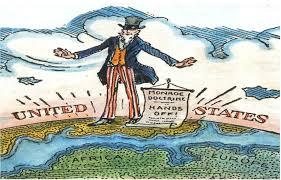
Remember the “Monroe Doctrine” you learned about in high school history? In 1823, President James Monroe warned European nations that the entire western hemisphere was our turf and that they entered it at their risk.

The nature of that risk became all too clear in 1962, when Cuba tried to exercise its “sovereign right” to choose its own alliance.

After the U.S. tried to overthrow its government, Cuba chose to ally with the Soviet Union and let the Russians put nuclear missiles in Cuba. The U.S. response was to bring the world to the brink of nuclear war rather than accept the Soviets’ move into our sphere of influence.

So much for “bedrock principles.”

The U.S. now proclaims it a “bedrock principle” that Ukraine, at least, can make an alliance with whomever they want, Russian sensibilities be damned. But suppose Mexico decided to join the Collective Security Treaty Organization, the Russian-sponsored counterpart to NATO?

Can anyone imagine the U.S. would quietly acknowledge Mexico’s right to do so?

The fact that a country considers it a prerogative to limit the destiny of its neighbors doesn’t make that right, whether it’s the U.S. or the Russians doing it. Ukraine has the right to defend itself, the right to conduct its internal affairs as it pleases, and the right not to be dismembered by a powerful neighbor.

However, it’s a sad reality of international affairs that powerful nations tell themselves that they (but no one else) have the right to meddle in the affairs of weaker neighbors.

Avoiding war doesn’t necessarily mean that the rights and interests of smaller nations have to be abandoned. But practically speaking, the path to peace does require mutual accommodation by all parties.

Finding the right accommodation may not be easy.

It is not unreasonable for the Russians not to want a hostile alliance — and potentially nuclear weapons — along their border. But Russia’s key interests do not reasonably include dismembering Ukraine.

Meanwhile the U.S. is not crazy for wanting Ukraine to be free to connect economically and culturally with Western Europe. But it’s not a key interest, requiring a confrontation between nuclear-armed states, to insist that Ukraine has the “right” to join NATO.

Peace cannot be found if the U.S. relies on the self-righteous assertion of principles that our government refuses to apply to itself.

Mitchell Zimmerman is an attorney, longtime social activist, and author of the anti-racism thriller Mississippi Reckoning. This op-ed was distributed by OtherWords.org.

Tuesday, January 25, 2022

Slyke of Hand, Part 5: Richard Sartor’s piggy bank

And while we’re at it, where’s our THREE MILLION DOLLARS?

By Will Collette

Bonnie Van Slyke is the senior Town Council member representing the Charlestown Citizens Alliance (CCA). I could make a second career out of following up on the banal and inaccurate things she says and “writes” (i.e. that are written for her).

Bonnie is currently campaigning to win public support for a really terrible approach to managing the town’s budget. She would have the Town Council, which the CCA controls by 3-2, carve into stone the un-written status quo policy of the CCA-controlled Budget Commission.

You can sum up that policy as: tax as much as you can, run up huge surpluses and then spend the surplus down on stupid stuff.

For the second time, Van Slyke has put her name to letters to the editor written for her extolling this approach. The CCA calls it “A Robust Plan For Stability And The Capacity To Recover From Major Adverse Events Is Essential.” Van Slyke assumes the CCA’s 3-2 majority will approve it at the February 14 Council meeting.

She says “The discussion has been continued [from January] so that all residents will have ample time to review and digest the issues involved.” That’s actually a lie. The CCA couldn’t get this thing rammed through the Council in January because somebody forgot to include a copy of the Budget Commission’s plan in the agenda packet.

It’s now available HERE.

Despite that SNAFU, all three CCA Council members wanted to approve the Plan at the January meeting anyway. However, they got so much flak from people who logged in for the on-line meeting that they had to back down.

This issue directly affects everyone who pays taxes to the town of Charlestown.

For many years, the town has collected a million+ dollars a year more than they needed to run the town. Rather than adjust the tax rate, the CCA-run Budget Commission and Town Council have come up with faulty, if not down-right stupid, ways to spend down the surplus without ever truly considering giving it back to the taxpayers.

To get into the nitty gritty, I suggest you read Stephen Hoff’s two-part series, “The Charlestown Shell Game (Part 1 HERE and Part 2 HERE).

In fact, the CCA’s enthusiasm for spending other people’s money got so out of hand that town auditors discovered on January 14 that the town actually has $3 million LESS in its surplus than it thought it did. The Budget Commission was outraged and determined to find someone to blame, other than themselves.

How did Charlestown “misplace” $3 million? That’s 10% of the total town budget and cuts the surplus we thought we had by almost half. Again, Stephen Hoff has the breakdown for you HERE.

Van Slyke and Budget Commissioner Richard Sartor want Charlestown to officially adopt the policy of tax-too-much and spend-foolishly even in light of this little $3 million oopsy.

Sartor wants to get the surplus up to around $10 million, a huge amount for a town our size, because he is concerned about impending disaster caused by what he calls “unknown unknowns.” Van Slyke talks about “hurricanes or other disaster.”

We’ve been slammed before and we will be slammed again and again, especially given the effects of the climate crisis. We face an inevitable loss of land over time due to sea level rise.

These things happen, but most municipalities don’t rely on over-taxing their residents just to build up huge surpluses. They buy insurance to cover most exigent circumstances. They make plans coordinated with state and federal officials so they can reasonably predict how much and how quickly aid will arrive after a disaster.

Van Slyke tells a story in her letters that helps us understand her reasoning:

“When I consider what is prudent, I think of the time I rented an apartment on the third floor of a 100-year-old building. The building had no external fire escape and one staircase. The building had survived 100 years; however, I purchased a foldable metal fire escape that could be lowered out a window, hoping that I had planned well enough.”

Well, I’m sure many of us can relate to living in substandard housing, especially when we were young and poor. But I wonder if Bonnie perhaps picked the wrong place to live. Or whether she thought to complain to the landlord or to local housing officials over a likely housing code violation. Then there are smoke detectors and fire alarms.

Finally, there’s insurance. When Cathy and I were first starting out in the early 70s, maybe around the same time as Bonnie, we rented and protected ourselves with rental insurance.

Instead, Bonnie bought a "foldable metal fire escape." I can’t imagine what it cost back then to buy and haul such a thing up three flights of stairs much less how she could have “lowered [it] out a window, hoping that I had planned well enough.”

I looked on Amazon for today’s equivalent of Bonnie’s 3-story folding metal ladder. I found several. The modern version is at least 26 feet long for three stories, weighs more than 50 pounds and is seven feet long and three feet wide when folded. It would have probably filled half a room in a 1970s apartment. It costs $700.

It would be a wonder to behold to watch her get it out the window, unfold it and get it planted on the ground during a fire. Frankly, she'd be burnt to a crisp before she got halfway done.

Whatever, but I think we can all agree this is not a useful analogy for Charlestown’s current financial management issues, although it does describe the CCA’s current and proposed approach to the town's surplus funds - buy a ladder you couldn't possibly use in an emergency.

There are smart ways to manage Charlestown’s money and the taxes levied to accumulate that money. Van Slyke is banging the drum for a plan that involves putting more money than we need in a giant piggy bank and burying it in Richard Sartor’s backyard.

And along the way, maybe another one, two or three million dollars might fall along the wayside.

I'm making up the piggy bank, but all the rest is true. Whether Bonnie's story is true, I don't know, but I directly quoted it the way she wrote it.

Frankly, with their track record, would you let these guys hold your wallet?

How we got here