 |
| For more cartoons by Tom Tomorrow, CLICK HERE |
Wednesday, June 21, 2023

Assembly passes Sen. Gu bill to update green building codes
Another win for Charlestown legislators

“This legislation ensures
Rhode Island’s buildings are built with the future in mind. Using the latest
energy efficiency standards will save consumers and businesses money on their
utility bills while helping us meet our emissions targets,” said Senator Gu
(D-Dist. 38, Charlestown, Westerly, South Kingstown).
The IECC is updated every
three years by the International Code Council through a
collaborative process with contractors, local governments and industry
professionals. But while the IECC was updated in 2021, regulators in Rhode
Island are still following the 2018 standards. The 2024 standards are expected
to be released this fall.


Spraying Poisons to Kill Backyard Ticks and Mosquitos Has Exploded
But Does It Work?
By Frank Carini / ecoRI News columnist

Mosquito Mary, Mosquito Mike, and Mosquito
Joe (I’ve yet to see a Mosquito Frank) are making bank killing insects we
depend on to pollinate the food we eat and the flowers we pick. The poisons
they spray don’t target just mosquitos and ticks; they can kill
indiscriminately, especially when applied improperly.
Market research shows the global mosquito
control market was valued at $793 million in 2021 and is projected to reach
$1.4 billion by 2027, according to a Georgia-based pest control franchise.
Over 20 million Americans struggle to regain smell and taste after COVID
Much depends on the severity of your COVID

During the COVID-19 pandemic, many patients experienced a loss of taste and smell during and after being infected with SARS-CoV-2. A retrospective study by researchers at Massachusetts Eye and Ear, a member of the Mass General Brigham healthcare system, investigated the loss of olfactory and gustatory senses and estimated that about a quarter of Americans who had COVID-19 reported only partial or no recovery of taste or smell. The results are published in The Laryngoscope.
Tuesday, June 20, 2023
Pharma Fights to Preserve the Gravy Train
Companies claim constitutional right to cheat
By Philip Mattera, director of the Corporate Research Project in the Dirt Diggers Digest
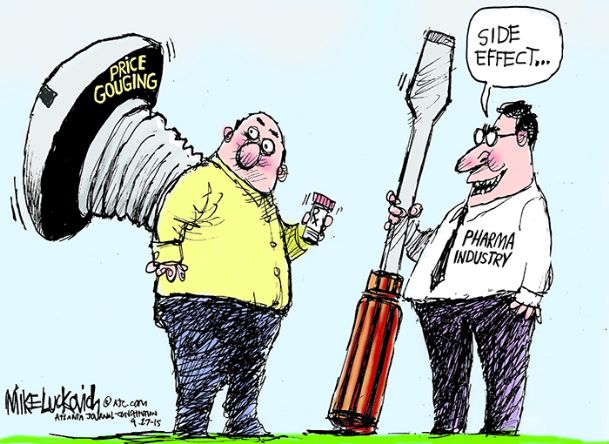
The Inflation Reduction Act included a provision
empowering Medicare to begin negotiating some drug prices in 2026.
One pharmaceutical giant has decided to fight to preserve the gravy train. Merck just filed a lawsuit challenging the law, claiming that the obligation to negotiate is an infringement of its constitutional rights.
The company argues that its Fifth Amendment protection against government
seizure of private property would be violated. It also says that having to sign
an agreement reached after negotiation would trample its First Amendment free
speech rights.
The Fifth Amendment takings argument is a favorite position of conservatives in opposing all manner of government regulation, but the obligation to negotiate prices is not regulation.


Rep. Spears initiatives included in budget
More than one way to get things done

Rep. Tina Spears is applauding significant funding in the Fiscal Year 2024 budget for programs she championed.
“In
my first year as an elected Representative, I brought my experience and energy
to deliver results for my constituents,” said Representative Spears (D-Dist. 36, Charlestown, Westerly, South
Kingstown, New Shoreham). “I’m proud many of the issues I advocated for
are funded by the final budget and will make the lives of Rhode Islanders
better. I thank Speaker Shekarchi and my colleagues in the General Assembly for
their support and my constituents for their confidence in me.”
Representative
Spears introduced several bills to benefit individuals with developmental
disabilities. One bill (2023-H
5996) Representative Spears introduced would remove income limits for
people with developmental disabilities to qualify for Medicaid. Currently, most
individuals with developmental disabilities qualify for Medicaid. But if they
earn more than 250% of the federal poverty level or have more than $10,000 in
savings, they lose their insurance. That, critics say, disincentivizes work and
condemns individuals with disabilities to a life of poverty.
While
the bill did not pass, Representative Spears advocated for its inclusion in the
budget and was successful.
“This
is a huge win for our neighbors with developmental disabilities. No longer do
they need to worry about losing health insurance because they have $10,000
saved for retirement,” Representative Spears said.
A
second bill Representative Spears introduced (2023-H
5633) would increase the personal needs allowance for individuals with
disabilities living in group homes from $20 to $45 per month. That increase was
also included in the budget.
Representative
Spears, along with fellow South County legislator Sen. Victoria Gu (D-Dist. 38, Charlestown, Westerly, South
Kingstown), introduced legislation (2023-S
0516, 2023-H
6119) to increase Medicaid reimbursements for ambulance services. The
budget more than doubles that funding.
Another
issue which Representative Spears advocated for was a sliding scale for state
benefits. Many individuals who qualify for benefits such as child care
assistance, Medicaid or nutritional assistance can be dropped from those
benefits if they get a raise or work too much overtime. That so called
“benefits cliff” often forces workers to limit their income or hours worked,
keeping them in poverty and contributing to short staffing.
Representative
Spears introduced a bill (2023-H
5998) to instruct the Executive Office of Health and Human Services (EOHHS)
to develop a sliding scale so that individuals who make up to 250% of the
federal poverty level would have their benefits reduced slowly rather than face
a cliff. The bill did not pass, but the budget includes instructions for EOHHS
to study the issue and report back to the General Assembly with its findings.
On
the subject of environmental protection, Representative Spears served on the
House Committee on Environment and Natural Resources. She introduced a bill (20023-H
6056) to create a Chief Resilience Officer to help municipalities and state
departments prepare for climate change. That position was created by executive
order and fully funded in the state budget. She also helped create a
commission to study how to reduce plastic waste and litter while increasing the
state’s recycling rate. The commission will also research how best to implement
a so-called “bottle bill.”
“I am really proud of all we were able to get done this
year,” said Representative Spears. “From making housing more affordable for
people of all income levels to protecting our environment to improving health
care delivery, we made significant strides this year on the issues that matter
to Rhode Islanders. I look forward to continuing this work.”
EDITOR'S NOTE: When I worked in DC, I had one job where the main task was getting a piece of legislation passed. It was an amendment to the Surface Mining Control and Reclamation Act that would protect wells from damage from underground coal mining. It had NO chance of passing as a free-standing bill, but it was enacted into law as a rider attached to the annual appropriations bill. Sometimes you do whatever you have to do to get the right thing done. - Will Collette
How chronic stress drives the brain to crave comfort food
Pass the grits
Garvan Institute of Medical Research
.webp)
According to
Sydney scientists, stress combined with calorie-dense 'comfort' food creates
changes in the brain that drive more eating, boost cravings for sweet, highly
palatable food and lead to excess weight gain.
A
team from the Garvan Institute of Medical Research found that stress overrode
the brain's natural response to satiety, leading to non-stop reward signals
that promote eating more highly palatable food. This occurred in a part of the
brain called the lateral habenula, which when activated usually dampens these
reward signals.
"Our
findings reveal stress can override a natural brain response that diminishes
the pleasure gained from eating -- meaning the brain is continuously rewarded
to eat," says Professor Herzog, senior author of the study and Visiting
Scientist at the Garvan Institute.
"We
showed that chronic stress, combined with a high-calorie diet, can drive more
and more food intake as well as a preference for sweet, highly palatable food,
thereby promoting weight gain and obesity. This research highlights how crucial
a healthy diet is during times of stress."
Supreme Court affirms tribal rights
Supreme Court affirms Congress’s power over Indian affairs, upholds law protecting Native American children
 |
| Wiping away tears, Nita Battise, vice chairperson of the tribal council of the Alabama-Coushatta Tribe of Texas, reacts to the Supreme Court ruling upholding a law that gives Native American families priority in adoptions and foster care placements of tribal children. Mandel Ngan/AFP via Getty Images |
Tribal leaders praised the decision as upholding the basic constitutional principles governing the relationships among Native nations and the federal government.
Congress originally passed the Indian Child Welfare Act in response to requests from tribal leaders, and other advocates for Native Americans, to stop state governments from removing an alarming number of Native children from their families.
Before the law took effect, state social welfare agencies were removing between 25% and 35% of all Native American children, and 90% of those removed were sent to be raised by non-Native families.
The Indian Child Welfare Act recognizes the government-to-government relationship Native American nations have with the United States. It covers certain child placements and sets uniform standards for state and tribal courts to follow when they decide American Indian child welfare cases.
These standards include provisions that ensure that tribal governments are aware of and can have a say in the placement of Native American children. They aim to reduce the trauma of family and tribal separation by instructing courts to make active efforts to keep families together.
In 2017, the state of Texas and non-Natives seeking to adopt or foster Native American children challenged provisions of the law. They argued that the law exceeds Congress’ constitutional powers, impermissibly tells state officials what to do, and illegally discriminates against non-American Indians.
Writing for a 7-2 majority, Justice Amy Coney Barrett wrote, “the bottom line is that we reject all of the petitioners’ challenges to the statute.”
As a result of the ruling, Native nations’ most valuable resource – their children – will continue to gain the benefits of growing up knowing their own Indigenous cultures and communities.
Monday, June 19, 2023


URI kinesiology researchers seek participants for exercise research
Study aims to capture public’s feelings about physical activity

Researchers in the University of Rhode Island Department of Kinesiology are seeking participants for a research study that examines psychophysiological responses to visual stimuli portraying different types of physical activities. The study will contribute to the scientific understanding of how people feel about exercising.
The research, which has been approved by the URI
Institutional Review Board, is being conducted by Assistant Professor Mark
Hartman and his graduate students. They are looking to recruit healthy adults
ages 18 to 45 who are fluent in English. The study involves one visit for about
45 minutes to the kinesiology lab located in Independence Square on the
Kingston Campus.
Subscribe to:
Posts (Atom)