 |
| For more cartoons by Jen Sorenson, CLICK HERE |
Tuesday, December 28, 2021

Long Covid is Pitting Patients Against Doctors.
That’s A Problem.

(LYDIA ZURAW/KHN ILLUSTRATION; GETTY IMAGES)
As of this month, nearly 250 million people around the world have recovered from Covid-19. But here, the word “recovered” refers only to the acute phase of the illness. Somewhere between 10 and 40 percent of Covid patients continue to experience symptoms several weeks to months after falling sick, a nebulous condition now referred to as post-Covid condition, or long Covid.
In long Covid, we are witnessing the emergence of a legitimate new illness, officially recognized by the World Health Organization’s International Classification of Diseases. Because it is difficult to diagnose and treat, however, long Covid has also become a subject of contention between the people who suffer from it and the health care professionals charged with treating them. Long Covid patients have described feeling dismissed and “gaslit” by doctors who seem to question their illness — or who seem at a loss for what to do about it.
Understandably, then, many long Covid sufferers have turned to patient and advocacy support groups for solutions. As physicians ourselves, we know that patient groups can provide needed social and emotional support, especially to patients who feel alienated and unheard by medical professionals.
But we also know they can be cauldrons of misinformation — and feeding grounds for snake-oil salesmen hawking unproven treatments. And so it’s critical that patients and health care professionals find ways to work with, rather than against, each other in the effort to find solutions for long Covid. Otherwise, the problem is destined go from bad to worse.
The task is made difficult by the fact that we know so little about long Covid. Although the condition is frequently marked by symptoms including fatigue, headaches, muscle pain, and “brain-fog,” laboratory tests and physical examinations of long Covid patients may show nothing out of the ordinary.
As a result, long Covid has drawn comparisons with so-called contested illnesses, such as myalgic encephalomyelitis (also known as chronic fatigue syndrome) and fibromyalgia, whose legitimacy are questioned by the medical profession.
There is even some evidence that some cases of long Covid may be caused by something other than Covid-19. A recent study found that patients who believed they’d been infected with Covid-19 — but hadn’t confirmed that status with testing — tended to report more symptoms of long Covid than patients who were confirmed with blood tests to have actually had Covid-19.
Collectively, this doubt and ambiguity has contributed to a potentially adversarial relationship between doctors and patients. Headlines like the one for a recent story in The Atlantic, “Long-Haulers Are Fighting for Their Future,” have only contributed to the combative tone.
But it would be unfair to say that the medical community has entirely dismissed long Covid. Substantial amounts of effort and funding are now being put into long Covid research. The National Institutes of Health has announced more than a billion dollars of new funding for a program that will, among other things, follow a cohort of Covid-19 patients over time to track the evolution of long Covid symptoms and hopefully elucidate the biology of the condition.
Similar research efforts are being mounted in other countries as well. In time, these efforts will help us more clearly understand the hallmarks of long Covid and develop best practices for treating it.
For now, however, the illness remains shrouded in unknowns, and there’s a legitimate concern that misinformation will fill in the gaps — as it seemingly has with almost everything Covid-19 related so far. Already, we have personally seen pseudoscientific groups claiming, without evidence, to have knowledge of how to treat long Covid. We have seen discussions about unproven treatments like extreme diets and ivermectin pop up frequently on long Covid social media boards. The misinformation seems to be spreading almost as fast as the disease itself.
Fortunately, there are steps that can be taken to mend the budding rift between long Covid patients and health care professionals — hopefully in time to stop the wave of misinformation before it crests.


Matunuck Oyster Bar serves up maybe the best class ever to URI students
Students savor sustainable bounty from sea during adventurous tasting dinner
 |
| URI students David Fiedorczyk and Julianna Cleary enjoy seafood delicacies at Matunuck Oyster Bar as part of the fall Honors Colloquium, “Sustaining our Shores.” URI photo by Nora Lewis |
Seafood is scary to many kids (and adults) in the United States, but when prepared well, it is both nutritious and delicious. Also, the ocean’s bounty from fishing is much more diverse than most people realize, according to the organizers of this fall’s recently concluded University of Rhode Island Honors Colloquium, “Sustaining Our Shores.”
To use the sea in a more sustainable way and improve our health, people need to be more adventurous and open-minded about the type and taste of marine life they consume, say colloquium coordinators J.P. Walsh and Andrew Davies. In short they say, we should eat everything we catch from the ocean and farm.
As
part of the colloquium, students were invited to a seafood tasting at Matunuck
Oyster Bar and Grill. That November night, sophomore pharmacy student David
Fiedorczyk said his favorite seafood was fried calamari (squid).
URI students, faculty, administrators and staff enjoy the seven-course
dining experience. URI photo by Nora Lewis
But
that was before the Easton, Massachusetts, resident
and 15 of his fellow students were introduced to delectable, sustainable and
healthy seafood offerings at the renowned Rhode Island restaurant owned and
operated by URI alumnus Perry Raso.
After tasting a chilled seafood salad, which consisted of wood-grilled local squid, steamed mussel, baby fennel, ruby red grapefruit, dill and toasted spice vinaigrette, Fiedorczyk had this to say: “The squid tastes healthier than fried calamari and I could taste the squid’s flavor more. This is a great alternative.”
Which comes first?
Your Likely Order of COVID-19 Symptoms Depends on the Variant
By PLOS
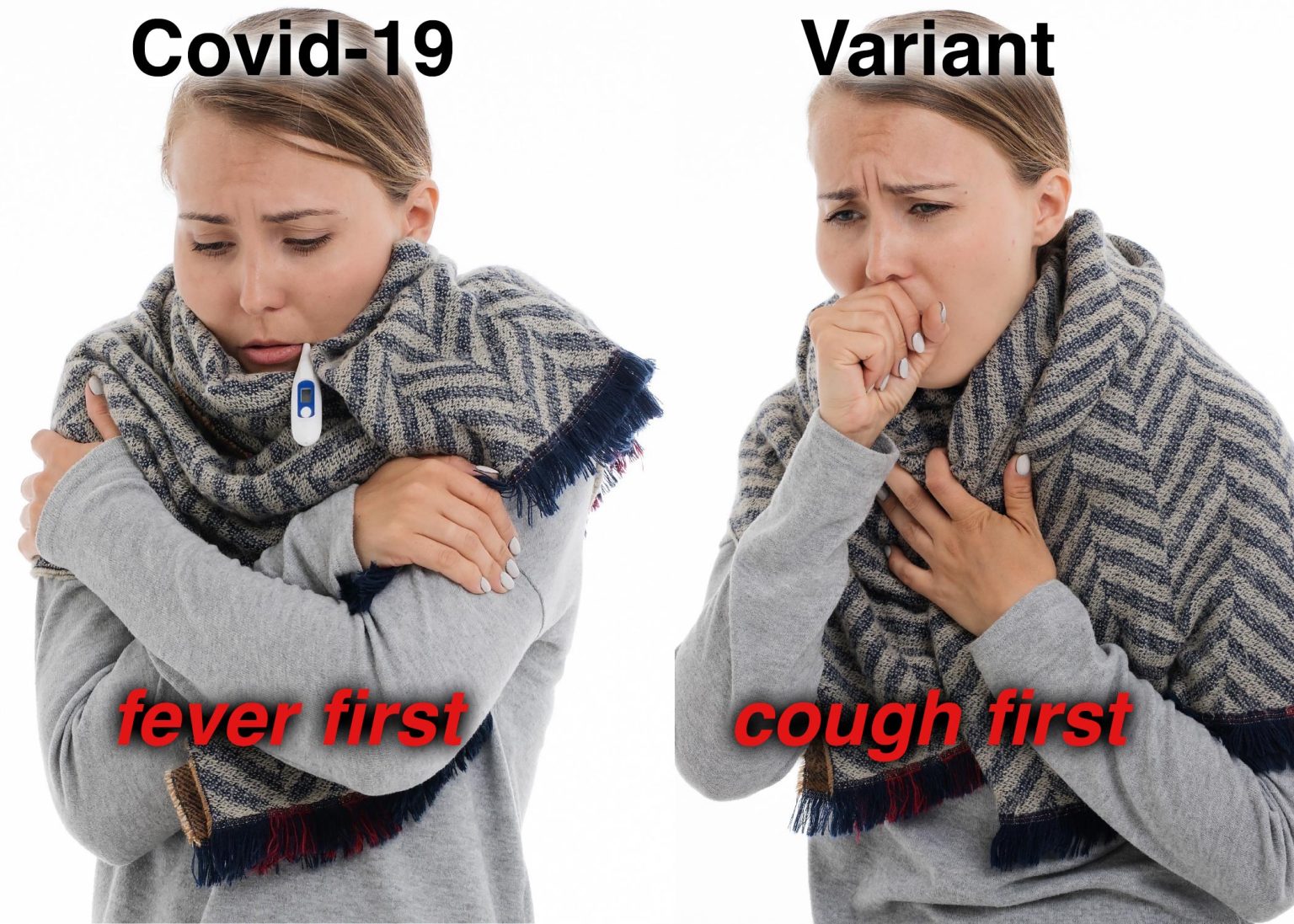
Fever was the most likely first symptom in early cases of COVID-19, whereas cough is the most likely first symptom in more recent D614G variant cases. Credit: Peter Kuhn
The researchers previously developed a mathematical model predicting the order of COVID-19 symptoms based on data from the initial outbreak in China in early 2020.
In the new work, they wanted to know whether the order of symptoms varied
in patients from different geographical regions or with various patient
characteristics. They used their modeling approach to predict symptom order in
a set of 373,883 cases in the USA between January and May 2020.
Surprisingly, the most likely symptom order differed between the initial outbreak in China—where fever most often preceded cough, and nausea/vomiting was a common third symptom—and the subsequent spread to the USA, where cough was most likely to be the first symptom, and diarrhea was a more common third symptom.
By analyzing additional data from Brazil, Hong Kong and Japan, the team showed that the different orders of symptoms were associated not with geographic region, weather, or patient characteristics, but with SARS-CoV-2 variants.
Monday, December 27, 2021
Thanks, Gina. Thanks, Dan.
Report: Rhode Island has turned away over $1billion in federal affordable housing funds
By Steve Ahlquist in UpRiseRI
 |
| You know, Dan, more affordable housing would actually help small business |
“From 2014 to 2020, Rhode Island was eligible for up to $1.553 billion in 4 percent tax credit funds, but we only spent $171.4 million, turning away a total of $1.381 billion. That works out to an average of $197.3 million of federal funds turned away each year,” said Dragseth.
“With the
housing crisis roiling Rhode Island, now is not the time to turn down federal
funds allocated to our state to build affordable housing. Rhode Island must act
fast to put in place the policies necessary to maximize the 4% credit federal
funding stream.”
In the report Dragseth
and Bell identify three primary reasons for the state’s failure to access this
federal funding:
1. Insufficient state funding for affordable housing. Until the
very end of 2020, 4% credits only subsidized 30% of construction cost. Thus,
additional subsidies are needed to finance the construction of affordable
housing. Today, even with the 27% boost to a 38% subsidy, some additional state
subsidies are still needed.
2. State affordable housing funds have not been used to help make
4% credit projects work. State funds have typically gone to build affordable housing
units with purely state subsidy and no matching 4% funds – mainly because the
income limits for state subsidies are too high to qualify for 4% funding.
3. Simply relying on the private market to take advantage of this
program does not work because markets are not perfectly efficient. The
assumption that private corporations will appear to take advantage of every
opportunity does not happen in reality. In general, developers avoid utilizing
4% credits because they can make more money devoting their time and energy to
building higher income housing.

Same crap, different name
Facebook became Meta – and the company’s dangerous behavior came into sharp focus in 2021: 4 essential reads
Eric Smalley, The Conversation
 |
| Facebook renamed itself Meta in 2021, but the year was more notable for revelations about the company’s bad behavior. AP Photo/Tony Avelar |
Growing concerns about misinformation, emotional manipulation and psychological harm came to a head this year when Haugen released internal company documents showing that the company’s own research confirmed the societal and individual harm its Facebook, Instagram and WhatsApp platforms cause.
The Conversation gathered four articles from our archives that delve into research that explains Meta’s problematic behavior.
Got Zoom fatigue?
Out-of-sync brainwaves could be another reason videoconferencing is such a drag
 |
| Conversation in person usually feels effortless. Conversation over video? Not so much. nensuria/iStock via Getty Images |
Zoom was how I enjoyed trivia nights, happy hours and live performances. As a university professor, Zoom was also the way I conducted all of my work meetings, mentoring and teaching.
But I often felt drained after Zoom sessions, even some of those that I had scheduled for fun. Several well-known factors – intense eye contact, slightly misaligned eye contact, being on camera, limited body movement, lack of nonverbal communication – contribute to Zoom fatigue. But I was curious about why conversation felt more laborious and awkward over Zoom and other video-conferencing software, compared with in-person interactions.
As a researcher who studies psychology and linguistics, I decided to examine the impact of video-conferencing on conversation. Together with three undergraduate students, I ran two experiments.
The first experiment found that response times to prerecorded yes/no questions more than tripled when the questions were played over Zoom instead of being played from the participant’s own computer.
The second experiment replicated the finding in natural, spontaneous conversation between friends. In that experiment, transition times between speakers averaged 135 milliseconds in person, but 487 milliseconds for the same pair talking over Zoom. While under half a second seems pretty quick, that difference is an eternity in terms of natural conversation rhythms.
We also found that people held the floor for longer during Zoom conversations, so there were fewer transitions between speakers. These experiments suggest that the natural rhythm of conversation is disrupted by videoconferencing apps like Zoom.
The Covid Death Count No One Knows About
Workers Who Died from the Infection Remain Invisible to the Government
By
Good news! Fake news? According to the Bureau of Labor
Statistics, the year 2020 also known as the year of Covid was a great year for
worker safety.
Sophia Foster-Dimino
2020 Census of Fatal
Occupational Injuries (CFOI) data released Thursday show,
“There were 4,764 fatal work injuries recorded in the United States in 2020, a
10.7% decrease from 5,333 in 2019.” That’s the lowest number since 2013!
And
if you only read the first few paragraphs and charts, you’d actually believe
that 2020 a great year for workers; time to declare victory and go home.
But
not so fast. Recork the champagne. One detail the bureau failed to examine — a
failure only mentioned below the main headlines at the bottom of the first page
of the press release — was worker deaths due to Covid.
According
to the bureau :
CFOI
reports fatal workplace injuries only. These may include fatal workplace
injuries complicated by an illness such as Covid. Fatal workplace illnesses not
precipitated by an injury are not in scope for CFOI. CFOI does not report any
illness-related information, including Covid.
That
means if you were so sick with Covid that you got dizzy and fell off a ladder,
your death was counted. Otherwise, you don’t count.
Removing
the bureaucratese, what we are viewing here is a tragedy laid upon a tragedy:
The thousands of workers who died bravely working through the greatest pandemic
in American history are essentially invisible.
Sunday, December 26, 2021
Psst: You want to know what’s really driving inflation?
It's not what the Fed thinks it is

Translated:
Powell and the Fed are about to slow the economy — even though we’re still at
least 4 million jobs short of where we were before the pandemic. And even
though, as a result, millions of American workers won’t get the raises they
deserve.
That’s a big
mistake. Powell’s medicine has nothing to do with the real reason for
inflation: the increasing concentration of the American economy into the hands
of a relative few corporate giants with the power to raise prices.
If markets were
competitive, companies would keep their prices down in order to prevent
competitors from grabbing away customers. But they’re raising prices even as
they rake in record profits. How can this be? The answer is they have so much
market power they can raise prices with impunity.
The underlying
problem is not inflation. It’s lack of competition. Corporations are using the
excuse of inflation to raise prices and make fatter profits.
In April,
Procter & Gamble announced it would start charging more for consumer
staples ranging from diapers to toilet paper, citing “rising costs for raw
materials, such as resin and pulp, and higher expenses to transport goods.”
That was
rubbish. P&G continues to rake in huge profits. In the quarter ending
September 30 (after its price increases went into effect) it reported a
whopping 24.7 percent profit margin. It even spent $3 billion during the
quarter buying back its own stock.


URI Research Foundation awarded Build Back Better Regional Challenge grant, will lead regional coalition to grow ‘blue economy’
$500K phase one planning grant makes Rhode Island eligible for up to $100M in challenge next phase

The award is designed to help communities revitalize their economies through the development of new industry clusters or by scaling up existing clusters.
The URI Research Foundation’s proposal focuses on Rhode Island’s natural advantages and the density of cross-sector excellence to advance a variety of new “blue” technology capabilities while addressing historically excluded populations and proposing strategies to address economic disparities across the state.
Rhode
Island is now one of 60 finalist applications out of 529 total that were
submitted to receive a phase one planning grant of $500,000 to develop and
support three to eight distinct and meaningful projects to grow the cluster.
Fourth U.S. COVID vaccine is on the way
New Novavax COVID-19 Vaccine Found To Be Safe and Effective in Trial
By UNIVERSITY OF MARYLAND SCHOOL OF MEDICINE

In the study,
researchers recruited nearly 30,000 adult volunteers at 113 clinical sites in
the United States and six sites in Mexico. Approximately 20,000 participants
received two doses of the vaccine spaced three weeks apart and 10,000 received
placebo. In addition to being highly effective in preventing COVID illness of
any severity, the vaccine was 100 percent effective in preventing moderate and
severe disease that required hospitalization.
During the first few
months of 2021 when the study was conducted in the U.S. and Mexico, the
predominant circulating strain was Alpha. The assessment did not include Delta
or Omicron, the newest variant of concern, which had not begun to circulate.
Most side effects were
mild to moderate and transient. Fever was very rare. The most common side
effects in the vaccine recipients included pain and tenderness at the injection
site, headache, muscle aches, and fatigue that lasted a day on average. None of
the recipients developed serious reactions like heart inflammation
(myocarditis) or blood clots.
Subscribe to:
Posts (Atom)