Menu Bar

Home           Calendar           Topics          Just Charlestown          About Us

Thursday, February 24, 2022

Why Trump Can't Be Ignored

He Must Be Held Accountable

By Thom Hartmann for the Independent Media Institute


Violent behavior on airplanes has reached such epidemic proportions that the President of Delta Airlines last week asked the Department of Homeland security to allow the airlines to submit passengers who have terrified or otherwise abused flight crews for placement on the government’s no-fly list.

This is a symptom of the much deeper problem: Donald Trump has planted authoritarianism across America like some kind of bizarre Johnny Appleseed, and only his humiliation and conviction will pull it out by the roots.


Eight Republican senators have now come forward to defend the air-crew abusers, as astonishing as that may seem.  In doing so, they’re making common cause with thousands of authoritarian followers who’ve adopted Donald Trump as their behavioral role model.


Why would eight GOP senators support abusers on airplanes?  Because these senators also view Trump as their own personal role model and believe they draw power, prestige and safety from their association with him.  They, like the people abusing flight crews, are authoritarian followers.


This explosion of “air rage” is a symptom of a much larger problem in contemporary America, one we may be on the edge of resolving.


A June, 2021 Morning Consult poll found that about 26 percent of Americans now embrace authoritarian leanings, about twice the proportion found in other democratic nations.  The reason, I believe, is that Donald Trump has socially encouraged and authorized their behavior, resulting in a nationwide acceptance and amplification of antisocial activities. 


No joy for Chuck

For more cartoons by Ted Rall, CLICK HERE.


Choice


All of South County's "local" newspapers are owned by one company


URI Theatre throws a party with Shakespeare’s riotous ‘Twelfth Night’

Spring semester opener starts March 3

Tony LaRoche

Carleigh Boyle (Olivia), left, and Peace Onyeme (Duke Orsino), right, compete for the hand of Riley Nedder (Viola/Cesario). (URI Photos by Jesse Dufault)

Two years into a pandemic, there’s probably no better time for a full-on party – a riotous, romantic comedy full of music, mistaken identity, separated and reunited twins, a bevy of clowns, and a love triangle that may be more of a quadrangle.

The University of Rhode Island’s Theatre Department fits the bill with Shakespeare’s “Twelfth Night,” which opens Thursday, March 3, in J-Studio in the Fine Arts Center, 105 Upper College Road, on the Kingston Campus. (Audience members are required to wear masks inside the Fine Arts Center.)

Believed to have been written around 1601 for the final night of the annual Twelve Days of Christmas festival, the play echoes the craziness of the holiday. Twins Viola and Sebastian are separated by a shipwreck that strands them on the seacoast of Illyria. Fearing her brother has drowned, Viola disguises herself as “Cesario” to find work as one of Duke Orsino’s manservants.

In the Duke’s court, Viola’s alter ego, Cesario, becomes Orsino’s go-between in professing his love to Countess Olivia. Olivia is mourning the death of her brother but nonetheless falls for Viola disguised as Cesario. And Viola becomes smitten with the Duke. Adding to the craziness, Olivia’s pompous steward, Malvolio, is fooled into believing Olivia is actually in love with him.

Mental speed hardly changes over a lifespan

Study shows that the speed of cognitive information processing remains largely stable over decades

Heidelberg University

Mental speed -- the speed at which we can deal with issues requiring rapid decision-making -- does not change substantially over decades. Psychologists at Heidelberg University have come to this conclusion. 

Under the leadership of Dr Mischa von Krause and Dr Stefan Radev, they evaluated data from a large-scale online experiment with over a million participants. 

The findings of the new study suggest that the speed of cognitive information processing remains largely stable between the ages of 20 and 60, and only deteriorates at higher ages. 

The Heidelberg researchers have hereby called into question the assumption to date that mental speed starts to decline already in early adulthood.

"The common assumption is that the older we get, the more slowly we react to external stimuli. If that were so, mental speed would be fastest at the age of about twenty and would then decline with increasing age," says Dr von Krause, a researcher in the Quantitative Research Methods department headed by Prof. Dr Andreas Voß at Heidelberg University's Institute of Psychology. 

In order to verify this theory, the researchers reevaluated data from a large-scale American study on implicit biases. In the online experiment with over a million participants, subjects had to press a button to sort pictures of people into the categories "white" or "black" and words into the categories "good" or "bad." 

According to Dr von Krause, the content focus was of minor importance in the Heidelberg study. Instead, the researchers used the large batch of data as an example of a response-time task to measure the duration of cognitive decisions.

Survey sheds light on how Rhode Island employers are responding to COVID-19

Have worker shortages resulted in better pay and benefits?

By Andy Boardman in UpRiseRI


As Rhode Island continues to contend with the COVID-19 pandemic, how are employers responding?

New data sheds light on this question, offering insights on Rhode Island business activity amid COVID-19 – and how it compares nationwide. The information comes from a recently-published survey fielded in the summer and fall of 2021 by the Bureau of Labor Statistics, providing a nationally-representative snapshot of private-sector practices at that time toward pay raises, remote work, employee vaccination and more. 

Here are three key things to know.

Wednesday, February 23, 2022

Republicans hurry to support Russian dictator and sneer at America

This is who they are

Mark Sumner, Daily Kos Staff

On February 21, Russian authoritarian ruler Vladimir Putin moved additional Russian forces into Ukraine, declaring that two regions in eastern Ukraine were now “independent republics.” On Tuesday, Putin expanded the scope of the new nations he peremptorily formed out of the territory of a neighboring country, setting up an excuse to occupy a much larger area and engage in direct military conflict with Ukrainian government forces. 

In response to Putin’s actions, both the United States and European nations took swift actions. Sanctions have been placed on Russia, making it extremely difficult to finance the country’s debt in international markets. Additional sanctions have been placed on Russian state banks. And, most importantly, completion of the Nord Stream 2 pipeline—a pipeline that would have carried 1.9 trillion cubic feet of natural gas from Russia to Germany each year—has been halted. This pipeline would have been a major source of revenue for Russia, which has an economy that is heavily dependent on export of fossil fuels.

 But as the world unites in opposition to Russian aggression, there is one notable exception: Republicans. From Donald Trump to Mike Pompeo to Josh Hawley, the same people who were in a hurry to overthrow democracy in America are using this moment to support the destruction of a democratic ally.

Trump’s response came during an interview on Tuesday with Trump-supporting podcaster Buck Sexton.

Trump: "I went in yesterday and there was a television screen, and I said, 'This is genius, Putin declares a big portion of the Ukraine, of Ukraine, Putin declares it as independent. Oh, that’s wonderful. I said, 'How smart is that?'”

Genius. Wonderful. Smart. That’s what Donald Trump thinks of Putin’s open seizure of property from a U.S. ally. But Trump didn’t stop there. He expressed a wish that some of those Russian tanks should come here

Trump: “And he’s gonna go in and be a peacekeeper, That’s the strongest peace force… We could use that on our southern border. That’s the strongest peace force I’ve ever seen. There were more army tanks than I’ve ever seen. They’re gonna keep peace all right. No, but think of it. Here’s a guy who’s very savvy."

It’s almost as if Trump believes that the puppet show Putin put on for his state-run media fooled everyone. Oh, gee, golly, we have to let Russia go in there and keep the peace for those poor independent republicans, yup, yup, yup. 

Putin’s attempt to excuse his actions is a sick joke. Much like Trump.

Also on Tuesday, former Secretary of State Mike Pompeo hustled out to sing his praises of Putin and undercut the U.S. position. In fact, he’s doing it so well that Pompeo is getting repeat play on Russian state TV.

Pompeo: “Very shrewd. Very capable. I have enormous respect for him.”

And then there was Hawley. A column from Feb. 3 called Hawley “Putin’s new favorite pet” for adopting Russian talking points and urging the nation to turn its back on Ukraine. Or, as The Kansas-City Star puts it: “Insurrection, racism, appeasement: Call it the Hawley Trinity.”

Hawley’s position—if it can be called a position—can be summed up in these two self-contradictory statements:

Hawley: “We have a strong interest in deterring Russian adventurism. But these interests are not so great that we should commit ourselves to fight Russia over Ukraine’s future.”

Appeasement is the order of the day for most Republicans in both politics and media. Here’s Charlie Kirk to complain about Biden calling it “a peacekeeping operation and invasion” and following it up with what might be the Republican theme song of the day.

Kirk: “Who cares? This is a family dispute between two countries. One rather strong, and one very corrupt and weak.”

Sure. When has it ever been a good idea to stop the strong from beating up the weak? That’s certainly not in the Republican world view.

Tucker Carlson, who has been carrying Putin’s water so long that he has almost (almost) developed a muscle, was reliably there for him on Tuesday, insisting that because Putin didn’t call him a racist or start the pandemic, there’s no reason to be mad at him.

According to Democratic Rep. Tom Malinowski, most Republicans in Congress started out “totally solid on Ukraine” and wanted to push back against Russia. However, “They’re beginning to feel this pressure percolating from their base because [Carlson] is the guy that speaks to more Republicans every day than anyone else in America.”

Carlson’s point is, of course, don’t hate Putin … hate Biden. It’s a point that the House Republicans underscored yesterday when they posted this response to Biden’s speech announcing an initial set of sanctions against Russia, with more to follow.

When they’re not spreading the news that Putin is strong, Biden is weak, and that the United States has no interest in promoting democracy, defending nations against aggressors, or upholding our word to allies, Republicans have taken some time out to make it clear that Ukraine totally deserves it. That “corrupt” that Kirk tossed into his statement was no coincidence. It’s how Republicans are describing Ukraine in statement after statement. And there’s this extraordinary claim from Rep. Marjorie Taylor Greene.

A day earlier, Greene declared that she wanted to impeach Biden for “threatening war with nuclear Russia.”

It’s not that Republicans don’t want a war. It’s that they’re already waging one—against democracy in the United States. This was what was on Steve Bannon’s mind on Tuesday as he grew concerned over how Russia’s invasion might interfere with issues of real importance.

Too late, vaxx-hole


Former Coal Power Site in Massachusetts to Become Offshore Wind Plant

Brayton Point to become green energy hub

E360 DIGEST

The Brayton Point Power Station just after its closure in 2017. MEIHE CHEN VIA WIKIPEDIA

The site of the last coal-fired power plant in Massachusetts will become home to the state’s first offshore wind manufacturing facility, Governor Charlie Baker announced Thursday.

Brayton Point power plant in Somerset was shuttered in 2017 after more than 50 years in operation, the final coal generator to go offline before Massachusetts went completely coal-free.

The site of the former plant, which sits on Mount Hope Bay, near Providence, Rhode Island, will host a $200 million facility manufacturing undersea transmission lines that will connect the grid to wind turbines offshore, beginning with Vineyard Wind’s Commonwealth Wind project, which will generate 1,200 megawatts of electricity, WBUR reported.

“I do think in some respects the industry has bought in to the opportunities associated with wind,” Governor Baker said. “And I think if we continue to play our cards well, we can make a very big investment in the commonwealth and in this region going forward and support a lot of activity in deep water [wind] up and down the Atlantic coast.”

Preventing pandemics costs far less than controlling them

Study projects prevention would be only 5% of the cost

Duke University


We can pay now or pay far more later. That's the takeaway of a new peer-reviewed study, published Feb. 4 in the journal Science Advances, that compares the costs of preventing a pandemic to those incurred trying to control one.

"It turns out prevention really is the best medicine," said Stuart Pimm, Doris Duke Professor of Conservation Ecology at Duke University, who was co-lead author of the study. "We estimate we could greatly reduce the likelihood of another pandemic by investing as little as 1/20th of the losses incurred so far from COVID into conservation measures designed to help stop the spread of these viruses from wildlife to humans in the first place."

A smart place to start, the study shows, would be investing in programs to end tropical deforestation and international wildlife trafficking, stop the wild meat trade in China, and improve disease surveillance and control in wild and domestic animals worldwide.

COVID, SARS, HIV, Ebola and many other viruses that have emerged in the last century originated in wild places and wild animals before spreading to humans, the study's authors note. Tropical forest edges where humans have cleared more than 25% of the trees for farming or other purposes are hotbeds for these animal-to-human virus transmissions, as are markets where wild animals, dead or alive, are sold.

Tuesday, February 22, 2022

A roadmap for Rhode Island to an equitable, worker-centered, green economy

A time of rare opportunity

George Nee and Sheila Dormody

Rhode Islanders don’t have to look far to find evidence of our crumbling infrastructure, deeply unequal economy, or the climate crisis. Luckily, we don’t have to look far for solutions anymore, either.  

With a state budget surplus of $618 million and more than $2.5 billion in federal infrastructure money in our public coffers, Rhode Island is in a strong position to tackle the climate crisis, rebuild our infrastructure, and invest in an equitable economy that works for all. A new report, authored by experts at Cornell University, shows how our state leaders can seize the moment and get it done.    

This timely climate jobs report, developed in consultation with the Climate Jobs Rhode Island coalition, shows how Rhode Island could become the first fully decarbonized state in the nation by outlining a suite of science-backed policy recommendations to create good union jobs, advance racial equity, and build a vibrant and inclusive renewable economy. 

Core provisions of the plan include decarbonizing the state’s K-12 public school buildings, installing 900 MW of solar energy and 1,300 MW of offshore wind energy, and modernizing the state’s electrical grid by 2030.

The report also includes recommendations aimed at slashing emissions from households and municipal buildings, expanding  public transportation, and facilitating a just transition for workers and communities that rely on the fossil fuel sector.  

Climate Jobs Rhode Island—a coalition of unions, environmental groups, and community organizations -that we helped to convene last year, is organizing around this plan. The coalition recently launched a “Green and Healthy Schools” campaign to retrofit, repair, and decarbonize Rhode Island’s aging public schools with the strongest labor and equity standards.

Safety first

By Dave Whamond


Staying, not going


Dozens of concerts to be held in URI Fine Arts Center this spring

Swing, classical music, jazz among offerings on URI Department of Music's spring schedule

By Gianna Cardarelli

The Jazz Big Band will perform a concert to support the fight against breast cancer on March 3 in the Fine Arts Center Concert Hall. (URI Photo by Nora Lewis)

From classic to contemporary music, from jazz big band to the symphony orchestra and concert band, the University of Rhode Island Music Department will present dozens of concerts this spring.

The one thing they have in common is most will be held in the Concert Hall in the Fine Arts Center, 105 Upper College Road, on the Kingston Campus. Many of the concerts are free and open to the public. All concert-goers are required to wear masks inside all URI buildings.

Here is a list of some of the performances that will be presented early in the spring semester. For more information, go to the Music Department’s events website

On Saturday, Feb. 26, the Symphony Orchestra, directed by Ann Danis, will perform an evening of music including works by Mozart and Ellington. The orchestra is made up of URI music students and members of the South County community. The concert starts at 8 p.m. in the Concert Hall. For tickets, click here.

The orchestra’s repertoire will include “Overture to the Wasps” by Vaughn Williams, Mozart’s “Ave Verum Corpus,” Alex Rowley’s “Admiral’s Hornpipe,” and a Duke Ellington medley.

The case for off-shore wind gets stronger

Offshore wind farms could help capture carbon from air and store it long-term

David GoldbergColumbia University

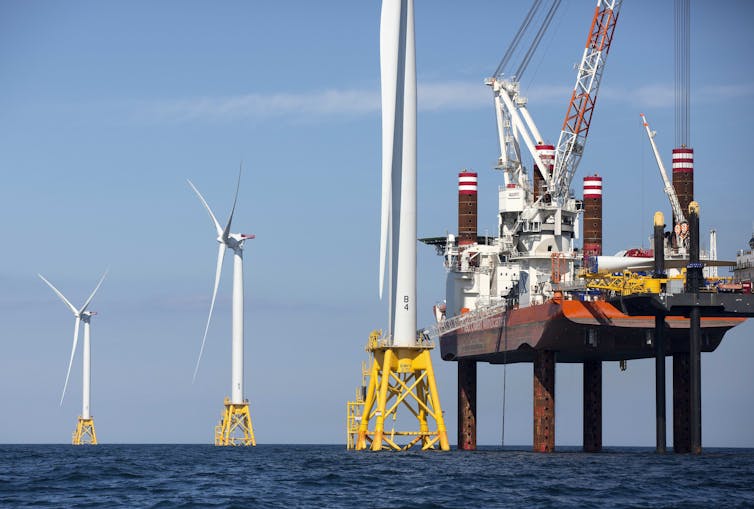
The U.S. had seven operating offshore wind turbines with 42 megawatts
of capacity in 2021. The Biden administration’s goal is 30,000
megawatts by 2030. AP Photo/Michael Dwyer
Off the Massachusetts and New York coasts, developers are preparing to build the United States’ first federally approved utility-scale offshore wind farms – 74 turbines in all that could power 470,000 homes. More than a dozen other offshore wind projects are awaiting approval along the Eastern Seaboard.

By 2030, the Biden administration’s goal is to have 30 gigawatts of offshore wind energy flowing, enough to power more than 10 million homes.

Replacing fossil fuel-based energy with clean energy like wind power is essential to holding off the worsening effects of climate change. But that transition isn’t happening fast enough to stop global warming. Human activities have pumped so much carbon dioxide into the atmosphere that we will also have to remove carbon dioxide from the air and lock it away permanently.

Offshore wind farms are uniquely positioned to do both – and save money.