Menu Bar

Home           Calendar           Topics          Just Charlestown          About Us

Thursday, November 3, 2022

What to do if your vote is challenged on Election Day

If you vote in person, BE PREPARED to defend your right to vote

Karen Figueroa-ClewettUSC Dornsife College of Letters, Arts and Sciences
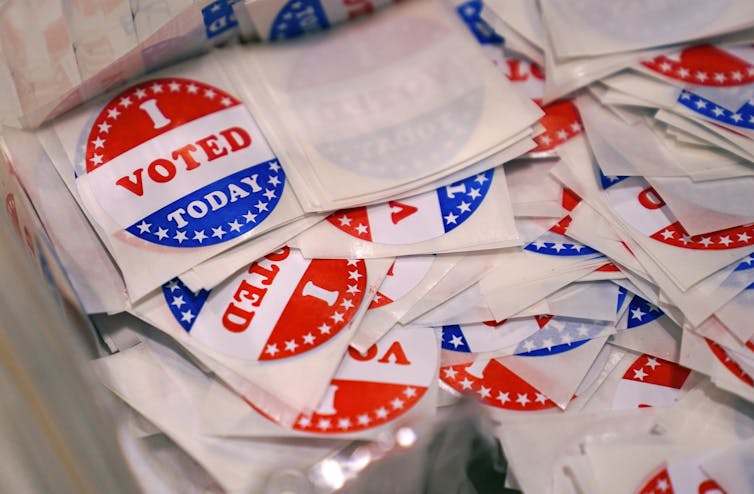
You need to be prepared so you can vote on Election
Day. AP Photo/Charles Krupa
With the general election drawing close, it’s important to know your rights in case your vote is challenged.

The best way to ensure that your vote is counted is to advocate for yourself. 

I’m a civil rights attorney and lecturer for the University of Southern California’s undergraduate civil rights advocacy initiative, Agents of Change. Here are several straightforward ways to ensure your vote is counted and two practical remedies for you to consider if your vote remains challenged.

A major part of ensuring that you are able to vote is doing the necessary preparation before you even get to the polling place.

Are you registered to vote? Check it out

Before you vote, you need to ensure that you’re registered to vote. You can verify your registration status using this tool. If you live in Rhode Island, CLICK HERE.

If you can’t use an online tool, then call your local election office or a voter help line like the ones listed in the hotline section below.

If you find you’re not registered, you can use this tool from the National Conference of State Legislatures to find your state’s online registration application. If you need to do this in person, then call your local election office for instructions.

At this point, you may have missed your state’s deadline for voter registration. But it may not be too late to register.

Many states allow same-day registration at the polling site. You can find your state’s same-day voter laws detailed here. Ask the poll worker, at the correct polling location, for a same-day registration form; complete the form, and then ask for a “conditional ballot.” A conditional ballot allows election officials to count your vote after verifying your voter eligibility. If you can’t research online, you can call your local election office to find out if you can register on Election Day.

Gather documents to verify your identity

Voter ID laws generally cover in-person voting, not absentee ballots or mailed ballots.

If you live in a state that requires identity verification to vote in person, gather the required documents – which may range from driver’s licenses to bank statements with identifying information – before traveling to the correct polling place. You can find your county election office’s contact information here. This webpage includes a table listing each state’s acceptable ID documents and possible exceptions for some folks. You may also call your local election office to find out what’s required.

Find the correct polling location

Charlestown's voting districts have changed due to the 2020 Census. You should have received a card from the town's Board of Canvassers telling you where you should go.

You can ensure that you’re headed to the right polling place with this tool. Or call your county election office to find your polling place and its hours of operation; you can look up your county’s election office contact information here.

Once you know your polling place and its hours, you can go there and check in. In most cases, you’ll be handed a ballot, shown where to vote and asked to put your ballot in a machine or a box, and then you can go merrily along your way.

But the moment of check-in is where things might go wrong.

Problems at your polling place

Here are potential vote challenges and ways to overcome them.

Possibility #1: Out-of-order polling machines.

If you’re asked to leave because of malfunctioning machines, don’t. Instead, ask for a paper ballot.

Possibility #2: You’re in line and officials announce the polls have closed.

If you’re in line at the polling location before it closes, don’t let them turn you away at closing time if you haven’t voted. You have the legal right to vote under those circumstances, so stay in line and wait to cast your ballot.

Possibility #3: You’re not on the registered voters list.

If you’re told you can’t vote because your name is not on the voter roster, ask the poll site worker to check again and to check what’s called the list of supplemental voters. If they still can’t find your name, ask the poll worker to verify that you’re at the right location.
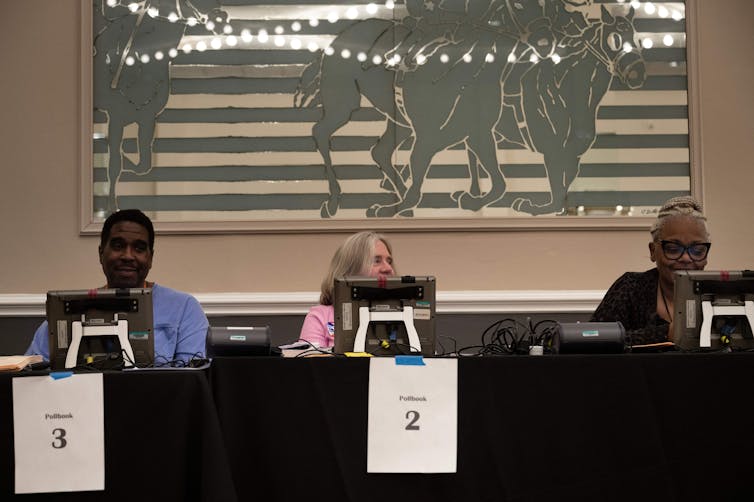
Three people sitting at computer screens at a table with a black tablecloth on it
Poll workers want you to vote. But sometimes there
are problems.
 
Brendan Smialowski/AFP via Getty Images

Possibility #4: Someone claims you shouldn’t be allowed to vote.

If your voting eligibility remains challenged after ensuring you’re at the right polling location, ask to cast a provisional ballot, which is available in every state except Idaho and Minnesota. You can find details about your particular state’s provisional ballot rules here.

Track your provisional ballot here.

Call a hotline

If you are not given a provisional ballot, call an election hotline for help. Here are four hotlines, run by members of the nonpartisan Election Protection coalition, that can help you:

English: 866-OUR-VOTE/866-687-8683, The Lawyers’ Committee for Civil Rights Under Law

Spanish: 888-VE-Y-VOTA/888-839-8682, The National Association of Latino Elected and Appointed Officials Education Fund

Asian Languages: 888-API-VOTE/888-274-8683, Asian and Pacific Islander American Vote

Arabic: 844-YALLA-US/844-925-5287, Arab American Institute

Report voter intimidation

If someone tries to scare you into voting or not voting for a candidate, stand your ground and demand a ballot from the poll site, call a hotline above to report the intimidation, and file a claim with the FBI later by phone at 800-CALL-FBI - 800-225-5324 - or online at tips.fbi.gov.

File a lawsuit

If you are still blocked from voting, consider legal action – but get advice on your exact situation from one of the hotlines, which have free lawyers on hand. It’s a good idea to write down the names of people who prevented you from voting and to ask people who witnessed the incident for their contact information.The Conversation

Karen Figueroa-Clewett, Lecturer, Agents of Change program, Department of Political Science and International Relations, USC Dornsife College of Letters, Arts and Sciences

This article is republished from The Conversation under a Creative Commons license. Read the original article.

New Insecticides Were Supposed To Be Harmless to Bees

They’re not

By MARTIN LUTHER UNIVERSITY HALLE-WITTENBERG 

Insecticides containing flupyradifurone and sulfoxaflor can have devastating effects on honey bee health, resulting in them becoming more susceptible to disease and therefore shortening their life span.

Insecticides containing flupyradifurone and sulfoxaflor, chemicals considered harmless to bees and bumblebees when approved, can have devastating effects on honey bee health. The substances damage the insects’ intestinal flora, especially when used in conjunction with a common fungicide. 

This makes them more susceptible to disease and shortens their life span. This was recently proven in a scientific study that was recently published in Science of the Total Environment

It was conducted at the Martin Luther University Halle-Wittenberg (MLU) and the Helmholtz Centre for Environmental Research (UFZ). The two insecticides were considered to be harmless to bees and bumblebees when approved, but their use has since been severely restricted. 

For the study, honey bees that were free from environmental influences were first bred in the laboratory. “We wanted to control every aspect of the bees’ lives — from their diet to their exposure to pathogens or pesticides,” says Dr. Yahya Al Naggar, the biologist who led the project at MLU and who now works at Tanta University in Egypt. 

All bees were given the same food, sugar syrup, for the first few days. They were then divided into several groups and various pesticides were added to their food. One group was given flupyradifurone, while another was given sulfoxaflor. Both substances are approved insecticides in Germany, although their use is now restricted to greenhouses.

As pesticides are often used as a mixture, the scientists also took this into account in their laboratory experiment by enriching the food administered to two other groups not only with the insecticides mentioned, but also with azoxystrobin. This chemical has been used to protect plants from harmful fungi for many decades. 

The concentration of the substances was well below the legal requirements in each case. “Our approach was based on the realistic concentrations that might be found in pollen and nectar from plants that have been treated with the pesticides,” says Al Naggar. A control group continued to receive the normal sugar syrup without additives.

Over a period of ten days, the team observed whether the substances had any effects on the bees and, if so, what. They found that the pesticides are anything but harmless: Around half of all bees whose diet had been supplemented with flupyradifurone died during the study — and even more when combined with azoxystrobin. While sulfoxaflor produced similar effects, more insects survived the diet.

The scientists also analyzed the bees’ intestinal flora, i.e. the bacteria and fungi living in their digestive tract. “The fungicide azoxystrobin led to a significant reduction in naturally occurring fungi. That was to be expected, as fungicides are used to control fungi,” says Dr. Tesfaye Wubet from the Helmholtz Centre for Environmental Research (UFZ), who is also a member of the German Centre for Integrative Biodiversity Research (iDiv) Halle-Jena-Leipzig.

Over the course of the ten-day study, however, the team was able to show that the mixture of fungi and bacteria detected in the insects differed greatly from the control group depending on the substances used. According to the researchers, the bacterium Serratia marcescens was able to spread alarmingly well in the digestive tract of the treated insects. 

“These bacteria are pathogenic and harmful to bees’ health. They can make it harder for the insects to fight off infection, leading to premature death,” explains Al Naggar.

As the study was conducted in a laboratory in Halle to exclude the number of external influences, it is unclear whether the same results can be found in nature.

“The effects of the pesticides could well be even more dramatic — or the bees might be able to fully or at least partially compensate for the negative effects,” concludes Wubet. 

With this in mind, the team calls for the potential effects of new pesticides on beneficial insects to be researched more rigorously before they are approved and for their effects on aspects such as intestinal flora to be included as standard in the risk assessment.

Reference: “Bees under interactive stressors: the novel insecticides flupyradifurone and sulfoxaflor along with the fungicide azoxystrobin disrupt the gut microbiota of honey bees and increase opportunistic bacterial pathogens” by Yahya Al Naggar, Bala Singavarapu, Robert J. Paxton and Tesfaye Wubet, 9 August 2022, Science of the Total Environment.
DOI: 10.1016/j.scitotenv.2022.157941

The study was funded by the Alexander von Humboldt Foundation with additional support via the EU-funded project “Poshbee.”

People who struggle to cope with stressful situations could benefit from owning a pet

I can attest to that

Kingston University

Photo by Will Collette
Having a pet can help people who are less resilient cope with the stresses of everyday life, new Kingston University research has found. Where owners consider their animals to be more important than the friends in their lives, however, it can contribute to increased feelings of loneliness.

Psychology student Ece Beren Barklam, who is completing a PhD in pet ownership and human-animal interactions, explored whether having a pet was linked to better mental wellbeing during the Covid-19 pandemic. The study took into account owners' perceptions of their own resilience levels and how emotionally attached they were to their animals.

The research, published in human-animal relations journal Anthrozoƶs, was carried out through two surveys of more than 700 people from the UK and around the world, one during the early stages of the pandemic in May 2020 and another in September 2021.

Overall, the study found pets had a mostly positive effect on the lives of their owners during the pandemic. Increased exposure to their animals -- such as taking them out for walks or playing with them more often -- was linked to better mental health, with owners who spent more time interacting with their animals during this time reporting being happier than those who did not.

Wednesday, November 2, 2022

UPDATED: Follow the money, Charlestown campaign 2022

As usual, the CCA counts on money from out of state as well as its old supporters

By Will Collette

UPDATE: I added an excerpt of the financial disclosure for Trumplican candidate Westin Place who is running for state Senate District 38. He admits he is in debt to the IRS for unpaid federal taxes. See below. - W. Collette

In case you were wondering where Uncle Fluffy Tom Gentz ended up, the Charlestown Citizens Alliance campaign finance reports tell us. Our former Town Council Boss sent the CCA $500 from his retirement home in Sunset City, Arizona. 

Another CCA regular, Peter Hernstein is now in Fountain Hills, AZ and he sent in his check for $100. Former CCA leader and co-founder Kate Waterman sent in her $500 from Connecticut. Nothing from Deputy Dan Slattery wherever he may be (maybe he’s on undercover assignment for the CIA).

As I read through the CCA’s report for the quarter going from July 1 to October, aside from the out-of-state money, I was amazed at how much the CCA took in from its candidates, past and present, various ward-heelers as well as prominent players in many of the CCA’s controversial land deals. Very little money came from newcomers.

People who stood to gain from the aborted Y-Gate Scandal are still giving, including Joanne D’Alcomo of Boston ($300) and Russ Ricci ($250). 

So are Sachem Passage Association folks who benefited from the town’s $2.1 million bailout of their botched resistance to the Whalerock wind turbine project (we bought the land where the turbines were to be built). 

Later on, the SPA tried it again, attempting to get Charlestown to take a bug-infested parcel off their hands for many times its assessed value – we dubbed that one “SPA-Gate.”   

In addition to Peter Hernstein, listed above, the CCA received $100 donations from SPA members Donna Chambers (seeking another term on the Chariho School Committee), Town Councilor Susan Cooper (SPA Trustee for the duration of Spa-Gate), and first-time donor John Kaptinski (SPA founding father), presumably holding out hope that Attorney Cooper can somehow engineer one last CCA bailout for the SPA should she be re-elected.         

Conspicuously absent is SPA El Presidente Ron Areglado, who “managed” the campaign against Whalerock and the bait-and-switch SPA-Gate scam, although his moneyman in both scams, Joseph Quadrato, coughed up $150 to reserve a slot in future CCA cash & carry do-overs.

Arnolda is well represented with donors but oddly, Councilor Bonnita Van Slyke donated nothing. She is not running for re-election, as she is trying to sell her Arnolda estate on the pond for $2.4 million to someone who will develop the land into “your own palatial coastal retreat.” 

Not only did Van Slyke stiff the CCA party, but she actually took $535.72 reimbursement for mailing expenses rather than make it an in-kind donation. 

In past years, the CCA attempted to hide the high level of out-of-state donations by reporting their absentee donors not at their actual addresses, but at their Charlestown vacation homes. 

They only did that once in this election cycle (so far), listing $1000 donor Robert Thavenius at 10 Dudley Lane when his mailing address is listed on the Charlestown Tax Assessor database as Avon, Connecticut. His family owns two properties in Charlestown assessed at $5,071,700.

In sum, the CCA began the campaign season with $7,911.24 and raised another $8,750 for a total campaign war chest of $16,701. Of that, they have spent $9,790 so far, most of it to produce and mail those laughable 6-page, trifold, fine-print graphic novels they’ve mailed to everyone – twice.

Though the CCA seems to be incapable of competently managing Charlestown’s money, they seem to have a good handle on their own cash. 

You can look up campaign finance reports for any candidate on the Board of Elections website HERE. If you enter “Charlestown,” you can see the files for anyone who has run for office from Charlestown going back to when the BOE set up the database. You can also enter a person’s name. 

I think campaign finance reports tell you more about a candidate than any other piece of information. For example, Trumplican Westin Place of Westerly is running for Senate 38 against Charlestown’s Victoria Gu (D) and former Republican Caswell Cooke of Westerly. 

Westin Place started out as a joke candidate, but his prospects came alive when the state GOP did some fund-raisers for him. In last quarter’s financial report, Place says he took in $2,100 from people he can’t identify. He also took major donations from big GOP donors statewide. In his last filing before the election, the only named donor is Gunowners PAC who gave him $200. 

One reason I didn't take Place seriously is that he was late in filing his organization report with the BOE and thus missed the cut-off to file a quarterly report. However, he did file his ethics disclosure statement with the Ethics Commission where he made this disclosure:

It's not a very good look for a candidate for state Senate to start campaigning while showing unpaid federal taxes.

A remarkable amount of money gets spent on political campaigns. It’s only loosely regulated and only occasionally do offenses get caught, like Charlestown’s Sen. Elaine Morgan who ripped off her campaign account to pay for personal expenses. Though she admitted the offenses, she threw her recently deceased husband under the bus by blaming him for her misdeeds. 

She got off with a fine, but I hope the voters will take this into account when they decide whether to re-elect her or replace her with her fine challenger, Charlestown’s Jennifer Douglas (D).

Big Tech Failing to 'Fight Hate and Lies' Ahead of US Midterms, Report Warns

And it's about to get worse 

KENNY STANCIL for Common Dreams


By Phil Hands
Facebook, TikTok, Twitter, and YouTube are failing to curb the spread of right-wing extremism and disinformation on their platforms and must immediately implement safeguards with the pivotal U.S. midterm elections less than two weeks away, a watchdog warned Thursday.

In Empty Promises: Inside Big Tech's Weak Effort to Fight Hate and Lies in 2022, Free Press analyzed the policies of the four social media giants to measure how prepared each one is to combat Trump-backed efforts to sow doubt about upcoming electoral outcomes.

According to Free Press, "The problem is just as dire in advance of the 2022 U.S. midterms as it was during the nation's 2020 elections."

In particular, the report found that the major social media networks have:

  • Failed to clearly update their election integrity systems in time for the elections;
  • Created a labyrinth of company commitments, announcements, and policies that make it difficult to assess what they're really doing, if anything, to protect users; and
  • Failed to close what they call "newsworthiness" or "public interest" exceptions that give prominent users and politicians a "get out of jail free" card and allow them to post lies without consequences from the platforms.

Free Press warned that these failures are likely to be felt not only at polling stations on November 8, "but also on the streets."

"The unchecked spread of online lies about the 2020 election fueled real-world violence on January 6," said Nora Benavidez, report author and senior counsel and director of digital justice and civil rights at Free Press. "And although most people in the United States now believe that Big Tech should do more to curb the online spread of disinformation and incitements to violence, social media companies keep failing to protect users."

As the report notes:

Change the Terms, a coalition of more than 60 civil and consumer rights organizations, developed a set of 15 priority reforms for social media companies to implement ahead of the midterm elections that would fight algorithmic amplification of hate and lies, protect users across all languages, and increase company transparency. Our coalition, of which Free Press is a founding member, then met with Meta, TikTok, Twitter, and YouTube throughout the summer of 2022, calling on each company to implement these 15 priority reforms as soon as possible and to share more data about their enforcement practices around election integrity.

Although tech companies had promised to fight disinformation and hate on their platforms this fall, there is a notable gap between what the companies say they want to do and what they actually do in practice. In sum, platforms do not have sufficient policies, practices, AI, or human capital in place to materially mitigate harm ahead of and during the November midterms.

"Even in writing, platforms like Meta, TikTok, Twitter, and YouTube can't commit to the most basic online protections to limit the spread of disinformation and hate," said Benavidez. "And in practice, our research shows ongoing gaps in companies' enforcement of their own meager safety policies."

"These are systemic failures across all of the major social media companies that show how little the companies care about safeguarding elections and fighting extremism and lies on their platforms," she added.

After Twitter's new mega-billionaire owner, Elon Musk, fired several of the platform's key leaders immediately upon taking over on Thursday night, Benavidez warned that content moderation on the site is poised to become even worse.

Free Press urged Facebook parent company Meta, TikTok, Twitter, and YouTube to take the following steps to stem the spread of bigotry and lies on their platforms:

  • Stop amplifying hate and disinformation content and implement algorithms without discrimination;
  • Protect people equally around the world and across languages through increased resourcing for civic integrity teams year-round; and
  • Boost transparency about company business models and moderation and enforcement practices, ensuring access to data for external researchers and journalists.

"We are less than two weeks from the U.S. midterms," Benavidez tweeted. "Over 30 other national elections have occurred around the world this year, featuring conspiracy theories and lies fanned by online rhetoric that social media companies allow to flourish."

"What will it take for the culture of Big Tech to change?" she asked. "What will it take for civil and human rights to become a real priority with evidence to show for it?"

Pumped

By Matt Davies


Of course, distances inside the bowl aren't that large

Goldfish show a keen ability to estimate distances

University of Oxford

The neural circuits that underpin spatial navigation in mammals, birds, and reptiles are well known, but it was unclear whether similar structures also existed in fish. This knowledge would allow us to build a more cohesive picture of how spatial navigation systems evolved.

To investigate whether fish have similar spatial navigation systems to terrestrial species, researchers from the University of Oxford tested whether goldfish (Carassius auratus) could perform a task central to spatial mapping-distance estimation.

The study, led by Dr Adelaide Sibeaux, trained nine goldfish to travel a distance of 70 cm within a narrow tank covered with a repeating pattern of vertical stripes every 2 cm. On reaching the set distance, the fish were prompted by an external cue to turn around and swim back to the start position.

Study Finds New Health Benefits of Walnuts

And tasty too

By KETCHUM NEW YORK  

Eating walnuts may reinforce favorable health effects such as improved diet quality and increased probability of physical activity.

Researchers found that participants who ate walnuts early in life showed a greater likelihood of being more physically active, having a higher quality diet, and experiencing a better heart disease risk profile as they aged into middle adulthood after reviewing 20 years of diet history and 30 years of physical and clinical measurements. 

The National Heart, Lung, and Blood Institute of the National Institutes of Health funded the long-term and ongoing Coronary Artery Risk Development in Young Adults Study (CARDIA), which intended to look at how risk factors for heart disease develop over time.

This study is one of the longest to demonstrate that including a few heart-healthy walnuts into the diet on a regular basis may serve as a springboard for the eventual adoption of other healthy lifestyle practices.

The results also support the idea that walnut consumption throughout adolescence and middle adulthood may reduce a number of heart disease risk factors.

Helping R.I. communities depolarize and resist divisive rhetoric

Lot’s of luck with that

By Kevin Stacey

Image via Amy Goodman/Democracy Now!

$700,000 grant from the Department of Homeland Security helps URI project build stronger communities through constructive conversation, media literacy

Scene at a Trump rally in Pennsylvania.
Start depolarizing here.
As a deep political polarization has divided the nation, communities, and even families, a new project led by a University of Rhode Island professor aims to help people tune out divisive rhetoric and spot misleading media messages.

The project, led by URI Communication Studies Professor Renee Hobbs, aims to engage faith leaders, K-12 teachers, law enforcement officials, public health workers, military veterans, high school students, and others in constructive dialogue, active listening, and creative media production. The work is supported by a four-year, $700,000 grant from the Department of Homeland Security.

Tuesday, November 1, 2022

GOP's "crime wave" is phony - a boogeyman to scare voters

But it beats running on their agenda to kill Social Security and Medicare

By Mitchell Zimmerman 

Graphic: FBI

If you’re trying to process all those political ads you’re seeing about crime, you’d better look at the facts.

First of all, why are we hearing about this now?

Republican-appointed justices just canceled the right to abortion. Most Republicans oppose acting to protect us from climate change. And with its embrace of the January 6 coup attempt, the GOP no longer supports American constitutional democracy.

But are Republicans running on that unpopular platform? Not really. Instead, they’ve unleashed a wave of ads claiming there’s a crime wave.

The reality is more complex.

Crime rates in America have dropped dramatically since the 1990s, falling from a peak of 750 violent crimes for every 100,000 people under George H. W. Bush to a low of 360 under Barack Obama.

Violent crime has slightly risen more recently, increasing 5 percent during the last year of Donald Trump’s presidency. Those rates continued rising during President Biden’s first year in office. Robberies have increased somewhat this year, but so far violent crimes like homicides and rapes are down in most major cities.

Should we blame Donald Trump for the increase in murders during his final year as president? Or for the fact that overall crime rates went up 30 percent during his last two years?

What about the fact that states that voted for Trump in 2020 had murder rates 40 percent higher than those won by Joe Biden?

Yeah, no sh*t

By Mike Luckovich


Who's with you, not against you


Fung tightens his bond with Congressional extremists

Allan Fung Accepts More Campaign Cash from Right-Wing Extremist Elise Stefanik

Fung's campaign is heavily funded by Republican
Congressional leadership who delivered THIS
record which Fung is expected to follow.
Republican Allan Fung reported new campaign contributions from Republican National Committee Chair Elise Stefanik, one of Donald Trump’s most loyal supporters who the Albany Times Unions just described as “too toxic for Congress and American politics.” 

Elise Stefanik rose through Republican leadership by taking on extreme right-wing stances like advocating for a national abortion ban, voting to overturn the 2020 election, and continuing to claim the Presidential election was stolen.

Stefanik joins other election deniers in support of Trump including Minority Leader Kevin McCarthy, Minority Whip Steve Scalise, and Budget Chairman Jason Smith— all of whom recently campaigned for Allan Fung.  

“Allan Fung continues to align himself with the extreme, right-wing leadership that wants to see Donald Trump back in the White House in 2024,” said Communications Director Patricia Socarras.

“Elise Stefanik and the other national Republicans supporting Fung’s campaign are pushing an agenda that cuts Social Security, allows big oil and big pharma to make runaway profits on the backs of hardworking people, takes away women’s right to choose and that goes against the values of Rhode Islanders. That’s why on November 8th, voters will reject him.” 

Supporters are encouraged to learn more about Fung’s extreme record at FactsAboutFung.com and to follow Magaziner’s campaign on Twitter, Facebook and Instagram.

I think I saw this on Star Trek

New flexible, steerable device placed in live brains by minimally invasive robot

Imperial College London

The early-stage research tested the delivery and safety of the new implantable catheter design in two sheep to determine its potential for use in diagnosing and treating diseases in the brain.

If proven effective and safe for use in people, the platform could simplify and reduce the risks associated with diagnosing and treating disease in the deep, delicate recesses of the brain.

It could help surgeons to see deeper into the brain to diagnose disease, deliver treatment like drugs and laser ablation more precisely to tumours, and better deploy electrodes for deep brain stimulation in conditions such as Parkinson's and epilepsy.

I want to believe

Signatures of alien technology could be how humanity first finds extraterrestrial life

Macy HustonPenn State and Jason WrightPenn State

Astronomers have been looking for radio waves sent by a distant civilization for more than 60 years. Rytis Bernotas/iStock via Getty Images

If an alien were to look at Earth, many human technologies – from cell towers to fluorescent light bulbs – could be a beacon signifying the presence of life.

We are two astronomers who work on the search for extraterrestrial intelligence – or SETI. In our research, we try to characterize and detect signs of technology originating from beyond Earth. These are called technosignatures. 

While scanning the sky for a TV broadcast of some extraterrestrial Olympics may sound straightforward, searching for signs of distant, advanced civilizations is a much more nuanced and difficult task than it might seem.