Menu Bar

Home           Calendar           Topics          Just Charlestown          About Us

Wednesday, September 27, 2017

Brain food

Nutrition has benefits for brain network organization
University of Illinois at Urbana-Champaign

Related imageNutrition has been linked to cognitive performance, but researchers have not pinpointed what underlies the connection. 

A new study by University of Illinois researchers found that monounsaturated fatty acids -- a class of nutrients found in olive oils, nuts and avocados -- are linked to general intelligence, and that this relationship is driven by the correlation between MUFAs and the organization of the brain's attention network.

The study of 99 healthy older adults, recruited through Carle Foundation Hospital in Urbana, compared patterns of fatty acid nutrients found in blood samples, functional MRI data that measured the efficiency of brain networks, and results of a general intelligence test. The study was published in the journal NeuroImage.

"Our goal is to understand how nutrition might be used to support cognitive performance and to study the ways in which nutrition may influence the functional organization of the human brain," said study leader Aron Barbey, a professor of psychology. 

"This is important because if we want to develop nutritional interventions that are effective at enhancing cognitive performance, we need to understand the ways that these nutrients influence brain function."


Business bad guys are often recidivists

A great tool to ID repeat corporate offenders
By Phil Mattera for the Dirt Diggers Digest

EDITOR’S NOTE: If Charlestown ever smartens up and adopts purchase and permitting standards that penalize law-breaking businesses, here is one of many user-friendly tools that provide a corporate rap sheet. – Will Collette

When a new corporate scandal arises, there is a tendency on the part of many observers to treat it as a complete surprise — as something that could not have been anticipated.

The truth is that large companies are rarely first time offenders. If you look into their background, you are likely to see evidence of past behavior that presaged the recent misconduct.

It is now easier than ever to research that track record thanks to a major expansion of Violation Tracker my colleagues and I just rolled out.

We posted an additional ten years of data, extending coverage back to 2000 and in the process nearly doubling the size of the database to 300,000 entries. Together, these account for $394 billion in fines and settlements — 95 percent of which was assessed against 2,800 large parent companies and their subsidiaries.

Take the example of Equifax, which is at the center of a growing scandal over its apparent negligence in protecting personal information and its delay in reporting a major hack.

Violation Tracker shows that early this year the company was fined $2.5 million by the Consumer Financial Protection Bureau for using deceptive means to lure people into purchasing costly credit-protection services.

The company was also ordered to provide $3.8 million in restitution to affected customers. Over the previous two decades, Equifax was fined three times by the Federal Trade Commission.


Tuesday, September 26, 2017

Trump stonewalls improved silica regulation

By Jordan Barab, Confined Space

Related imageEDITOR’S NOTE: Regulating silica dust has been a prime concern of local Westerly and Charleston neighbors of the infamous Copar quarry site in Bradford. They have argued their families are exposed to silica blown off the granite dust piles. The Trump regime’s unwillingness to enforce stronger standards is bad news not just for workers but for communities exposed to large and regular doses of silica dust. – Will Collette

You won’t see it in a press release, but on September 19 the Occupational Safety and Health Administration announced another 30-day delay in full enforcement of the silica standard for many employers.  Acting Deputy Assistant Secretary Tom Galassi sent a memo to regional administrators outlining the policy that will take effect on Sept. 23:

During the first 30 days of enforcement, OSHA will carefully evaluate good faith efforts taken by employers in their attempts to meet the new construction silica standard. OSHA will render compliance assistance and outreach to assure that covered employers are fully and properly complying with its requirements. Given the novelty of the Table 1 approach, OSHA will pay particular attention to assisting employers in fully and properly implementing the controls in the table. OSHA will assist employers who are making good faith efforts to meet the new requirements to assure understanding and compliance.

(Editor’s Note: Inhaling silica dust is known to cause cancer, silicosis, chronic obstructive pulmonary disease and kidney disease.)


Help!

Pic of the Moment

$19 million to URI for coastal ecology

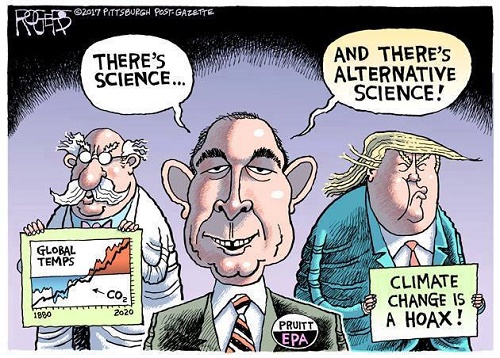
National Science Foundation counters Trump efforts to defund climate change science

Image result for defunding climate changeThe National Science Foundation has awarded the University of Rhode Island a $19 million grant to establish a statewide research consortium to study the effects of climate variability on coastal ecosystems. 

The funding builds on more than $30 million of previous NSF funding through its Established Program to Stimulate Competitive Research (EPSCoR), which aims to strengthen the state’s research competitiveness and fund workforce development initiatives.

The state of Rhode Island, through Commerce Rhode Island, has committed an additional $3.8 million toward the initiative over the next five years, which will be used to provide collaborative grants and support workforce development.


American citizens left to suffer and die

Trump just refused to provide immediate aid for Puerto Rico

For more cartoons by Mike Luckovich, CLICK HERE.
The humanitarian crisis in Puerto Rico continues to grow in the wake of a devastating hurricane that has left the American territory without food, medical resources, enough housing and with the power out across the island.

Trump has been criticized for being more concerned about football players lack of patriotism than he is about the devastation impacting the lives of thousands in Puerto Rico.

Of course, Trump claims the government, mostly through FEMA, is doing everything it can, but those on the ground – including the governor of Puerto Rico, Ricardo A. Rosselló – disagree. 

Today was even more discouraging after the Trump administration officials said they would get around to asking Congress for more money to help Puerto Rico somewhere around the middle of next month, insisting they have resources needed to help now.

However, the reality is that after hurricanes in Texas and Florida, FEMA is already stretched thin, in terms of resources and money to help victims. The resources that are arriving are being hindered because of damage to the ports and airports where it has to be received, so the problems and delays are mounting.

Is Trump really doing all he can?


Pyramid scammers like Amway, Herbalife, Avon get a little help from their Republican friends

Lawmakers want to blur the lines between legal and illegal marketing schemes
BY JILLIAN S. AMBROZ

Image result for Amway ponzi schemeRepublican members of Congress want to make life a little easier for multi-level marketing companies. They are pushing legislation to ease restrictions on the pyramid-like companies that have long histories of exploiting their customers and their recruited sales forces.

In mid-July, Rep. Tom Graves (R-Ga.) introduced HR 3280, the Financial Services and General Government Appropriations Act of FY 2018. Around the same time, a Michigan Congressman, John Moolenaar (R), tacked on an amendment to the bill that loosens the definition of the term pyramid promotion scheme and limits funds for enforcement actions outside this new definition. 

It was adopted on a voice vote by the House Appropriations Committee, and they will go forward with the bill—never mind that the bill and the amendment aren’t remotely related.

A simple definition of a pyramid scheme would be a scam, right? It’s an enterprise built on a broad base with a narrowing as money rises to the top, but where the base finds their money gone and those at the top get rich.

No law or regulation clearly distinguishes a scam from a direct-selling or multi-level marketing company that both looks and operates like a pyramid scheme.

Direct-sales companies, such as the cosmetics marketer Avon, sell their products or services directly to consumers. 

Business regulators and burned participants say that too often, companies such as Herbalife International of America Inc., ignore the consumer part of the equation and generate most or all of their sales revenue not from customers, but from people recruited to sell the products. 

Those people have to buy the products as inventory to get started and many have over the years bought a garage full of lipsticks or soaps or diet pills that they could not find buyers for at any price, which looks like a pyramid scheme.

Herbalife paid $200 million and overhauled its business practices as part of its Federal Trade Commission settlement. Earlier this year, the FTC cut nearly 350,000 checks to people who lost money trying to run Herbalife businesses.

The FTC relies heavily on decades of court decisions on what constitutes unfair or deceptive practices to pursue companies. But Republicans have recently made some moves that could further muddy the definition of a pyramid scheme and tie the hands of the FTC.

In addition, Rep. Marsha Blackburn (R-Tenn.) introduced a bill in late July deceptively titled the Anti-Pyramid Promotional Scheme Act of 2017, HR 3409. This bill, which looks to amend the Federal Trade Commission Act would “dramatically limit FTC actions against pyramid schemes,” says William Keep, dean of the School of Business Administration at The College of New Jersey.

Keep wrote in a blog for The Hill that since 1996, the FTC filed 26 pyramid scheme cases against multi-level marketing companies. Of those willing to face FTC prosecutors in court, all lost. 

The remaining cases all settled, agreeing to FTC terms. And the vast majority closed their doors, he wrote. “If made into law, the amendment ties the hands of federal regulators and further facilitates an already troubled industry that lacks transparency. If multi-level marketers and [the association] truly believe in the various manifestations of the multi-level business model, then let them welcome a full congressional hearing on the matter.”

The bill has seven co-sponsors, five of which serve on the Congressional Direct Selling Caucus, established in September 2015 by the Direct Selling Association and co-chairs Blackburn and Marc Veasey (D-Texas), one of the bill’s co-sponsors. 

Rep. Moolenaar is also a caucus member.

And if you’re wondering why such a green congressman is central to all of this—Moolenaar has only been in the House of Representatives since 2015, though he does serve on the Appropriations Committee—it likely boils down to simple proximity. 

Moolenaar’s district is just east of Ada, Mich., the Grand Rapids suburb where Amway, the nation’s largest multi-level marketer, is located. It has good reason to want to loosen the language around pyramid schemes; Amway paid $56 million to settle a class-action suit in 2010 alleging the company operated as one.

EDITOR’S NOTE: Amway heiress Betsy DeVos whose enormous fortune came out of what is basically a Ponzi scheme is now Donald Trump’s Secretary of Education.


Sometimes the Poor Make It Big. Usually They Stay Poor.

Why? The game is rigged.

Related image

We all want to live in a country where all it takes is hard work and some talent for anyone to succeed. We tell ourselves that we do. We even see examples of people who “came from nothing” and ended up rich and famous.

And it’s true that it sometimes happens. Sometimes a child born into poverty grows up to become the president of the United States, a multi-billionaire, or an Olympic gold medalist.

Most of the time, however, they don’t. And it’s not because they’re bad, lazy, stupid, or immoral. Often it’s because of our system itself.


Monday, September 25, 2017

The politics of cancer

We need prevention and a cure more than “awareness”
By Will Collette

That's Flip on the far right, as is fitting.
On October 1, Rep. Blake “Flip” Filippi (R-Charlestown), along with some luminaries from the Charlestown Citizens Alliance, will speak before the annual “Twin Peaks Preservation Stroll” here in Charlestown.

No doubt Flip will wear his pink t-shirt again to show that he cares.

But wearing a pink t-shirt and talking about cancer awareness is not enough. After years of events for “cancer awareness,” I think it’s fair to say that everyone who is capable of awareness of cancer is aware.

Isn’t it time to start saying what we really need: a cure for cancers that threaten to kill but most of all, prevention of future cancers?

That’s where the politics get sticky. While everyone is in favor of “awareness,” there is less consensus around prevention because it means getting serious about anti-cancer vaccination and about environmental triggers that cause or boost the risk of cancer.

It boggles my mind how our local politicians Flip can prance around in pink cancer “awareness” t-shirts, yet oppose mandatory vaccination against HPV, the virus that causes a variety of cancers such as cervical cancer.

Cervical cancer is the fourth-most common form of cancer in women and kills over 4,000 American women every year. It used to kill a lot more women, but thanks to PAP smear tests, often done at Planned Parenthood, the fatality rate declined.

Trump and his own brand of flag etiquette

Image may contain: 7 people, text

Magaziner applauds new “Transparent Treasury” law

Investment Transparency Policy Codified by RI Lawmakers 

Image result for government transparencyRhode Island Treasurer Seth Magaziner applauded the General Assembly's passage of legislation which will create a legal requirement to maintain the "Transparent Treasury" investment policy he implemented just months after taking office in 2015, which requires investment managers to publicly report fees and performance.

"Transparency is essential to good government," said Treasurer Magaziner. "As Treasurer, I take the seriously my obligation to set a high standard of reporting that publicly discloses investment performance and fees. I commend the General Assembly for codifying my "Transparent Treasury" policy, which will now be in place beyond my administration."


Talking points or an actual plan? You be the judge.

Related imageHave you noticed that there’s no Trump tax plan and no Republican tax plan? 

All they’ve come up with so far is a bunch of platitudes about how nice it would be to cut taxes, simplify the tax code, and spur economic growth. 

Who doesn’t support these nice goals?

The reason there’s no tax plan is congressional Republicans are hopelessly divided on it.

Right-wing Republicans (the “Freedom Caucus” along with what’s left of the Tea Party) are most interested in reducing the size of the government and shrinking the federal deficit and debt.

Corporate and Wall Street Republicans – along with Donald Trump – are most interested in cutting taxes on corporations and the wealthy. 

They have the backing the GOP’s big business donors who stand to make a bundle off tax cuts.

Here’s the problem. You can’t have a giant tax cut for corporations and the wealthy, and at the same time shrink the federal deficit and debt – unless you make gigantic cuts in government spending on things the American public wants and needs.


Sunday, September 24, 2017

Republicans aim to prove that no lives matter – except the rich

New Health Repeal Shows GOP’s Reckless Disregard for Our Lives

Image may contain: 5 people, textHow cruel and inhumane can a piece of legislation get?

The latest Republican proposal to repeal health care – yes, GOP leaders are at it again – takes us to a new low, with a revised version of repeal analysts are calling even more damaging than a “repeal-without-replace.”

Republican leaders in the Senate are making a last-ditch effort to pass legislation that will throw tens of millions of us off coverage – and they want to do it before September 30, so they can get away with repealing our care with only 50 votes.

And they’re gunning for that deadline with their worst repeal bill to date.

The Worst Health Bill So Far

The main sponsors of this new bill, Sen. Bill Cassidy and Sen. Lindsay Graham, have been busy pitching their legislation as a friendlier, more moderate health care repeal than the package the GOP tried and failed to pass in July.

But nothing could be further from the truth.


The labor market

For more cartoons by Ted Rall, CLICK HERE.

Week 35 in review