
Wednesday, July 26, 2023
New Round of PFAS Testing Leads to Three R.I. ‘Do Not Drink’ Water Orders
New law requires public water systems test for forever chemicals
PFAS found in Exeter, at URI and Wood River
By Colleen Cronin / ecoRI News
staff
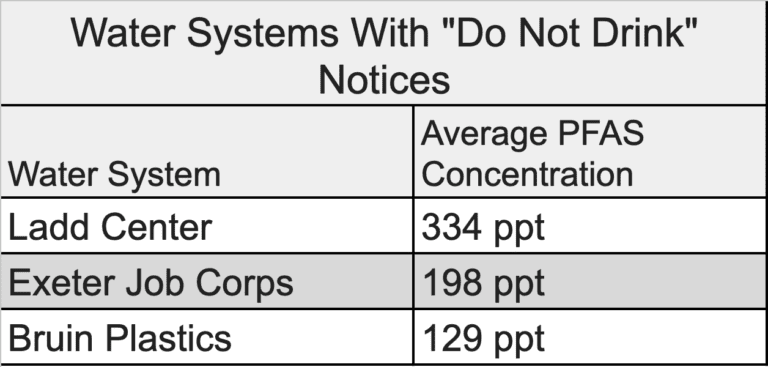 |
| A new law requires public water systems to test for forever chemicals. (Colleen Cronin/ecoRI News graphic) |
The Ladd Center and Exeter Jobs Corps on the former Ladd
School property in Exeter and Bruin Plastics in Burrillville can no longer use
their wells for drinking water after they tested above 70 parts per trillion
(ppt) for per- and polyfluoroalkyl substances (PFAS).
A law that was
passed last year, modified earlier this year, and went into effect July 1,
mandates that public water systems test for the chemicals, which are found in
firefighting foams to food packaging and floor wax and are linked to several cancers, fertility
issues, and developmental delays in children.
Of the 170 public water systems in the state, 164 have
sampled their water, according to RIDOH spokesperson Joseph Wendelken. The
remaining six have until Aug. 10 to report their samplings to be in compliance
with the law.
In addition to requiring new testing, the General
Assembly also created a new interim drinking water standard of 20 ppt for PFAS.
Systems that test above 20 ppt must notify their customers and enter an
agreement with RIDOH within 180 days to remediate the impacted wells, but only
systems that tested above 70 must issue “do not drink” notices to their
customers.
RIDOH and its toxicologist determined that 70 ppt put consumers at a much higher health risk than 20 ppt and decided to set the higher number as the “do not drink standard,” Amy Parmenter, chief administrator for RIDOH’s Center for Drinking Water Quality, told ecoRI News.


Is manganese in drinking water a health hazard?
Unsafe Manganese Levels Found in Massachusetts Drinking Water
By BOSTON UNIVERSITY SCHOOL OF
PUBLIC HEALTH

Now, a new study led by researchers at Boston
University School of Public Health (BUSPH) has found that concentrations of
manganese in a Massachusetts community’s drinking water often surpassed the
maximum recommended levels of manganese stated in current guidelines.
Published in the Journal of Exposure Science & Environmental Epidemiology,
a Nature publication, the findings also suggest that
the observed manganese levels may be high enough to pose a risk to children and
other vulnerable communities who are exposed.
Manganese is a naturally occurring component
of soil and rock, and it is both an essential nutrient and a toxic
substance—so, too little or too much exposure can be harmful to health. Despite
the fact that manganese is found in many communities’ drinking water across the
US, it is not federally regulated.
The US Environmental Protection Agency has
developed guidelines that identify a maximum level of daily exposure to
manganese for “aesthetic” purposes (i.e. color and taste), as well as for the
overall health and safety of the general population. But these guidelines are
only recommendations; they cannot be enforced in the way that established
primary standards can.
“Some level of manganese is needed for
health, but growing evidence suggests that excess levels of manganese can harm
children’s brains,” says study lead and corresponding author Alexa Friedman, a
doctoral student at BUSPH at the time of the study.
“Our findings suggest that the level of
manganese that is present in public drinking water exceeded, on average, the
aesthetic guidelines 40 percent of the time, and health-based guidelines 9
percent of the time. These data support the need for a legally
enforceable primary drinking water standard for manganese in order to
better protect children’s health.”
EDITOR'S NOTE: Iron and manganese are common in Charlestown's well water, sometimes causing discoloration and staining if not filtered. CLICK HERE for a URI fact sheet on the problem. - Will Collette
Blame capitalism?
Why hundreds of decades-old yet vital drugs are nearly impossible to find
 |
| There is presently no end in sight to the drug supply shortage. FG Trade/E+ via Getty Images |
Patients and their providers increasingly face limited or nonexistent supplies of drugs, many of which treat essential conditions such as cancer, heart disease and bacterial infections.
The American Society of Health System Pharmacists now lists over 300 active shortages, primarily of decades-old generic drugs no longer protected by patents.
While this is not a new problem, the number of drugs in short supply has increased in recent years, and the average shortage is lasting longer, with more than 15 critical drug products in short supply for over a decade.
Current shortages include widely known drugs such as the antibiotic amoxicillin; the heart medicine digoxin; the anesthetic lidocaine; and the medicine albuterol, which is critical for treating asthma and other diseases affecting the lungs and airways.
What’s going on?
I’m a health economist who has studied the pharmaceutical industry for the past 15 years. I believe the drug shortage problem illustrates a major shortcoming of capitalism. While costly brand-name drugs often yield high profits to manufacturers, there’s relatively little money to be made in supplying the market with low-cost generics, no matter how vital they may be to patients’ health.
Tuesday, July 25, 2023
GOP Obsession: War on Mexico
They want a shooting war on drugs with one of our closest allies
By

Among
the Republican candidates, there’s a continuing, growing favorite cause
spreading – to bomb or otherwise invade Mexico to wipe out drug and smuggling
cartels.
Donald
Trump says he is committed to declare war and defeat the
cartels, including a “full naval embargo” on them. Florida Gov.
Ron DeSantis promised to deploy the U.S. military against cartels in Mexico and
has suggested executing migrants who carry drugs. Sen. Tim Scott, R, S.C, says he wants
to use “the world’s greatest military” to solve the problem.
In
the House, Dan Crenshaw, R-Texas, and Mike Waltz, R-Fla., have bills
seeking authorization for the use of military force to “put us at war with the cartels.”
Sen. Tom Cotton, R-Ark., says he is open to sending U.S.
troops into Mexico to target drug lords even without that nation’s
permission. There are bills to label cartels as terrorist organizations.
A recent poll found
strong support for military action among self-identified GOP primary voters.
Whether
it is to solve fentanyl or interfere with human smuggling, the bomb Mexico
refrain—once an idea limited to the extreme fringe — is taking hold in Republican
leadership opinions that remain a lot more about hot air than
executable proposal.

Uncovering the Science Secrets Behind a Good Night’s Sleep
Chemistry?
By UNIVERSITY OF TSUKUBA
.webp)
In a new study, researchers from the University of Tsukuba in Japan have now
provided some answers, revealing a signaling pathway within brain cells that
regulates the length and depth of sleep.
Is It Safe to Eat Fish from Beach Waters Closed to Swimming?
Good question
By Frank Carini / ecoRI News
staff

The question was sensible, and it didn’t cross this reporter’s mind when reporting the story.
Every summer Environment America publishes an analysis of
bacteria testing at beaches nationwide. In 2022, 51% of the beaches in southern
New England were potentially unsafe for swimming on at least one testing day.
ecoRI News published a story about the
report, Safe for Swimming?,
July 10. A reader commented, asking: “Can you still eat the salt water fish
caught off these beaches?”
Surf casting is popular on beaches in Charlestown,
Narragansett, and Westerly, and at the edges of other Ocean State beaches.
ecoRI News reached out to the departments of health in
Rhode Island, Massachusetts, and Connecticut to ask if beach closures and
swimming/health advisories also cover the eating of fish from their waters?
Joseph Wendelken, public information officer for the
Rhode Island Department of Health, said there is not a concern, as long as the
fish are cooked. He noted sushi made with fish caught in an area with a
swimming restriction due to bacteria is not a good idea. Shellfishing is
more of a concern, he added.
The Massachusetts and Connecticut departments of public
health didn’t respond.
The federal government does advise women who are or may
become pregnant, nursing mothers, and young children not to gorge on several
marine species, namely albacore tuna, king mackerel, swordfish, and tilefish,
because of the concentration in the tissue of these fish of methylmercury, a
highly toxic organic compound of mercury.
Looks like Justice Thomas' pal deducted his bribes
How Harlan Crow Slashed his Tax Bill by Taking Clarence Thomas on Superyacht Cruises
By Paul Kiel for ProPublica

Crow’s lawyer argues that Congress has no authority to probe the GOP donor’s generosity and that doing so violates a constitutional separation of powers between Congress and the Supreme Court.
Members of Congress say there are federal tax laws underlying their interest and a known propensity by the ultrarich to use their yachts to skirt those laws.
Tax data obtained by ProPublica provides a glimpse of what congressional investigators would find if Crow were to open his books to them. Crow’s voyages with Thomas, the data shows, contributed to a nice side benefit: They helped reduce Crow’s tax bill.
The rich, as we’ve reported, often deduct millions of dollars from their taxes related to buying and operating their jets and yachts. Crow followed that formula through a company that purported to charter his superyacht. But a closer examination of how Crow used the yacht raises questions about his compliance with the tax code, experts said. Despite Crow's representations to the IRS, ProPublica reporters could find no evidence that his yacht company was actually a profit-seeking business, as the law requires.
Monday, July 24, 2023
One million unnecessary American deaths each year
Unprecedented US mortality far exceeds other wealthy nations
Boston University School of Public Health
 |
| Ron Cogswell / Flickr cc |
Published in the journal PNAS Nexus,
the study refers to these excess deaths as "Missing Americans,"
because these deaths reflect people who would still be alive if the US
mortality rates were equal to its peer countries.
Comparing age-specific death rates in the
U.S. and 21 other wealthy nations from 1933 through 2021, the authors find that
current death rates in the US are much higher than other wealthy nations, and
the number of excess U.S. deaths has never been larger.


Another good reason to keep your cat indoors
WHO Warning: Ongoing Bird Flu Outbreaks in Animals Pose Risk to Humans
By WORLD HEALTH ORGANIZATION (WHO)
 |
| They can watch the birds but can't touch (photo by Will Collette) |
The current outbreaks of avian influenza (also called “bird flu”) have caused devastation in animal populations, including poultry, wild birds, and some mammals, and harmed farmers’ livelihoods and the food trade. Although largely affecting animals, these outbreaks pose ongoing risks to humans.
The Food
and Agriculture Organization of the United Nations (FAO), the World Health
Organization (WHO), and the World Organisation for Animal Health (WOAH) are
urging countries to work together across sectors to save as many animals as
possible and to protect people.
Avian influenza viruses normally spread among birds, but the increasing number of H5N1 avian influenza detections among mammals—which are biologically closer to humans than birds are—raises concern that the virus might adapt to infect humans more easily.
In addition, some mammals may act as mixing
vessels for influenza viruses, leading to the emergence of new viruses that
could be more harmful to animals and humans.
Unlocking the Secrets of “Good Fat”
Protein Discovery Advances Potential Treatments for Obesity and Diabetes
By UNIVERSITY OF PENNSYLVANIA

Published in Science Advances, the work is a collaboration between
researchers with the Perelman School of Medicine at the University of Pennsylvania and University of Cambridge, Free University of Brussels, and University of East Anglia.
Human bodies consist of two types of fat: brown and
white. Brown fat breaks down blood sugar (glucose) and fat molecules,
generating heat in response to cold temperatures helping to maintain normal
body temperature. The majority of fat in humans is white fat, and building up
too much white fat contributes to obesity and other health issues.
Using the Krios G3i, a cryogenic electron microscope at
the Penn Singh Center for Nanotechnology researchers were able to view
mitochondrial uncoupling protein 1 (UCP1)—a protein which allows fat tissue to
burn off calories as heat—in atomic detail for the first time. This work
uncovered new insights into how this protein’s activity in brown fat cells
could potentially be harnessed for weight loss.
Subscribe to:
Posts (Atom)