
Tuesday, November 21, 2023
Devices used to clean plastic waste out of waterways clear out more than trash
Scientists caution against a reliance on mechanical devices to clear water bodies of plastic
Alan Williams, Senior Media and Communications Officer
1.jpg)
An international group of scientists has cautioned against reliance on mechanical cleanup devices as a means of addressing the plastic pollution crisis.
The researchers – comprising a number of the world’s
foremost experts in plastic pollution, and including Professor
Richard Thompson OBE FRS from the University of Plymouth – say
they appreciate the clear and pressing need to tackle the millions of tons of
waste that have already accumulated in the ocean and waterways.
However, they caution that plastic removal technologies
used so far have shown varied efficiency in the amount of waste material they
are able to collect, many have not been tested at all.
In fact, some have been shown to harm quantities of
marine organisms – including fish, crustaceans and seaweeds – that far exceed
the amount of plastic captured, meaning their overall impact on the ocean is
potentially more harmful than helpful.
Writing in the journal One Earth, the
scientists say with plastic production projected to triple by 2060 the most
cost-effective and efficient way to prevent further pollution is to reduce
plastic production and consumption, and for essential applications of plastics
to design safe, sustainable products with a readily available and effective
pathway for end-of-life disposal.
They also assert that the environmental costs of leaving
plastic pollution in the ocean should be weighed against the full environmental
and economic cost of plastic removal technologies, and call for clear criteria
for such judgments to be incorporated in the United Nations Global Plastics
Treaty.
Their commentary has been published as world leaders
prepare to resume discussions on the Treaty at the third meeting of the
Intergovernmental Negotiating Committee on Plastic Pollution.
Previous
research by the University of Plymouth provides the first
independent evaluation of the performance of a Seabin device, which is designed
to continuously suck water inwards using a submersible pump which is then
filtered.
Hundreds have been installed globally and
are reported to have captured over 2.5 million kilograms of litter from calm
sheltered environments such as marinas, ports and yacht clubs.
The Plymouth study found that a total of
1,828 items, 0.18kg of litter, was retained by a device installed on the city’s
waterfront during 750 hours of operation between April and June 2021. This was
equivalent to 58 items a day, but the device also captured one marine organism
for every 3.6 items of litter.
In addition to the Seabin, the research
published in One Earth highlights that in recent years several
forms of cleanup devices have been developed to remove plastics from the
environment.
Sieving vehicles are a common sight on
tourist beaches, plastic trapping technologies have been deployed in harbors,
and various types of booms, watercraft vehicles, bubble curtains, or
receptacles have been positioned across rivers and estuaries.
In addition, there are innovations for the
open ocean and the seabed that use combinations of towed nets, autonomous
vessels and artificial intelligence.
However, the authors of the current paper
say that even if these technologies were to show signs of being truly
effective, they would barely scratch the surface of the global problem. Cleanup
practices could also lead to greenwashing through new schemes to offset the use
of plastics through plastic collection.
As a result, the international group is concerned that focusing too greatly on cleanup approaches will create more environmental risk, and be a distraction from the key priorities of the Plastic Treaty negotiations: plastic pollution prevention.
The full study – Bergmann et al: Moving
from symptom management to upstream plastics prevention: The fallacy of plastic
cleanup – is published in One Earth, DOI:
10.1016/j.oneear.2023.10.022.
The research was co-authored by scientists
from: Alfred Wegener Institute, Helmholtz Centre for Polar and Marine Research
(Germany); Norwegian Geotechnical Institute, Norwegian University of Science
and Technology (Norway); University of Gothenburg, Stockholm University
(Sweden); Moore Institute for Plastic Pollution Research, Gyres Institute;
Earth Commons Institute, Georgetown University (USA); Aarhus University,
Roskilde University (Denmark); Cukurova University, Özyeğin University
(Turkey); University of Plymouth (UK); Manipal Academy of Higher Education
(India); Massey University (New Zealand).


Cars vs. bikes and pedestrians
Interactive map assembling 13 years of crash data reveals increasing crashes and fatalities
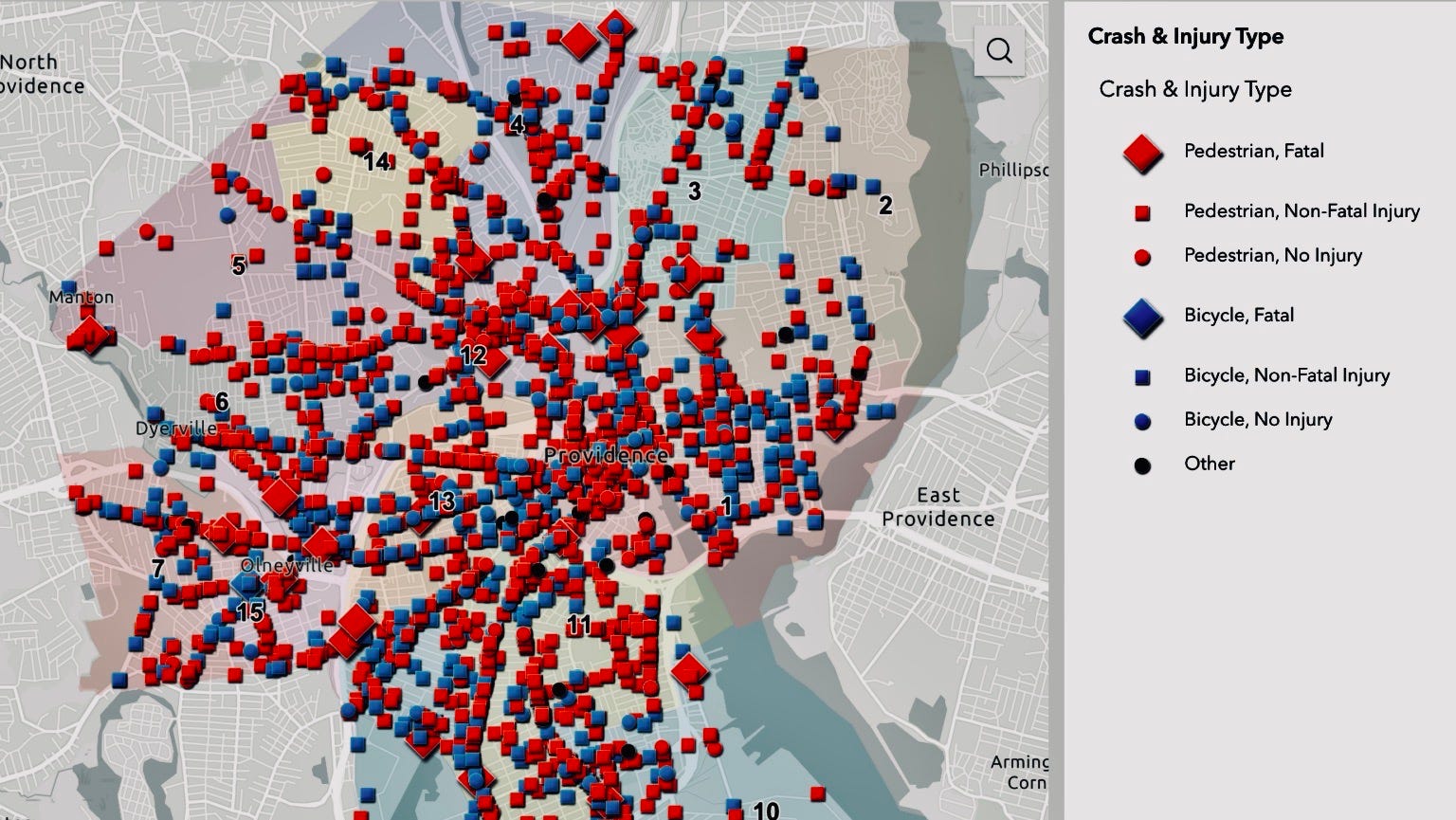
A new interactive data and mapping initiative from the Providence Streets Coalition (PSC) is now available to the public, giving residents and officials a block-by-block visualization of every reported motor vehicle crash involving a person walking or bicycling since 2010.
The
interactive map pinpoints and details more than 3,600 crashes in the City of
Providence in a 13-year timeframe, and reveals the many dangerous areas and
alarming trends facing non-drivers within the City.
Key takeaways from the new initiative
include:
- 2022 was the deadliest year for pedestrians since 2016
- 30 people have been killed by motor vehicles on Providence streets since 2010
- 3,678 pedestrians and cyclists have been hit by motor vehicles since 2010 (2% of Providence’s population)
- 88% of crashes resulted in injuries or fatalities
- 40% of collisions occurred at signaled intersections
- 28% of crashes were hit-and-run
Facing Financial Ruin as Costs Soar for Elder Care
Costs impoverish older Americans and sometimes their families

She used to fear his disease-induced paranoia, but now he’s so frail and confused that he wanders away with no idea of how to find his way home. He gets lost so often that she attaches a tag to his shoelace with her phone number.
The financial and emotional toll of providing and paying for long-term care is wreaking havoc on the lives of millions of Americans. Read about how a few families are navigating the challenges, in their own words.
Feylyn Lewis, 35, sacrificed a promising career as a research director in England to return home to Nashville after her mother had a debilitating stroke. They ran up $15,000 in medical and credit card debt while she took on the role of caretaker.
Sheila Littleton, 30, brought her grandfather with dementia to her family home in Houston, then spent months fruitlessly trying to place him in a nursing home with Medicaid coverage. She eventually abandoned him at a psychiatric hospital to force the system to act.
“That was terrible,” she said. “I had to do it.”
Millions of families are facing such daunting life choices — and potential financial ruin — as the escalating costs of in-home care, assisted living facilities, and nursing homes devour the savings and incomes of older Americans and their relatives.
“People are exposed to the possibility of depleting almost all their wealth,” said Richard Johnson, director of the program on retirement policy at the Urban Institute.
Monday, November 20, 2023
Good news, bad news
The Supreme Court has adopted a conduct code, but who will enforce it?
by Joshua Kaplan, Justin Elliott, Brett Murphy and Alex Mierjeski for ProPublica

The Supreme Court on Monday released a code of conduct governing the behavior of the country’s most powerful judges for the first time in its history. But experts said it was unclear if the new rules, which do not include any enforcement mechanism, would address the issues raised by recent revelations about justices’ ethics and conduct.
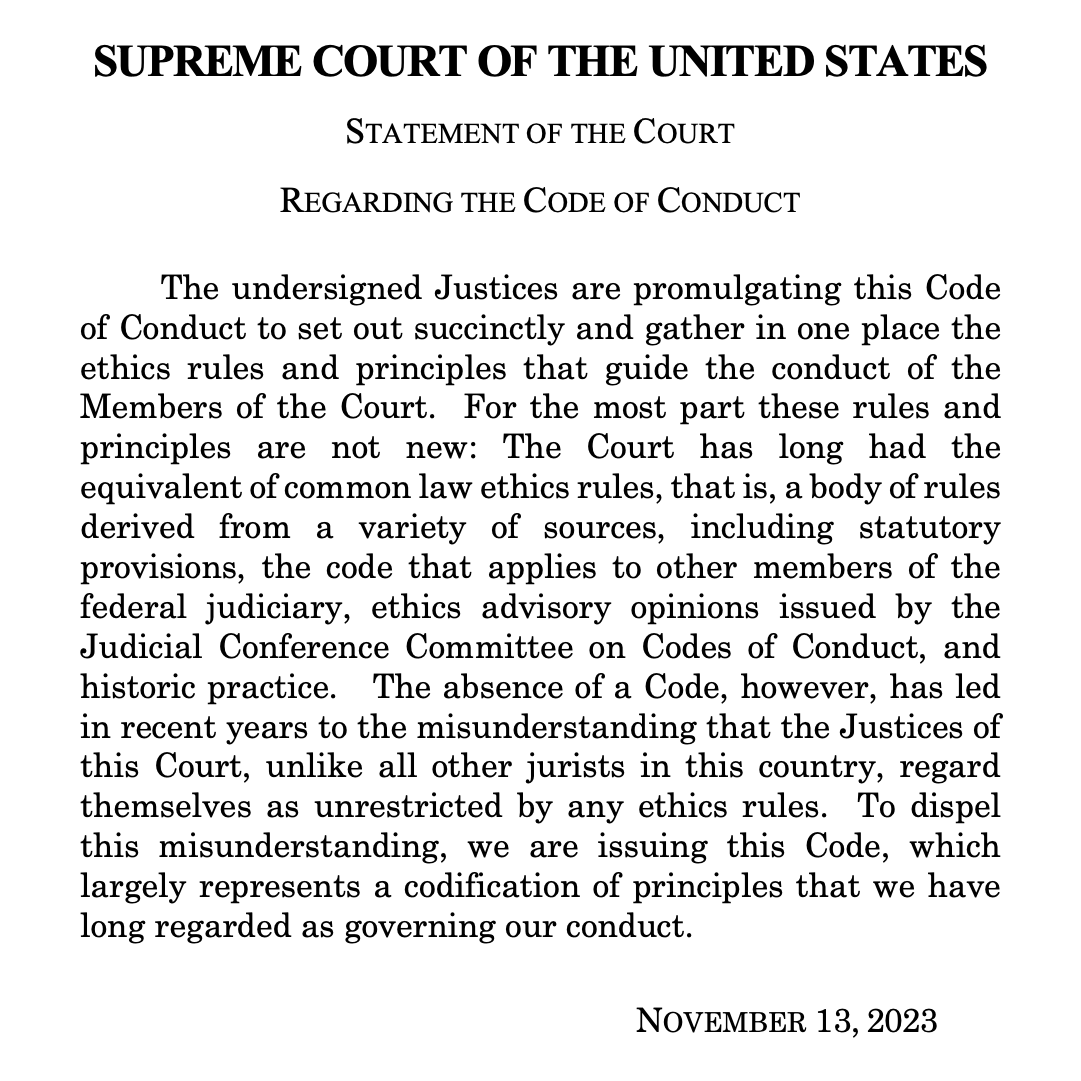
The code does not specify who, if anyone, could determine whether the rules had been violated.
The new Supreme Court code’s lack of any apparent enforcement process is “the elephant in the room,” said Stephen Vladeck, a law professor at the University of Texas who studies the court.


New state grant cycle for watershed protection
DEM Announces Availability of $1.2M in EPA Grant Funding for Projects to Improve Water Quality in Watersheds
.webp)
Local, state and regional governmental agencies, as well as public schools, universities, and non-profit watershed, environmental or conservation organizations, and 501(c)3 non-profit organizations with the capacity to carry-out eligible projects such as urban neighborhood associations, are eligible to apply for the grants.
Public Workshop (Hybrid)
A public hybrid workshop will be offered on Thursday, Nov.
30, 2023 at 10 AM on Zoom and in-person at DEM’s Providence Headquarters, 235
Promenade Street, Room 300 (third floor), Providence, Rhode Island 02908. To
register for the workshop on Zoom, click here.
Nonpoint source pollution arises from many diverse sources, such as uncontrolled storm water runoff, pet waste, cesspools and failing septic systems, erosion due to land disturbances and other stressors, including aquatic invasive species.
DEM’s NPS Management Program works
to prevent or reduce negative impacts to Rhode Island’s water resources. These
funds target specific watersheds (see below) as well as eligible disadvantaged
communities. These competitive grants will be awarded according to the Request for
Proposals (RFP) and require a match commitment.
Tons of acorns?
It must be a mast year
Emily Moran, University of California, Merced
 |
| A mast year can be a squirrel’s dream come true. Editor77/Shutterstock.com |
Naturalists have declared this fall a mast year for many trees: Not just oaks, but walnuts, beeches and more are all making tons of nuts all at the same time.
Many other types of trees, from familiar North American species such as pines and hickories to the massive dipterocarps of Southeast Asian rainforests, show similar synchronization in seed production. But why and how do trees do it?
Rhode Islanders are worried about democracy.
What they blame depends on their political party.
by Nancy Lavin, Rhode Island Current
 |
| By Clay Bennett |
The online survey published Monday by The Pell Center at Salve Regina University asked 887 registered voters about political polarization, the health of the country’s democracy and elections, and the accuracy of news media, breaking down responses based on political affiliation.
The survey, which has a 3.3% margin of error, was conducted by Embold Research from Oct.12-17, with questions in English and Spanish.
“We’re trying to better understand the nuances and complexity of polarization,” said Katie Langford Sonder, the Pell Center’s associate director. “Often, we are inundated with these narratives that are oversimplified. We want to really understand why these two sides are feeling farther and farther apart.”
The survey highlighted some areas of commonality: mainly, that over half of survey takers don’t think the U.S. democracy is healthy, with shared concern over elections and the accuracy or objectivity of news media. But they disagreed on the causes.
Republicans overwhelmingly pointed to partisan media, voter fraud and President Joe Biden as the top threats to democracy. Democrats, in contrast, named former President Donald Trump as the No. 1 threat, followed by voter suppression and Republican officials.
Sunday, November 19, 2023
Trump/GOP plan for a fascist America in 2025
Trumpian Project 2025 is 'Far-Right Playbook for American Authoritarianism'
 |
| Trump offers creepy smile in snap with current House Speaker MAGA Mike Johnson |
Project 2025, as it
is also known, builds on Heritage's latest Mandate for Leadership,
a series which since the Reagan administration has served as the right-wing
think tank's to-do list for the next Republican president.
The Global Project Against Hate and Extremism (GPAHE) put
out a detailed analysis of
Project 2025, which the group described as a "far-right playbook for
American authoritarianism" and "a threat to a multiracial, diverse
democracy."
Across 13 sections, the GPAHE report introduces the
project, explains the role of Christian nationalism, and details efforts to gut
the civil service, reverse progress on racial equality, eviscerate LGBTQ+
rights, restrict reproductive freedom, impose hardline immigration rules, roll
back climate action, end "woke" military policies, overhaul public
education, and curb human rights.
The analysis also features a full list of organizational
supporters and profiles of key backers, including the Family Research Council,
Heartland Institute, Moms for Liberty, and Turning Point USA.


Another reason why recycling is not the answer to plastic trash
Scientists found hundreds of toxic chemicals in recycled plastics
University of Gothenburg

Because of this, the scientists judge recycled
plastics unfit for most purposes and a hinder in the attempts to create a
circular economy.
The results are published in a study led by scientists at
the University of Gothenburg.
Delegates, scientists and health and environmental
advocates from around the world are traveling to Nairobi, Kenya for the third session of the Plastics Treaty Intergovernmental
Negotiating Committee (INC-3).
There scientists will urge delegates to heed the latest
science showing that because toxic chemicals are used to make all plastics, and
plastics will adsorb other chemicals during use, there are no plastics that can
be deemed safe or circular.
Getting to know your cranberries
Cranberries can bounce, float and pollinate themselves
Serina DeSalvio, Texas A&M University
 |
| Cranberries grow on vines in sandy bogs and marshes. Lance Cheung, USDA/Flickr |
Compared to many valuable plant species that were domesticated over thousands of years, cultivated cranberry (Vaccinium macrocarpon) is a young agricultural crop, just as the U.S. is a young country and Thanksgiving is a relatively new holiday. But as a plant scientist, I’ve learned much about cranberries’ ancestry from their botany and genomics.
Subscribe to:
Posts (Atom)