Menu Bar

Home           Calendar           Topics          Just Charlestown          About Us

Wednesday, May 3, 2023

If It Pays To Be a Jerk, Why Isn’t Everyone That Way?

Unraveling the Evolutionary Puzzle

By PEERJ

Getty Images
Throw a tantrum. Threaten, shove aside, or steal from your colleagues. Science confirms, yet again, that brutish behavior can be an effective path to power. And not just in humans, but in chimpanzees, too.

A new study published on April 24 in the journal PeerJ Life and Environment found that male chimps with more bullying, greedy and irritable personalities reached higher rungs of the social ladder and were more successful at siring offspring than their more deferential and conscientious counterparts.

But if that’s the case, researchers ask, why isn’t every chimp a bully?

Gardener’s delight on Saturday

URI’s Master Gardeners to hold plant sale May 6 on Kingston Campus

by Hugh Markey 

Got tomatoes? Broccoli? How about peanuts and cotton? On Saturday, May 6, the University of Rhode Island Cooperative Extension’s Master Gardener Program will hold its annual plant sale in the Kingston Campus’ botanical gardens on Greenhouse Road.

TIP from the editor: Get there EARLY.

It will feature the standard favorite plants alongside some surprises. Open from 9 to noon, thousands of plants will be available for purchase by credit card or cash. URI Master Gardeners will also be there to answer lawn and garden questions.

Coastal Management Council Delays Final Vote on Revolution Wind to May 9

A yes vote by CRMC would be essential to permitting the offshore wind project

By Mary Lhowe / ecoRI News contributor

The Revolution Wind facility is proposed for federal waters off the coast of Rhode Island and Massachusetts. (BOEM)

Mindful of concessions and mitigation actions promised by the developers of the proposed Revolution Wind project, staff of the Coastal Resources Management Council have recommended the council vote yes on the project, thereby declaring that it conforms with the state’s coastal management plan.

But after hearing four hours of arguments from fishermen and the public at its April 25 meeting and with several people still waiting to comment at 10 p.m., the CRMC board took no vote, continuing the matter to its May 9 meeting.

A yes vote, declaring that the project is consistent with the state’s Ocean Special Area Management Plan, would be essential to permitting the wind facility, which still is awaiting final approval on the federal level from the Bureau of Ocean Energy Management (BOEM).

Tuesday, May 2, 2023

What to do with the messed up CRMC?

Series of Bills Would Revamp Ocean State’s Coastal Management Agency

By Rob Smith / ecoRI News staff


The calls for reforming the state’s coastal management agency are growing stronger in the General Assembly.

Members of the Senate Environment and Agriculture Committee heard a package of five bills to overhaul the Coastal Resources Management Council, the regulatory agency responsible for permitting offshore wind, aquaculture, and development along Rhode Island’s more than 400 miles of coastline.

Unusually for state agencies, CRMC’s final decision-making authority lies with a 10-member council, on which nine seats are appointed by the governor, and the council has no coastal policy expertise requirements for its members. Members representing specific communities are required to be appointed or elected officials within that community, although that rule often hasn’t been enforced.

As a result, the council has attracted increased scrutiny over its decisions in recent years.

Kiss, kiss


Sheldon Whitehouse nails it


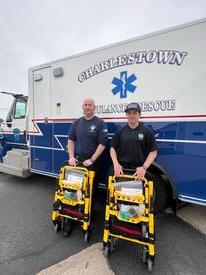
Charlestown team work to support emergency responders

Sen. Gu, Rep. Spears bill would increase EMS funding

EDITOR'S NOTE: Cathy and I would like to personally thank Charlestown Ambulance and Rescue for their quick response last Friday and their kind and gentle care. - Will Collette

When Chief Andrew Kettle receives a dispatch call, he sends an ambulance of trained professionals to provide rapid, quality care. But if the patient in question gets their health insurance through Medicaid, the nonprofit he operates will lose hundreds of dollars on that service.

Sen. Victoria Gu (D-Dist. 38, Charlestown, Westerly, South Kingstown) and Rep. Tina Spears (D-Dist. 36, Charlestown, Westerly, South Kingstown, New Shoreham) are hoping to change that. Legislation they are sponsoring would increase the Medicaid rate of reimbursement for ambulance services.

“Our emergency services are an absolutely vital community resource,” said Senator Gu. “We need to make sure we’re providing them the resources to recruit and retain qualified first responders. And we should be making sure those first responders are paid a decent wage. Otherwise, response times and quality of care may suffer.”

Almost a quarter of the state’s population is covered by Medicaid, which pays for health care needs, including ambulance services. Chief Kettle runs Charlestown Rescue, a private nonprofit that provides all emergency rescue services for the town of Charlestown. 

He estimates his agency loses about $260 on every emergency call from a Medicaid patient. Those funds must be made up for by support from the town of Charlestown, which puts the burden on property taxpayers. Even then, Chief Kettle says, he is struggling to stay afloat.

“If you call 911, we will send an ambulance with half a million dollars’ worth of equipment and trained professional first-responders including Emergency Medical Technicians, cardiac specialists and paramedics,” said Chief Kettle. “But if you have Medicaid, we get paid about $75 for that ride. We will absolutely respond to your emergency, but we are stuck figuring out how to pay for it all after.”

In Rhode Island, Medicaid pays a flat rate of $69.95 per ambulance ride with an additional $0.56 per mile. That is less per mile than the IRS reimbursement rate of $0.655 per mile. In Massachusetts, Medicaid pays flat rates ranging from $250.65 to $334.19 and Connecticut Medicaid pays $220.44 to $293.90, based on the acuity of the patient. Massachusetts pays an additional $6.45 per mile and Connecticut pays an additional $5.88, according to information provided by Chief Kettle.

The legislation (2023-S 0516, 2023-H 6119) would increase the Medicaid rate of reimbursement for ambulance and wheelchair van services to not less than ninety percent (90%) of Medicare rates for the same medical services. Medicare, paid for by the federal government, pays a base rate of $265.54, with significantly higher rates based on the acuity of the patient. Medicare also reimburses at least an additional $8.54 per mile. Data can be found on the Center for Medicare and Medicaid Services website.

“Our emergency responders are trained professionals who work 24/7/365, with the lives of our neighbors in their hands. We’re asking them to do a stressful job, away from their families on weekends and holidays, and some get paid as little as $18 per hour,” Chief Kettle said. “We really need to pay them better. This bill will help us do that, and I’m so grateful to Senator Gu and Representative Spears for their efforts.”

The town of Charlestown subsidizes Charlestown Rescue directly from the town budget to help keep the agency fiscally solvent. In many other communities, municipal employees are responsible for providing ambulance services. The insufficient Medicaid rate puts a strain on municipal budgets and, ultimately, property taxpayers.

“Health insurance coverage needs to pay fairly for services and our hard-working emergency professionals,” said Representative Spears. “Rhode Island Medicaid rates for critical life-saving transports shouldn’t be the worst in the nation, and right now we are.  I believe fair compensation for essential services when our community members are in a medical crisis should be a top priority for insurers in Rhode Island. This bill will ensure our local towns are able to quickly respond to the medical crises in their communities.”

Both bills will have their first hearing on Thursday, May 4. The House Committee on Finance will hear Representative Spears’ bill at the rise of the House (sometime after 4:30 p.m.) in Room 35 in the basement of the State House. The Senate Committee on Finance will hear Senator Gu’s bill at the rise of the Senate (sometime after 4:30 p.m.) in Room 211 on the second floor of the State House.

Warning: Study Finds Superbugs Lurking in 40% of Supermarket Meat

“Superbugs” present in chicken, turkey, beef and pork

By EUROPEAN SOCIETY OF CLINICAL MICROBIOLOGY AND INFECTIOUS DISEASES  

A Spanish study found 40% of supermarket meat samples contained multidrug-resistant E. coli strains, highlighting the need for regular assessments of antibiotic-resistant bacteria in meat products and emphasizing farm-to-fork interventions and proper food handling practices to reduce risks.

Multidrug-resistant E. coli were found in 40% of supermarket meat samples tested in a Spanish study. E. coli strains capable of causing severe infections in people were also highly prevalent, this year’s European Congress of Clinical Microbiology & Infectious Diseases (ECCMID 2023, Copenhagen, April 15-18) will hear.

Antibiotic resistance is reaching dangerously high levels around the world. Drug-resistant infections kill an estimated 700,000 people a year globally and, with the figure projected to rise to 10 million by 2050 if no action is taken, the World Health Organization (WHO) classes antibiotic resistance as one of the greatest public health threats facing humanity.

Multidrug-resistant bacteria can spread from animals to humans through the food chain but, due to commercial sensitivities, data on levels of antibiotic-resistant bugs in food is not made widely available.

The Truth About Gas Stoves

Carefully weigh the risks versus the benefits

BY RENEE CHO 

“The world of tomorrow is cooking with gas!” This phrase was popularized by the gas industry as far back as the 1930s, promoting gas stoves as clean and reliable.

Carmen Miranda even sang, “Cooking With Gas” in the 1948 film “A Date With Judy” and the American Gas Association (AGA) got Bob Hope to adopt the catchphrase “Now you’re cooking with gas” in his routines. 

The gas industry’s marketing campaign was a big success: gas came to be seen as clean and natural, and eventually gas stoves became the cooktop of choice for most professional chefs.

Today, about 40 million U.S. households use gas stoves—more than 30 percent of homes; in New Jersey, California, Chicago, and New York City, it’s about 70 percent of households. But recently, concerns have arisen  about their impacts on children’s health. What does the science show, and why are we only hearing about this now?

In January, the chair of the Consumer Product Safety Commission (CPSC) announced that emissions from gas stoves could be hazardous and that it was looking into ways to reduce the indoor air pollution they produce. Although the CPSC said it was not considering a ban on gas stoves, the media was suddenly awash with reports on the dangers of gas stoves and campaigns that defended them.

Monday, May 1, 2023

Rhode Island's Housing Crisis

Local Initiatives Support Corporation (LISC) supports action on housing

By Jeanne Cola, LISC Rhode Island Executive Director 

In partnership with the Rhode Island Foundation and others, LISC Rhode Island was proud to support the development of an in-depth analysis of the housing crisis in Rhode Island. 

The environmental scan and analysis by the Boston Consulting Group assessed the overall need and available resources to address the emergency and need within the community. The resulting report identifies the state's biggest challenges, lays out suggestions, and encourages action. 

It's clear from the past year, and made more evident through this report, that we cannot afford to wait any longer to implement multiple strategies on a wide variety of initiatives. 

We need to walk and chew gum at the same time — actually, we need to run and chew. We need to advance housing production through our existing channels and partner networks, but we also need to eliminate barriers and urgently invest in new ways of doing things and get them done faster.

Make a choice, GOP, or are your minds made up?

By Bill Bramhall


Protecting the protectors

URI to host film screening and discussion on impact of PFAS in firefighting

Kristen Curry 

The University of Rhode Island is providing a forum for a true story that illustrates the impact of PFAS in a personal way, with the film screening of Burned, the story of how the spouse of a firefighter revealed significant exposure to forever chemicals affecting the firefighting community nationally.

The film drives home the prevalence of PFAS because it tells the story of a local community – Fall River – and an unexpected source of exposure to the chemicals in firefighter turnout gear with high levels of PFAS not disclosed on labels.

The 30-minute film will be hosted by URI’s Superfund Research Program, STEEP (Sources, Transport, Exposure and Effects of PFAS) on Thursday, May 4, from 6 to 7 p.m. in Room 170 of the College of Pharmacy’s Avedisian Hall, 7 Greenhouse Road, Kingston.

The URI community and the public are invited to attend the screening and panel discussion featuring Jason Burns, Fall River firefighter and executive director of the Last Call Foundation, with Rainer Lohmann, Ph.D., director of STEEP at URI’s Graduate School of Oceanography, and Angela Slitt, Ph.D., STEEP researcher and project lead, from the URI College of Pharmacy.

URI experts team up with regional partners to determine best practices to control ticks – with your help

Residents urged to take online survey, signup for free backyard evaluation

Tony LaRoche 

The Centers for Disease Control and Prevention estimates there are about 500,000 new cases of Lyme disease a year. That’s just one of the serious health risks posed by ticks. But for many people, what works best in their own backyards to control ticks is probably guesswork. 

The New England Center of Excellence in Vector-Borne Disease wants to clear up the confusion—with your help.

The federally designated Center of Excellence, a partnership of seven regional colleges and universities including the University of Rhode Island, has launched Project ITCH (Is Tick Control Helping?) with the aim of determining best practices for residential tick control—in each New England state—so residents can protect themselves, their families and their pets. 

The project includes an online survey asking residents in each New England state about their practices in preventing tick exposure and tick bites. Participants can sign up to let researchers know they would be interested in having a property visit and a free evaluation of tick (and mosquito) conditions on their property.

Rhode Island scores high ranking for working moms

According to Wallethub, a national rating service, Rhode Island can in at second place behind Massachusetts in a national ranking among the states for conditions amenable to working moms.

For the most part, the best conditions were held by northern blue states, while the worst conditions were in southern red states although California and Michigan were surprisingly low and Tennessee was surprisingly high.

Here's the scorecard: 


Construction workers oppose GOP effort to hobble solar power

Trade Unions Representing 1.5 Million American Workers Oppose Retroactive Solar Tariffs

By Solar Energy Industry Association 

Members of the International Union of Operational Engineers (IUOE) assess solar equipment at the union’s training facility in Crosby, Texas. Photo courtesy of IUOE.

Americans across the clean energy industry sprang to action as Congress threatened $1 billion in retroactive solar tariffs. A handful of lawmakers are using the Congressional Review Act (H.J. Res. 39) to repeal President Biden’s two-year moratorium on the enforcement of tariffs resulting from the Auxin anti-circumvention case.

This reprieve is a necessary bridge for the solar and storage industry as the Inflation Reduction Act goes to work for the economy and spurs domestic manufacturing across the country.

This week, clean energy trade associationsenvironmental groups such as the League of Conservation Voters and Sierra Club, and 417 solar companies all voiced their strong opposition to this harmful bill in letters to the Hill.

Now, the largest trade unions active in the U.S. solar and storage industry are joining the industry opposition.