Menu Bar

Home           Calendar           Topics          Just Charlestown          About Us

Monday, September 25, 2023

Everyday Pleasures Can Boost Cognitive Performance

Among them, music and coffee

By NYU TANDON SCHOOL OF ENGINEERING

Listening to music and drinking coffee are the sorts of everyday pleasures that can impact a person’s brain activity in ways that improve cognitive performance, including in tasks requiring concentration and memory.

That’s a finding of a new NYU Tandon School of Engineering study involving MINDWATCH, a groundbreaking brain-monitoring technology.

Developed over the past six years by NYU Tandon’s Biomedical Engineering Associate Professor Rose Faghih, MINDWATCH is an algorithm that analyzes a person’s brain activity from data collected via any wearable device that can monitor electrodermal activity (EDA). 

This activity reflects changes in electrical conductance triggered by emotional stress, linked to sweat responses.

In this recent MINDWATCH study, published in the journal Scientific Reports, subjects wearing skin-monitoring wristbands and brain-monitoring headbands completed cognitive tests while listening to music, drinking coffee and sniffing perfumes reflecting their individual preferences. They also completed those tests without any of those stimulants.

The MINDWATCH algorithm revealed that music and coffee measurably altered subjects’ brain arousal, essentially putting them in a physiological “state of mind” that could modulate their performance in the working memory tasks they were performing.

Specifically, MINDWATCH determined the stimulants triggered increased “beta band” brain wave activity, a state associated with peak cognitive performance. Perfume had a modest positive effect as well, suggesting the need for further study.

Starting today, you can again order free COVID tests

No charge, mailed to your home

By Will Collette

UPDATE: I just placed my order and was amazed at how fast and easy it was.

COVID is making a comeback as case numbers again rise, as well as hospitalizations and death.

Among the obvious actions reasonable (i.e. not anti-vaxxers) people can take are:

Get the new COVID vaccine as soon as you can. Don’t forget to also get your flu shot and the new RSV vaccine. The potential side effects are nothing compared to the misery and danger to your life from the full-blown diseases;

Mask up again, especially in crowded places and

Get your at-home COVID test kits by ordering them directly from the government’s  COVIDTests.gov portal beginning on Monday, Sept. 25

Before you throw out your old test kits, Check to see if your COVID-19 tests' expiration dates have been extended.

If you get a positive result on your COVID kit, you can report the results HERE but, of course, contact your primary care provider to determine what treatment you should consider.

Over one million Americans have died from COVID, most of them unnecessarily because they took their advice from internet quacks or craven politicians. 

It’s your life on the line so be safe and sensible.

Sunday, September 24, 2023

Murdoch's legacy of lies at Fox

Little accountability, and political power that rose from the belief in his power 

Lorna Grisby, The Conversation

By Ben Jennings
Rupert Murdoch, 92, one of the world’s most influential modern media figures, announced on Sept. 21, 2023, that he is stepping down as chair of Fox Corp. and executive chairman of News Corp. 

By mid-November, he will no longer be at the helm of the multibillion-dollar media empire that has stirred so much controversy over decades.

Through Fox News, Murdoch is leaving a lasting impression on American journalism and politics. It just may not be what most people think.

Here are three essential reads from The Conversation about Murdoch and Fox News and how they have shaped the American media and political landscapes.

If only Elon Musk had been around at the start of World War II

For more cartoons by Ruben Bolling, CLICK HERE

Shame. Shame.

Walk into the light

New evidence indicates patients recall death experiences after cardiac arrest

Elsevier

Up to an hour after their hearts had stopped, some patients revived by cardiopulmonary resuscitation (CPR) had clear memories afterward of experiencing death and had brain patterns while unconscious linked to thought and memory, report investigators in the journal Resuscitation, published by Elsevier.

In a study led by researchers at NYU Grossman School of Medicine, in cooperation with 25 mostly US and British hospitals, some survivors of cardiac arrest described lucid death experiences that occurred while they were seemingly unconscious. 

Despite immediate treatment, fewer than 10% of the 567 patients studied, who received CPR in the hospital, recovered sufficiently to be discharged. Four in 10 of patients who survived, however, recalled some degree of consciousness during CPR not captured by standard measures.

The study also found that in a subset of these patients, who received brain monitoring, nearly 40% had brain activity that returned to normal, or nearly normal, from a "flatline" state, at points even an hour into CPR. 

As captured by EEG, a technology that records brain activity with electrodes, the patients saw spikes in the gamma, delta, theta, alpha, and beta waves associated with higher mental function.

Why you shouldn't drink the Kool-Aid

Daily consumption of sugary drinks linked to increased risk of liver cancer and chronic liver disease

By MASS GENERAL BRIGHAM 

Around 65% of American adults regularly consume beverages sweetened with sugar. 

Chronic liver disease stands as a predominant source of illness and death globally, potentially leading to liver cancer and fatalities associated with liver diseases.

Researchers from Brigham and Women’s Hospital, a founding member of the Mass General Brigham healthcare system, led one of the first studies to look at the association between intake of sugar-sweetened beverages, artificially sweetened beverages, and the incidence of liver cancer and chronic liver disease mortality. The results of the study were recently published in the journal JAMA.

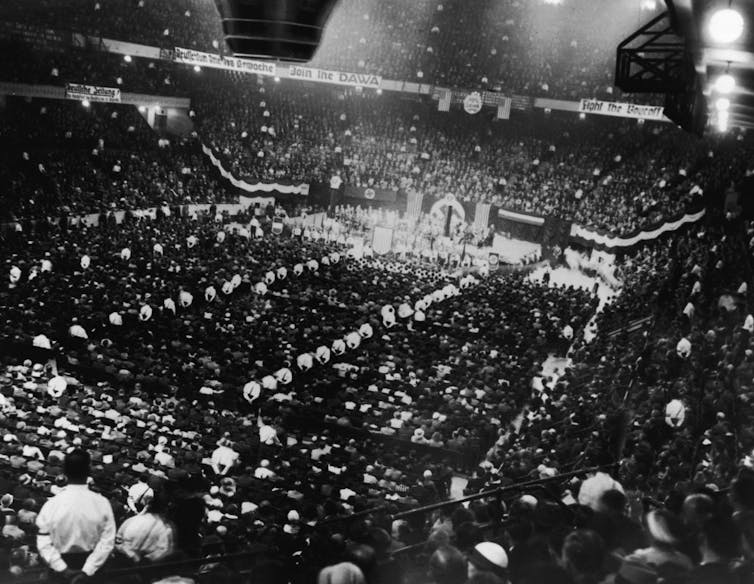
Nazis and evangelicals - a long-standing relationship

Legacy of shame

Meghan Garrity, George Mason University and Melissa Jo Wilde, University of Pennsylvania

Thousands of people attend a pro-Nazi rally at Madison
Square Garden in New York in May 1934, with
counterprotestors outside. 
Anthony Potter Collection/Hulton Archive via Getty Images
Each September marks the anniversary of Nazi Germany’s Nuremberg Laws, whose passage in 1935 stripped Jews of their German citizenship and banned “race-mixing” between Jews and other Germans.

Eighty-eight years later, the United States is facing rising antisemitism and white supremacist ideology – including two neo-Nazi demonstrations in Florida in September 2023 alone.

The Nuremberg Laws were a critical juncture on the Third Reich’s path toward bringing about “the full-scale creation of a racist state … on the road to the Holocaust,” according to legal historian James Whitman. Yet across the Atlantic, many Americans were unconcerned, and even admiring – including some religious leaders.

As a political scientist and a sociologist, we wanted to examine what Americans thought about Hitler and the National Socialist Party before the U.S. entered World War II – and see what lessons those findings might hold for our country today. Our recent research, which focused on religious publications, suggests that Americans’ support for Nazi Germany is best explained by belief in white supremacy.

Saturday, September 23, 2023

More corrupt practices by "Justice" Thomas uncovered

Clarence Thomas Secretly Participated in Koch Network Donor Events

by Joshua Kaplan, Justin Elliott and Alex Mierjeski for ProPublica

Supreme Court Justice Clarence Thomas is pictured at the Bohemian Grove with billionaire industrialist David Koch documentary filmmaker Ken Burns. 

(Photo: Obtained by ProPublica)

Supreme Court Justice Clarence Thomas’ decades long friendship with real estate tycoon Harlan Crow and Samuel Alito’s luxury travel with billionaire Paul Singer have raised questions about influence and ethics at the nation's highest court.

On Jan. 25, 2018, dozens of private jets descended on Palm Springs International Airport. Some of the richest people in the country were arriving for the annual winter donor summit of the Koch network, the political organization founded by libertarian billionaires Charles and David Koch. A long weekend of strategizing, relaxation in the California sun and high-dollar fundraising lay ahead.

Just after 6 p.m., a Gulfstream G200 jet touched down on the tarmac. One of the Koch network’s most powerful allies was on board: Supreme Court Justice Clarence Thomas.

No cure


Will you pass or fail?


Teresa Tanzi feted for her work

Rep. Tanzi honored for her advocacy for mental health  

Rep. Teresa A. Tanzi, center, with Mental Health
Association of Rhode Island Executive Director
Laurie-Marie Pisciotta, left, and 
Sandra Victorino,
chair of the Mental Health Association of
Rhode Island and director of workforce development,
diversity inclusion & community relations at
Care New England.
Local mental and behavioral health advocates and leaders gathered recently to honor Rep. Teresa A. Tanzi for her passionate and determined advocacy for support for mental and behavioral health resources for Rhode Islanders.

This legislative session, Representative Tanzi (D-Dist. 34, South Kingstown, Narragansett) championed the passage of a resolution (2023-H 6524) asking the Rhode Island Office of the Health Insurance Commissioner to examine, publicly report data on, and make recommendations for addressing the critical inadequacy of  access to behavioral health services in Rhode Island’s commercial health insurance networks. The report is due by March 1, 2024.

Representative Tanzi also sponsored legislation (2023 H-5657) this session to raise commercial health insurers’ reimbursement rates. In advocating for these two bills, she helped to raise awareness among her General Assembly colleagues of the behavioral and mental health care crisis in Rhode Island.

The complex chemistry behind America’s spirit

How bourbon gets its distinctive taste and color


Most bourbon is made in Kentucky. 
Catherine Falls Commercial/Moment via Getty Images
Few beverages have as rich a heritage and as complicated a chemistry as bourbon whiskey, often called “America’s spirit.” Known for its deep amber hue and robust flavors, bourbon has captured the hearts of enthusiasts across the country.

But for a whiskey to be called a bourbon, it has to adhere to very specific rules. For one, it needs to be made in the U.S. or a U.S. territory – although almost all is made in Kentucky.

The other rules have more to do with the steps to make it – how much corn is in the grain mixture, the aging process and the alcohol proof.

I’m a bourbon researcher and chemistry professor who teaches classes on fermentation, and I’m a bourbon connoisseur myself. The complex science behind this aromatic beverage reveals why there are so many distinct bourbons, despite the strict rules around its manufacture.

When swimming holes go bad

No Splashing: Swimmers Banned from Popular Pond to Make Way for Boats

By Frank Carini / ecoRI News columnist

Beach Pond in Exeter was once a popular swimming hole,
but is now reserved for boaters and anglers.
(Frank Carini/ecoRI News)

Unlike many other Rhode Island waterbodies, a local pond off Route 165 wasn’t contaminated this summer by fecal matter or toxic algae. The former swimming beach was closed in 2008 for other human-caused reasons.

With a week left in Summer 2023, freshwater and saltwater beaches around the state have been closed for a combined 288 days, the highest number of closures recorded since 2006.

Beaches are closed by order of the state Department of Health when they test positive for elevated levels of enterococci bacteria, which live in the intestinal tracts of warm-blooded animals, including humans, and indicate possible water contamination by fecal waste.

Last month the departments of health and environmental management advised people to avoid contact with Fishing Cove in Coventry, Coomer Lake in Glocester, and Roger Williams Park Ponds in Providence because of blue-green algae blooms. They aren’t the only waterbodies to have been sickened this year by pea soup gone bad.

Beach Pond, which spans both sides of Ten Rod Road in western Rhode Island, has been closed to swimming for 15 years. The 430-acre pond that straddles the border between Connecticut and Rhode Island wasn’t closed because of poop in the water or by cyanobacteria, though.

The pond, up to 60 feet deep in places, is on the state’s list of impaired waters because of the presence of non-native aquatic plants (variable milfoil and inflated bladderwort), but it is perfectly safe for swimming. But an army of “No Swimming” signs tells a different story.

Friday, September 22, 2023

The GOP Crushed America's Historical Vision

Can they Be Stopped?

By Thom Hartmann, Independent Media Institute 

Nations don’t just exist geographically; they also exist psychologically. Every nation has a story it tells itself about who and what it and its people are, how it came to be and the core values that brought that about, and its ultimate goals as it works toward its highest purpose.

For most of American history, the story we told ourselves about America was that we were a good and decent people who were striving to achieve a government that drew its legitimacy from “the consent of the governed” and championed the values of the Enlightenment.

Clearly we didn’t always live up to those standards: from slavery to the Native American genocide to our support for foreign dictators and overthrow of democratic republics, we’ve come from a pretty grim start and made a lot of terrible mistakes.

But always, at the core of the American ideal, was that goal, that ideal, that we are dedicated to expanding human freedom and possibility for all. As President Lincoln told the nation at Gettysburg on November 19, 1863:

“Four score and seven years ago our fathers brought forth on this continent a new nation, conceived in liberty and dedicated to the proposition that all men are created equal. … It is rather for us to be here dedicated to the great task remaining before us … that we here highly resolve that these dead shall not have died in vain, that this nation under God shall have a new birth of freedom, and that government of the people, by the people, for the people shall not perish from the earth.”

Nearly every generation of the 16 since this nation’s founding has seen forward progress toward the ideals that our Founders, and Lincoln, FDR, JFK, and other American leaders have declared. 

Until now.

Today, the Republican Party is openly rejecting this historic view of America’s destiny, the ideal of ever-greater inclusion, of support and compassion for our fellow human beings, of our willingness to work and even fight to support democracy both at home and around the world.