Friday, April 19, 2024
Tele-health coverage needs Congressional renewal
Congress Likely to Kick the Can on Covid-Era Telehealth Policies

Federal lawmakers face a year-end deadline to solidify or scuttle an array of covid-era payment changes for telehealth services that include allowing people to stay in their homes to see a doctor or therapist.
During the hearing in early March, Wenstrup and other House members offered personal anecdotes on how telehealth, home visits, and remote monitoring helped their patients, relatives, and constituents.
Wenstrup, a Republican from Ohio who is also a podiatric surgeon and a retired Army reservist, told the audience: “Patients are less anxious and heal better when they can be at home.”
Most of the proposals focus on how Medicare covers telehealth services. But the rules affect patients on all types of insurance plans because typically private insurers and some government programs follow Medicare’s example.
Without congressional action, virtual health care services like audio-only calls or meeting online with specialty doctors — such as an occupational therapist — could end.
The bills would also continue to allow rural health clinics and other health centers to offer telehealth services while waiving a requirement for in-person mental health visits.
Telehealth use ballooned in the early months of the covid-19 pandemic and grew into a household term. The practice has become a popular issue for lawmakers on both sides of the aisle.
In one U.S. Census Bureau survey conducted from April 2021 to August 2022, Medicare and Medicaid enrollees reported using telehealth visits the most — 26.8% and 28.3%, respectively. The survey of nearly 1.2 million adults also found that Black patients and those earning less than $25,000 reported high rates of telehealth use. Notably, people of color were more likely to use audio-only visits.


PFAS Exposure From High Seafood Diets May Be Underestimated
Study stresses the need to set safety standards for “forever chemicals” in seafood.
Morgan Kelly
.webp)
The findings stress the need for more stringent public health guidelines that establish the amount of seafood people can safely consume to limit their exposure to perfluoroalkyl and polyfluoroalkyl substances, the researchers report in the journal Exposure and Health.
This need is especially urgent for coastal regions such as
New England where a legacy of industry and PFAS pollution bumps up against a
cultural predilection for fish, the authors write.
“Our
recommendation isn’t to not eat seafood—seafood is a great source of lean
protein and omega fatty acids. But it also is a potentially underestimated
source of PFAS exposure in humans,” says Megan Romano, the study’s
corresponding author and an associate professor of epidemiology at
the Geisel
School of Medicine.
“Understanding
this risk-benefit trade-off for seafood consumption is important for people
making decisions about diet, especially for vulnerable populations such as
pregnant people and children,” Romano says.
A dollar by dollar look at how our taxes enrich military contractors — at the expense of things that actually make us secure.
You're paying for it
 |
| Illustration by Sarah Gertler / Institute for Policy Studies. |
Ever wonder where your taxes go? Each year, the Institute for Policy Studies releases a tax receipt so you can find out.
One item always stands out: the Pentagon — and the
contractors who profit off it.
In 2023, the average taxpayer spent $2,974
on the Pentagon. Of that, just $705 went to salaries for the troops,
who often have to rely on programs like food stamps. A much larger sum — $1,748
— went to corporate Pentagon contractors. That’s more than the
average American’s monthly rent, $1,372.
From Lockheed Martin (the top federal contractor and longtime weapons maker)
to SpaceX (which Elon Musk runs when he’s not spewing racist and anti-semitic tropes), these corporations don’t
need your support. And they aren’t operating with your well-being in mind.
Enriching them comes at the cost of better health care,
education, clean air and water, disaster management, and more. Here are just
five examples from the average tax bill.
Thursday, April 18, 2024
Do not feed the trolls.
It only encourages them
By Will Collette
.webp)
There is no reasoning with bots and, unfortunately, you also can't carry on a rational conversation with fanatics, especially Trump's legion of MAGAnuts. They may be human but they're really not all there. Plus, engagement could be dangerous since at least a few of them are prone to violence.
Recently, Charlestown's Jim Mageau has been flexing his rhetorical muscles with rants in the Westerly Sun, often to attack Democrats, excoriate Joe Biden and promote his spiritual master Donald Trump. These letters have gotten Jim the attention he so desperately needs by drawing in well-meaning people who felt the need to debate him.
Big mistake.
I have to admit I was tempted, but then after thinking about it, I wrote this Letter to the Sun instead:
Letters to the
editor columns and social media get filled these days with many provocative
messages often filled with lies and personal attacks. It’s hard not to get
angry and want to lash out with a counterattack.
Most of the time,
it’s a waste of time to do get into the argument. It adds little to rational
public debate since most of these provocations are so over the top that few pay
them any attention.
You won’t change
the messengers' minds since they range from Russian bots designed to disrupt
American civil society to pathetic old cranks looking for attention.
Don’t give them
what they want – it only encourages them.
If you actually
like trolls, come to Ninigret Park this summer and enjoy.


Does the time of day you move your body make a difference to your health?
Physical activity in the evening linked to greater health benefits for people with obesity
University of Sydney
.webp)
Using wearable device data to categorize participant's
physical activity by morning, afternoon or evening, the researchers uncovered
that those who did the majority of their aerobic moderate to vigorous physical
activity- the kind that raises our heartrate and gets us out of breath- between
6pm and midnight had the lowest risk of premature death and death from
cardiovascular disease.
The frequency with which people undertook moderate to
vigorous physical activity (MVPA) in the evening, measured in short bouts up to
or exceeding three minutes, also appeared to be more important than their total
amount of physical activity daily.
Tiny plastic particles are found everywhere
Worse than we thought
University of Basel
.webp)
The total of 17 seawater samples all indicated higher
concentrations of microplastics than in previous studies. "The reason for
this is the type of sampling we conducted," says Clara Leistenschneider,
doctoral candidate in the Department of Environmental Sciences at the
University of Basel and lead author of the study.
The current study focused on particles measuring between 11 and 500 micrometers in size. The researchers collected them by pumping water into tanks, filtering it, and then analyzing it using infrared spectroscopy.
Previous studies in the region had mostly collected microplastic particles out
of the ocean using fine nets with a mesh size of around 300 micrometers.
Smaller particles would simply pass through these plankton nets.
The results of the new study indicate that 98.3 percent
of the plastic particles present in the water were smaller than 300
micrometers, meaning that they were not collected in previous samples.
"Pollution in the Antarctic Ocean goes far beyond what was reported in
past studies," Leistenschneider notes. The study appears in the
journal Science of the Total Environment.
What role do ocean currents play?
The individual samples were polluted to different extents. The offshore samples, which were collected north of the continental slope and the Antarctic Slope Current, contained the highest concentrations of microplastics. The reasons for this are not conclusively known.
It may be that the ice that tends to form near the coast retains the tiny plastic particles, and they are only released back into the water when the ice melts. It could also be the case that ocean currents play a role.
"They might work like a
barrier, reducing water exchange between the north and south," suggests
Gunnar Gerdts from the AWI in Heligoland, Germany.
What is certainly true is that ocean currents are an important factor and the subject of many open questions in the field. So far the researchers have only examined water samples from the ocean surface, but not from lower depths. This is primarily due to limited time on the ship expeditions for taking samples and to equipment with insufficient pumping capacity.
"It would nonetheless be revealing to analyze such data, since
the deep currents differ greatly from the surface currents and thermohaline circulation
leads to exchange with water masses from northern regions,"
Leistenschneider says.
It is also still unclear how the microplastics make their way to the Weddell Sea in the first place and whether they ever leave the region. The strong Antarctic Circumpolar Current, which flows all the way around the Antarctic Ocean at a latitude of about 60° south, might prevent their departure.
The researchers are also not yet able to say conclusively
where the microplastics originate. Possible sources include regional ship
traffic from the tourism, fishing and research industries, as well as research
stations on land. However, the microplastics might also make their way to
Antarctica from other regions via ocean currents or atmospheric transport.
Research leads to awareness
Clara Leistenschneider plans to focus next on analyzing
the sediment samples she collected during the same expedition. This should
provide information about how microplastics are accumulating on the sea floor,
which is home to unique and sensitive organisms and is a breeding ground for
Antarctic icefish (Bovichtidae).
With the increase in tourism in the Antarctic Ocean,
pollution may increase even more in the future, further impacting the
environment and the food chain.
Nonetheless, Leistenschneider remains cautiously optimistic: "Research on the topic has dramatically increased awareness in recent years of the problems that microplastics cause for the environment and all living organisms."
Although there is no all-encompassing solution, she notes that a variety of stakeholders all over the world are working intensively to better understand the problem and develop innovative ideas to reduce plastic pollution. And, of course, "every individual who engages in environmentally-conscious behavior can bring about positive change."
Rhode Island’s ‘uncommitted’ vote secures a DNC delegate
Protest vote nets one delegate
By Nancy Lavin, Rhode Island Current

The Rhode Island Democratic Party in a statement Thursday announced the 12 elected delegate winners from the April 2 primary, all of whom are pledged to President Joe Biden.
Biden secured a decisive victory with 80.7% of ballots cast in the Democratic primary, according to final results certified by the Rhode Island Board of Elections Thursday. However, 14.5% of Democratic voters statewide opted for the “uncommitted” option as a signal of support for Palestine in the ongoing conflict in Gaza.
In the 2nd Congressional District, the protest movement was even stronger, garnering 15.2% of votes cast — just over the 15% threshold required by state party rules in its proportional allocation of delegates.
Which means one delegate representing the 2nd District uncommitted voters will head to the DNC in Chicago in August, joining the 12 other elected delegates, along with seats reserved for state officials and national party leaders who live in Rhode Island. Rhode Island will send 30 Democratic delegates to the DNC in total.
The uncommitted delegate has not been chosen, since all of the candidates who ran for delegate in the primary were Biden supporters.
Any non-binary or male Democrat can compete for the uncommitted delegate spot during the state party convention on June 9, based on the party requirement for equal representation of men and women district-level delegates. Four of the five delegates already elected to represent the 2nd Congressional District are women.
Wednesday, April 17, 2024
Display of crass conduct from GOP election opponent of Sen. Sheldon Whitehouse
Rep. Patricia Morgan disrupted the committee hearing of her bill
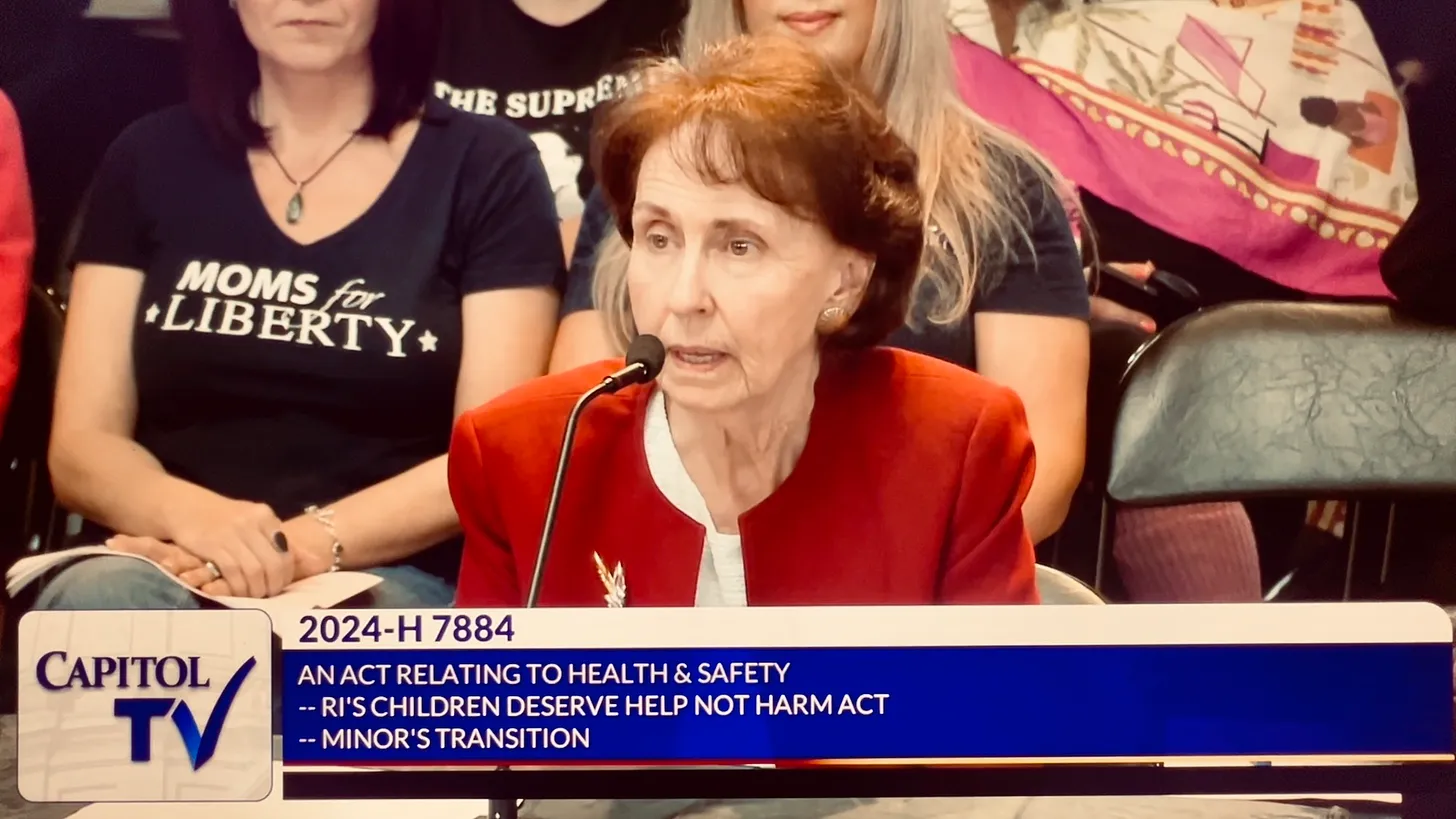
“The bill presented to you and the testimony that you've
heard in support is based on incorrect information and a complete lack of
understanding about the needs and experiences of transgender non-binary and
gender diverse people” said Ryan Fontaine, testifying on behalf of Thundermist
Health Center.
“Ryan, can you hold on just a second please?” asked
Representative Brandon Potter (Democrat, District 16, Cranston), the
second vice-chair of the committee. “Can I just remind the audience please that
if we're going to have conversations, please take them outside?”
“Representative Lima!” said Representative Megan
Cotter (Democrat, District 39, Richmond, Exeter, Hopkinton). “That's you.”
Representative Lima stepped away as Fontaine continued
her testimony, but the conversation between Representative Morgan and the clerk
didn't stop. If anything, it intensified. It was so distracting that she lost
track of her testimony.
“I'm sorry,” said Ryan Fontaine.
"Representative Morgan, you're disrupting the
testimony," said Representative Cotter.
“I'm chatting to the clerk,” said Representative Morgan,
unperturbed.


Commercial Fisheries Apprenticeship Program seeks applicants for 2024
Program run by Commercial Fisheries Center of R.I., with URI assistance
.webp)
Now in its seventh year, the apprenticeship program is fully funded by Real Jobs Rhode Island through the Department of Labor and Training.
The program will accept 16 individuals to partake in the program
beginning May 28 and ending in late June 2024. After the initial training,
apprentices will be given opportunities to work as crew members on Rhode Island
vessels to begin on-the-job learning.
Infections after surgery are more likely due to bacteria already on your skin than from microbes in the hospital
BYOB (Bring your own bacteria)
Dustin Long, University of Washington and Chloe Bryson-Cahn, University of Washington
 |
| Genetic analysis of the bacteria causing surgical site infections revealed that many were already present on the patient’s skin. Ruben Bonilla Gonzalo/Moment via Getty Images |
Research comparing bacteria in the microbiome – those colonizing our noses, skin and other areas of the body – with the bacteria that cause pneumonia, diarrhea, bloodstream infections and surgical site infections shows that the bacteria living innocuously on our own bodies when we’re healthy are most often responsible for these bad infections when we’re sick.
Our newly published research in Science Translational Medicine adds to the growing number of studies supporting this idea. We show that many surgical site infections after spinal surgery are caused by microbes that are already on the patient’s skin.