Menu Bar

Home           Calendar           Topics          Just Charlestown          About Us

Sunday, February 18, 2024

Breathe!

Simple Breathing Exercises Can Relieve Long COVID Symptoms

By UNIVERSITY OF LEEDS 
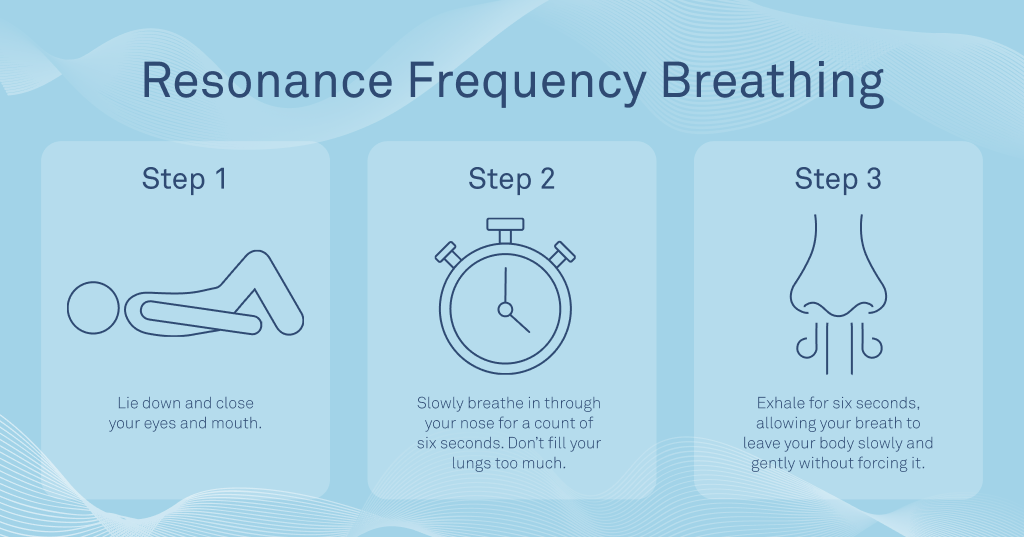

New research indicates that performing simple breathing exercises twice a day with the help of a mobile phone application can alleviate Long Covid symptoms.

Resonant breathing, which consists of a four-second inhale and six-second exhale through the nose repeated for 10 minutes, significantly improved symptoms among the 13 Long Covid patients in the University of Leeds study.

Participants used a free heart rate variability app on their mobile phones, which provided breathing guides that allowed them to track the effects of the technique. 

They monitored the effects using a chest strap heart rate monitor while completing the breathing exercises. Data from this, combined with heart rate data from a smartwatch worn for the duration of the study, was used to analyze their progress.

FCC bans robocalls using deepfake voice clones

AI-generated disinformation still looms over elections

Joan Donovan, Boston University

The FCC is responding to the threat of deepfakes.
 AP Photo/Andrew Harnik
The Federal Communications Commission on Feb. 8, 2024, outlawed robocalls that use voices generated by artificial intelligence.

The 1991 Telephone Consumer Protection Act bans artificial voices in robocalls. The FCC’s Feb. 8 ruling declares that AI-generated voices, including clones of real people’s voices, are artificial and therefore banned by law.

The move follows on the heels of a robocall on Jan. 21, 2024, from what sounded like President Joe Biden. The call had Biden’s voice urging voters inclined to support Biden and the Democratic Party not to participate in New Hampshire’s Jan. 23 GOP primary election. 

The call falsely implied that a registered Democrat could vote in the Republican primary and that a voter who voted in the primary would be ineligible to vote in the general election in November.

The call, two days before the primary, appears to have been an artificial intelligence deepfake. It also appears to have been an attempt to discourage voting.

The FCC and the New Hampshire attorney general’s office are investigating the call. On Feb. 6, 2024, New Hampshire Attorney General John Formella identified two Texas companies, Life Corp. and Lingo Telecom, as the source and transmitter, respectively, of the call.

Saturday, February 17, 2024

Not his father's son

The growing disgrace and danger of Robert F. Kennedy Junior

Robert Reich

Jack Ohman/Tribune Content Agency
Robert F. Kennedy Junior has apologized to relatives after his Super Bowl ad last Sunday, which mirrored an ad broadcast by his uncle John F. Kennedy’s campaign in 1960.

The Super Bowl ad included images of RFK Jr. spliced into the original 1960 ad and a jaunty jingle that repeated the Kennedy surname 15 times in 30 seconds.

RFK Junior said the ad was the work of his SuperPAC and he had nothing to do with it.

Rubbish. Junior placed the ad at the top of his X feed, and it remained there Monday.

The ad cost $7 million. Timothy Mellon — grandson of Andrew Mellon and an heir to the Mellon banking fortune — gave RFK Junior’s SuperPAC $15 million.

Hmmm. Mellon is also a major donor to PACs supporting Trump. RFK Junior’s candidacy is backed by a PAC that also funds Marjorie Taylor Greene.

No one should doubt that Trump and Trump donors are behind RFK Junior’s campaign, with the goal of siphoning off enough votes from Biden to ensure a Trump victory.

Suprise!

Edward Steed

SCAM ALERT: Don't give them personal information. Hang up and check them out

From classical to jazz, early spring semester concerts highlight works of underrepresented composers

Concert kick-off on Feb. 25

by Samantha Melia

The University of Rhode Island Department of Music kicks off the spring semester with a series of performances in the coming weeks that showcase the hard work and dedication of URI’s student-musicians.

On Sunday, Feb. 25, the Wind Ensemble and Concert Band will perform in the Concert Hall of the Fine Arts Center. The theme for the joint performance will be “inspired by literature,” and the set will include musical compositions that owe their creation to a literary classic.

The Concert Band will play music based on The Divine Comedy by Dante, and the musical selection provided for the Wind Ensemble references three very different thematic literature-based pieces. 

These include Vanity Fair by composer Percy Fletcher, inspired by a short story of the same name, and Illyrian Dances by composer Guy Woolfenden, a song that references the utopic peninsula described by William Shakespeare. 

Additionally, the Wind Ensemble will perform Suite from Leonard Bernstein’s operetta Candide, named for Enlightenment philosopher Voltaire’s satirical book of the same name.

According to URI Director of Bands Brian Cardany, who conducts both ensembles, the set will be about 90 minutes long, with a brief intermission in between performances. The concert starts at 3:30 p.m. and tickets can be purchased here.

Drunk and love at first sight

Debunking the Myth: Alcohol, Attraction, and the Illusive Beer Goggles Effect

By UNIVERSITY OF PORTSMOUTH 

New research explored the theory that alcohol consumption may increase perceptions of attractiveness in others, potentially due to the effect of alcohol making faces appear more symmetrical.

If you believed that blurry eyes were to blame for the “beer goggles” phenomenon, think again.

Scientists from the University of Portsmouth have tested the popular theory that people are more likely to find someone attractive while drunk, because their faces appear more symmetrical. The term “beer goggles” has been used for decades to describe when a person finds themselves sexually attracted to someone while intoxicated, but not sober.

One possible explanation for the effect is that alcohol impairs the drinker’s ability to detect facial asymmetry, thus making potential partners more visually appealing.

Existing research has shown that a part of what makes people attractive to others is how well both sides of their face match. The thinking goes, the more symmetry the better the gene pool. But when alcohol is introduced, it’s thought a person is less likely to notice if the faces around them are non-symmetrical.

The myth of men’s full-time employment

Men who don't work

Sarah Damaske, Penn State and Adrianne Frech, Ohio University

He’s not alone. Image Bank/Getty Images
Men’s employment in the U.S. reached a 20-year high in 2023, with nearly 90% of men ages 25 to 54 in the workforce, according to the Bureau of Labor Statistics. 

This supports the broad expectation – some might say stereotype – that full-time employment is the norm for American men.

Yet examining employment at a single point in time leaves out important information about whether people are able to maintain stable work. Our recent study of male baby boomers’ working lives – spanning more than two decades – tells a very different story.

In fact, men’s labor force participation has been steadily declining since the 1970s, and workers are experiencing greater labor market precarity – that is, shorter job spells, greater job insecurity and more long-term unemployment.

In our research as experts in the study of people’s employment over time, we have previously challenged the myth that most women “opt out” of the workforce, establishing that the majority of women work steadily and full time. That led us to suspect that the picture of men’s employment could also be incomplete.

To understand these long-term trends, we studied data from about 4,500 men collected over more than 25 years. We were looking for patterns in the amount of time these men spent employed, unemployed and looking for work, and out of the workforce and not looking for work.

We were surprised to find that only 41% of late baby boomer men – those who were between 14 and 21 years old in 1979 – worked steadily and continuously, which we defined as working almost every week of the year between ages 27 and 49. 

This is a cohort of men who were widely thought to have taken a “lockstep” approach to work: entering the labor market when they finished their schooling and remaining employed until retirement.

We found most men didn’t fit this stereotype. About a quarter didn’t reach steady employment until they were nearly 50. Another quarter either found themselves increasingly unemployed and out of work as they aged or able to find only intermittent work. 

Finally, a smaller group of men left the labor market entirely – some leaving paid work at relatively young ages, while others leaving as they reached middle age.

Friday, February 16, 2024

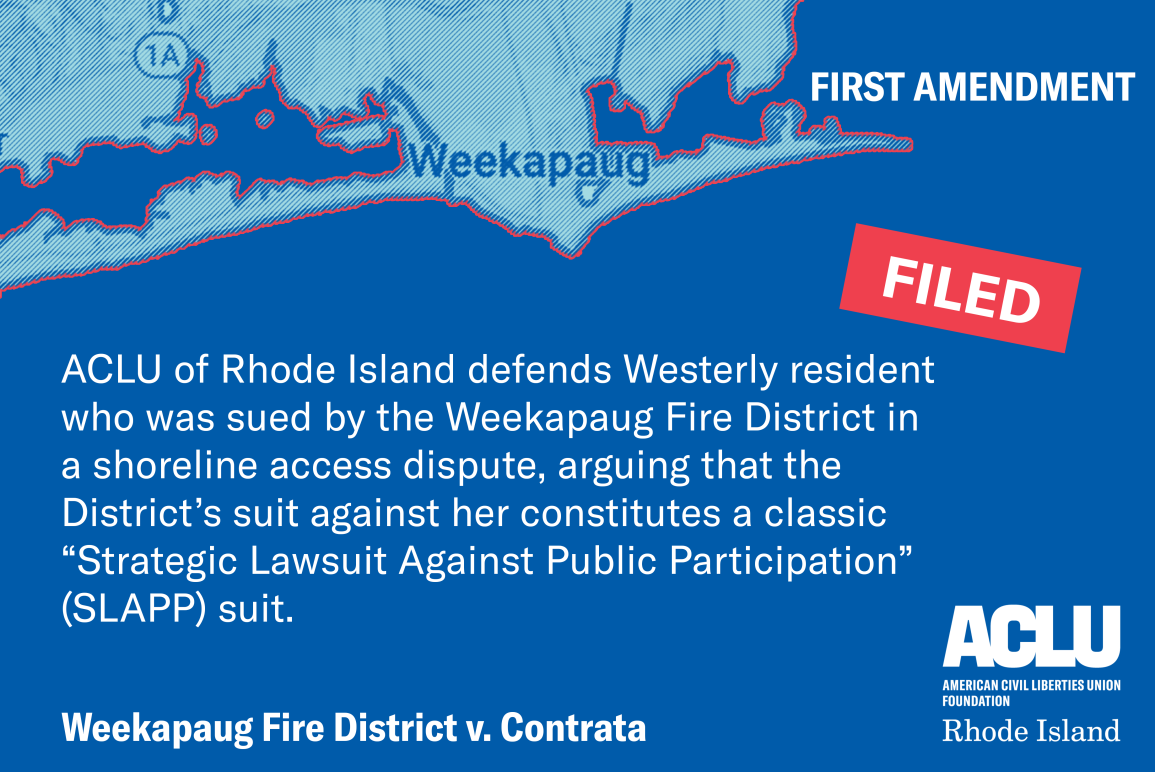
ACLU defends Westerly woman from SLAPP suit by local fake fire district

The continuing fight between the Weekapaug "Fire" District and the public over beach access

By the ACLU RI 

EDITOR'S NOTE: Weekapaug Fire District is one of several along the coastline (two in Charlestown) that have no fire-fighting capability. Instead, they function as high-end Homeowner Associations that manage more than 400 acres of beach property, usually paying little or no taxes. Their tax-exempt and under-taxed properties drain millions of dollars from Charlestown and other coastal towns' tax base. This issue has been studied in detail by Alex Nunes at the Publics Radio (click here for an article with excellent background on Weekapaug and other fake fire districts) as well as here in Progressive Charlestown (click here for an overview of their impact on taxes). - Will Collette

In its third skirmish with the Weekapaug Fire District in less than six months, the ACLU of Rhode Island has come to the defense of Westerly resident Caroline Contrata, who has been sued for monetary damages by the District in a high-profile shoreline access case solely because, the ACLU argues, she “had the temerity to ask the CRMC to designate a tract that is universally acknowledged as a roadway … as a public right-of-way.”

In response to the suit filed against Contrata, ACLU of Rhode Island cooperating attorney Michael Rubin today filed a motion to have her dismissed from the case, arguing that the District’s suit against her constitutes a classic SLAPP suit. 

SLAPP (“Strategic Lawsuits Against Public Participation”) refers to lawsuits brought to chill people from exercising their freedom of speech on matters of public concern.

The state’s anti-SLAPP statute establishes a process for defendants in such lawsuits to quickly move to have the suit dismissed if it is based on a good faith exercise of their right to free speech.

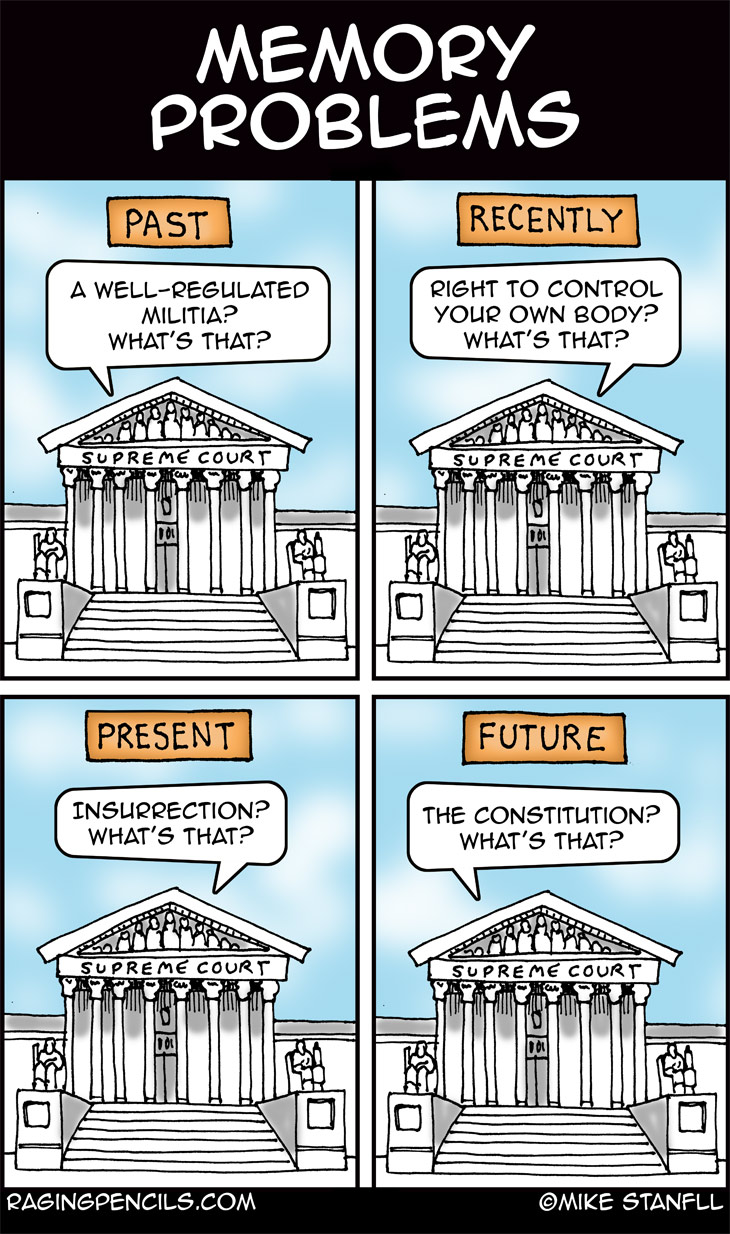
Demented Court?


Beats "thoughts and prayers"


URI theatre to stage Shakespeare’s ‘Macbeth’ on Feb. 22

Production opens eight-show run Feb. 22 in J Studio

Macbeth and Lady Macbeth and the witches who predict their
rise and fall – from left, Alora McCarroll, Eva St-Germain
and Celeste Tucci.
With all the adaptations of Shakespeare, you might wonder what version of “Macbeth” will show up on the University of Rhode Island’s J Studio stage when the play opens Thursday, Feb. 22. 

There will be no Denzel Washington movie adaptation, no Ralph Fiennes in Army fatigues, no one-hour concept play, says Lisa Wolpe, a Shakespeare scholar and visiting artist from Santa Monica, California, who is directing URI’s production. 

“I was asked to do a fairly traditional production,” says Wolpe, who is a veteran of staging innovative and inclusive configurations of the Bard’s works. “Many of the students are doing their first Shakespeare and they’ve never heard the play. To actually just hear the play as written, with very few cuts, is a particular opportunity.” 

That opportunity includes a play—one of Shakespeare’s most popular—full of political ambition, murder, guilt and the supernatural. 

You probably won't need a bigger boat

Plentiful and Ferocious Shark Lurks In Local Waters

By Frank Carini / ecoRI News staff

Spiny dogfish. Credit: National Ocean Service
The great white shark gets all the coverage, but another shark species, with a far-less cool-sounding name, dominates local waters, at least in sheer numbers.

The Atlantic spiny dogfish (Squalus acanthias) is the poor cousin to the more-alluring sharks of greater size and fame. They have sharp, albeit little, teeth, are ferocious predators, and are opportunistic feeders. They like to devour mackerel and herring.

Spiny dogfish can arch their backs and inject venom into predators from their dorsal spines. They are harmless to humans — although a jab from one of their dorsal spines could get infected — but they have been observed biting through fishing nets to get at prey, according to the National Marine Sanctuary Foundation.

They migrate into local waters in the warmer months, and some remain through the winter. But most stocks are highly migratory, and they spawn in the winter in offshore waters. Spiny dogfish females have between two and 12 eggs per spawning season.

The spiny dogfish is the most abundant shark in the western North Atlantic, but they aren’t the only species of dogfish swimming in local waters. Like the spiny version, the smooth dogfish or dusky smooth-hound (Mustelus canis) can be found in Narragansett Bay. The chain dogfish (Scyliorhinus retifer) can’t. It’s also, confusingly, known as a chain catshark.

Atlantic Ocean is headed for a tipping point

When disaster movie plots get real

René van Westen, Utrecht University; Henk A. Dijkstra, Utrecht University, and Michael Kliphuis, Utrecht University

Too much fresh water from Greenland’s ice sheet can
slow the Atlantic Ocean’s circulation.
 Paul Souders/Stone via Getty Images
Superstorms, abrupt climate shifts and New York City frozen in ice. 

That’s how the blockbuster Hollywood movie “The Day After Tomorrow” depicted an abrupt shutdown of the Atlantic Ocean’s circulation and the catastrophic consequences.

While Hollywood’s vision was over the top, the 2004 movie raised a serious question: If global warming shuts down the Atlantic Meridional Overturning Circulation, which is crucial for carrying heat from the tropics to the northern latitudes, how abrupt and severe would the climate changes be?

Twenty years after the movie’s release, we know a lot more about the Atlantic Ocean’s circulation. Instruments deployed in the ocean starting in 2004 show that the Atlantic Ocean circulation has observably slowed over the past two decades, possibly to its weakest state in almost a millennium. 

Studies also suggest that the circulation has reached a dangerous tipping point in the past that sent it into a precipitous, unstoppable decline, and that it could hit that tipping point again as the planet warms and glaciers and ice sheets melt.

In a new study using the latest generation of Earth’s climate models, we simulated the flow of fresh water until the ocean circulation reached that tipping point.

The results showed that the circulation could fully shut down within a century of hitting the tipping point, and that it’s headed in that direction. If that happened, average temperatures would drop by several degrees in North America, parts of Asia and Europe, and people would see severe and cascading consequences around the world.

We also discovered a physics-based early warning signal that can alert the world when the Atlantic Ocean circulation is nearing its tipping point.

Thursday, February 15, 2024

If safety is the goal, guns are not the answer.

New Analysis Blows Hole in 'Good Guy With a Gun' Myth

JULIA CONLEY for Common Dreams

Fueled by right-wing politicians and the powerful gun lobby, nearly three-quarters of firearm owners in the United States believe the enduring myth that a gun at the ready will keep them safer—but a new analysis offers the latest hard evidence that guns simply make life more dangerous and deadly for everyone.

The Center for American Progress (CAP) joined gun violence research group GVPedia to release an issue brief debunking the falsehoods pushed by the National Rifle Association (NRA) and other pro-gun groups, which, looking to "counter the horrors of everyday gun violence in America... masterfully constructed a narrative based on the myth of a 'good guy with a gun' using their weapon defensively to stop an armed assailant before harm can be done."

Listening to former NRA CEO Wayne LaPierre and the right-wing lawmakers who count on the gun lobby's endorsements, one could hardly be blamed for conjuring an image of a "good guy with a gun" who frequently stops a violent attack from happening—but the analysis shows how faulty research in the 1990s underpinned such claims.

Surveys at the time, including a widely-cited study by Gary Kleck and Matt Gertz, estimated that between 760,000 and 2.5 million defensive gun uses (DGU) occurred annually.

But the Harvard Injury Control Research Center found two years later that fewer than 550,000 burglaries occurred in gun owners' homes annually, while Kleck and Gertz had estimated that "guns were used for self-defense during burglaries approximately 845,000 times."